Money in Japan【A Complete Guide to Cash, Cards & Payments for Tourists】
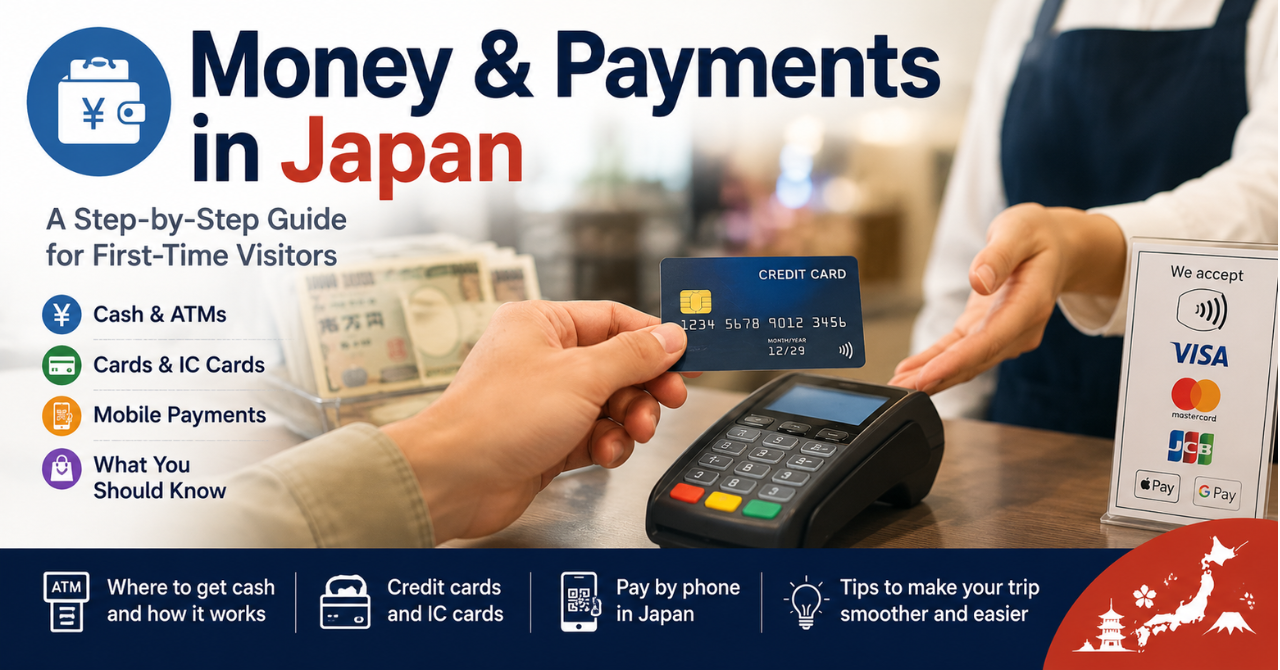
- Money in Japan: Do You Still Need Cash?
- Using Credit Cards in Japan
- Money in Japan: How to Withdraw Cash from ATMs
- Using IC Cards for Payments in Japan
- Mobile and Contactless Payments in Japan
- Paying and Tipping at Restaurants in Japan
- Money in Japan: Common Payment Mistakes to Avoid
- Final Tips for Managing Money in Japan
Money in Japan: Do You Still Need Cash?
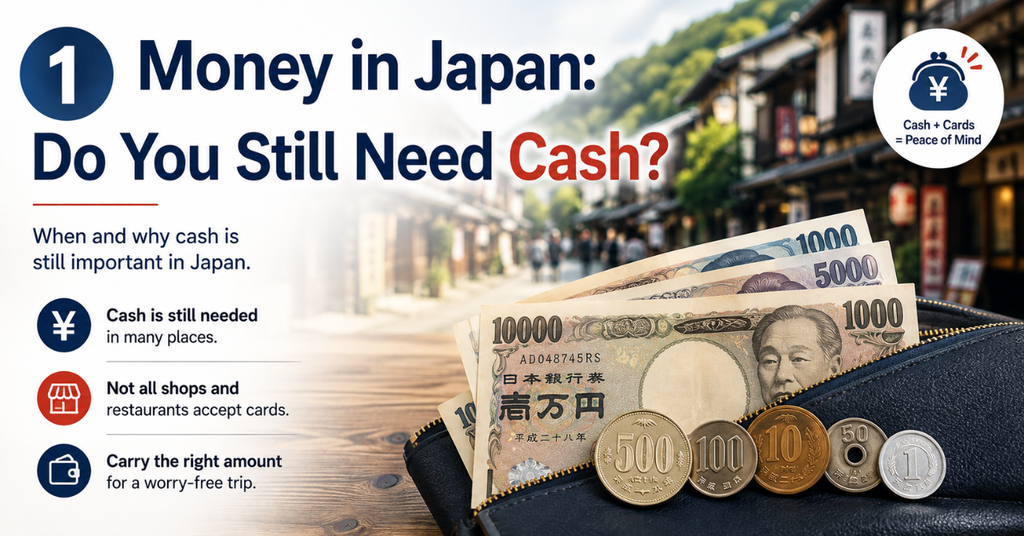
Japan has become much more cashless in recent years. Credit cards, IC cards, and contactless payments are now widely used, especially in major cities and popular tourist areas.
However, that doesn’t mean you can travel around Japan without cash.
Some small restaurants, local shops, temples and shrines, and businesses in rural areas may still require cash. Payment options can vary from place to place, so carrying some Japanese yen is a good idea even if you plan to use your credit card most of the time.
Japan Is Becoming More Cashless
If you’ve heard that “Japan is a cash-only country,” that image is becoming outdated.
Credit cards and cashless payments are increasingly common at hotels, department stores, convenience stores, chain restaurants, major tourist attractions, and many other businesses.
You may be surprised by how often you can travel, shop, and eat without using cash—particularly in larger cities such as Tokyo and Osaka.
Still, cashless payment options are not universal. A payment method that works at one store may not be accepted at another.
Travel Tip: Don’t rely on a single payment method. A credit card plus some Japanese yen gives you a useful backup.
Where You May Still Need Cash in Japan
Even though cashless payments are becoming more common, there are situations where having yen can still be useful.
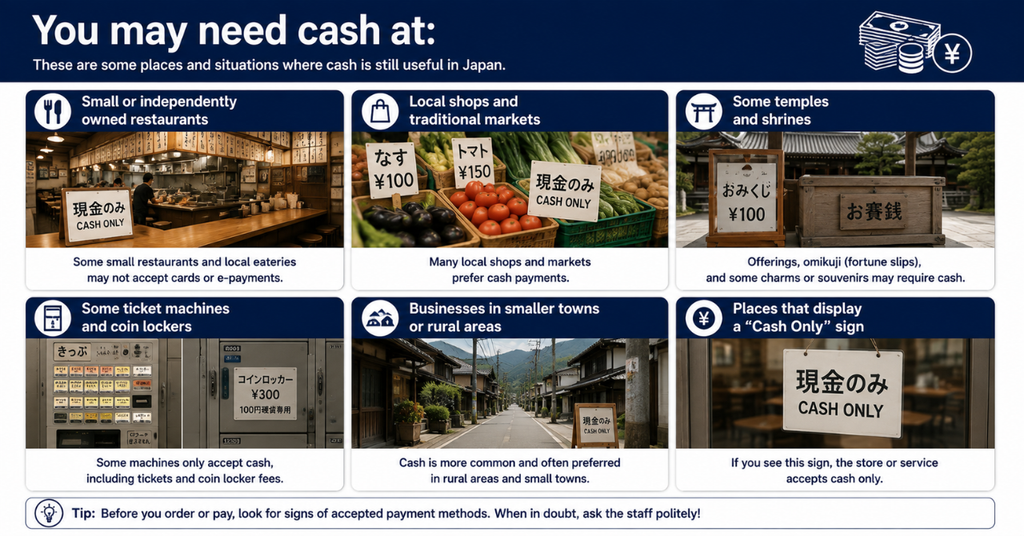
You may need cash at:
- Small or independently owned restaurants
- Local shops and traditional markets
- Some temples and shrines
- Some ticket machines and coin lockers
- Businesses in smaller towns or rural areas
- Places that display a “Cash Only” sign
One situation that may surprise first-time visitors is visiting a shrine or temple. Small offerings, omikuji fortune slips, and some charms or souvenirs may require cash.
This is a good example of something that feels completely normal in Japan but can catch international visitors off guard.
Before making a purchase, look near the entrance or register for signs showing accepted payment methods. If you’re unsure, asking the staff before ordering or buying something can save you trouble later.
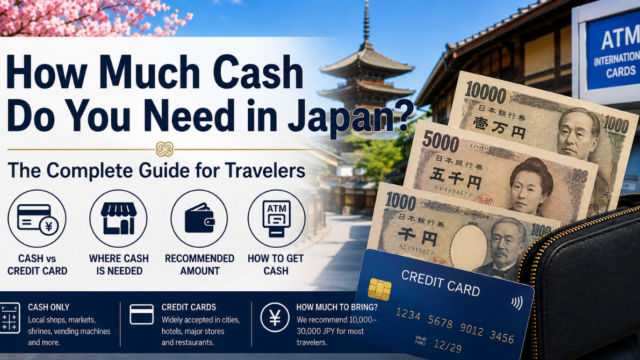
How Much Cash Should You Carry in Japan?
There isn’t one perfect amount of cash for every traveler.
How much you need depends on where you’re going, what you’re doing, and which payment methods you plan to use.
If you’re spending most of your time in major cities and using a credit card, you may only need cash as a backup. If you’re visiting rural areas, traditional neighborhoods, temples, local restaurants, or smaller businesses, having more cash available can be helpful.
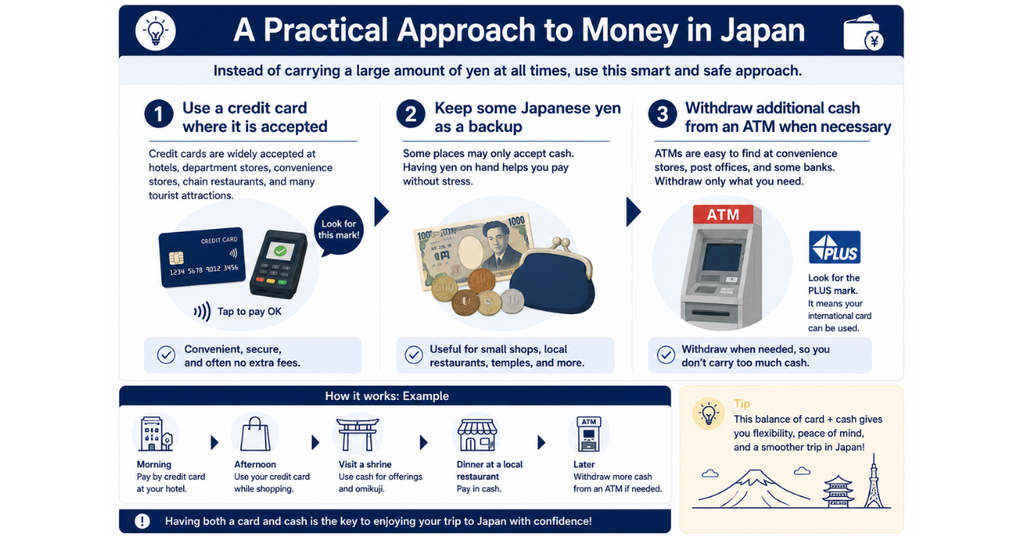
Instead of carrying a large amount of yen at all times, a practical approach is to:
- Use a credit card where it is accepted
- Keep some Japanese yen as a backup
- Withdraw additional cash from an ATM when necessary
We’ll explain where to find traveler-friendly ATMs and how to withdraw Japanese yen later in this guide.
Key Takeaway: Japan is increasingly cashless, but cash hasn’t disappeared. Having both cash and a card is one of the easiest ways to avoid payment problems during your trip.
Using Credit Cards in Japan
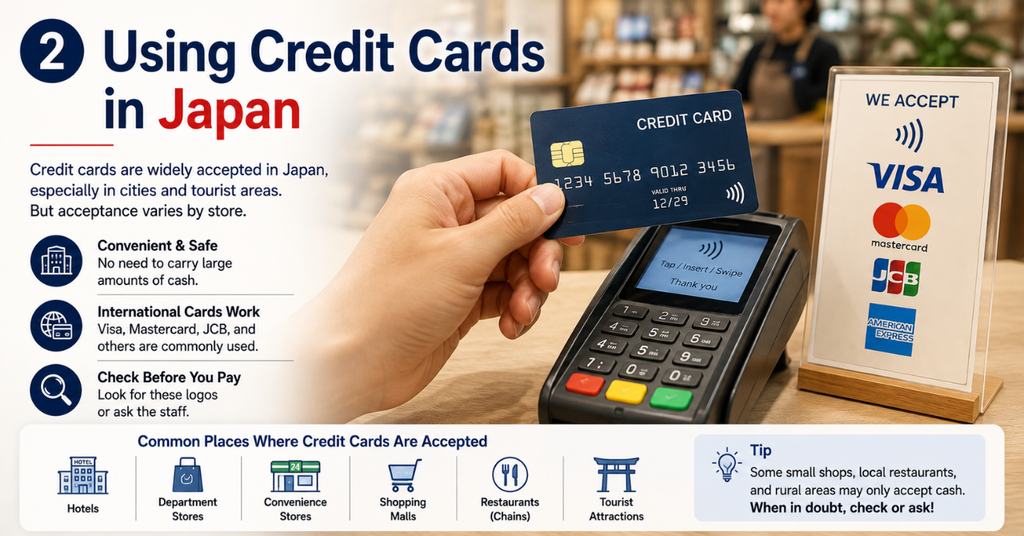
Credit cards are widely accepted in Japan, especially in major cities and popular tourist areas. Hotels, department stores, convenience stores, shopping malls, and many restaurants commonly accept international credit cards.
However, card acceptance can still vary by store. Smaller restaurants, family-run businesses, traditional shops, and businesses in rural areas may prefer cash or accept only certain payment methods.
That’s why it’s a good idea to carry some Japanese yen even if you plan to use your credit card as your main payment method.
Where Credit Cards Are Commonly Accepted
You can usually use credit cards at many places travelers visit, including:
- Hotels
- Department stores
- Convenience stores
- Shopping malls
- Chain restaurants
- Major tourist attractions
- Large electronics stores
- Many supermarkets and drugstores
In large cities such as Tokyo, Osaka, and Kyoto, you may be able to pay by card for much of your trip.
However, don’t assume that every restaurant or shop accepts cards just because you’re in a major city. Small independent businesses may still be cash-only.
Travel Tip: If you’re visiting a small restaurant or local shop, check the payment signs near the entrance or register before ordering or shopping.
Which Credit Cards Are Commonly Accepted in Japan?
Major international credit card brands are widely accepted at businesses that take cards.
You will commonly see logos such as:
- Visa
- Mastercard
- JCB
- American Express
Other card brands may also be accepted depending on the business and payment terminal.
Keep in mind that seeing a card logo does not guarantee that every foreign-issued card will work. Your card issuer, payment network, security settings, or the store’s payment system can sometimes affect whether a transaction is approved.
For this reason, bringing more than one payment option can be useful.
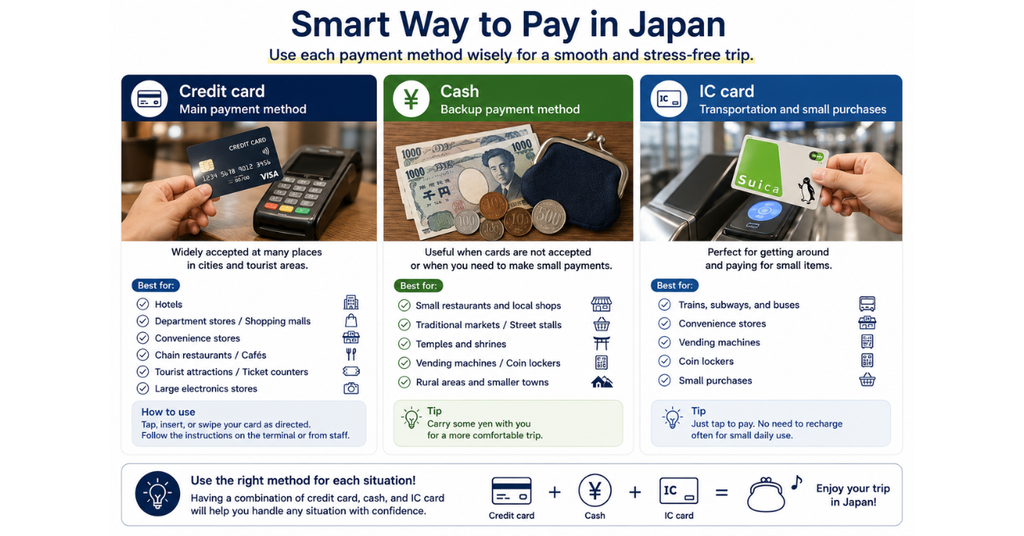
For example, you might travel with:
Credit card → Main payment method
Cash → Backup payment method
IC card → Transportation and small purchases
This gives you another option if one payment method doesn’t work.
How to Check If a Store Accepts Your Card
Before paying, look near the entrance, cash register, or payment terminal for stickers or signs showing accepted payment methods.
You may see logos for credit cards, IC cards, contactless payments, and QR code payment services.
If you’re not sure whether your card is accepted, you can simply show your card and ask:
“Card okay?”
You can also say:
“Kādo wa tsukaemasu ka?” (カードは使えますか?)
“Can I use a card?”
This simple phrase can be very helpful at smaller restaurants and shops.
Another thing that may surprise first-time visitors is that the payment process can differ between businesses. At one store, you may tap your card yourself. At another, you may insert it into the terminal or follow instructions from the staff.
Key Takeaway: Credit cards are convenient and widely accepted in Japan, but they shouldn’t be your only payment method. Carrying some cash and having another payment option can make your trip much easier.
Money in Japan: How to Withdraw Cash from ATMs
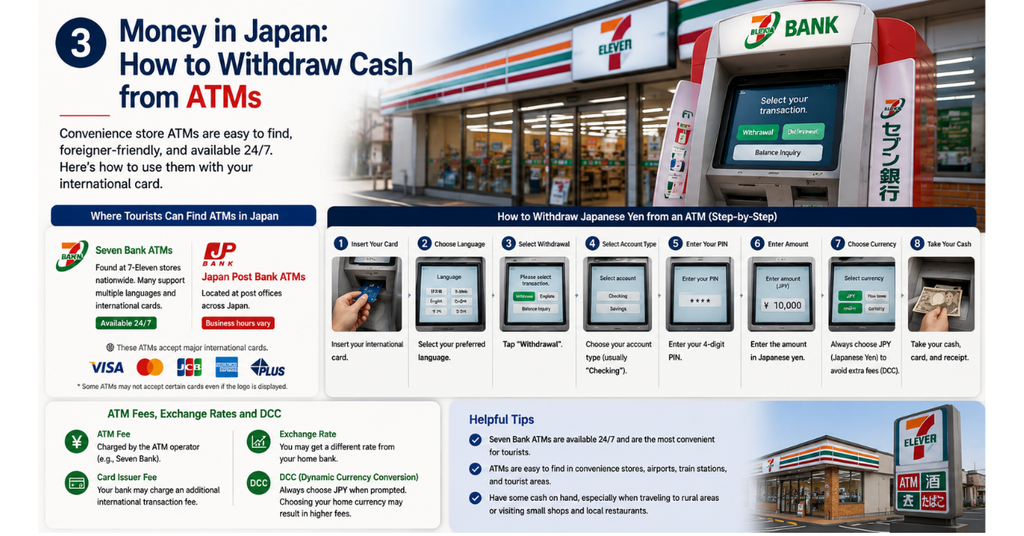
If you run low on Japanese yen during your trip, you don’t need to exchange a large amount of cash in advance. International travelers can withdraw yen from certain ATMs in Japan using eligible overseas-issued cards.
However, not every ATM accepts every foreign card. Knowing where to look and checking your card’s network before you travel can save you time and stress.
Where Tourists Can Find ATMs in Japan
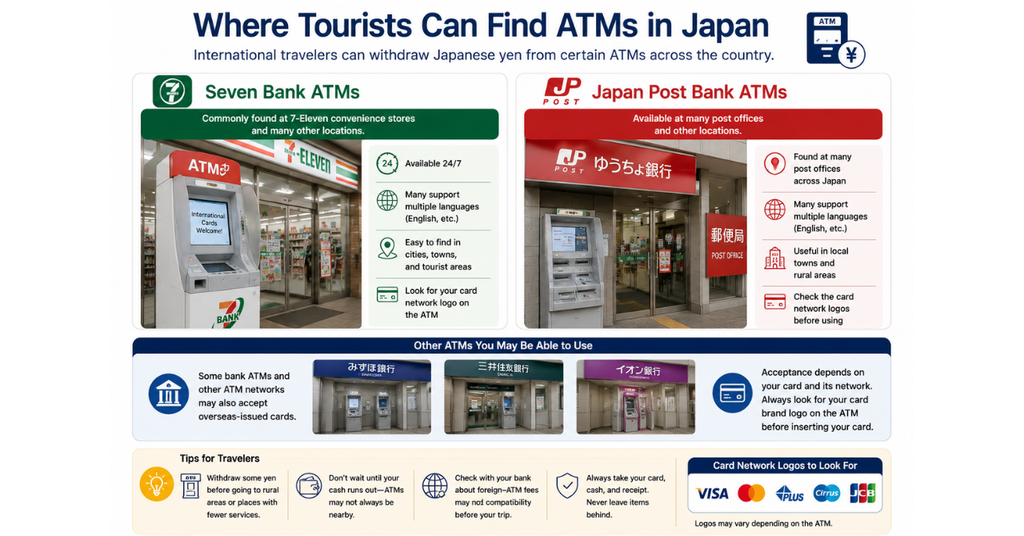
Two useful options for international travelers are:
- Seven Bank ATMs — commonly found at 7-Eleven convenience stores and other locations
- Japan Post Bank ATMs — available at many post offices and other locations
Depending on your card and its network, other ATMs may also accept overseas-issued cards.
Convenience stores can be especially useful because they are easy to find in many cities and tourist areas.
Look for your card network logo on the ATM before inserting your card. Even when an ATM supports international cards, availability can depend on your card issuer and network.
Travel Tip: Don’t wait until your wallet is completely empty. If you’re heading to a rural area or somewhere with fewer services, withdraw some yen beforehand.
How to Withdraw Japanese Yen from an ATM
The exact screens and steps vary depending on the ATM, but the process is generally straightforward.
A typical withdrawal may look like this:
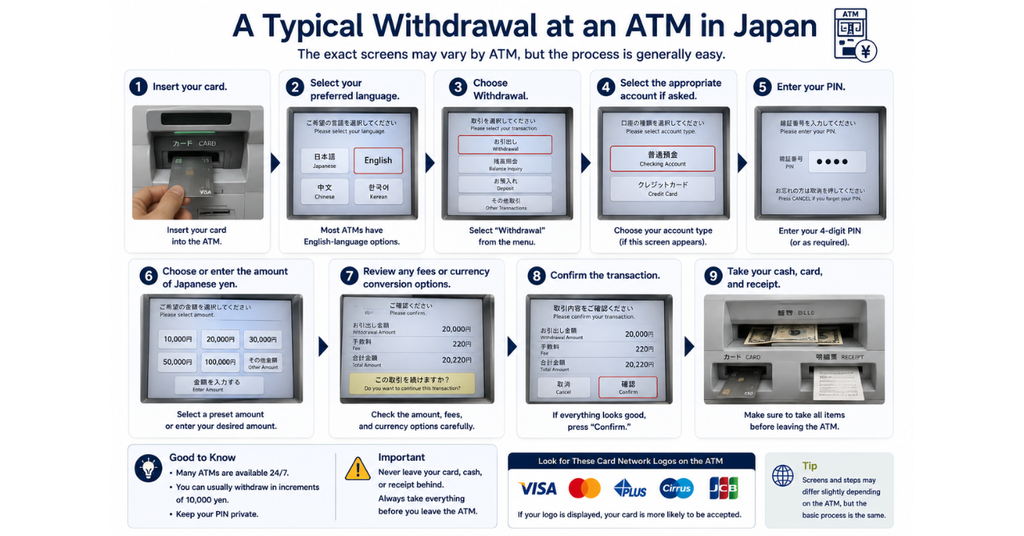
- Insert your card.
- Select your preferred language.
- Choose Withdrawal.
- Select the appropriate account if asked.
- Enter your PIN.
- Choose or enter the amount of Japanese yen you want to withdraw.
- Review any fees or currency-conversion options shown on the screen.
- Confirm the transaction.
- Take your cash, card, and receipt.
Many ATMs used by international travelers provide English-language instructions, so you usually don’t need to understand Japanese to complete a withdrawal.
Important: Never leave your card, cash, or receipt behind after using an ATM.
ATM Fees, Exchange Rates and DCC
Before confirming a withdrawal, pay attention to the fees and currency options shown on the ATM screen.
The total cost of withdrawing cash can depend on several factors, including:
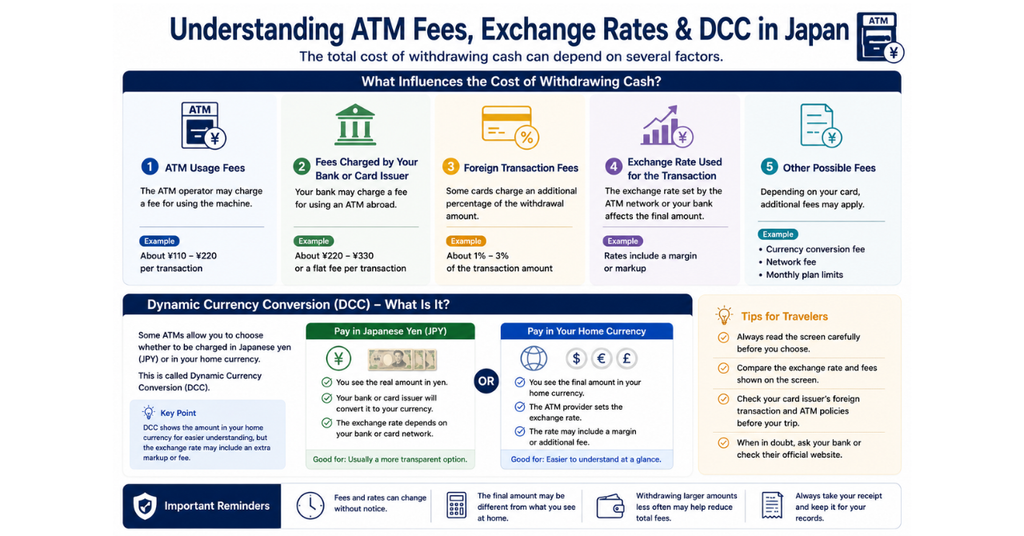
- ATM usage fees
- Fees charged by your bank or card issuer
- Foreign transaction fees
- The exchange rate used for the transaction
You may also be offered a choice between being charged in Japanese yen (JPY) or seeing the transaction converted into your home currency.
This type of currency conversion is often called Dynamic Currency Conversion (DCC).
DCC can make the cost easier to understand at a glance because it shows the amount in your home currency, but the conversion may include its own exchange rate or additional markup.
Don’t automatically choose one option without checking the details. Compare the rate and fees shown on the screen, and check your card issuer’s foreign transaction and ATM policies before your trip.
Key Takeaway: You don’t need to carry all of your travel money from the beginning of your trip. Keep some yen available and use compatible ATMs to withdraw additional cash when you need it.
Using Currency Exchange Machines in Japan
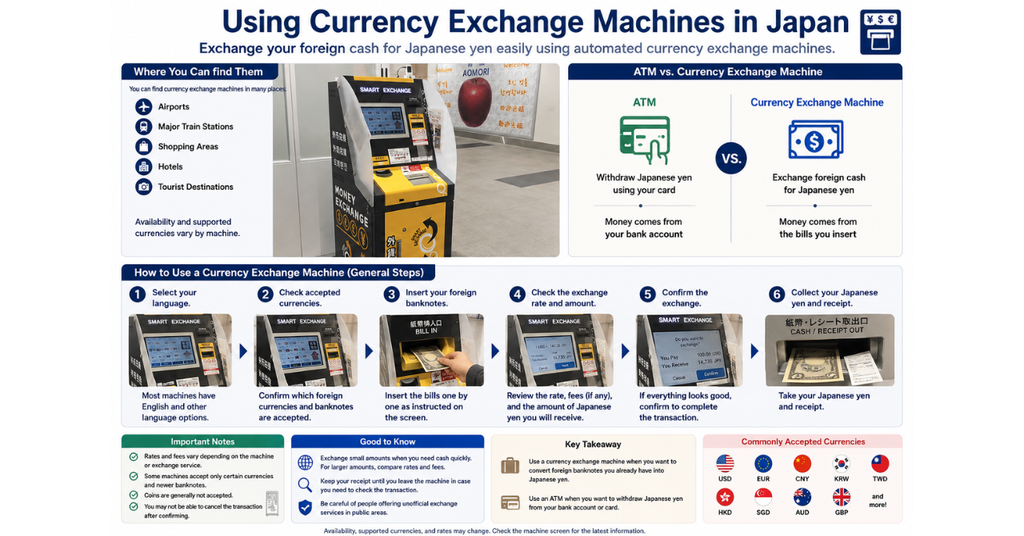
ATMs aren’t the only way to get Japanese yen during your trip. If you’re carrying foreign currency in cash, you may also be able to exchange it for yen using an automatic currency exchange machine.
These machines can be found in places such as airports, major train stations, shopping areas, hotels, and popular tourist destinations. However, availability and supported currencies vary by machine.
The biggest difference between an ATM and a currency exchange machine is simple:
ATM → Withdraw Japanese yen using your card
Currency Exchange Machine → Exchange foreign cash for Japanese yen
Using a currency exchange machine is usually straightforward:
- Select your preferred language.
- Check which foreign currencies the machine accepts.
- Insert your foreign banknotes.
- Review the exchange rate and the amount of Japanese yen you will receive.
- Confirm the exchange.
- Collect your Japanese yen and receipt.
Before confirming the transaction, always check the exchange rate and any fees or conditions displayed on the screen. Rates can vary depending on the machine or exchange service.
Also keep in mind that some machines accept only certain currencies or banknotes, and coins generally cannot be exchanged.
Travel Tip: Currency exchange machines can be a useful backup if you already have foreign cash with you, but don’t rely on finding one everywhere. ATMs are generally another practical option for accessing Japanese yen during your trip.
Key Takeaway: Use an ATM when you want to withdraw yen from your bank account or card. Use a currency exchange machine when you want to convert foreign banknotes you already have into Japanese yen.
Using IC Cards for Payments in Japan
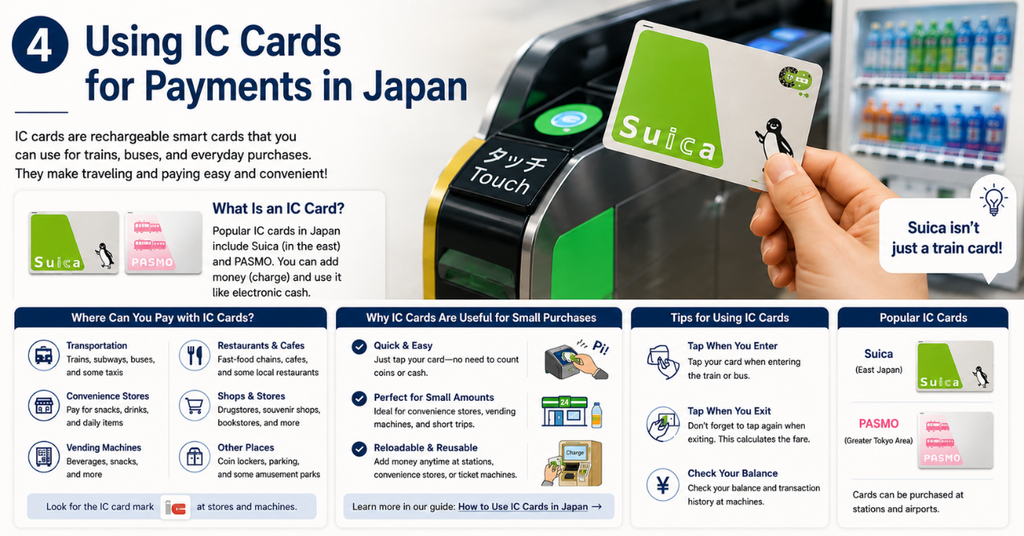
IC cards are one of the most convenient payment tools for traveling around Japan.
You may already know cards such as Suica, PASMO, and ICOCA as transportation cards for trains and buses. But they aren’t just for transportation.
You can also use IC cards as prepaid electronic money at many convenience stores, vending machines, restaurants, coin lockers, and other businesses.
For first-time visitors, this can make everyday purchases much easier—especially when you don’t want to deal with coins or take out your credit card for every small purchase.
What Is an IC Card?
An IC card is a rechargeable prepaid card that can be used for public transportation and electronic payments.
Some of the best-known IC cards in Japan include:
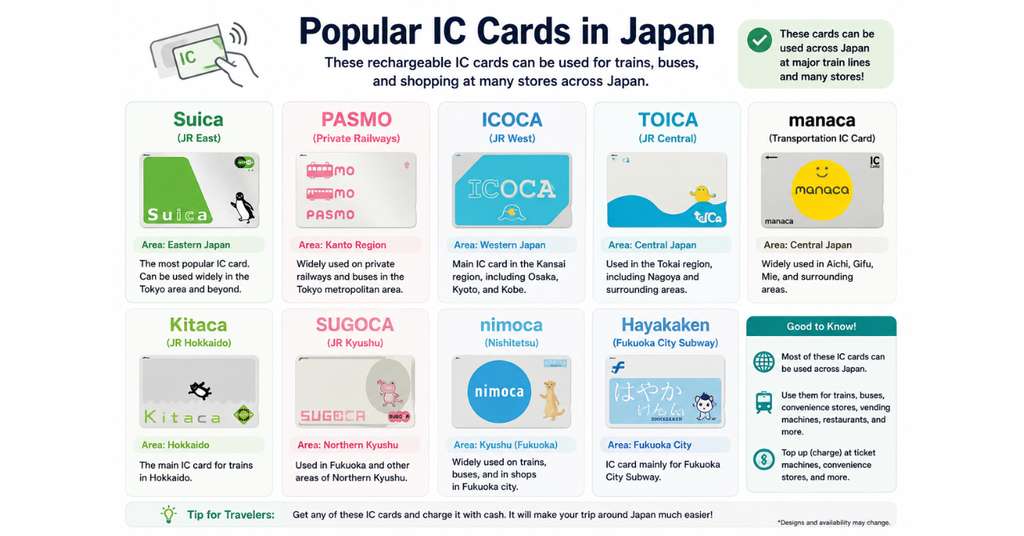
- Suica
- PASMO
- ICOCA
- TOICA
- manaca
- Kitaca
- SUGOCA
- nimoca
- Hayakaken
Different cards are issued in different regions, but major interoperable IC cards can be used across many transportation networks and participating businesses throughout Japan.
To pay, simply touch your IC card to the reader.
One thing that surprises many first-time visitors is:
Suica isn’t just a train card.
Once you’ve added money to your card, you can also use that balance for many everyday purchases.
Travel Tip: Think of your IC card as both a transportation card and a small prepaid wallet.
Where Can You Pay With IC Cards?
IC cards can be used at many businesses displaying a compatible IC card logo.
Depending on the location, you may be able to use them at:
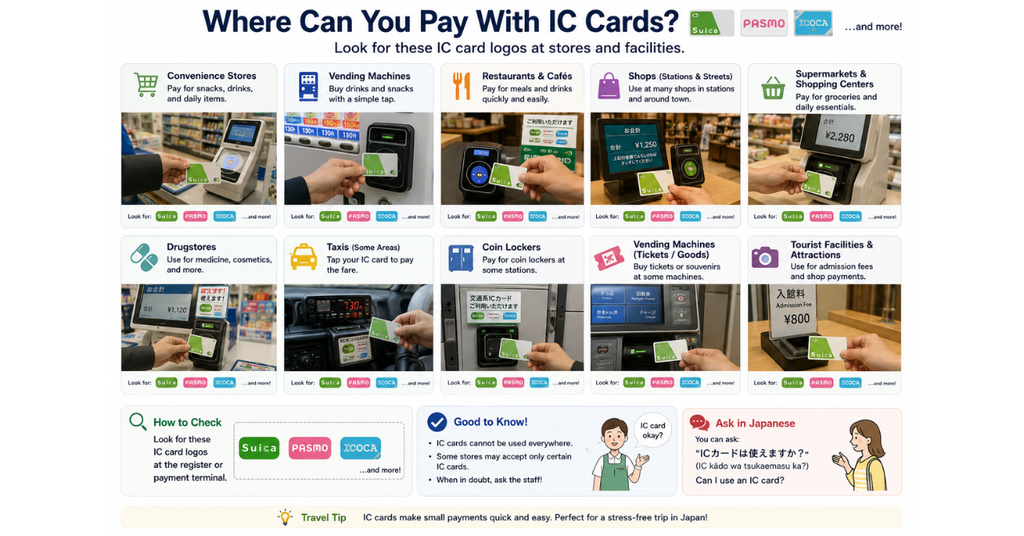
- Convenience stores
- Vending machines
- Restaurants and cafés
- Shops inside and around train stations
- Supermarkets and shopping centers
- Drugstores
- Some taxis
- Some coin lockers
- Some tourist facilities
For example, JR East officially lists convenience stores, beverage vending machines, restaurants, taxis, tourist facilities, and station coin lockers among places where Suica can be used.
However, IC cards aren’t accepted everywhere.
Before paying, look for the Suica, PASMO, ICOCA, or compatible transportation IC card logo near the register or payment terminal.
If you’re unsure, you can ask:
“IC card okay?”
Or in Japanese:
“IC kādo wa tsukaemasu ka?”(ICカードは使えますか?)
“Can I use an IC card?”
Why IC Cards Are Useful for Small Purchases
One of the biggest advantages of an IC card is how quickly you can pay for small everyday purchases.
Instead of taking out cash, counting coins, or using your credit card, you can simply tap your IC card on the reader.
For example, during a day of sightseeing, you might use the same IC card to:
Take the train → Buy a drink from a vending machine → Pay at a convenience store → Take another train
That makes IC cards particularly convenient for travelers who use public transportation frequently.
Just remember that IC cards are prepaid. If your balance gets low, you’ll need to add more money before you can continue using the card.
Depending on the card and location, you can recharge at places such as station ticket machines, dedicated recharge machines, and some convenience stores.
Key Takeaway: An IC card isn’t only for getting around Japan. It can also work as a convenient prepaid payment method for many small purchases during your trip.
Mobile and Contactless Payments in Japan
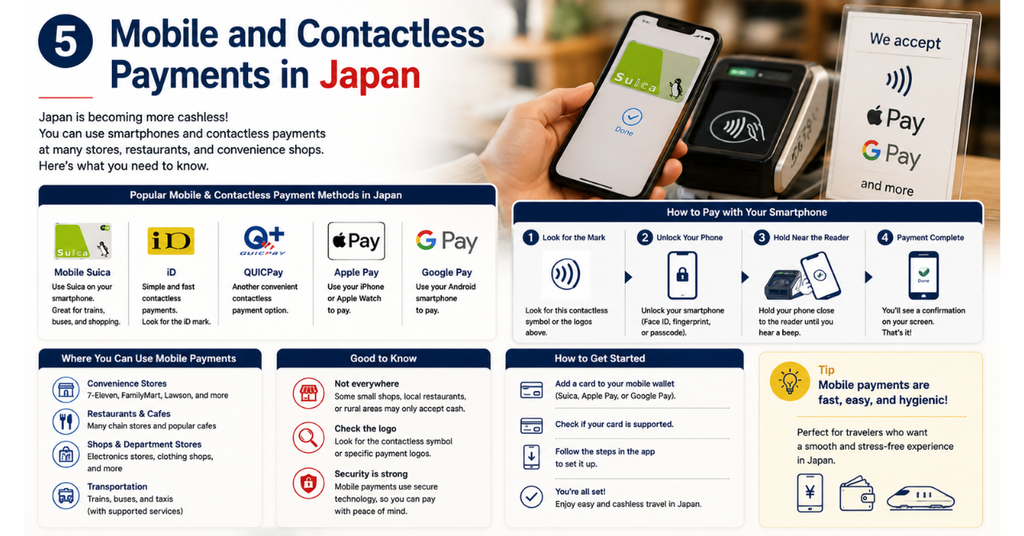
Mobile and contactless payments are becoming increasingly common in Japan, especially in major cities.
You may see contactless payment symbols at convenience stores, restaurants, supermarkets, shopping centers, and other businesses.
However, there is one important thing international visitors should know:
Just because a store accepts contactless payments doesn’t mean every overseas payment method will work.
Your ability to use a smartphone or contactless card can depend on the store’s payment system, your device, your card issuer, and the payment service you use.
For this reason, mobile payments are convenient—but it’s still a good idea to carry another payment method.
Can Tourists Use Apple Pay or Google Pay in Japan?
ou may be able to use Apple Pay or Google Pay in Japan if your card and device are compatible with the payment system accepted by the store.
However, compatibility can vary.
A store may accept certain contactless card networks or Japanese electronic money services without supporting every card stored in an overseas Apple Pay or Google Pay wallet.
Before paying, look for the contactless symbol or supported payment logos near the register.
If you’re unsure, you can ask:
“Can I use contactless payment?”
Or simply show your phone or card to the staff and ask which payment method is accepted.
Travel Tip: Don’t assume that your mobile wallet will work everywhere just because you use it regularly at home. Keep a physical credit card or some Japanese yen as a backup.
What About QR Code Payments in Japan?
QR code payments are also common in Japan.
You may see services such as PayPay, Rakuten Pay, d払い, and au PAY displayed at stores and restaurants.
However, many of these services are primarily designed for people living in Japan and may require a Japanese account, phone number, or other local setup.
This means QR code payments are usually not something international visitors need to rely on during a short trip.
Instead, most tourists will find it easier to use a combination of:
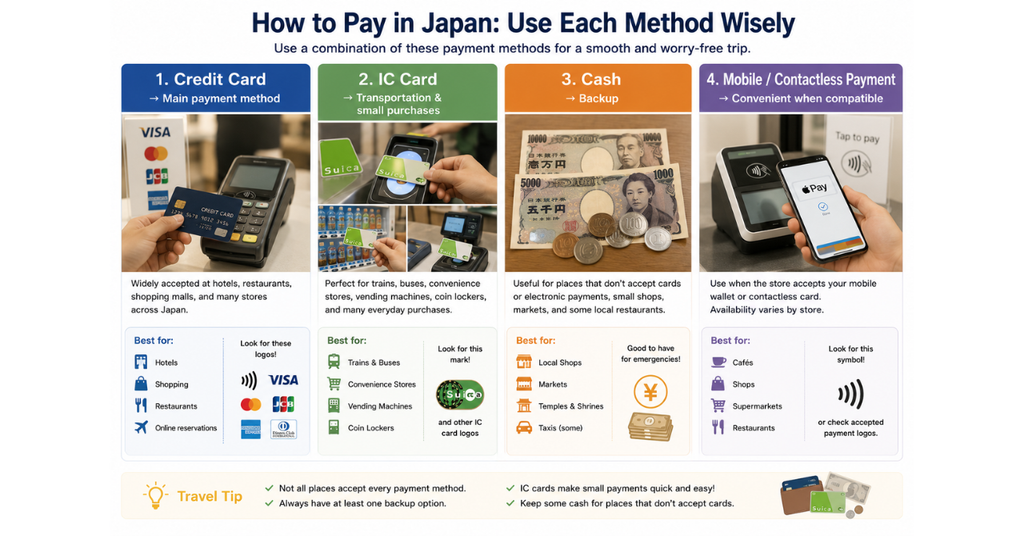
Credit card → Main payment method
IC card → Transportation and small purchases
Cash → Backup
Mobile/contactless payment → Convenient when compatible
Key Takeaway: Mobile and contactless payments can make traveling in Japan easier, but compatibility isn’t universal. Always have at least one backup payment method available.
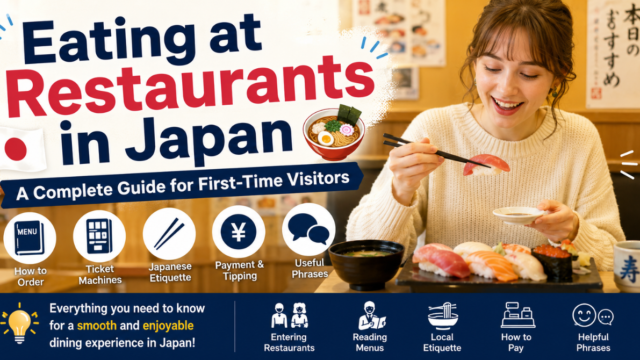
Paying and Tipping at Restaurants in Japan
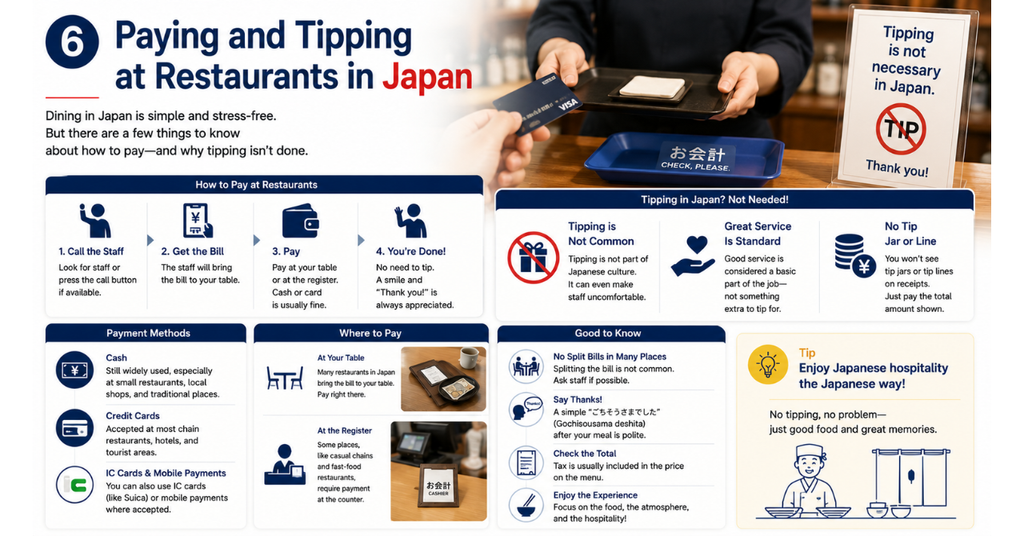
Paying at restaurants in Japan can be a little different from what you’re used to at home.
One of the biggest differences is that tipping is generally not expected in Japan. You may also need to pay at a register instead of at your table, and some restaurants ask you to buy a meal ticket before you even sit down.
Knowing these simple differences can make eating out in Japan much easier.
Do You Need to Tip in Japan?
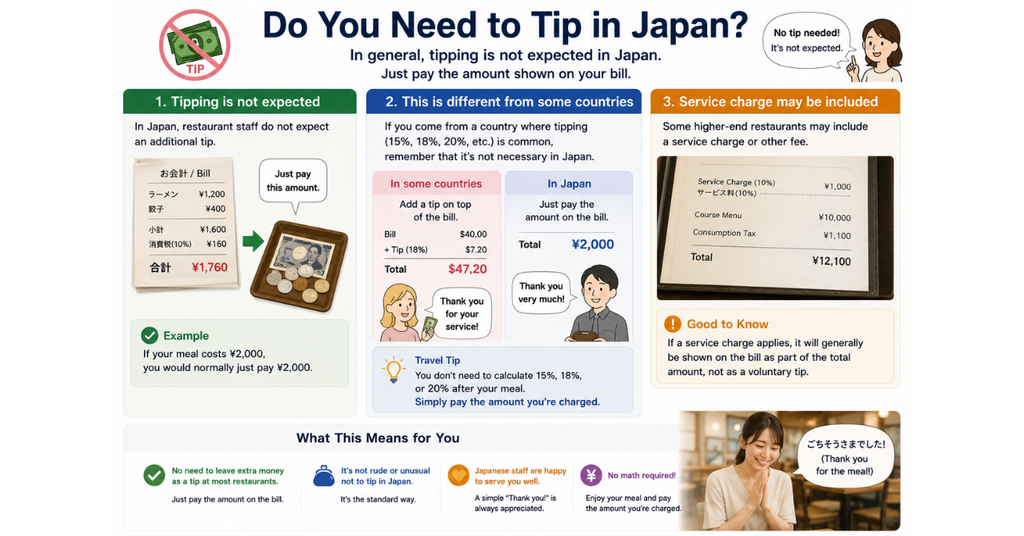
In general, you don’t need to tip at restaurants in Japan.
Restaurant staff do not normally expect customers to leave an additional percentage of the bill as a tip.
If your meal costs ¥2,000, for example, you would normally just pay the amount shown on your bill.
This is one of the biggest differences for visitors coming from countries where tipping at restaurants is common.
Travel Tip: You don’t need to calculate 15%, 18%, or 20% after your meal. Simply pay the amount you’re charged.
However, some restaurants—particularly certain higher-end establishments—may include a service charge or other fee. If one applies, it will generally be handled as part of the restaurant’s billing system rather than as a voluntary tip.
Do You Pay at the Table or Register?
The payment process depends on the restaurant.
At many casual restaurants, the staff may leave a small bill or receipt at your table after you order or finish eating.
Instead of waiting for someone to bring a card terminal to your table, you may need to:
Take the bill → Go to the register → Pay → Leave
This is completely normal in Japan.
Other restaurants may offer table payment, self-checkout machines, or different payment systems, so follow the restaurant’s instructions.
Before paying, you can also check which payment methods are accepted. Depending on the restaurant, you may be able to use cash, credit cards, IC cards, or other cashless payments.
Good to Know: If a bill has been left on your table, don’t assume you need to wait for the staff to collect your payment. Check whether there is a register near the entrance.
What Are Restaurant Ticket Vending Machines?
Here’s another payment system that can surprise first-time visitors:
At some Japanese restaurants, you pay before you eat.
Ramen shops, soba and udon restaurants, casual restaurants, and other establishments may use a ticket vending machine near the entrance.
The basic process usually looks like this:
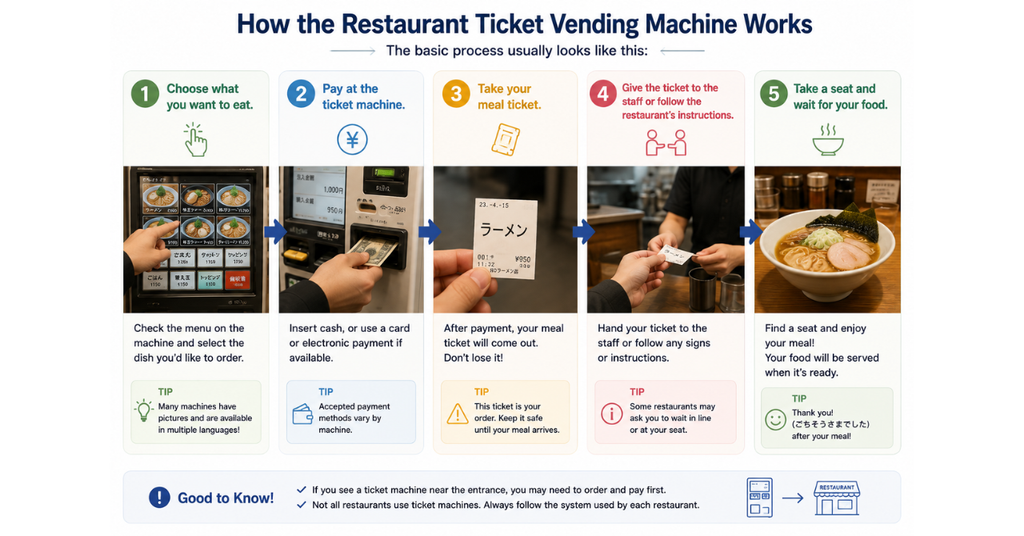
- Choose what you want to eat.
- Pay at the ticket machine.
- Take your meal ticket.
- Give the ticket to the staff or follow the restaurant’s instructions.
- Take a seat and wait for your food.
Some newer machines have touchscreens with pictures or multiple language options, which can make ordering easier for international visitors.
Accepted payment methods vary by machine. Some may accept cash, while others may also support cards or electronic payments.
Travel Tip: If you see a ticket machine immediately after entering a restaurant, check it before finding a seat. You may need to order and pay first.
Key Takeaway: Restaurant payment in Japan varies by establishment, but three things are useful to remember: tipping is generally unnecessary, you may pay at the register rather than at the table, and some restaurants require you to buy a meal ticket before sitting down.
Money in Japan: Common Payment Mistakes to Avoid
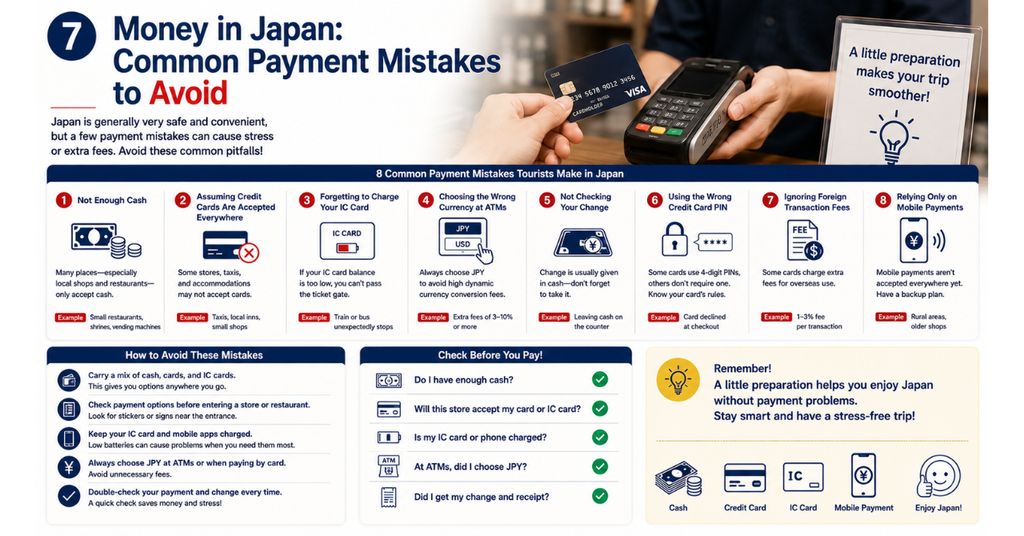
Paying for things in Japan is usually easy once you understand the basics. However, first-time visitors sometimes run into problems because they assume the payment methods they use at home will work the same way in Japan.
The easiest way to avoid trouble is to prepare more than one way to pay.
Here are some common payment mistakes to avoid during your trip.
Relying Only on Credit Cards
Credit cards are widely accepted in Japan, but they aren’t accepted everywhere.
Some small restaurants, traditional shops, temples and shrines, local businesses, and places outside major tourist areas may still require cash.
Even when a store accepts cards, your particular card may occasionally be declined because of the card issuer, network, or payment system.
That’s why relying on a single credit card isn’t a good idea.
A simple setup is:
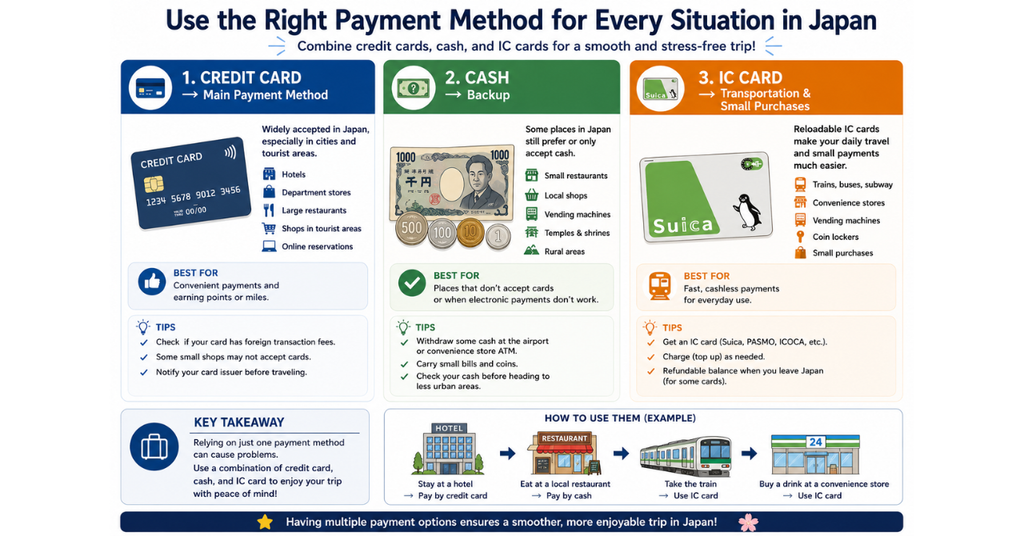
Credit card → Main payment method
Cash → Backup
IC card → Transportation and small purchases
Travel Tip: Carry at least two ways to pay so you still have another option if one doesn’t work.
Assuming Every Contactless Payment Will Work
Seeing the contactless symbol at a register doesn’t necessarily mean every contactless card or mobile wallet will work.
Japan has several different electronic payment systems, and compatibility can depend on the store, terminal, card, device, and payment service.
This is particularly important if you plan to use an overseas card through Apple Pay or Google Pay.
Before tapping your phone or card, check the payment logos displayed near the register.
If you’re unsure, ask the staff which payment methods they accept.
Good to Know: “Contactless accepted” doesn’t always mean “every contactless payment method accepted.”
Waiting Until You Run Out of Cash
Another easy mistake is waiting until you have no cash left before looking for an ATM.
ATMs that accept overseas-issued cards are relatively easy to find in many cities and tourist areas, but availability can become more limited depending on where you’re traveling.
If you’re heading to a rural area, small town, or somewhere away from major transportation hubs, it’s a good idea to check your cash before leaving.
You don’t need to carry all the money for your trip at once.
Instead:
Keep some yen → Check your remaining cash → Withdraw more when necessary
This gives you a backup without carrying an unnecessarily large amount of cash.
Forgetting About Foreign Transaction and ATM Fees
The price shown at a store isn’t always the only cost associated with using an overseas card.
Depending on your bank or card issuer, you may also encounter:
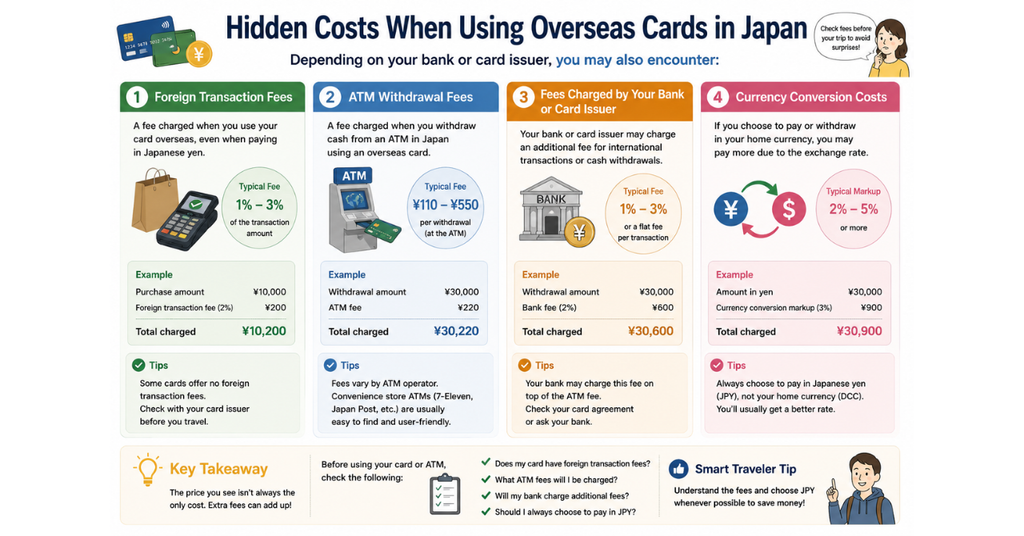
- Foreign transaction fees
- ATM withdrawal fees
- Fees charged by your bank or card issuer
- Currency conversion costs
The exact fees vary considerably depending on the card, bank, ATM, and transaction.
Before traveling, check your card issuer’s international transaction and ATM policies.
When using an ATM, also review the exchange rate, fees, and any currency-conversion options shown on the screen before confirming the withdrawal.
Travel Tip: Don’t choose a currency-conversion option automatically. Check what is being offered and understand the rate and fees before confirming.
Key Takeaway: Most payment problems in Japan can be avoided by using a combination of payment methods. Keep a credit card, some Japanese yen, and an IC card available rather than relying on just one option.
Final Tips for Managing Money in Japan
Mobile and Contactless Payments in Japan
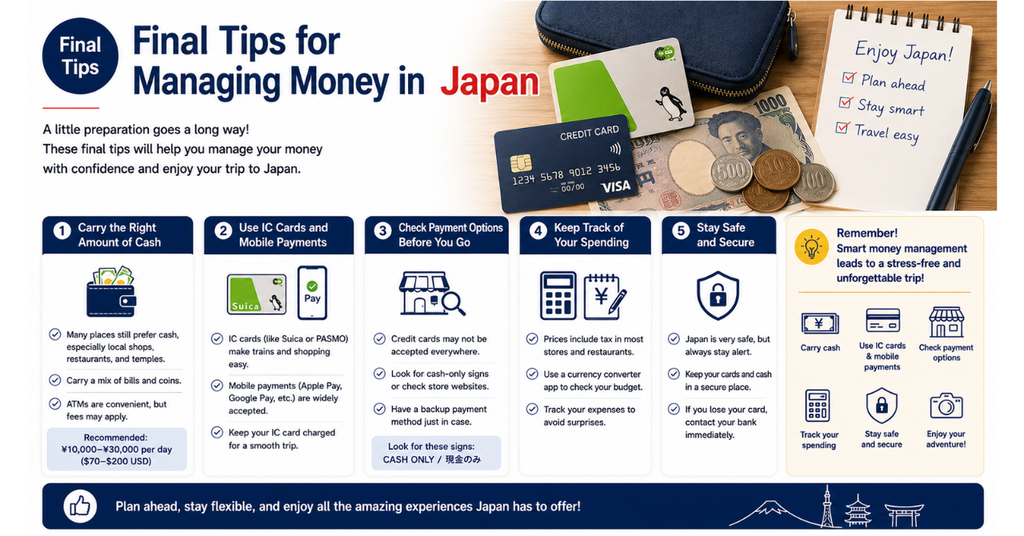
Managing money in Japan doesn’t have to be complicated.
Credit cards and cashless payments are widely available, but cash is still useful in certain situations. IC cards can also make transportation and small everyday purchases much easier.
The key is simple:
Don’t rely on just one payment method in Japan.
For most travelers, a practical combination is:
Credit Card → Main payment method
Cash → Backup for cash-only situations
IC Card → Transportation and small purchases
With these three options available, you’ll be prepared for most payment situations during your trip.
Can Tourists Use Apple Pay or Google Pay in Japan?
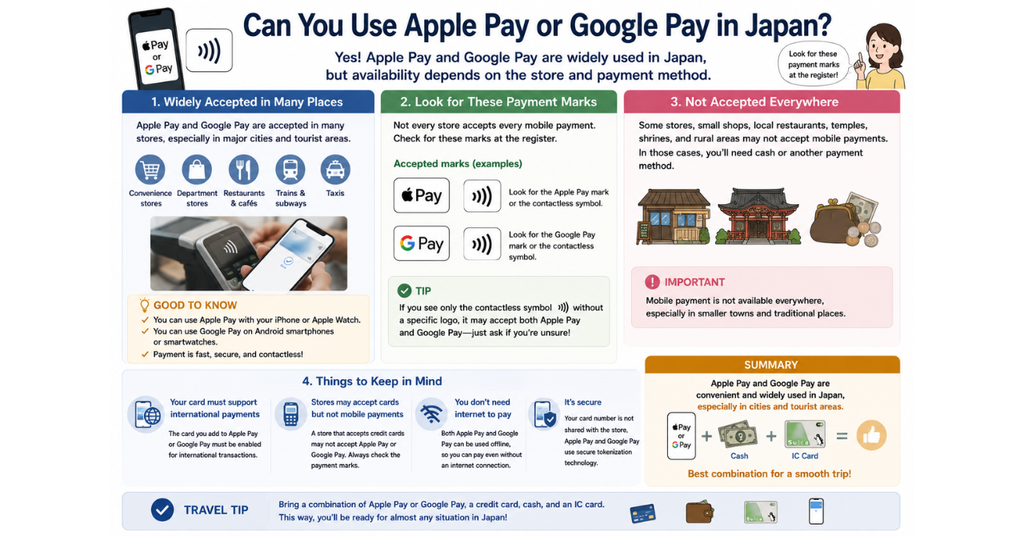
ou may be able to use Apple Pay or Google Pay in Japan if your card and device are compatible with the payment system accepted by the store.
However, compatibility can vary.
A store may accept certain contactless card networks or Japanese electronic money services without supporting every card stored in an overseas Apple Pay or Google Pay wallet.
Before paying, look for the contactless symbol or supported payment logos near the register.
If you’re unsure, you can ask:
“Can I use contactless payment?”
Or simply show your phone or card to the staff and ask which payment method is accepted.
Travel Tip: Don’t assume that your mobile wallet will work everywhere just because you use it regularly at home. Keep a physical credit card or some Japanese yen as a backup.
What About QR Code Payments in Japan?
QR code payments are also common in Japan.
You may see services such as PayPay, Rakuten Pay, d払い, and au PAY displayed at stores and restaurants.
However, many of these services are primarily designed for people living in Japan and may require a Japanese account, phone number, or other local setup.
This means QR code payments are usually not something international visitors need to rely on during a short trip.
Instead, most tourists will find it easier to use a combination of:
Credit card → Main payment method
IC card → Transportation and small purchases
Cash → Backup
Mobile/contactless payment → Convenient when compatible
ou may be able to use Apple Pay or Google Pay in Japan if your card and device are compatible with the payment system accepted by the store.
However, compatibility can vary.
A store may accept certain contactless card networks or Japanese electronic money services without supporting every card stored in an overseas Apple Pay or Google Pay wallet.
Before paying, look for the contactless symbol or supported payment logos near the register.
If you’re unsure, you can ask:
“Can I use contactless payment?”
Or simply show your phone or card to the staff and ask which payment method is accepted.
Travel Tip: Don’t assume that your mobile wallet will work everywhere just because you use it regularly at home. Keep a physical credit card or some Japanese yen as a backup.
Key Takeaway: Mobile and contactless payments can make traveling in Japan easier, but compatibility isn’t universal. Always have at least one backup payment method available.