How to Use Trains in Japan【A Beginner’s Guide for First-Time Visitors】
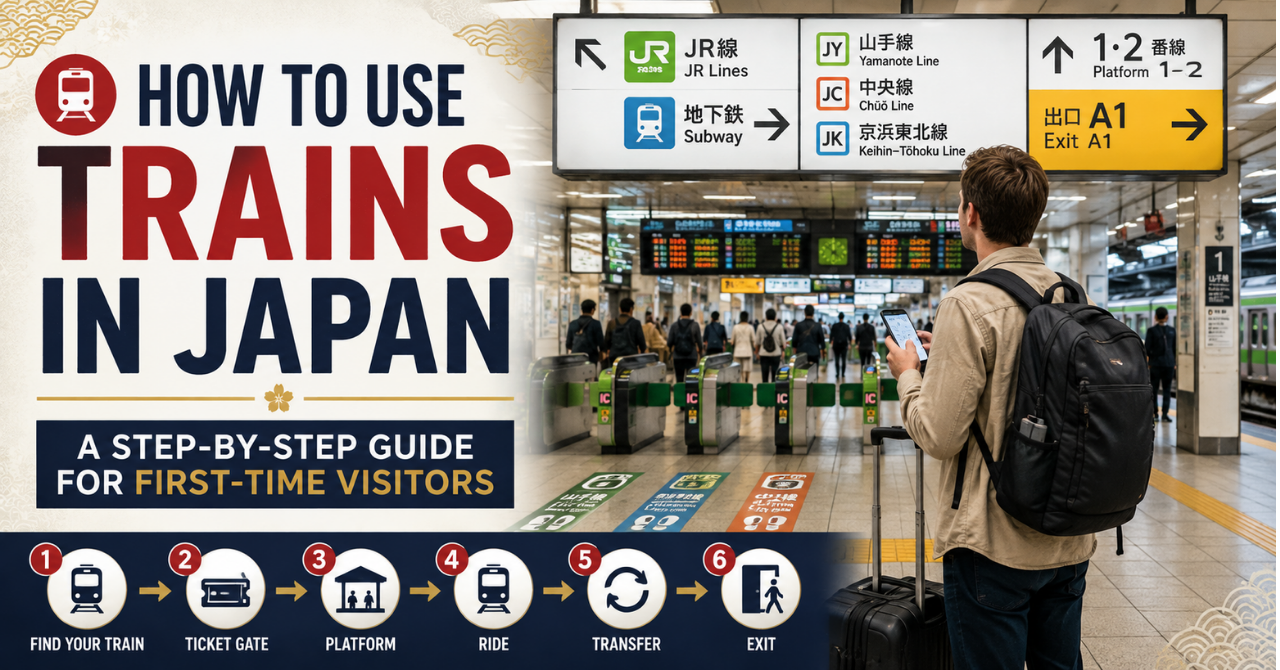
Japan’s train system is one of the most convenient ways to travel around the country. From major cities like Tokyo and Osaka to popular sightseeing destinations, trains can take you almost anywhere you want to go.
However, if you’re using trains in Japan for the first time, the experience can feel a little overwhelming.
JR lines, subways, and private railways may operate from the same area. Large stations can have dozens of platforms and exits, and even trains leaving from the same platform may stop at different stations depending on whether they are local, rapid, or express services.
You may also notice things that seem unusual at first. Why is everyone lining up at specific spots on the platform? Why are train cars often so quiet? And how do you know which station exit to use?
Don’t worry—you don’t need to understand Japan’s entire railway system to travel comfortably.
In this guide, we’ll walk you through how to use trains in Japan step by step, from finding the right train and entering the ticket gate to boarding, transferring, and finding the correct exit at your destination.
We’ll also explain a few train customs that may seem completely normal in Japan but surprising to first-time visitors.
By the end, you’ll know what to look for and what to do when taking a train in Japan.
Let’s get started!

- Useful Train Apps to Download Before Traveling in Japan
- Why Do Japan’s Trains Seem So Complicated?
- Step 1: Find the Right Train
- Step 2: Enter the Ticket Gate
- Step 3: Find the Right Platform
- Step 4: Ride the Train
- Step 5: Transfer Between Trains
- Step 6: Exit the Station Without Getting Lost
- What If Something Goes Wrong? Don’t Panic!
Useful Train Apps to Download Before Traveling in Japan
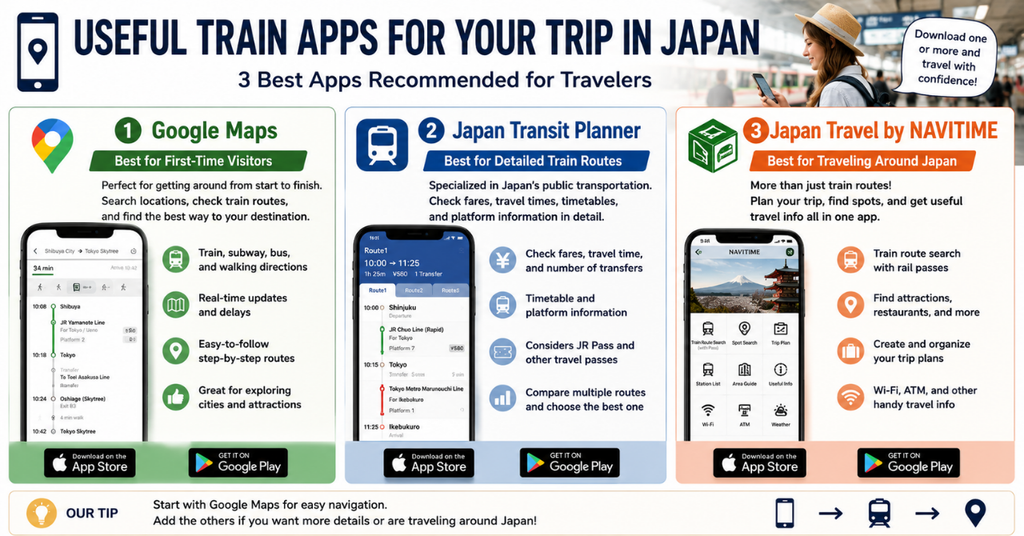
Before taking your first train in Japan, downloading a useful navigation app can make your journey much easier.
Japan’s railway system includes JR lines, subways, private railways, and many different train services. Even people living in Japan often use route-planning apps to check the best train, departure time, platform, and transfers before traveling somewhere unfamiliar.
So there’s no need to memorize Japan’s complicated railway network.
Your smartphone can do most of the hard work for you.
Here are three useful apps to consider before traveling in Japan.
1. Google Maps — Best for First-Time Visitors
For most first-time visitors, Google Maps is one of the easiest places to start.
The biggest advantage is that you can use the same app for almost your entire journey.
You can search for your hotel, restaurant, or sightseeing destination and follow the route from your current location to the station, through your train journey, and then continue walking after you arrive.
When checking a train route, look for information such as:
- Train line
- Departure time
- Platform
- Direction or destination
- Transfer station
- Travel time
- Recommended station exit when available
This makes Google Maps especially useful in large cities where you may need to combine walking, trains, subways, and transfers during a single journey.
Best for: First-time visitors who want one simple app for both trains and walking navigation.
Our Tip: If you only want to download one navigation app before your first trip to Japan, start with Google Maps.
Download Google Maps
App Store: [Google Map]
Google Play: [Google Map]
2. Japan Transit Planner — Best for Detailed Train Routes
If you want more detailed information specifically about public transportation in Japan, Japan Transit Planner is another useful option.
The app is provided by Jorudan, the company behind the Japanese route-planning service “Norikae Annai.”
This is interesting for international visitors because route-planning apps are completely normal in everyday life in Japan. Many people check train times and transfers on their phones even when they already know how to use the railway system.
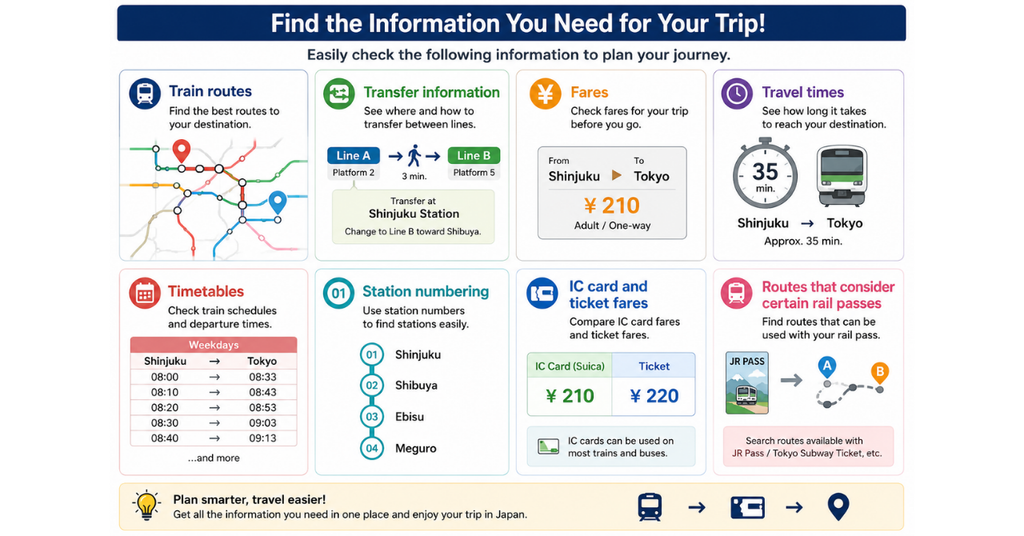
Japan Transit Planner allows travelers to search for information such as:
- Train routes
- Transfer information
- Fares
- Travel times
- Timetables
- Station numbering
- IC card and ticket fares
- Routes that consider certain rail passes
You can also compare routes based on factors such as travel time, cost, and number of transfers.
This can be especially helpful when several different train routes can take you to the same destination.
Best for: Travelers who want more detailed information about trains, fares, timetables, and transfers.
Our Tip: Use Google Maps for general navigation and Japan Transit Planner when you want to compare train routes in more detail.
Download Japan Transit Planner
App Store: [Japan Transit Planner]
Google Play: [Japan Transit Planner]
3. Japan Travel by NAVITIME — Best for Traveling Around Japan
Japan Travel by NAVITIME is designed specifically to help international visitors travel around Japan.
In addition to public transportation route searches, the app includes features that can be useful throughout your trip.
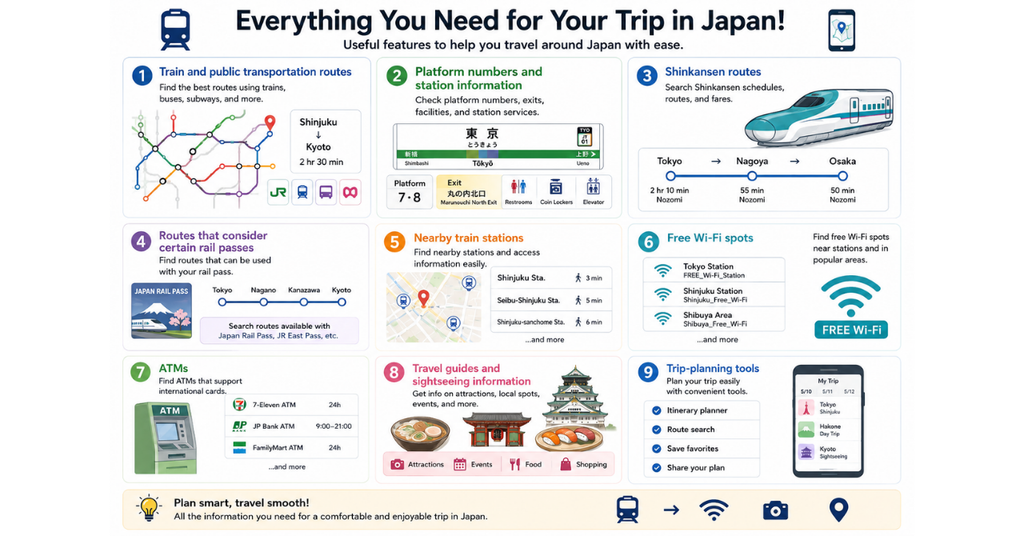
Depending on the feature, you can use it to find:
- Train and public transportation routes
- Platform numbers and station information
- Shinkansen routes
- Routes that consider certain rail passes
- Nearby train stations
- Free Wi-Fi spots
- ATMs
- Travel guides and sightseeing information
- Trip-planning tools
This makes it different from an app focused only on train transfers.
If you’re traveling between several cities or want an app that combines transportation with other Japan travel information, it may be worth downloading.
Best for: Travelers who want an app for both transportation and general trip planning in Japan.
Our Tip: This is especially useful if your trip includes multiple destinations and different types of transportation.
Download Japan Travel by NAVITIME
App Store: [Japan Travel by NAVITIME]
Google Play: [Japan Travel by NAVITIME]
Which App Should You Use?
You don’t need to download every transportation app available in Japan.
For most first-time visitors, we recommend starting with Google Maps because it’s simple and useful both inside and outside train stations.
If you want more detailed information about train routes, fares, and transfers, try Japan Transit Planner.
If you’re traveling around several parts of Japan and want additional travel-planning features, Japan Travel by NAVITIME can also be useful.
And remember:
Even people in Japan use navigation and transfer apps all the time.
Checking your phone before getting on a train doesn’t mean you’re bad at navigating Japan—it simply makes traveling easier.
Once you have your navigation app ready, let’s use it to find your first train.
Why Do Japan’s Trains Seem So Complicated?
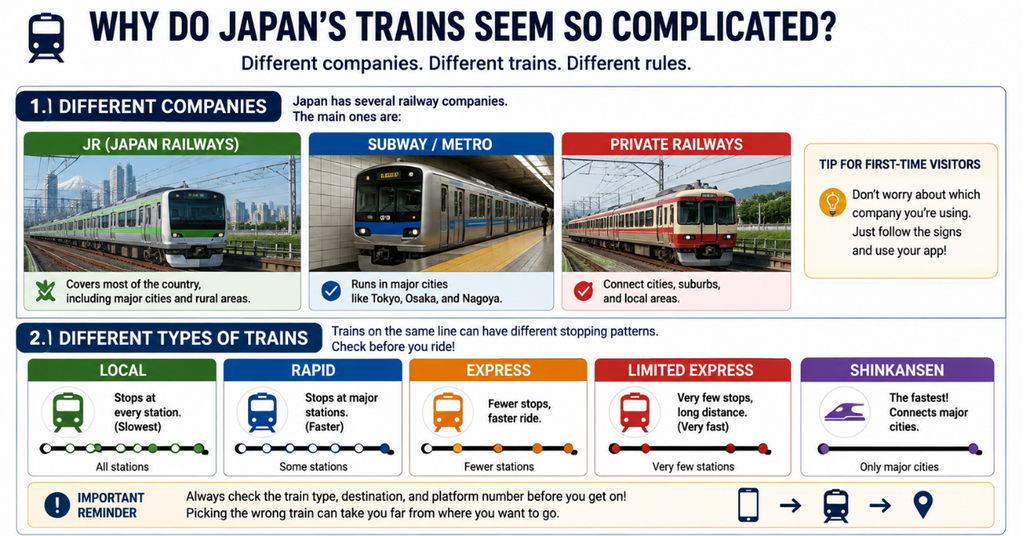
If you look at a railway map in Tokyo or Osaka for the first time, you might wonder, “How am I supposed to understand all of this?”
Japan’s railway system includes JR lines, subways, and private railways operated by different companies. In major cities, several railway companies may serve the same area, and some large stations connect multiple lines in one enormous station complex.
This is completely normal for people living in Japan, but it can be confusing for first-time visitors.
The good news is that you don’t need to memorize every railway company or train line. For most trips, you only need to know which line to take, which direction to travel, where to transfer, and where to get off.
Before we walk through how to use a train step by step, let’s look at two things that often confuse first-time visitors.
1. JR, Subways, and Private Railways: What’s the Difference?
One of the first things you may notice is that not every train in Japan is operated by the same company.
JR (Japan Railways) operates a large railway network throughout Japan, including many local and regional lines.
Major cities also have subway systems. Tokyo, Osaka, Kyoto, Nagoya, and several other cities have subway lines that are especially useful for getting around urban areas.
In addition, Japan has many private railway companies. These trains often connect city centers with residential areas, airports, and popular sightseeing destinations.
For travelers, the most important thing to remember is simple:
JR, subways, and private railways are different railway networks, but you may use all of them during the same trip.
For example, your route may tell you to take a JR train first and then transfer to a subway or private railway.
You don’t need to memorize which company operates every train. Simply follow your navigation app and check the line name, station name, and signs inside the station.
2. Local, Rapid, Express… Why Are There So Many Train Types?
Another thing that can surprise first-time visitors is that trains on the same line do not always stop at the same stations.
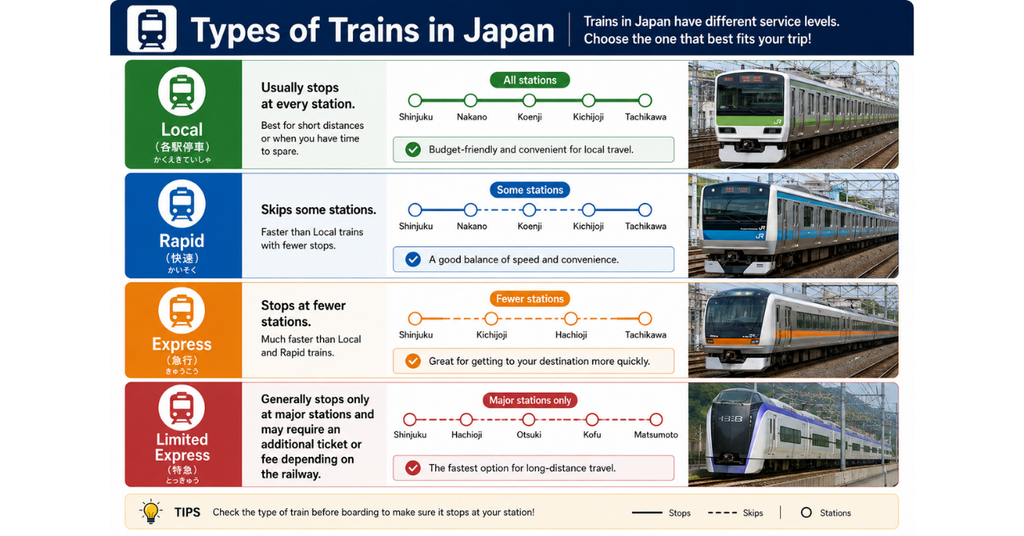
You may see words such as:
- Local – usually stops at every station
- Rapid – skips some stations
- Express – stops at fewer stations
- Limited Express – generally stops only at major stations and may require an additional ticket or fee depending on the railway
This is something many people in Japan use without thinking much about it, but it can easily cause confusion if you’re visiting for the first time.
Imagine standing on the correct platform and getting on a train going in the correct direction—only to watch your destination pass by because the train doesn’t stop there.
Before boarding, check both the destination of the train and whether your station is one of its stops.
Navigation apps can make this much easier by showing the train type, departure time, platform, and stations where you need to transfer or get off.
You don’t need to understand every train type in Japan. Just remember one important rule:
Being on the right platform doesn’t always mean every train that arrives is the right train.
Check before you board, and you’ll avoid one of the most common mistakes first-time visitors can make.
Step 1: Find the Right Train
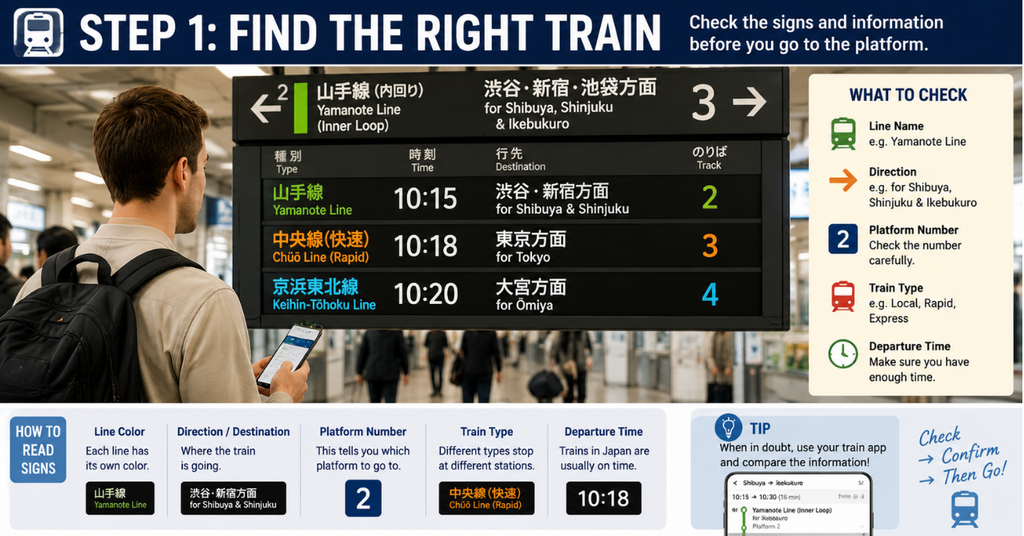
Once you know where you want to go, the first step is finding the right train.
In Japan’s major cities, there may be several different ways to reach the same destination. You might be able to take a JR line, subway, or private railway depending on where you’re starting from.
For first-time visitors, the easiest way to find the right route is to use a navigation app such as Google Maps.
Enter your destination, choose public transportation, and check the suggested train route.
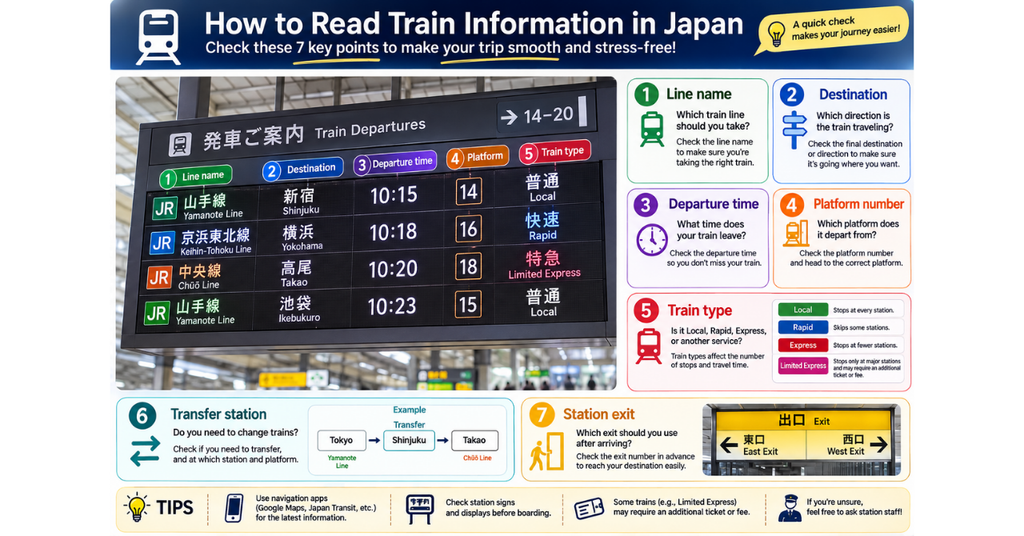
Before heading to the platform, pay attention to the following information:
- Line name – Which train line should you take?
- Train direction or destination – Which direction is the train traveling?
- Departure time – What time does your train leave?
- Platform number – Which platform does it depart from?
- Train type – Is it Local, Rapid, Express, or another service?
- Transfer station – Do you need to change trains?
- Station exit – Which exit should you use after arriving?
You don’t need to memorize all of this information. Keep your navigation app open and check it again whenever you’re unsure.
Follow the Line Name and Color
Train and subway lines in Japan often have their own names and colors. Subway systems may also use letters and station numbers to make navigation easier.
For example, instead of trying to remember only a Japanese station name, you may see a station code made up of a letter and number.
These signs can be especially helpful if Japanese station names are difficult to read or remember.
When walking through a large station, look for the line name, line color, and station or platform signs rather than simply following the crowd.
Check the Direction Carefully
Finding the correct line is only part of the journey. You also need to make sure you’re traveling in the correct direction.
Station signs often show major stations in each direction, and navigation apps usually display the train’s destination or direction.
Before boarding, compare the information on your phone with the signs on the platform.
This simple check can prevent you from accidentally traveling in the opposite direction.
Don’t Just Follow the Crowd
At busy stations in Japan, it may look like everyone around you knows exactly where they’re going.
And most of them probably do.
But following the crowd isn’t always a good idea.
The person in front of you might be taking a different line, using another exit, or transferring to a completely different train.
Instead, follow the signs that match the route shown on your phone.
Travel Tip: Take a screenshot of your route before starting your journey. It can be useful if your internet connection becomes unstable inside a station.
And if you still can’t find the correct platform, don’t hesitate to ask a station employee for help. Showing the destination on your phone is often enough to help them point you in the right direction.
Step 2: Enter the Ticket Gate
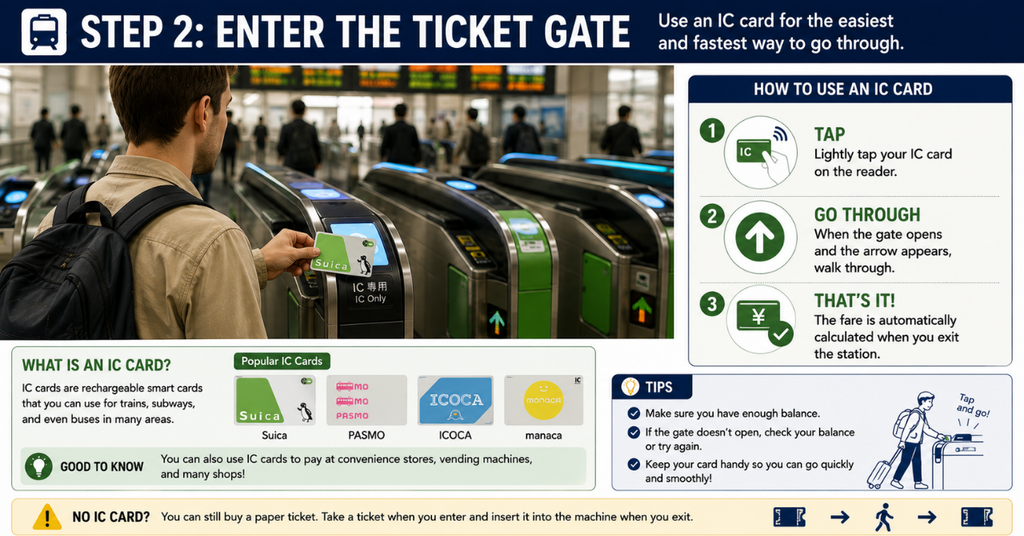
Once you’ve found the train you need to take, the next step is entering the station through the ticket gate.
At first, Japanese ticket gates may look a little intimidating, especially in a busy station where everyone seems to pass through them quickly.
But don’t worry. Once you know what to do, using them is very simple.
For most everyday train journeys, you’ll usually enter the station using either an IC card or a paper ticket.
Using an IC Card
IC cards are one of the easiest ways to travel by train in Japan.
Instead of buying a paper ticket for every journey, you can simply touch your IC card to the reader on the ticket gate.
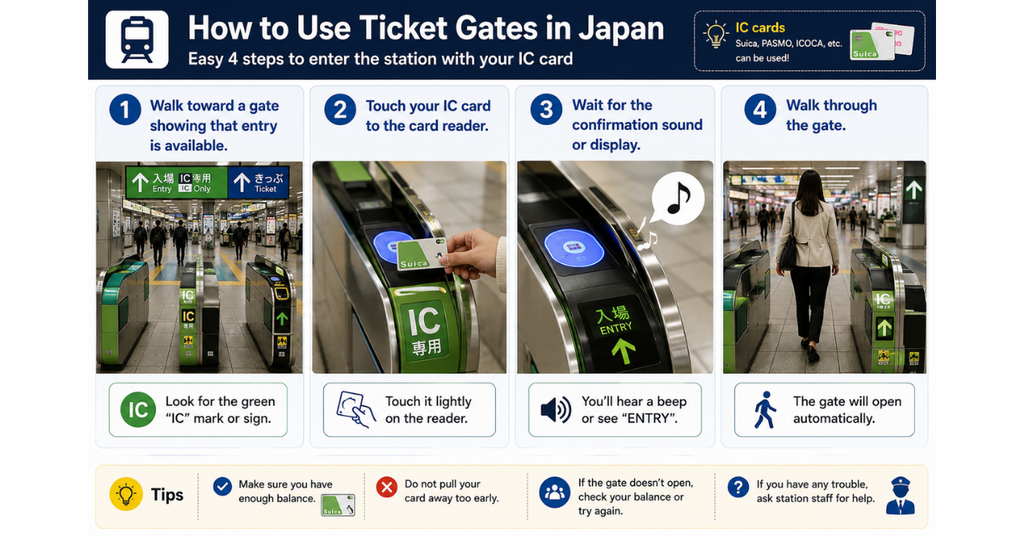
When you enter the station:
- Walk toward a gate showing that entry is available.
- Touch your IC card to the card reader.
- Wait for the confirmation sound or display.
- Walk through the gate.
When you arrive at your destination, touch the same card again when leaving the station. The correct fare is generally calculated and deducted automatically.
You may notice that people in Japan barely slow down when tapping their cards at the gate. That’s simply because many commuters use the same system every day.
There’s no need to rush. Take your time, make sure your card has been read, and then walk through.
Using a Paper Ticket
If you’re using a paper ticket, insert it into the ticket slot at the gate instead of touching the IC card reader.
The ticket will pass through the machine and come out on the other side.
Don’t forget to take it!
You’ll usually need the ticket again when you leave the station.
At your destination, insert the ticket into the exit gate. Depending on the type of ticket and journey, the machine may keep the ticket when you exit.
What If the Ticket Gate Doesn’t Open?
If the gate doesn’t open, don’t panic.
There can be several reasons, such as insufficient balance on an IC card, a ticket issue, or the card not being read correctly.
Don’t try to force your way through the gate or immediately follow another passenger through.
Move to the side so other passengers can pass, then try again or ask a station employee for help.
If your IC card doesn’t have enough balance, you may be able to add money using a fare adjustment or charging machine before exiting.
Don’t Tap In and Immediately Follow Someone Else
Busy ticket gates can move very quickly, and first-time visitors may feel pressure to keep up with the people around them.
However, each passenger needs to use their own valid ticket or IC card.
Wait until the person in front of you has passed through, then tap your own card or insert your own ticket.
Travel Tip: Before reaching the gate, have your IC card or ticket ready. This makes entering the station easier and gives you more time to focus on the signs showing which direction to go next.
Step 3: Find the Right Platform
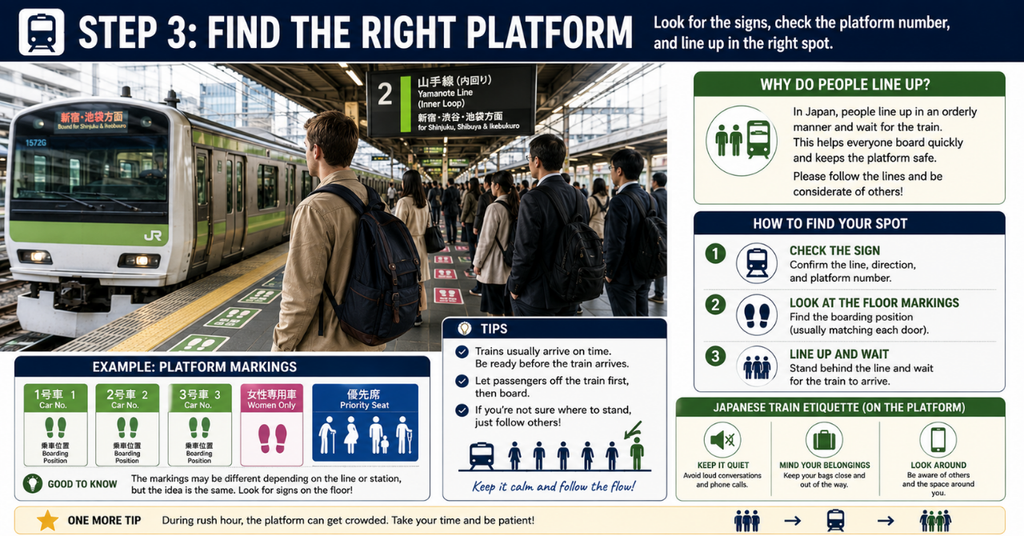
After passing through the ticket gate, your next step is finding the correct platform.
Large stations in Japan can have many platforms, so don’t worry if the station feels confusing at first. Look at the signs above you and compare them with the information shown on your navigation app.
Pay attention to:
- Line name
- Platform number
- Direction or destination
- Departure time
- Train type, such as Local, Rapid, or Express
Follow the signs until you reach the correct platform.
Check the Information Board Before Boarding
Once you arrive at the platform, check the electronic information board before getting on the train.
It usually displays useful information such as the departure time, train type, destination, and platform information. At many major stations, some information is also displayed in English.
This is especially important because, as we explained earlier, being on the correct platform doesn’t always mean that every train stopping there will take you to your destination.
A Local train may stop at your station while a Rapid or Express train may pass it.
Take a few seconds to compare the train information with your route before boarding.
Why Is Everyone Lining Up in the Same Places?
Here’s something you may notice almost immediately on a Japanese train platform:
People often form neat lines in very specific places.
They’re not choosing those spots randomly.
Many platforms have markings on the floor showing where the train doors are expected to stop. Passengers line up around these markings and wait for the train to arrive.
Depending on the station and train, you may also see different markings for different train services or car configurations.
If you’re unsure where to stand, look at the floor markings and follow the designated waiting lines.
This may seem surprisingly organized at first, but it helps passengers board trains smoothly, especially at busy stations.
Let Passengers Get Off First
When the train arrives, you may notice another common habit.
People waiting on the platform usually leave space in front of the doors so passengers can get off before anyone boards.
Wait beside the doors, let passengers exit, and then board when your line begins moving.
Trying to enter while people are still getting off can block the doorway and slow everyone down.
A simple rule to remember is:
Get off first, get on second.
Stay Behind the Safety Line
Japanese train platforms can become extremely crowded, particularly during rush hour.
Always stay behind the safety line or platform doors while waiting for your train, and avoid standing too close to the edge of the platform.
If you’re traveling with a suitcase, keep it close to you and make sure it doesn’t block the walking area or other passengers.
Travel Tip: If the platform is busy, don’t feel pressured to board immediately. If the train is extremely crowded and your schedule allows it, waiting for the next train can sometimes make your journey much more comfortable.
Step 4: Ride the Train
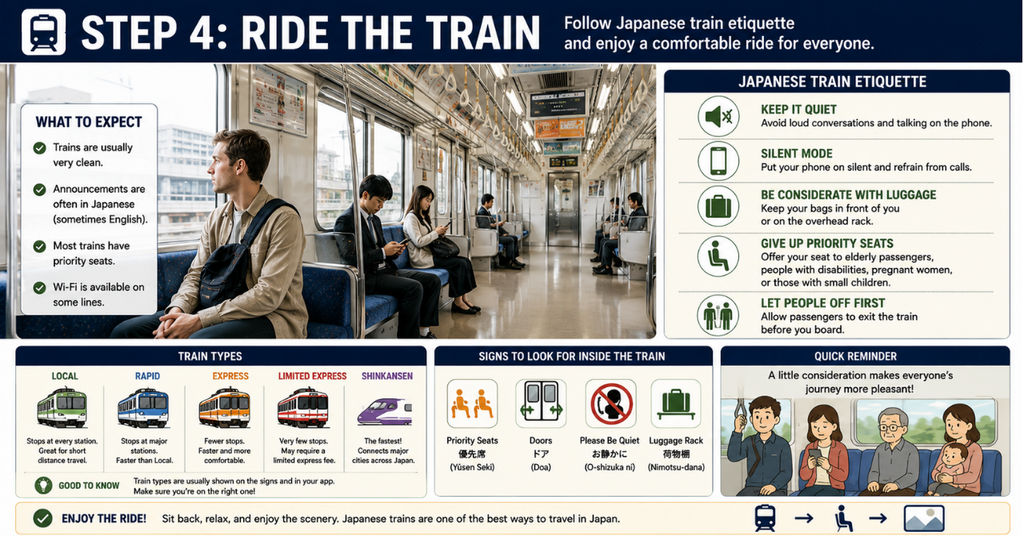
Once everyone getting off has left the train, it’s time to board.
Find a comfortable place to stand or sit, keep your belongings close to you, and check the information screens or announcements so you know when your station is approaching.
Riding a train in Japan is usually simple, but there are a few customs that may be different from what you’re used to.
Why Are Japanese Trains So Quiet?
One of the first things you may notice is how quiet many trains in Japan can be.
Even on a crowded train, passengers often speak quietly, use their phones silently, read, or simply relax during the journey.
You don’t have to remain completely silent. Talking with your travel companions is fine, but keeping your voice at a reasonable level is appreciated.
Avoid Phone Calls on the Train
You may notice many people using smartphones on trains but very few talking on them.
Phone calls are generally avoided inside train cars.
If you receive a call, it’s usually better to send a message or wait until you leave the train before calling back.
This may feel unusual if phone conversations on public transportation are common where you live, but keeping train cars relatively quiet is a widely followed custom in Japan.
Be Careful With Backpacks and Large Luggage
If you’re carrying a backpack, suitcase, or other large item, be aware of the space around you.
During crowded periods, a backpack worn on your back can accidentally bump into other passengers or take up extra space. You may see commuters hold their bags in front of them or place smaller belongings on an overhead luggage rack when available.
If you have a suitcase, keep it close and make sure it doesn’t block the doors or aisle.
You don’t need to copy everything other passengers do—just try to use as little unnecessary space as possible.
What About Priority Seats?
Most trains have designated priority seats for passengers who may need them, such as older people, passengers with disabilities or injuries, pregnant passengers, and people traveling with small children.
If a priority seat is available, rules and expectations may vary depending on the situation and railway. The important thing is to remain aware of the people around you and be prepared to offer the seat to someone who needs it.
You may also see signs asking passengers to be considerate with mobile phone use around priority-seat areas. Follow any instructions displayed inside the train.
How Do You Know When to Get Off?
Don’t worry about memorizing every station along the route.
Many trains have electronic displays showing the current station and upcoming stops, and announcements may also provide station information in English, particularly on major routes.
You can also keep your navigation app open and follow your journey as the train moves.
Station numbers can be useful too. If your destination is marked with a code, comparing that code with station signs can make it easier to recognize your stop.
When your station is approaching, gather your belongings and prepare to leave.
There’s no need to rush to the door several stations early.
Travel Tip: Before getting off, quickly check that you have your phone, wallet, passport, bags, and other belongings. If you leave something on a train, recovering it may require contacting railway staff or a lost-and-found office.
Step 5: Transfer Between Trains
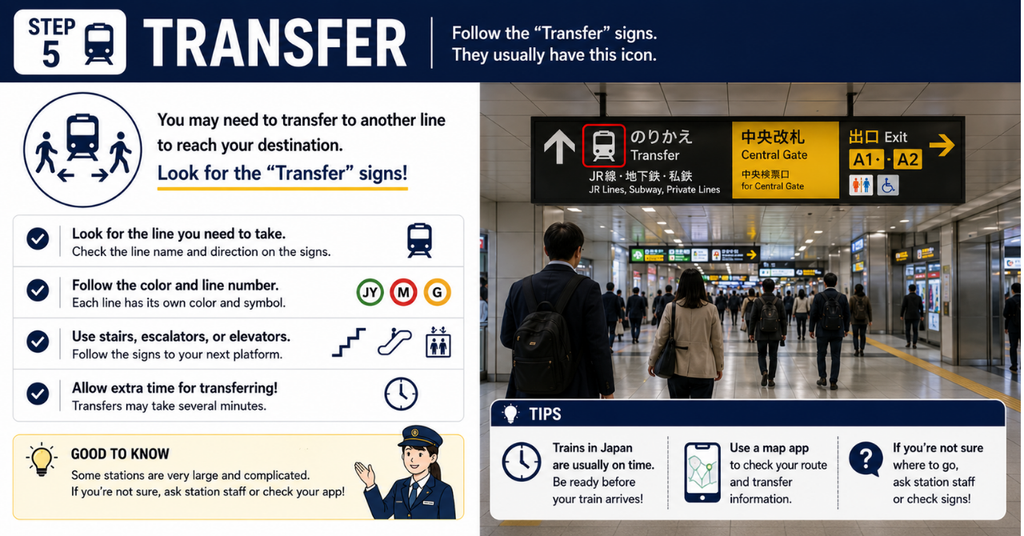
Depending on your route, you may need to transfer to another train before reaching your destination.
Transfers in Japan can be very simple at smaller stations, but at large stations they may involve walking through long corridors, changing floors, or moving between different railway companies.
Don’t worry if your navigation app says the transfer takes several minutes. That’s completely normal at some stations.
Follow the Transfer Signs
After getting off the train, look for signs showing the line you need to take next.
Instead of immediately following signs for the exit, look for words such as “Transfer” or the name of your next train line.
Your navigation app may also show the next line, platform, departure time, and how long you have to transfer.
Keep your phone available, but remember to look at the actual station signs too.
In large stations, these signs are often the easiest way to find your next platform.
Do You Need to Exit the Ticket Gate?
Not always.
Some transfers can be completed without leaving the ticketed area. You simply follow the transfer signs from one platform to another.
However, other transfers may require you to pass through a transfer gate or exit one railway company’s ticket gate and enter another.
This is especially important when changing between different railway operators.
For a first-time visitor, this can feel strange:
“I’m only changing trains. Why am I leaving the ticket gate?”
Nothing is necessarily wrong. Depending on the route and station, passing through a gate can simply be part of the transfer.
Follow the route shown on your navigation app and the signs inside the station.
The Same Station Name Doesn’t Always Mean a Short Transfer
Here’s another thing that can surprise visitors.
Two lines may use the same station name, but their platforms can still be quite far apart.
At large station complexes, transferring may involve walking through underground passages, going up or down several levels, or following signs for several minutes.
So if your app says your transfer requires a 5- or 10-minute walk, don’t automatically assume something has gone wrong.
This is one reason it’s useful to allow a little extra time when traveling through unfamiliar stations.
What If You Miss Your Connecting Train?
Don’t panic.
For many regular urban train routes, another train will arrive soon. Simply check your navigation app again and see whether it suggests the next departure or a different route.
If you’re using a train with reserved seating, a limited express service, or another service tied to a specific ticket or departure, the situation may be different. In that case, ask railway staff what you should do.
For ordinary local train travel, missing one train usually doesn’t ruin your journey.
Don’t Be Afraid to Ask for Help
Large Japanese stations can be confusing even if you’ve already used trains in Japan several times.
If you’re unsure where to go, find a station employee and show them the name of the line or destination on your phone.
You don’t need to explain everything in Japanese.
A simple question such as:
“Excuse me, where is the ___ Line?”
can be enough to get you pointed in the right direction.
Travel Tip: When your transfer involves a large station, check how much transfer time your navigation app allows before you begin your journey. If the connection looks very tight and you’re unfamiliar with the station, choosing a route with a little more time can make the journey much less stressful.
Step 6: Exit the Station Without Getting Lost
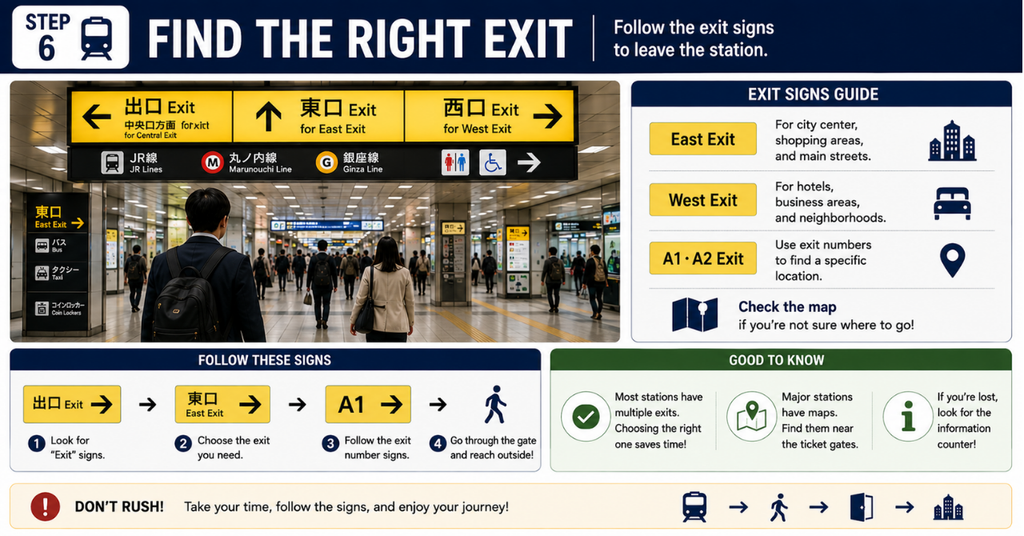
You’ve arrived at your destination station!
But before you celebrate, there’s one more step: finding the right exit.
At smaller stations, this may be easy. At large stations in cities such as Tokyo and Osaka, however, there can be many different exits leading to completely different streets, neighborhoods, and buildings.
Choosing the right exit can save you a lot of unnecessary walking.
Check Your Exit Before Leaving the Station
Before heading through the ticket gate, check which exit is closest to your destination.
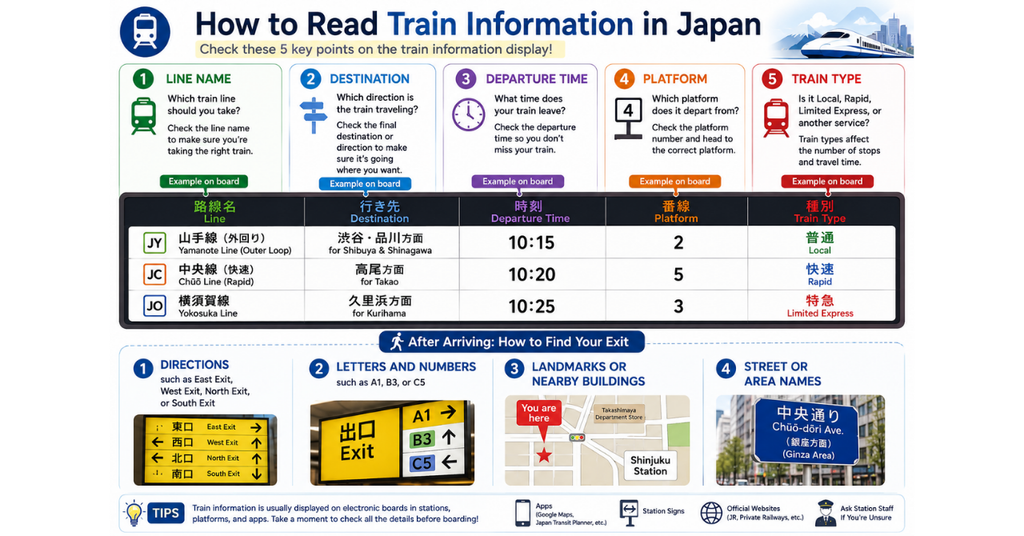
Depending on the station, exits may be identified by:
- Directions, such as East Exit, West Exit, North Exit, or South Exit
- Letters and numbers, such as A1, B3, or C5
- Landmarks or nearby buildings
- Street or area names
Your navigation app may show a recommended station exit, so check your route before leaving the station.
You can also look at station maps and signs showing nearby attractions, hotels, shopping areas, and major buildings.
Why Does One Station Have So Many Exits?
This can be surprising if you’re visiting Japan for the first time.
You arrive at the correct station, follow a sign marked “Exit,” and walk outside…
only to discover that your destination is on the other side of the station.
Large Japanese stations often connect to underground passages, shopping centers, department stores, office buildings, and multiple surrounding streets.
Because of this, a single station may have many different exits.
For people who use the station every day, saying “Meet me at the East Exit” or “Use Exit A3” may sound completely normal.
For a first-time visitor, however, choosing the correct exit can make a huge difference.
Don’t Rush Through the First Exit You See
When you get off the train, resist the temptation to simply follow the nearest “Exit” sign.
First, check the exit recommended for your destination.
If you choose the wrong one, you can usually still reach your destination, but you may have to walk farther, cross a busy road, or find your way around a large station building.
Taking 30 seconds to check your exit can sometimes save several minutes of walking.
How to Leave Through the Ticket Gate
Once you’ve found the correct exit, pass through the ticket gate.
If you’re using an IC card, touch it to the reader just as you did when entering the station. The fare is generally calculated and deducted automatically.
If you’re using a paper ticket, insert it into the gate. Depending on your ticket and journey, the machine may keep it when you exit.
If the gate doesn’t open, move to the side and ask a station employee for help rather than blocking the gate.
Check Your Route Again Once You’re Outside
After leaving the station, open your navigation app again and check the direction to your final destination.
GPS can sometimes take a moment to determine your exact direction, especially around large buildings or underground stations.
Instead of immediately walking away from the station, take a moment to confirm that you’re heading the right way.
Travel Tip: If you’re visiting a hotel, restaurant, or tourist attraction near a large station, check the recommended station exit before you begin your train journey. Knowing something as simple as “Shinjuku Station – West Exit” or “Exit A2” in advance can make arriving much easier.
And congratulations—you’ve successfully completed a train journey in Japan!
What If Something Goes Wrong? Don’t Panic!
Even if you understand how Japan’s train system works, mistakes can still happen.
You might get on a train going in the wrong direction, miss your stop, take the wrong type of train, or suddenly find that the ticket gate won’t open.
Don’t panic.
Most train mistakes are easy to fix. Stop somewhere that doesn’t block other passengers, check where you are, and decide what to do next.
If You Take a Train in the Wrong Direction
If you realize you’re traveling in the wrong direction, get off at the next appropriate station.
Once you’re off the train, check your navigation app again and find the route to your destination. You may simply need to move to the opposite platform and take a train back.
If you’re unsure whether you need to pass through a ticket gate or make a fare adjustment, ask a station employee before continuing.
Don’t rush across the platform or try to take shortcuts. Follow the station signs to the correct platform.
If You Miss Your Stop
Did you look at your phone for a little too long and suddenly realize your station has already passed?
It happens.
Get off at the next station and check the route back to your destination.
Depending on your ticket, route, and railway, the fare situation may vary. If you’re unsure, show your ticket or IC card to a station employee and explain where you wanted to go.
The important thing is not to panic and start tapping your IC card at different gates trying to fix the problem yourself.
If Your Train Skips Your Station
You may be on the correct line and traveling in the correct direction but suddenly watch your station pass by.
There’s a good chance you’ve boarded a Rapid, Express, or another train service that doesn’t stop at your destination.
Get off at the next station where the train stops and check which train will take you back.
This is exactly why checking the train type before boarding is so important.
If the Ticket Gate Won’t Open
If the ticket gate closes or gives you an error, don’t try to force your way through.
Move to the side so other passengers can continue through the gate.
If you’re using an IC card, there may be an issue such as insufficient balance or an incomplete entry or exit record. If you’re using a paper ticket, you may need a fare adjustment or assistance with your ticket.
Look for a staffed ticket gate and show your IC card or ticket to the station employee.
In many cases, they’ll be able to tell you what went wrong and what you need to do next.
If You Get Lost Inside a Station
Large Japanese stations can sometimes feel like small cities.
If you’ve been following signs for several minutes and still have no idea where you are, stop somewhere away from the main flow of passengers and check your route again.
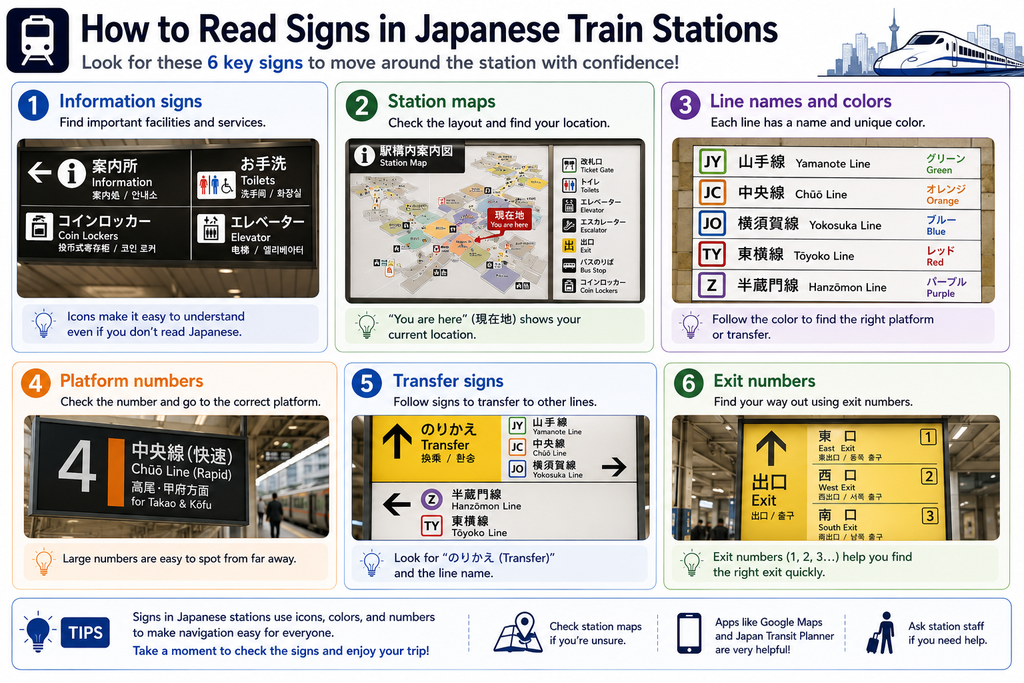
Look for:
- Information signs
- Station maps
- Line names and colors
- Platform numbers
- Transfer signs
- Exit numbers
If you’re still lost, ask a station employee.
You can simply show the destination or train line on your phone.
Useful Japanese Phrases When You Need Help
You don’t need to speak Japanese to use trains in Japan, but a few simple phrases can be useful when something goes wrong.
Sumimasen.
Excuse me.
○○-eki ni ikitai desu.
I want to go to ○○ Station.
○○-sen wa doko desu ka?
Where is the ○○ Line?
Nanban hōmu desu ka?
Which platform is it?
And if explaining the problem feels difficult, simply show the station employee your destination and route on your phone.
Remember: Even People in Japan Get Confused
If you’re standing in a huge station wondering where the correct platform or exit is, you’re definitely not the only one.
Even people who live in Japan can get confused when using an unfamiliar station or railway line.
You don’t need to understand everything perfectly.
Remember these three things:
Stop → Check → Ask
Stop somewhere safe without blocking other passengers, check your current location and route, and ask a station employee if you’re still unsure.
A small mistake usually means a small detour—not the end of your trip.
Take your time, check the signs, and continue your journey.