Earthquakes in Japan: What Tourists Should Do Before and During a Quake
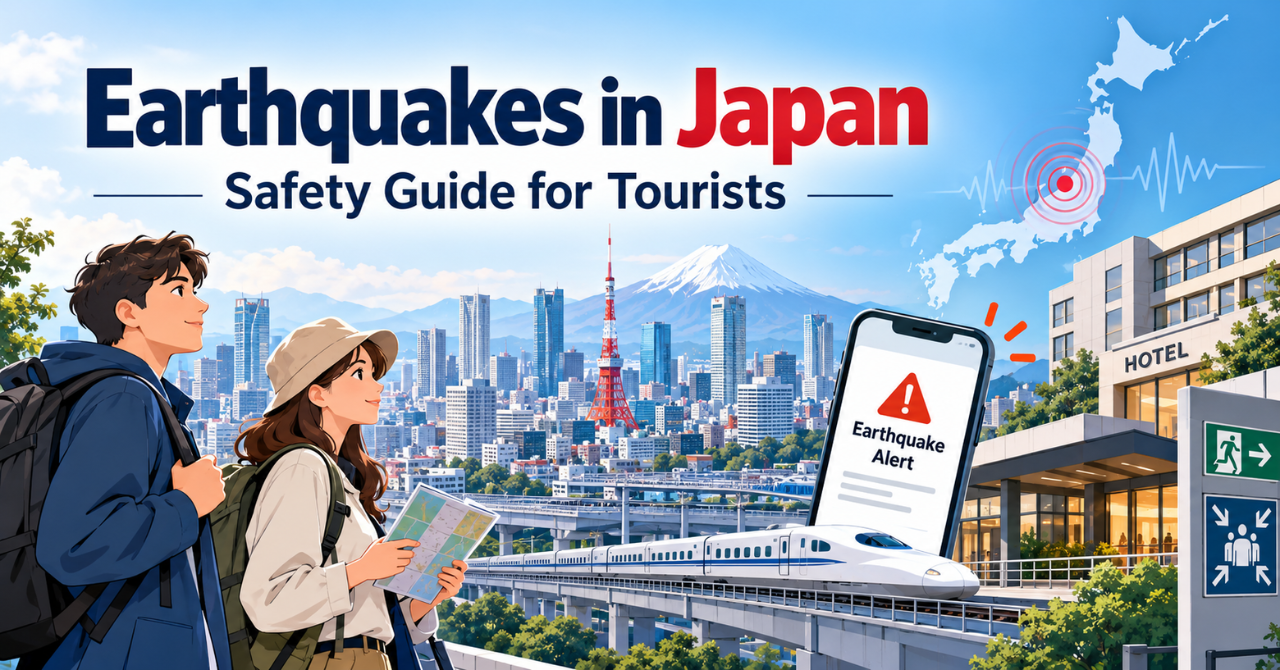
Earthquakes in Japan are a common concern for many first-time visitors.
Japan experiences frequent seismic activity, but most earthquakes are small and do not cause serious problems for travelers. Even so, knowing what to do during an earthquake can make a big difference if one happens during your trip.
In this guide, you will learn what to do during and after an earthquake, how to stay safe in hotels, trains, and other places, what to know about tsunami warnings, and which emergency apps and services are useful for travelers.
You do not need to be afraid of traveling to Japan. With a little preparation, you can react more calmly and safely if an earthquake occurs.
- Are Earthquakes Common in Japan?
- What to Do During an Earthquake in Japan
- What to Do After the Shaking Stops
- What to Do If You Are Near the Coast
- Earthquake Early Warnings in Japan
- Best Earthquake Apps and Official Information for Tourists
- Emergency Numbers and Help for Foreign Tourists
- How to Prepare Before Your Japan Trip
- What Is the Nankai Trough Earthquake?
- Should You Cancel Your Japan Trip After an Earthquake?
- Common Earthquake Mistakes Tourists Should Avoid
- Earthquakes in Japan FAQ
- Final Earthquake Safety Tips for Tourists
Are Earthquakes Common in Japan?
Japan experiences earthquakes more frequently than many other countries.
This is because Japan is located in an area where several tectonic plates meet. The movement of these plates causes frequent seismic activity around the Japanese islands.
However, most earthquakes are small and may not even be noticeable. Strong earthquakes that cause serious damage are much less common.
If you feel an earthquake during your trip, you may notice buildings gently swaying, hanging signs moving, or an earthquake alert appearing on your phone.
Modern buildings in Japan are designed with earthquake resistance in mind, and emergency systems are widely used throughout the country.
For travelers, the most important thing is not to panic. Knowing what to do before an earthquake happens can help you react calmly and safely.
In the next section, we will explain exactly what to do if an earthquake happens while you are traveling in Japan.
What to Do During an Earthquake in Japan
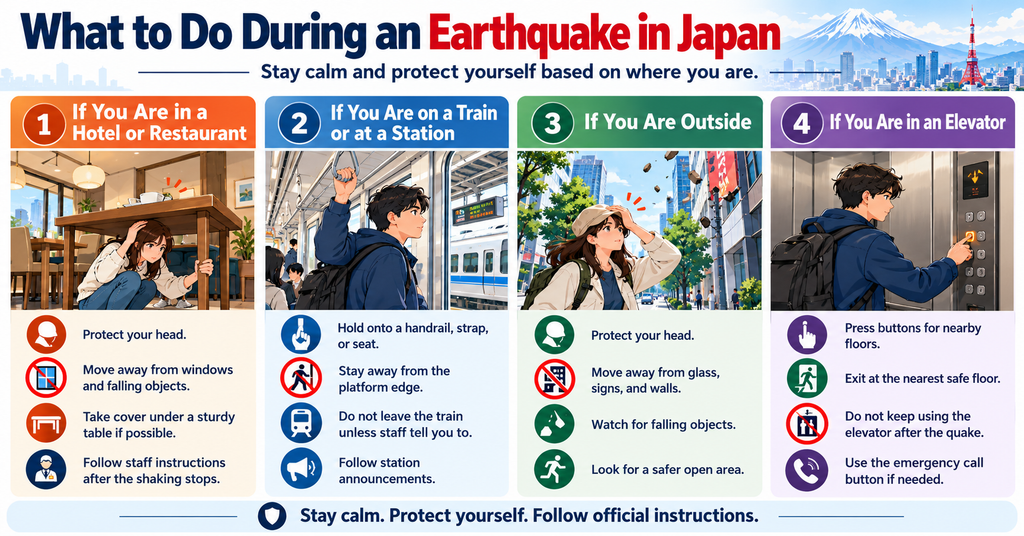
If an earthquake happens while you are traveling in Japan, your first priority is to protect yourself from falling objects and broken glass.
Stay calm and avoid rushing outside while the shaking is still strong.
What you should do depends on where you are, so follow the basic safety steps below.
If You Are in a Hotel or Restaurant
If you are inside a hotel, restaurant, or other building, protect your head and move away from windows, shelves, and objects that could fall.
If there is a sturdy table nearby, take cover underneath it.
Do not rush toward the exit while the building is shaking.
In hotels, restaurants, shopping malls, and other public facilities, follow instructions from staff after the shaking stops.
If you are staying at a hotel, check the evacuation route when you first arrive so you know where to go in an emergency.
If You Are on a Train or at a Station
If you are on a train during an earthquake, hold firmly onto a handrail, strap, or seat.
Trains may slow down or stop automatically when strong shaking is detected.
Do not try to leave the train unless staff tell you to do so.
If you are at a station, move away from the edge of the platform and watch for falling signs or other objects.
Follow announcements and station staff instructions before continuing your journey.
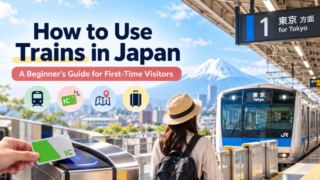
If you are unfamiliar with Japan’s railway system, our train guide explains how to use trains, stations, transfers, and navigation apps step by step.
If You Are Outside
If you are outside, protect your head and look around for falling objects.
Move away from glass windows, signs, walls, and other structures that could fall or collapse.
In busy city areas, broken glass and signs falling from buildings can be a serious danger.
If you are near a mountain or cliff, be aware of the risk of falling rocks or landslides.
Do not run blindly. First, look for a safer open area and stay aware of your surroundings.
If You Are in an Elevator
If you are inside an elevator when an earthquake begins, press the buttons for nearby floors.
Get out at the nearest floor where the elevator stops safely.
Do not continue using the elevator after the earthquake.
If the elevator stops and the doors do not open, stay calm and use the emergency call button or intercom to contact building staff.
What to Do After the Shaking Stops
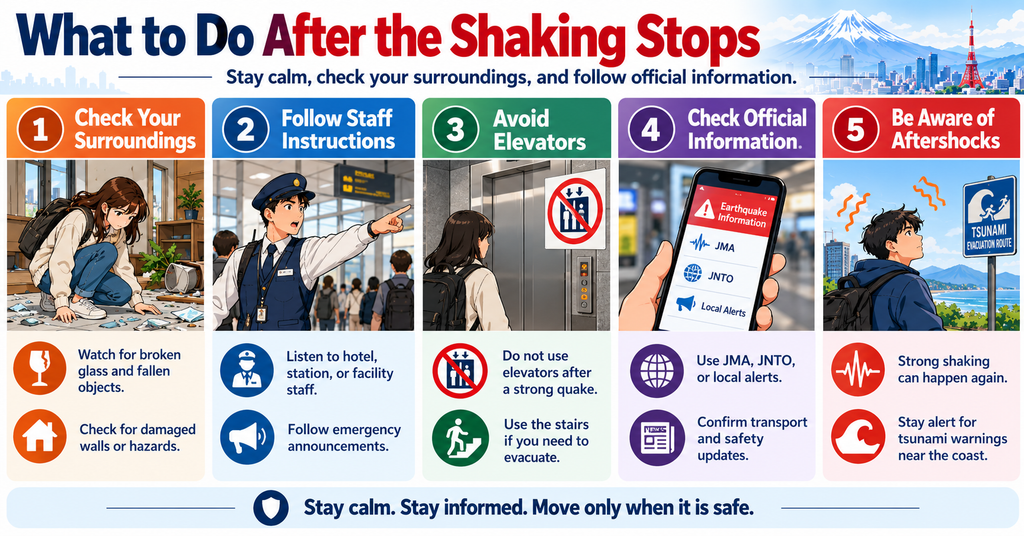
After the shaking stops, stay calm and check your surroundings before moving.
Watch for broken glass, fallen objects, damaged walls, and other hazards.
If you are inside a hotel, restaurant, station, or other public facility, follow instructions from staff and emergency announcements.
Do not use elevators after a strong earthquake. Use the stairs if you need to evacuate.
Be prepared for additional earthquakes after a large quake. Strong shaking can happen again, especially in the first few days.
Check official information from the Japan Meteorological Agency (JMA), JNTO, or local authorities before deciding where to go next.
If you are near the coast, pay special attention to tsunami warnings and evacuation instructions.
Only return to your hotel or continue your journey after you have confirmed that it is safe to do so.
What to Do If You Are Near the Coast
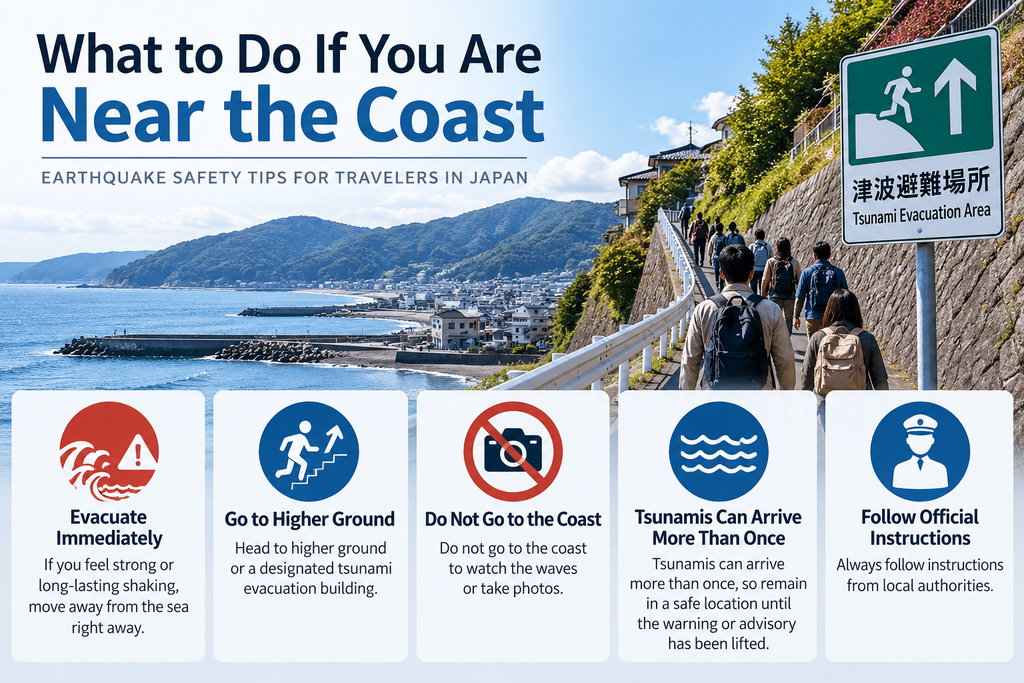
If you are near the coast when an earthquake happens, pay close attention to the risk of a tsunami.
A tsunami can follow a strong earthquake, and in some cases it may reach coastal areas quickly.
If you feel strong shaking or weak but long-lasting shaking near the coast, leave the coastal area immediately.
If a Major Tsunami Warning or Tsunami Warning is issued, evacuate from coastal and river areas immediately to higher ground or a designated tsunami evacuation building.
If a Tsunami Advisory is issued, get out of the water and leave coastal areas immediately. Do not return until the advisory has been lifted.
Earthquakes and Tsunami Risk
Not every earthquake causes a tsunami.
However, large earthquakes under or near the ocean can move the seafloor and generate tsunami waves.
Tsunamis can become much higher as they approach the coast, so even a wave that seems small offshore can become dangerous near land.
Do not go to the beach, harbor, or river to watch the waves.
Tsunami waves may arrive more than once, so stay away from coastal areas until the warning or advisory has officially been lifted.
When to Move to Higher Ground
Move to higher ground immediately if you feel strong shaking or weak but long-lasting shaking near the coast.
You should also evacuate to higher ground or a designated tsunami evacuation building if a Major Tsunami Warning or Tsunami Warning is issued.
If a Tsunami Advisory is issued, get out of the water and leave coastal areas immediately.
Do not wait to see a tsunami before moving to safety.
Follow tsunami evacuation signs and instructions from local authorities.
Do not return to coastal areas until the warning or advisory has officially been lifted.
Earthquake Early Warnings in Japan
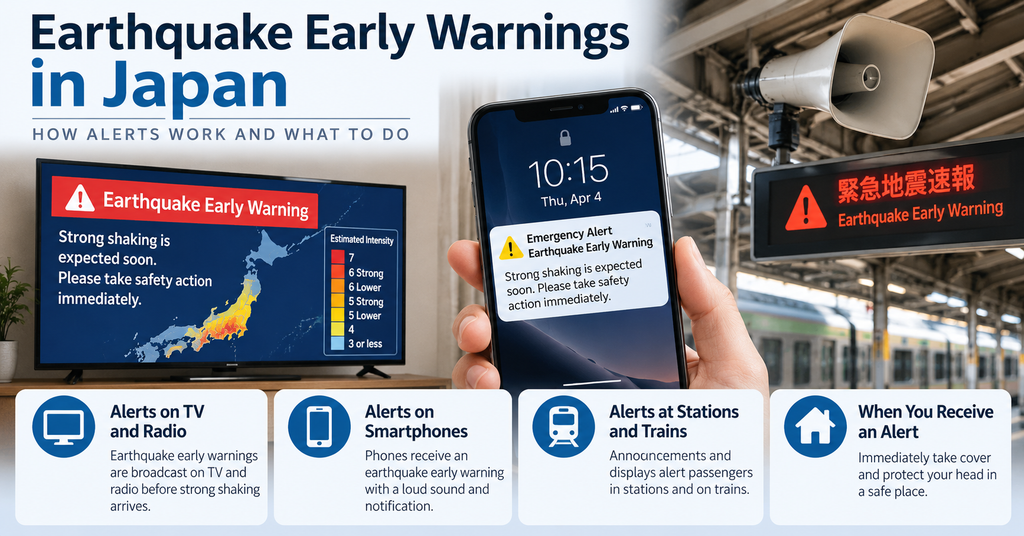
Japan has an Earthquake Early Warning system that can alert people shortly before strong shaking arrives.
The warning is issued by the Japan Meteorological Agency (JMA) after an earthquake is detected and strong shaking is expected in certain areas.
You may receive the alert on your smartphone, or see and hear it on television, radio, or public announcement systems.
The warning usually gives only a few seconds to a few tens of seconds before strong shaking begins, so you should act immediately.
If you receive an Earthquake Early Warning, protect your head, move away from windows and shelves, and avoid rushing outside.
If you are on a train or bus, hold onto a handrail or strap. If you are in a public building, follow staff instructions.
Keep in mind that you may not always receive a warning before you feel the earthquake, especially if you are close to the epicenter.
For foreign travelers, the Safety tips app can also provide earthquake and tsunami alerts in multiple languages.
Best Earthquake Apps and Official Information for Tourists
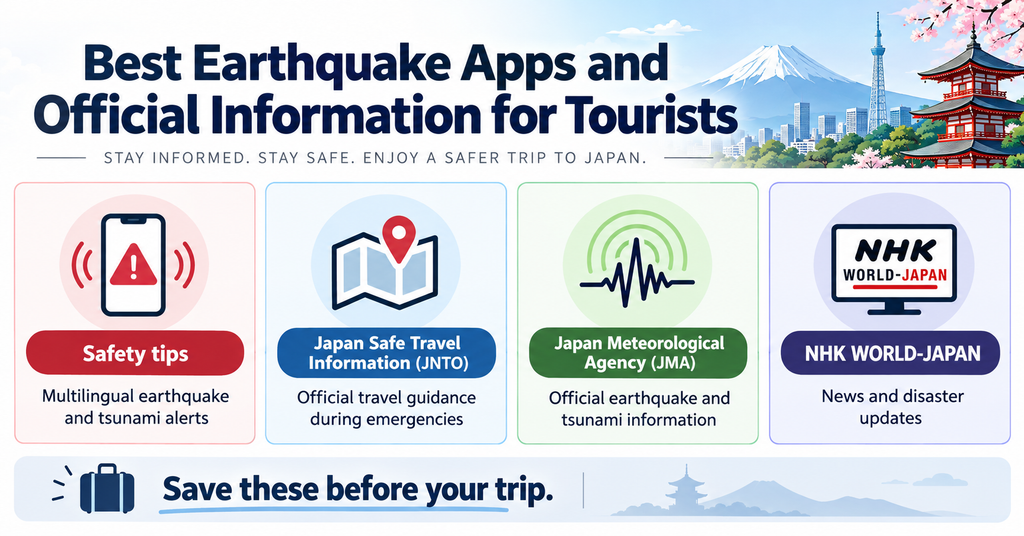
When an earthquake happens in Japan, reliable information is extremely important.
Social media can be useful, but emergency information should always be confirmed through official sources.
For foreign travelers, the most useful services are Safety tips, Japan Safe Travel Information, and the Japan Meteorological Agency (JMA).
It is a good idea to save these services before your trip so you can access them quickly in an emergency.
Check the latest earthquake and emergency information on the official Japan Safe Travel Information website.
Safety tips
Safety tips is a free disaster information app supervised by the Japan Tourism Agency.
It can send push notifications for Earthquake Early Warnings, tsunami warnings, special weather warnings, evacuation information, and other emergencies in Japan.
The app also includes useful emergency guidance, communication cards, and links to important information.
Safety tips currently supports 15 languages, making it especially useful for international visitors.
Download the app before your trip and allow notifications so you can receive important alerts while traveling in Japan.
Visit the official Safety tips information page for app details and download links.
JNTO / Japan Safe Travel Information
Japan Safe Travel Information is an official service provided by the Japan National Tourism Organization (JNTO).
It provides information for travelers about earthquakes, severe weather, natural disasters, and other emergencies in Japan.
The earthquake page includes recent earthquake information and basic guidance on what travelers should do.
JNTO also operates the Japan Visitor Hotline, which can provide assistance during natural disasters and other emergencies.
Saving the Japan Safe Travel Information website on your phone can be useful if you need reliable travel information during your trip.
Japan Meteorological Agency (JMA)
The Japan Meteorological Agency (JMA) is the official source for earthquake and tsunami information in Japan.
JMA provides information about earthquake locations, magnitude, seismic intensity, and tsunami warnings or advisories.
If a major earthquake occurs, check JMA information to understand which areas have been affected and whether a tsunami warning has been issued.
JMA information may be more technical than tourist-focused services, but it is one of the most important official sources during an emergency.
For simple travel guidance, you can use Safety tips or JNTO alongside JMA information.
For official earthquake and tsunami information, check the Japan Meteorological Agency.
Emergency Numbers and Help for Foreign Tourists
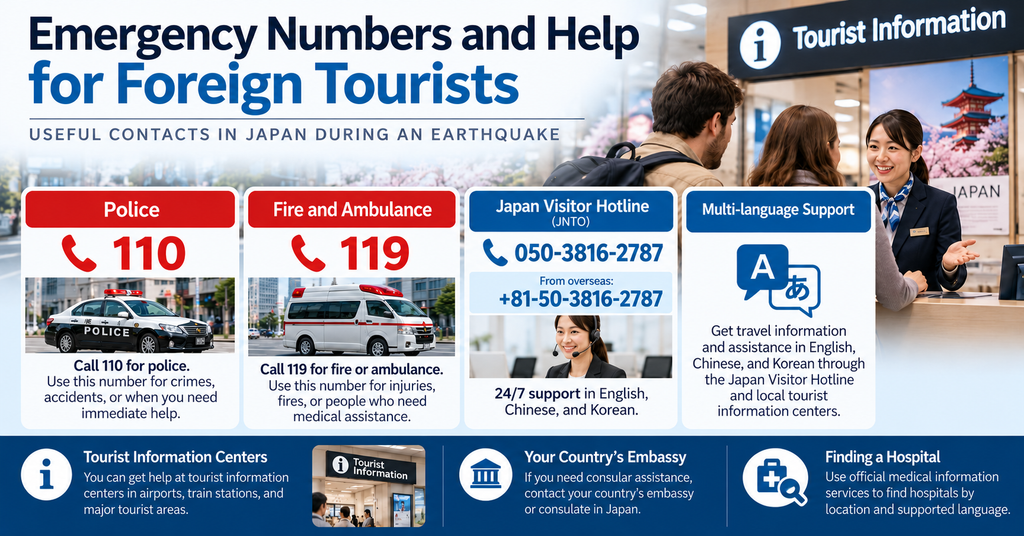
If you need urgent help in Japan, remember these emergency numbers:
Police: 110
Fire and Ambulance: 119
These numbers can be called from phones in Japan during an emergency.
For foreign travelers, the Japan National Tourism Organization (JNTO) also operates the Japan Visitor Hotline.
Japan Visitor Hotline:
050-3816-2787
From overseas:
+81-50-3816-2787
The hotline is available 24 hours a day, 365 days a year, and supports English, Chinese, and Korean.
It can provide assistance during accidents, illness, natural disasters, and other emergencies.
If you are staying at a hotel, you can also ask hotel staff for help contacting emergency services or understanding local instructions.
For emergency assistance in English, Chinese, or Korean, travelers can also contact the JNTO Japan Visitor Hotline.
How to Prepare Before Your Japan Trip
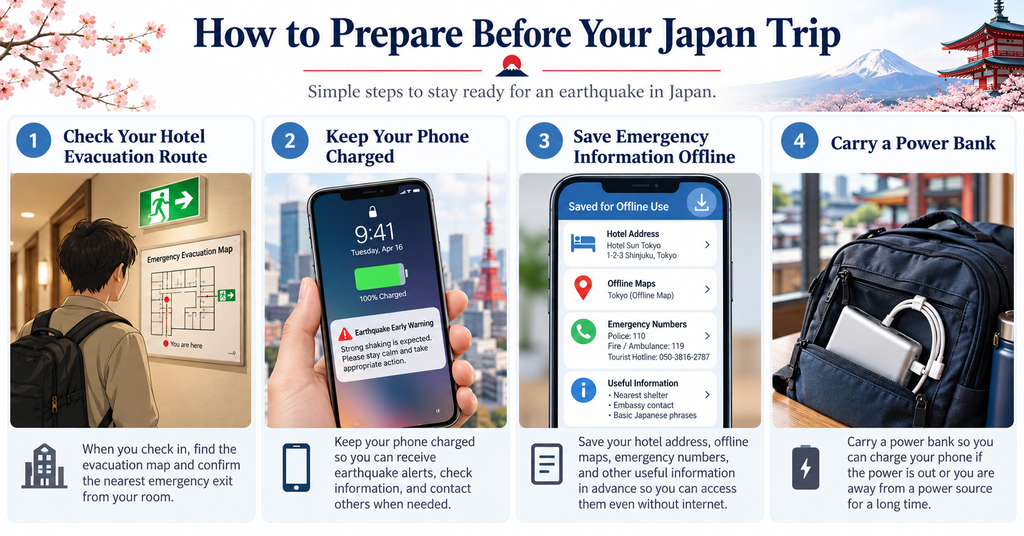
A little preparation before your trip can make a big difference during an earthquake or other emergency in Japan.
You do not need to prepare for every possible situation, but a few simple steps can help you react more quickly and calmly.
Before traveling, check your accommodation, prepare your phone, save important information, and make sure you have a backup power source.
For more practical advice before your trip, check our complete guide to essential things first-time visitors should know about Japan.

Check Your Hotel Evacuation Route
When you check into your hotel, take a moment to find the nearest emergency exit and evacuation route.
Check the evacuation map on your room door or in the hallway, and make sure you know where the stairs are located.
During an emergency, elevators may not be available, so knowing the location of the stairs can be especially helpful.
You do not need to memorize the entire building. Simply knowing your nearest safe exit can save valuable time.
Keep Your Phone Charged
Your smartphone can be one of your most useful tools during an emergency.
You may need it to receive earthquake alerts, check official information, view maps, contact your hotel, or communicate with family and friends.
Try to keep your phone charged throughout the day, especially when traveling long distances.
Avoid letting your battery become extremely low when you are away from your accommodation.
Save Emergency Information Offline
Internet and mobile networks may become slow or difficult to use after a major earthquake.
Before your trip, save important information on your phone so you can access it offline.
Useful information may include your hotel address, emergency phone numbers, screenshots of maps, train information, and contact details for your travel companions.
It is also helpful to bookmark official websites such as JNTO and the Japan Meteorological Agency before you travel.
Carry a Power Bank
A portable power bank can be very useful during long travel days or emergencies.
If trains stop or you cannot return to your hotel immediately, your phone battery may need to last much longer than usual.
Carry a fully charged power bank in your day bag, along with the cable needed for your phone.
Remember to recharge your power bank regularly during your trip.
What Is the Nankai Trough Earthquake?
The Nankai Trough is a long ocean trench that runs along the Pacific side of central and western Japan.
Large earthquakes have repeatedly occurred along this area in the past, and another major earthquake is expected to occur in the future.
However, scientists cannot accurately predict the exact date, location, or magnitude of a future Nankai Trough earthquake.
The Japan Meteorological Agency (JMA) continuously monitors earthquakes and crustal movement in the region.
If unusual activity is detected, JMA may issue Nankai Trough Earthquake Extra Information to encourage people to review their earthquake preparedness and follow official updates.
For travelers, the most important thing is not to change your plans based on rumors or social media posts.
Check official information from JMA and local authorities, know what to do during an earthquake, and follow evacuation instructions if an emergency occurs.
Learn more about Nankai Trough Earthquake Information from the Japan Meteorological Agency.
Should You Cancel Your Japan Trip After an Earthquake?
An earthquake in Japan does not always mean that you need to cancel your entire trip.
The impact can vary greatly depending on where the earthquake happened, how strong it was, and whether transportation, hotels, or tourist attractions were affected.
Before changing your plans, check official information from the Japan Meteorological Agency (JMA), JNTO, local authorities, airlines, and railway companies.
If your destination is outside the affected area and transportation is operating normally, your trip may still be possible.
However, if there are tsunami warnings, damaged infrastructure, major transport disruptions, or evacuation instructions, avoid traveling into the affected area.
After a large earthquake, additional strong earthquakes can occur, so continue checking official updates even after the initial shaking has stopped.
Do not make travel decisions based only on rumors or social media posts. Use reliable official information and adjust your itinerary if necessary.
Common Earthquake Mistakes Tourists Should Avoid
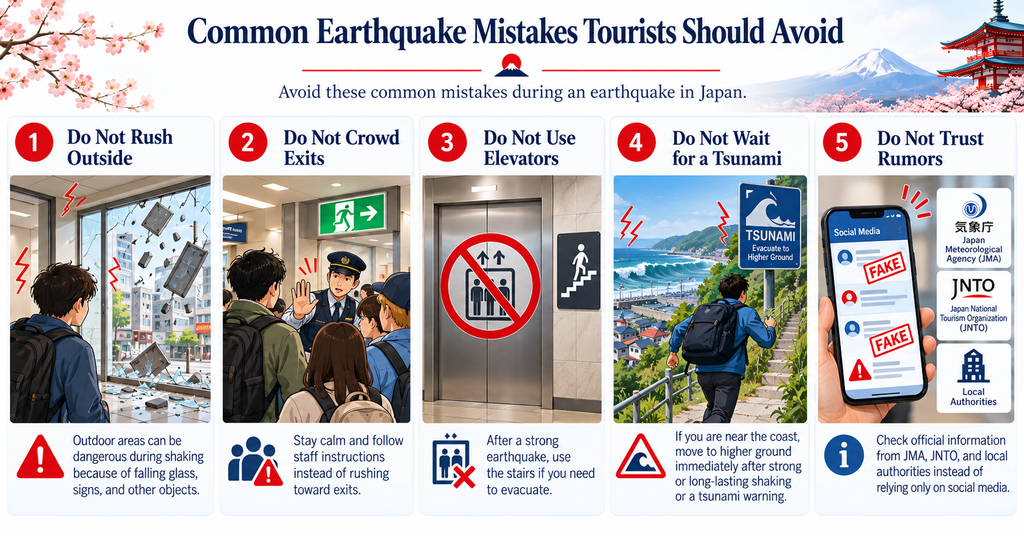
During an earthquake in Japan, avoiding the wrong actions can be just as important as knowing what to do.
Here are some common mistakes travelers should avoid.
Do not rush outside while the ground is still shaking. Falling glass, signs, and other objects can make outdoor areas dangerous.
Do not run toward exits in crowded buildings. Stay calm and follow staff instructions.
Do not use elevators after a strong earthquake. Use the stairs if you need to evacuate.
If you are near the coast, do not wait to see a tsunami before moving to safety. Move to higher ground if you feel strong shaking, weak but long-lasting shaking, or if a Major Tsunami Warning or Tsunami Warning is issued. If a Tsunami Advisory is issued, leave the coastal area immediately.
Do not rely only on social media for emergency information. Check official sources such as JMA, JNTO, and local authorities.
Do not assume the danger is over as soon as the shaking stops. After a large earthquake, additional earthquakes and other hazards may still occur.
Earthquakes in Japan FAQ
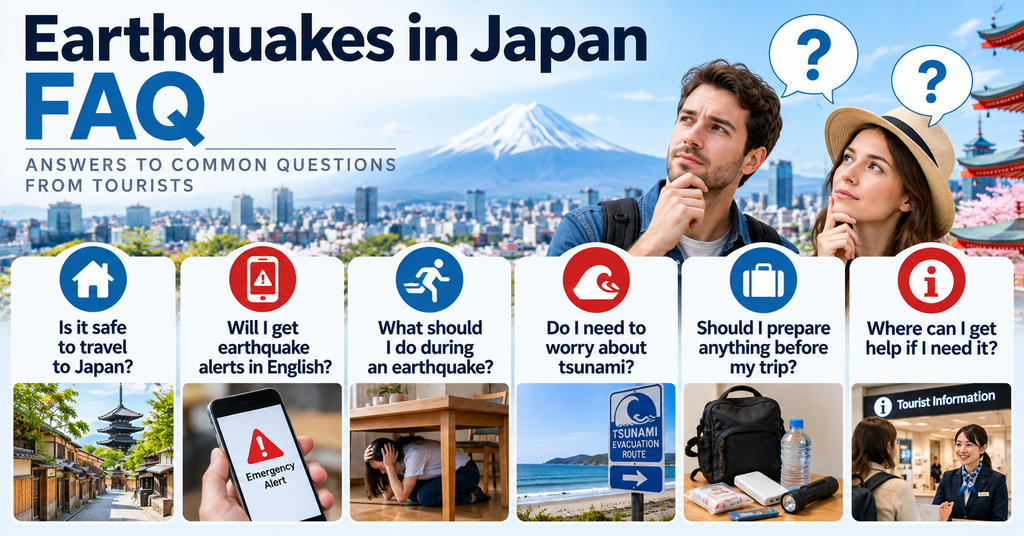
Here are answers to some common questions travelers have about earthquakes in Japan.
How Often Do Earthquakes Happen in Japan?
Earthquakes occur frequently in Japan because the country is located in a highly active seismic region.
However, many earthquakes are small and are not felt by most people.
Strong earthquakes that seriously affect travelers are much less common.
Because earthquakes can happen without warning, it is still a good idea to know the basic safety steps before your trip.
Are Hotels in Japan Safe During Earthquakes?
Hotels in Japan are required to follow Japanese building and safety regulations, but no building can be guaranteed to be completely safe during a major earthquake.
If an earthquake happens while you are in a hotel, protect yourself from falling objects and broken glass.
After the shaking stops, follow instructions from hotel staff and use the stairs if you need to evacuate.
When you check in, take a moment to locate the nearest emergency exit and evacuation route.
What Should I Do If I Receive an Earthquake Alert?
If you receive an Earthquake Early Warning, act immediately.
You may have only a few seconds before strong shaking begins.
Protect your head, move away from windows and shelves, and do not rush outside.
If you are on a train or bus, hold onto a handrail or strap.
If you are in a public building, stay calm and follow staff instructions.
Can Trains Stop After an Earthquake?
Yes. Trains in Japan may slow down or stop when an earthquake is detected.
Service may remain suspended while railway operators inspect tracks, equipment, and other facilities for safety.
If your train stops, stay inside unless staff tell you to leave.
Follow train or station announcements and check the railway operator’s official website or app before continuing your journey.
What Should I Do If a Tsunami Warning Is Issued?
If a Major Tsunami Warning or Tsunami Warning is issued while you are near the coast, evacuate immediately.
Move away from coastal and river areas and head to higher ground or a designated tsunami evacuation building.
If a Tsunami Advisory is issued, get out of the water and leave coastal areas immediately.
Do not go to the coast to watch the waves or take photos.
Tsunamis can arrive more than once, so remain in a safe location until the warning or advisory has officially been lifted.
Always follow instructions from local authorities.
Final Earthquake Safety Tips for Tourists
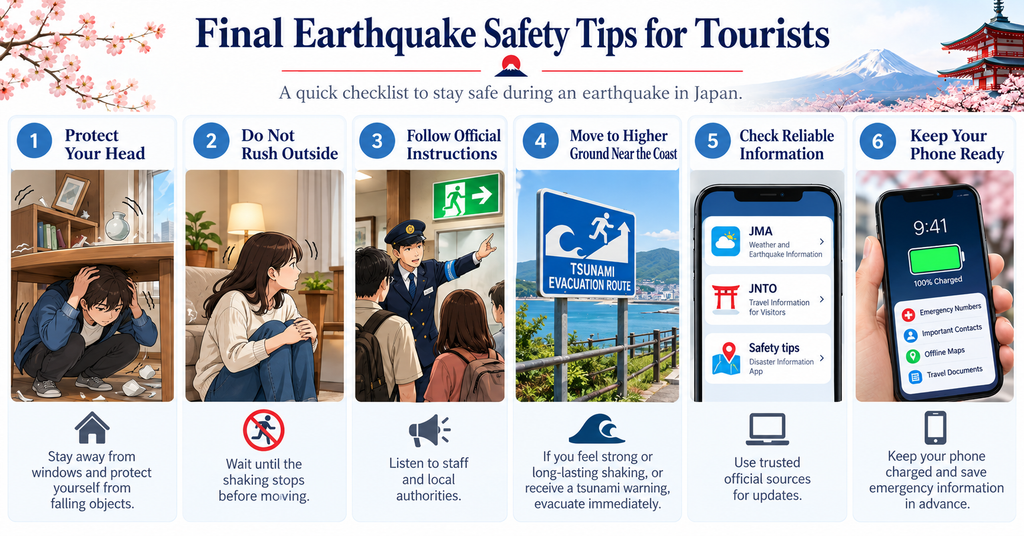
Earthquakes are a part of life in Japan, and knowing how to respond can help you stay safer during your trip.
The best way to stay safe is to prepare in advance and know how to react if an earthquake happens.
Remember these basic safety tips:
Protect your head and stay away from windows and falling objects.
Do not rush outside while the ground is shaking.
Follow instructions from hotel staff, station staff, and local authorities.
If you are near the coast, move to higher ground if you feel strong shaking, weak but long-lasting shaking, or receive a Major Tsunami Warning or Tsunami Warning.
Check reliable information from JMA, JNTO, and the Safety tips app.
Keep your phone charged and save important emergency information before your trip.
With a little preparation, you can travel around Japan with more confidence and respond calmly if an earthquake occurs.
Japan has extensive earthquake monitoring, early warning, and disaster-preparedness systems.
Knowing the basic safety steps and checking official information can help you respond more calmly if an earthquake occurs during your trip.