Taxis in Japan: A Complete Guide for Travelers
Taxis in Japan can be a convenient way to travel, especially when trains and buses are not available or when you are carrying heavy luggage.
They are generally easy to use, but some parts of the experience may feel different from what you are used to at home.
For example, taxi doors often open automatically, fares are usually calculated by meter, and payment methods can vary depending on the taxi company.
In this guide, you will learn how to get a taxi in Japan, how much taxis cost, how to pay, which taxi apps are useful, how to tell the driver your destination, and important etiquette for travelers.
- Taxis in Japan: What Travelers Should Know First
- How to Get a Taxi in Japan
- How to Tell If a Taxi Is Available
- How to Use a Taxi in Japan
- How Much Do Taxis Cost in Japan?
- How to Pay for a Taxi in Japan
- Best Taxi Apps in Japan for Travelers
- How to Tell the Driver Your Destination
- Using Taxis at Airports in Japan
- Taxi Etiquette in Japan
- When Taxis Are Most Useful in Japan
- Tips for Taking Taxis in Japan
- Final Tips for Using Taxis in Japan
Taxis in Japan: What Travelers Should Know First
Taxis in Japan can be useful when public transportation is limited, when you have heavy luggage, or when you want to travel directly to your destination.
You can find taxis at taxi stands, hail them on the street in some areas, or book one through a taxi app.
Fares are usually calculated by meter, although some airport routes and other services may offer fixed fares.
Many taxis accept cash, while some also accept credit cards, IC cards, or app-based payments.
One thing that may surprise first-time visitors is that the rear passenger door often opens and closes automatically, so you usually do not need to touch it yourself.
Taxi services and payment options can vary by city and company, so check the signs, payment stickers, or app information before your ride.
For official information about using taxis in Japan, see the Japan National Tourism Organization’s taxi guide.
How to Get a Taxi in Japan
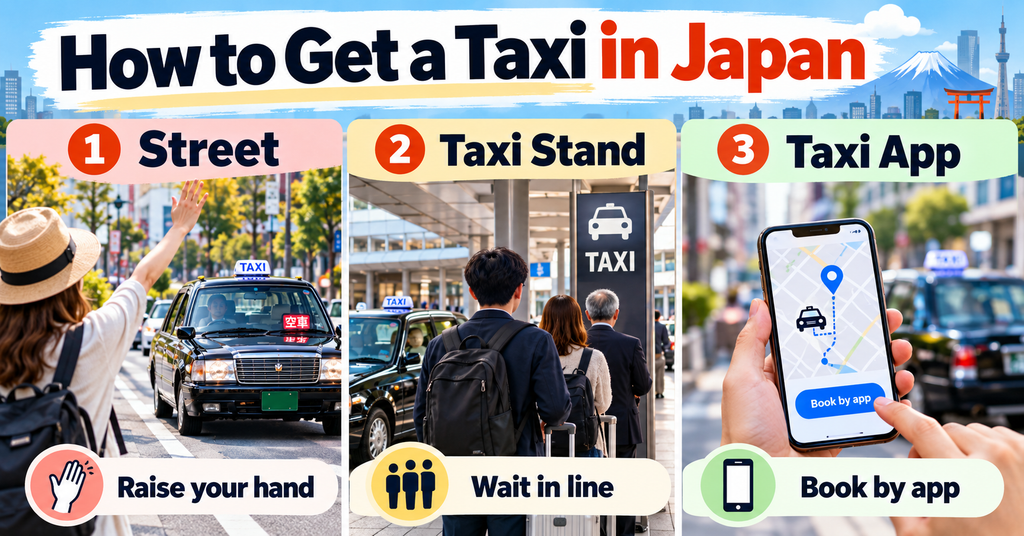
There are several ways to get a taxi in Japan.
You can hail one on the street, wait at a taxi stand, or use a taxi app.
The easiest option depends on where you are, the time of day, and whether taxis are available nearby.
Hail a Taxi on the Street
In busy city areas, you may be able to hail a taxi directly from the street.
Stand in a safe place where the driver can stop, and raise your hand when you see an available taxi approaching.
Avoid trying to stop a taxi where parking or stopping is restricted.
Use a Taxi Stand
Taxi stands are common at major train stations, airports, hotels, and popular tourist areas.
Look for signs marked “Taxi” or “タクシー” and wait in the designated line.
At busy stations, using a taxi stand is often easier than trying to hail a taxi on the street.
Book a Taxi with an App
Taxi apps can be convenient if you want to request a ride from your current location.
Depending on the app, you may be able to enter your destination, check the estimated pickup location, and pay through the app.
App availability and supported payment methods vary by area, so check the details before booking.
For more useful apps for transportation, navigation, and everyday travel, check our guide to the best Japan travel apps for travelers.
How to Tell If a Taxi Is Available
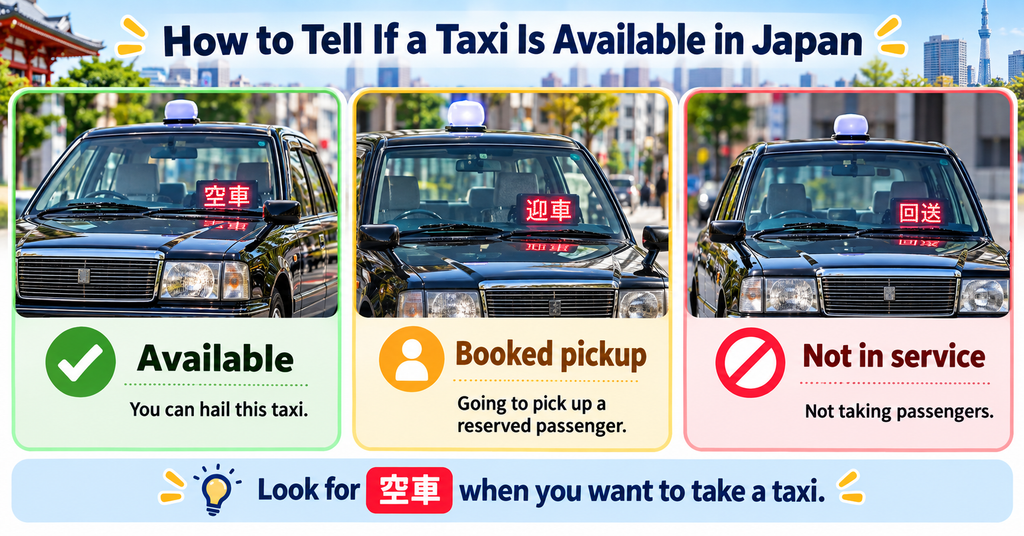
Taxis in Japan usually display their current status on a sign near the front of the vehicle.
These signs are often written in Japanese, so knowing what to look for can help you avoid trying to stop a taxi that is already occupied or reserved.
The most important sign for travelers is 空車, which means the taxi is available.
Look for the 空車 Sign
The Japanese word 空車 (kuusha) means “vacant” or “available.”
If you see 空車 displayed in the front of the taxi, it generally means the driver can pick up passengers.
JNTO also notes that taxi status signs are often color-coded, but the Japanese text is the most useful thing to recognize because display styles can vary.
Be Careful with Other Taxi Status Signs
You may also see other Japanese status signs on taxis.
For example, 迎車 (geisha) usually means the taxi is on the way to pick up a booked passenger, while 回送 (kaisou) means the taxi is not currently taking passengers.
Some taxis may also display signs showing that they are reserved or already occupied.
If you do not see 空車, it is usually better to wait for another taxi or use a taxi app instead.
How to Use a Taxi in Japan
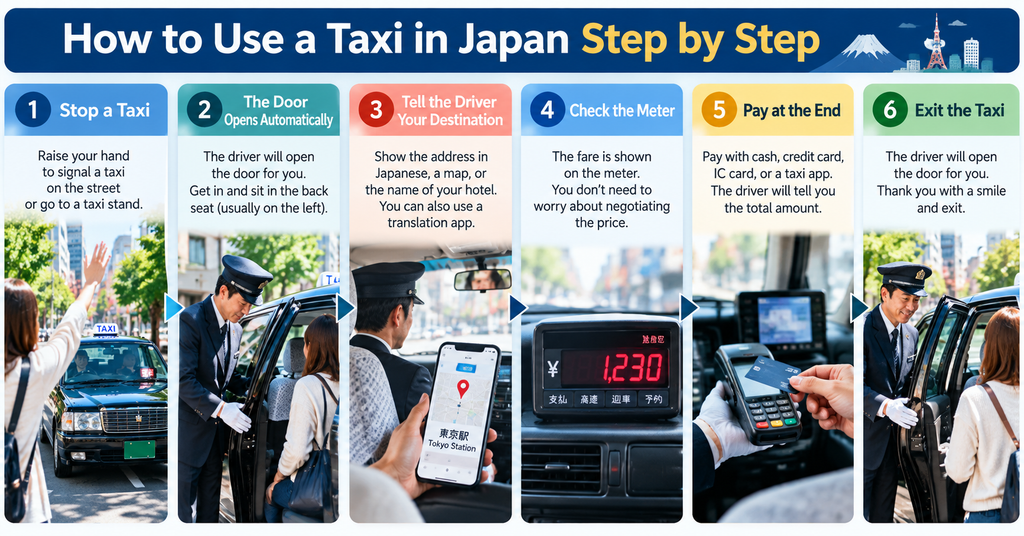
Taking a taxi in Japan is usually simple once you understand the basic process.
The experience may feel slightly different from taxis in other countries, especially because the rear passenger door is often operated automatically by the driver.
Follow these steps as a general guide.
Step 1: Wait for the Taxi to Stop
If you are hailing a taxi on the street, raise your hand when you see an available taxi.
Wait until the taxi has completely stopped before approaching the vehicle.
If you are at a taxi stand, wait in line and use the next available taxi.
Step 2: Let the Driver Open the Door
One thing that may surprise first-time visitors is that the rear passenger door on many taxis in Japan opens automatically.
Wait for the driver to open the door for you rather than pulling it open yourself.
This is a common feature of Japanese taxis and is one of the main differences travelers may notice.
Step 3: Show or Tell the Driver Your Destination
Tell the driver where you want to go after getting into the taxi.
If you do not speak Japanese, showing the destination on your phone is usually the easiest option.
A hotel name, address, map pin, or Google Maps screen can help the driver understand exactly where you want to go.
Step 4: Check the Meter
For a normal metered taxi ride, the fare is calculated using the taxi meter.
The meter should start when your trip begins, and the fare will increase depending on distance and, in some situations, travel time.
Some routes or services may use a fixed fare instead, so check the details before your ride if you are using a special airport or reservation service.
Step 5: Pay the Fare
When you arrive, check the final fare shown on the meter or payment screen.
Depending on the taxi, you may be able to pay with cash, a credit card, an IC card, or another cashless payment method.
If you booked through an app, the fare may be charged automatically through the app.
Step 6: Let the Driver Open the Door When You Leave
After paying, wait for the driver to open the rear passenger door.
Do not try to force the automatic door open or closed yourself.
Before leaving, check the seat and floor carefully to make sure you have not forgotten your phone, wallet, bags, or other belongings.
How Much Do Taxis Cost in Japan?
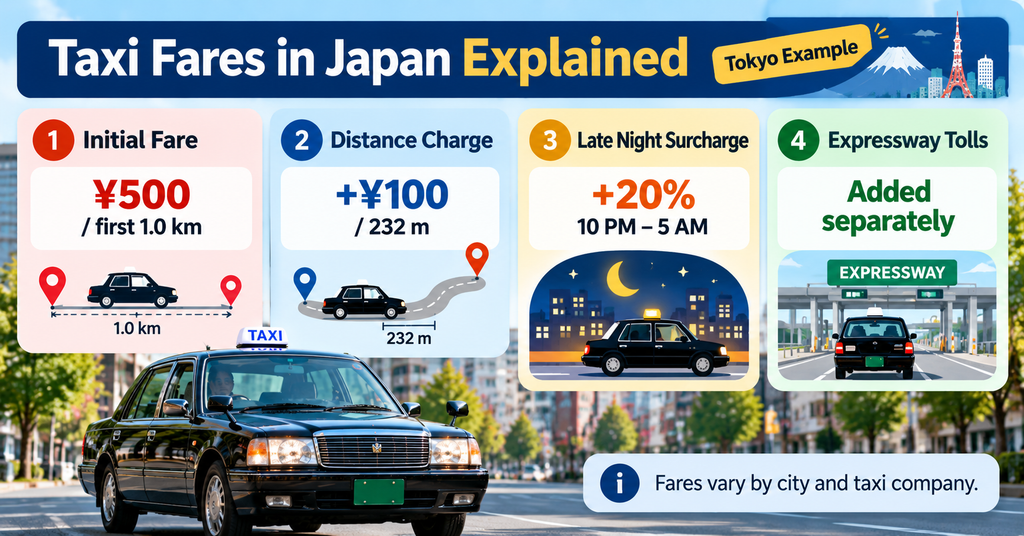
Taxi fares in Japan vary depending on the city, taxi company, distance, travel time, and time of day.
Most regular taxi rides use a meter, so the final fare depends on how far you travel and, in some cases, how long the taxi spends moving slowly in traffic.
Always treat fare estimates as a general guide rather than a guaranteed price.
Taxi Fares Vary by City
There is no single taxi fare that applies everywhere in Japan.
Initial fares and additional distance charges vary by area.
For example, in Tokyo’s 23 wards, Musashino, and Mitaka, the standard maximum fare for a regular taxi is ¥500 for the first 1.0 km, with an additional ¥100 charged for each 232 meters.
For current taxi fares in Tokyo, check the official fare table from the Tokyo Hire-Taxi Association.
When the taxi is traveling slowly, such as in heavy traffic, the fare may also increase based on time.
Check local taxi information or your taxi app if you want an estimated fare before your ride.
Late-Night and Early-Morning Surcharges
Taxi fares can be higher late at night and early in the morning.
In Tokyo, a 20% late-night and early-morning surcharge applies from 10:00 p.m. to 5:00 a.m.
Surcharge hours and rules can vary by area, so check the local fare information when traveling outside Tokyo.
This is especially useful to remember if you plan to take a taxi after the last train.
Expressway Tolls and Other Extra Charges
If your taxi uses an expressway or another toll road, the toll is generally added to your taxi fare.
You may also have to pay a pickup or booking fee when requesting a taxi, depending on the taxi company or app.
Some airport taxis use fixed fares, but expressway tolls may still be charged separately.
Check the fare details when booking if you want to know which additional charges may apply.
How to Pay for a Taxi in Japan
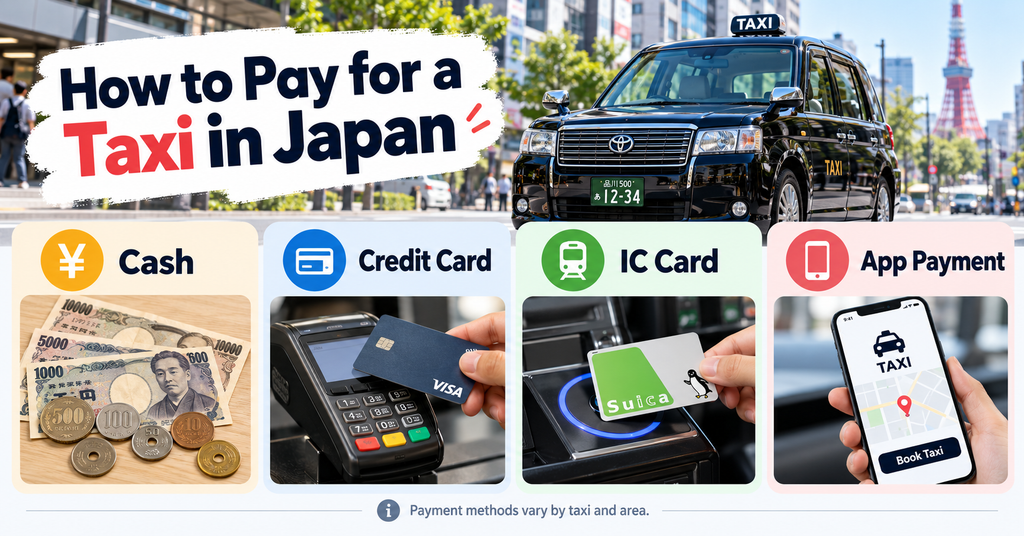
Payment methods for taxis in Japan vary depending on the taxi company, vehicle, and area.
Cash is widely accepted, while many taxis also support credit cards, IC cards, electronic money, or app-based payments.
Check the payment stickers inside the taxi or ask the driver if you are unsure.
It is still a good idea to carry some Japanese yen as a backup, especially when traveling outside major cities.
If you want to learn more about cash, credit cards, IC cards, and other payment methods, see our complete guide to money and payments in Japan.
Cash
Cash is one of the most reliable ways to pay for a taxi in Japan.
You can pay the fare in Japanese yen when you arrive at your destination.
If you plan to take taxis in rural areas or use smaller taxi companies, carrying cash is especially useful because cashless payment options may be more limited.
Credit Cards
Many taxis in major cities accept credit cards.
Look for card logos inside the taxi or on the payment terminal to see which cards are supported.
However, you should not assume that every taxi accepts international credit cards.
If you are unsure, check before the ride or keep enough cash available as a backup.
IC Cards and Other Cashless Payments
Some taxis accept transportation IC cards such as Suica and PASMO.
Depending on the taxi, other electronic or contactless payment methods may also be available.
Look for the supported payment logos before paying, because accepted methods vary between taxis.
Make sure your IC card has enough balance before using it for your fare.
Paying Through a Taxi App
If you book a taxi through an app, you may be able to register a payment method and pay automatically through the app.
This can be convenient because you do not need to handle cash or use the payment terminal inside the taxi.
Available payment methods depend on the app and service you use, so check the payment settings before booking.
Keep another payment method available in case app payment is not available for your ride.
Best Taxi Apps in Japan for Travelers
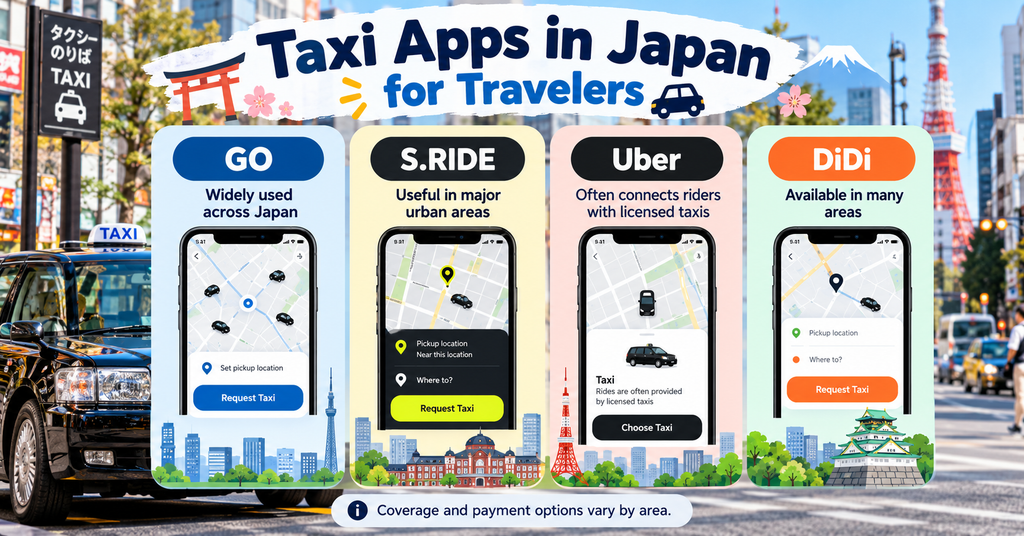
Taxi apps can make it much easier to get a taxi in Japan, especially if you do not speak Japanese.
Many apps allow you to set your pickup point and destination before the taxi arrives, so you do not always need to explain everything to the driver.
However, service areas, payment methods, and account requirements vary between apps.
It is a good idea to install at least one taxi app before your trip.
GO
GO is one of the most widely used taxi apps in Japan.
It is available in all 47 prefectures, although actual taxi availability can still vary by city and area.
You can enter your pickup location and destination in the app and request a taxi nearby.
GO also supports international credit cards and Apple Pay, which can make payment easier for overseas travelers.
Because of its wide coverage, GO is a useful app to have installed when traveling around Japan.
You can check current service areas, payment options, and app information on the official GO website.
S.RIDE
S.RIDE is another taxi app that is especially useful in major urban areas.
The app supports English and allows you to request a taxi with a simple swipe.
Depending on the service, you can also use features such as advance booking and cashless payment.
Coverage is more limited than some nationwide apps, so check whether S.RIDE is available in the area you plan to visit.
Check the official S.RIDE website for current service areas and available features.
Uber and DiDi
Uber and DiDi are also available in many parts of Japan.
In Japan, these apps often connect you with licensed taxis rather than operating exactly like ride-hailing services in some other countries.
They can be convenient if you already have an account and are familiar with the app.
DiDi allows app payments with registered credit cards, debit cards, or PayPay, while Uber is available in many cities across Japan.
Availability varies by location, so compare the apps in your area before booking.
You can also check the official Uber Taxi website to see whether the service is available in your destination.
How to Tell the Driver Your Destination
If you do not speak Japanese, telling the taxi driver where you want to go may feel difficult at first.
Fortunately, you do not need to explain everything in Japanese.
Showing the exact address, hotel name, or map location on your phone is often the easiest way to communicate your destination.
Show the Address on Your Phone
Before getting into the taxi, prepare the name and address of your destination on your phone.
Showing the address in Japanese can be especially helpful because some place names may be difficult to understand from English pronunciation alone.
If possible, show both the destination name and full address so the driver can confirm the correct location.
Use Google Maps or a Hotel Business Card
Google Maps can help you show the driver exactly where you want to go.
Open the destination and show the map, address, or place name on your screen.
If you are staying at a hotel, carrying the hotel’s business card can also be useful because it usually includes the hotel name, address, and phone number in Japanese.
This can be especially helpful when returning to your hotel late at night.
Useful Japanese Phrases for Taking a Taxi
You do not need to speak fluent Japanese to take a taxi.
A few simple phrases can still be helpful.
(Koko made onegaishimasu) — Please take me here.
(Kono juusho made onegaishimasu) — Please take me to this address.
(Koko de daijoubu desu) — Here is fine.
(Arigatou gozaimasu) — Thank you.
If pronunciation is difficult, simply show the destination on your phone and point to the address.
Using Taxis at Airports in Japan
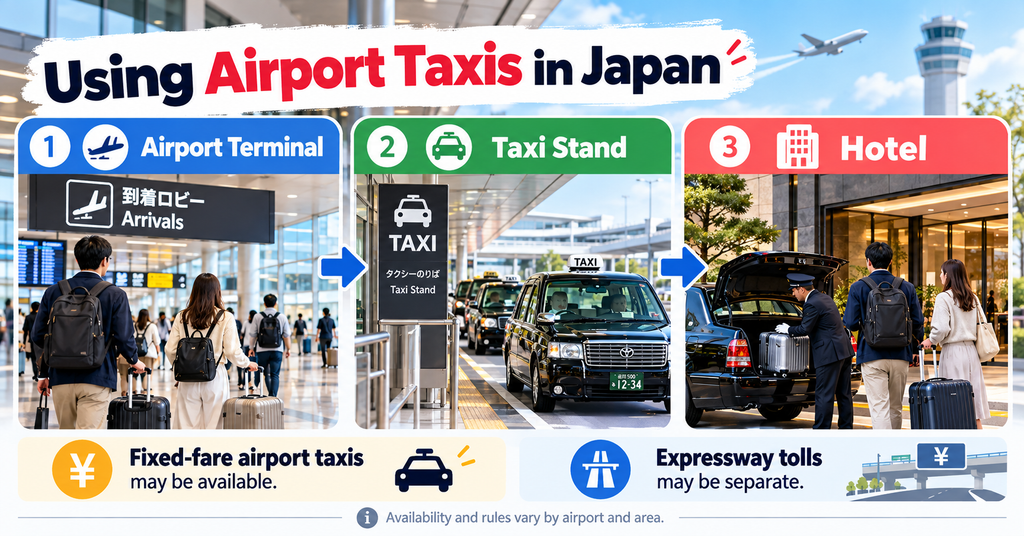
Taxis can be especially useful when traveling to or from an airport, particularly if you have heavy luggage, arrive late at night, or are traveling with several people.
Major airports in Japan have designated taxi stands, and some airport routes also offer fixed fares.
However, airport taxi prices can be much higher than trains or buses, especially for long-distance trips.
Airport Taxi Stands
Major airports in Japan have designated taxi stands outside the terminal buildings.
Follow the airport signs for “Taxi” and wait at the appropriate taxi stand.
At large airports, there may be different taxi stands depending on the terminal or service, so check the signs carefully before getting in line.
Fixed-Fare Airport Taxis
Some airport taxi routes offer fixed fares instead of using a regular meter for the entire trip.
For example, fixed-fare taxi services are available between Haneda Airport and parts of Tokyo, and between Narita Airport and different areas of Tokyo.
The fixed fare may not include expressway tolls, and late-night surcharges may also apply.
Always check what is included before starting your ride.
For current airport taxi information and fixed fares, check the official Haneda Airport and Narita Airport websites before your trip.
When an Airport Taxi Makes Sense
An airport taxi can be a good option if you have large or heavy luggage, are traveling with children, arrive after public transportation becomes limited, or want to go directly to your hotel.
It can also be more practical when several people are traveling together and can share the fare.
For solo travelers on a budget, trains and airport buses are usually more economical.
Compare the cost, travel time, and convenience before deciding which option works best for your trip.
Taxi Etiquette in Japan
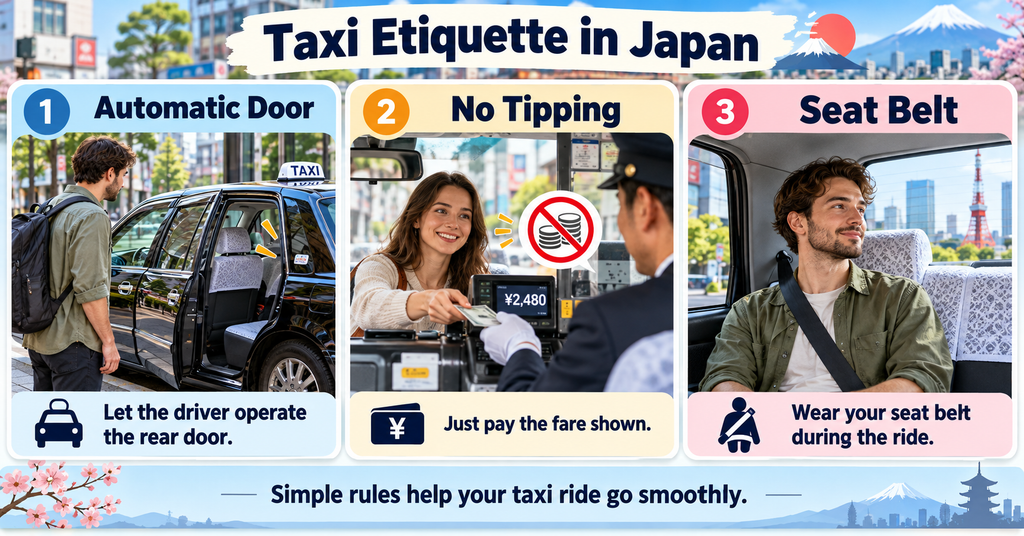
Taxi etiquette in Japan is generally simple, but there are a few customs that may be different from what you are used to.
The most important things are to let the driver operate the rear door, wear your seat belt, and remember that tipping is not expected.
Following these basic rules will help your ride go smoothly.
Do Not Open or Close the Rear Door Yourself
On many taxis in Japan, the rear passenger door is opened and closed automatically by the driver.
Wait for the door to open before getting in, and let the driver close it after you enter.
When you arrive, wait for the driver to open the door again before getting out.
Trying to pull or push the automatic door yourself can be unnecessary and may interfere with the mechanism.
No Tipping Is Required
Tipping taxi drivers is not generally expected in Japan.
Simply pay the fare shown on the meter or payment screen.
Good service does not require an additional tip, so there is no need to calculate or add extra money.
Wear Your Seat Belt
Wear your seat belt while riding in a taxi, including when sitting in the rear seat.
Fasten it after you get into the vehicle and keep it on until the taxi has stopped at your destination.
This is a simple safety habit and an important part of using taxis properly in Japan.
When Taxis Are Most Useful in Japan
Taxis are not always the cheapest way to travel in Japan, but there are situations where they can be very useful.
They are especially convenient when public transportation is limited, when you have a lot of luggage, or when traveling directly to a destination saves time and effort.
Here are some situations where taking a taxi may make sense.
Late at Night
Taxis can be useful after trains and buses stop running for the night.
In major cities, you can often find taxis near busy stations, entertainment districts, and hotels.
Keep in mind that late-night surcharges may apply, so the fare can be higher than during the daytime.
When Traveling with Heavy Luggage
A taxi can be much more convenient if you are carrying large suitcases or several bags.
It can help you avoid stairs, crowded trains, and long walks between a station and your hotel.
This can be especially useful when arriving at or leaving an airport, or when changing hotels during your trip.
If you only need to store your luggage temporarily while sightseeing, coin lockers can also be a convenient option.
In Rural Areas
Taxis can be particularly useful in rural areas where trains and buses may run less frequently.
Some sightseeing spots are difficult to reach by public transportation, and a taxi may be one of the easiest ways to travel the final part of your journey.
Availability can be limited in smaller towns, so booking in advance may be helpful.
When Traveling in a Small Group
Taxis can also be practical when traveling with a small group.
If several people share the fare, the cost per person may be more reasonable.
A taxi can also be convenient when your group wants to travel directly between hotels, restaurants, stations, or sightseeing spots without making transfers.
Tips for Taking Taxis in Japan
Taking a taxi in Japan is usually easy, but a little preparation can make the experience much smoother.
Prepare your destination before getting into the taxi, especially if you do not speak Japanese. Showing the place name and address on your phone can help avoid confusion.
Keep some cash with you even if you plan to use a credit card or taxi app, because accepted payment methods can vary between taxis.
If you are using a taxi app, check the pickup point carefully. In busy areas, stations and large buildings may have several entrances, so make sure you are waiting in the correct place.
When traveling late at night, remember that fares may be higher because of late-night surcharges.
If you are going to an airport, check whether a fixed-fare taxi is available and whether expressway tolls are included in the quoted fare.
Before leaving the taxi, check the seat and floor for your phone, wallet, passport, shopping bags, and other belongings.
If possible, keep the taxi receipt. It may include information that can help you contact the taxi company if you realize later that you left something behind.
Final Tips for Using Taxis in Japan
Using taxis in Japan is usually simple once you understand the basic system.
Look for an available taxi, prepare your destination in advance, and let the driver operate the rear passenger door.
Check the fare, payment method, and any possible extra charges before or during your ride.
Taxi apps can be especially useful if you want to set your pickup point and destination without speaking much Japanese.
Keep some cash as a backup, remember that tipping is not required, and check your belongings before leaving the taxi.
With a little preparation, taxis can be a convenient and stress-free way to travel around Japan.
If this is your first trip to Japan, you may also find our guide to essential things to know before visiting Japan helpful.