Coin Lockers in Japan: A Complete Guide for Travelers
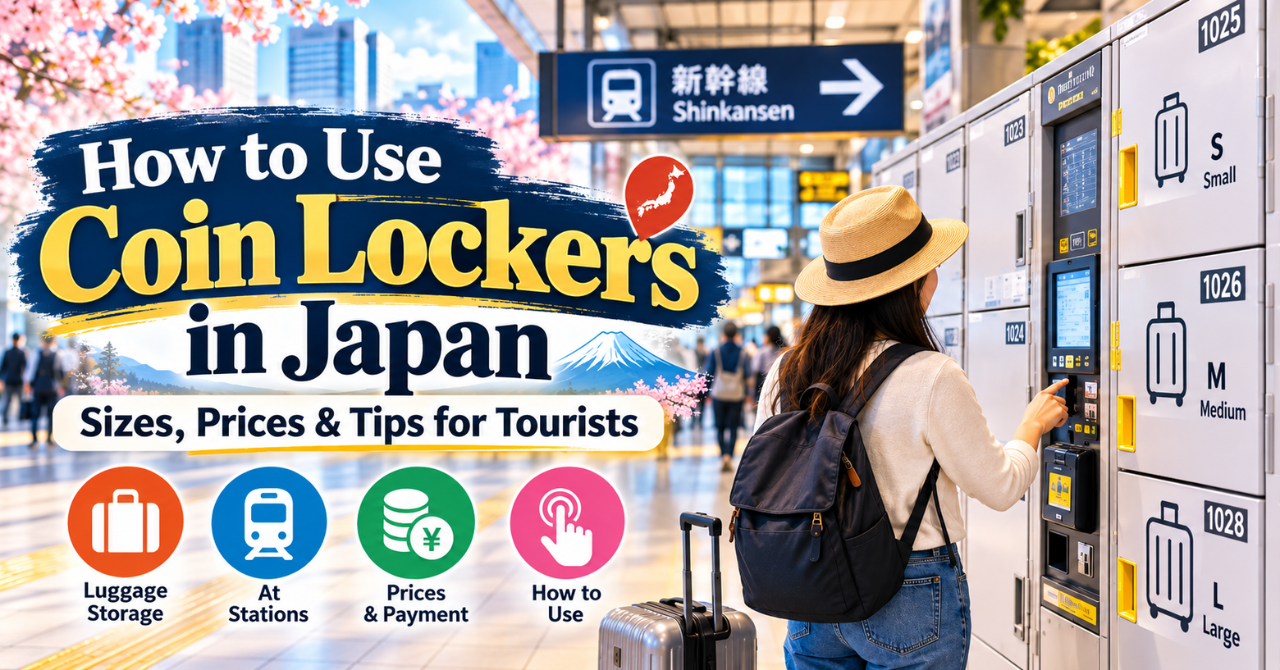
Traveling around Japan with a large suitcase can be tiring, especially when you want to explore a city before hotel check-in or after check-out.
Fortunately, coin lockers are widely available throughout Japan and are one of the easiest ways to store your luggage temporarily.
You can find them at major train stations, airports, shopping centers, and popular tourist areas. Many modern lockers also accept IC cards such as Suica or PASMO, making them convenient even if you do not have coins.
In this guide, you will learn how to use coin lockers in Japan, how much they cost, what sizes are available, how long you can store your luggage, and what to do when all the lockers are full.
Local Tip: At major stations, the first locker area you see is not always the only one. If it is full, check another exit, a different floor, or a nearby luggage-storage counter before giving up.
- What Are Coin Lockers in Japan?
- Where Can You Find Coin Lockers in Japan?
- How to Use Coin Lockers in Japan
- How Much Do Coin Lockers Cost in Japan?
- What Coin Locker Sizes Are Available?
- How Can You Pay for Coin Lockers?
- How Long Can You Use a Coin Locker?
- What If All the Coin Lockers Are Full?
- Important Coin Locker Tips for Travelers
- Coin Lockers vs Luggage Delivery in Japan
- Final Tips for Using Coin Lockers in Japan
What Are Coin Lockers in Japan?
Coin lockers in Japan are self-service storage lockers that allow travelers to leave bags and luggage for a short period of time.
Despite the name “coin locker,” many newer lockers do not require coins. Depending on the location, you may be able to pay with cash, an IC card, or a touchscreen payment system.
They are especially useful when you arrive before your hotel check-in time, want to explore a city without carrying a suitcase, or have several hours between trains.
Coin lockers come in different sizes, from small lockers for backpacks and shopping bags to large lockers that can fit many suitcases.
Because they are commonly located inside or near train stations, they are an extremely convenient option for travelers moving around Japan by train.
Where Can You Find Coin Lockers in Japan?
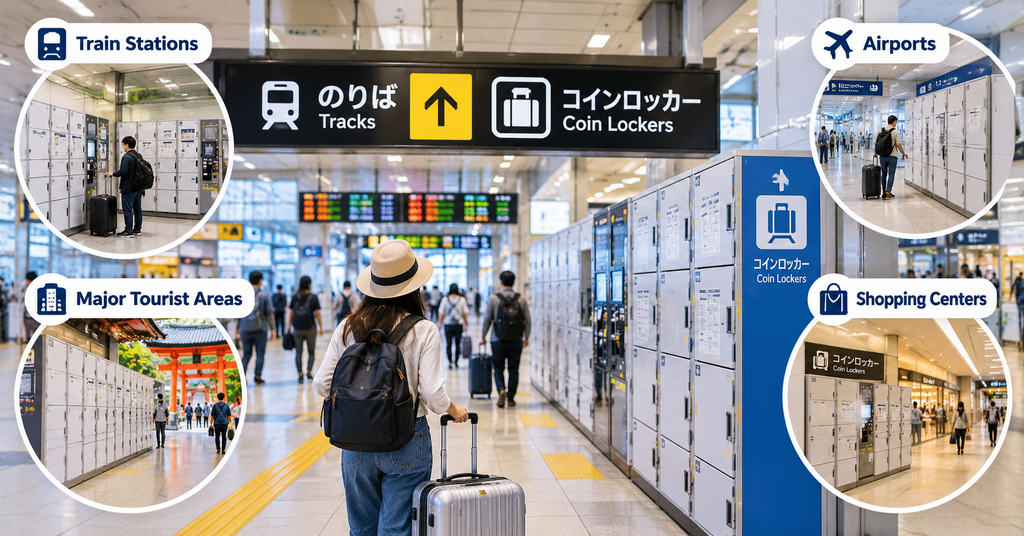
Coin lockers are easy to find in many parts of Japan, especially in places where travelers frequently pass through.
The most common locations are train stations, airports, shopping centers, and busy tourist areas.
However, the number and size of lockers can vary depending on the location, so large lockers may be harder to find during busy travel periods.
Train Stations
Train stations are the most common place to find coin lockers in Japan.
Large stations such as Tokyo, Shinjuku, Shibuya, Kyoto, and Osaka often have several locker areas located near ticket gates, station exits, and underground passages.
One important thing to remember is that major Japanese stations can be very large. After storing your luggage, take a photo of the locker area, nearby signs, or the locker number so you can find it again later.

Shopping Malls and Tourist Areas
Coin lockers can also be found in shopping malls, department stores, amusement areas, and popular sightseeing districts.
These lockers are useful when you want to shop or explore without carrying heavy bags.
Some facilities may only allow access during business hours, so always check the closing time before leaving your luggage.
Airports
Major airports in Japan usually have coin lockers and other luggage storage services.
They can be useful if you have several hours before your flight or want to explore nearby areas without carrying your suitcase.
Airport lockers may be located in different terminals or floors, so check airport signs or information counters if you cannot find them easily.
If you are arriving at Narita Airport, you can also check the official Narita Airport coin locker information before your trip.
Narita Airport also provides an official facility guide with information about useful services available inside the terminals.
How to Use Coin Lockers in Japan
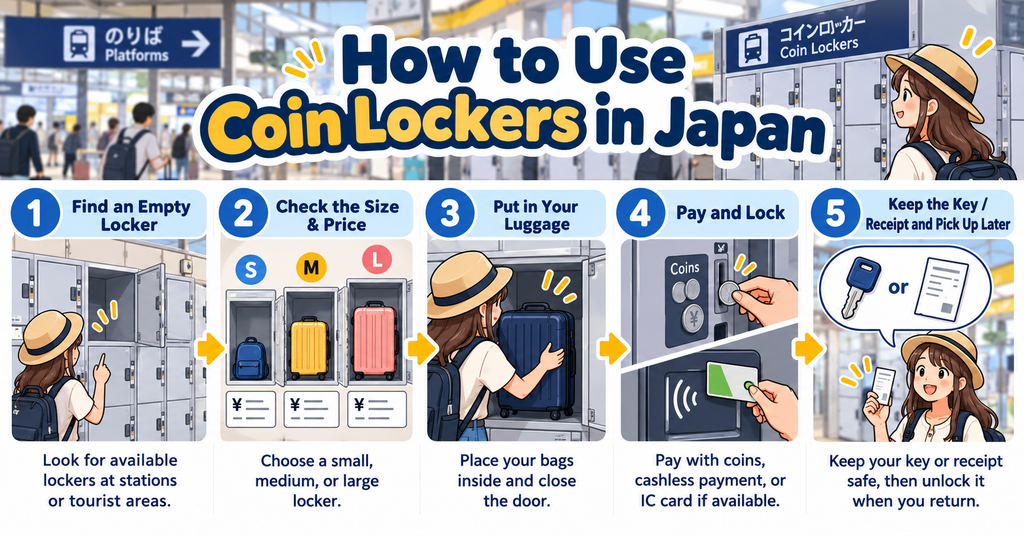
Using a coin locker in Japan is usually simple, even if you do not speak Japanese.
Most lockers have clear instructions, and newer lockers often include English on the screen.
The exact process may vary slightly depending on the locker type, but the basic steps are usually the same.
1. Find an Available Locker
First, look for an empty locker that is large enough for your luggage.
Many modern lockers have lights or screen indicators showing which lockers are available.
If you are using a large suitcase, check the larger lockers first because they can fill up quickly at busy stations.
2. Put Your Luggage Inside
Place your bag or suitcase inside the locker and make sure the door closes properly.
Do not force oversized luggage into a locker, as the door may not lock correctly.
If your suitcase does not fit, look for a larger locker or use a luggage storage service instead.
3. Pay for the Locker
Depending on the locker, you may pay with coins, cash, an IC card, or a touchscreen payment system.
Older lockers usually require coins, while newer electronic lockers often accept IC cards such as Suica or PASMO.
Follow the instructions shown on the screen or near the locker.
4. Keep Your Key or Receipt
After payment, keep the key, receipt, or locker information in a safe place.
Electronic lockers may give you a receipt with a locker number or a PIN code.
If you use an IC card, the same card may be required when you return to open the locker.
5. Collect Your Luggage
When you are ready to collect your luggage, return to the same locker area.
Use the key, PIN code, receipt, or IC card depending on the locker type.
Before leaving, check the locker carefully to make sure you have not forgotten anything inside.
How Much Do Coin Lockers Cost in Japan?
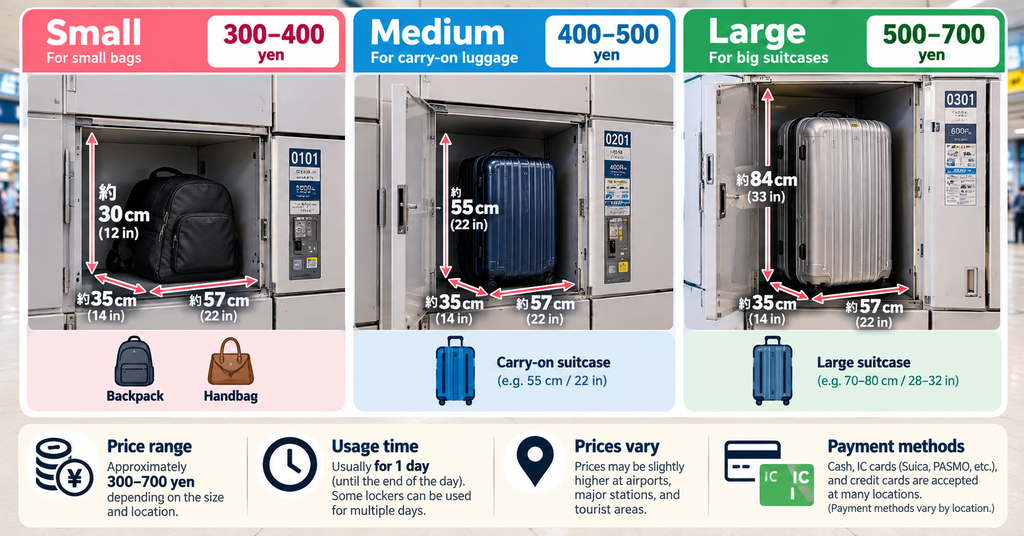
Coin locker prices in Japan vary depending on the location, locker size, and type of locker.
As a general guide, small lockers usually cost around ¥300 to ¥500, medium lockers around ¥500 to ¥800, and large lockers around ¥700 to ¥1,100.
Large stations and newer electronic lockers may be more expensive than lockers at smaller stations.
Some reservation-enabled lockers may also charge higher prices during busy travel periods.
Before storing your luggage, always check the price displayed on the locker or touchscreen.
What Coin Locker Sizes Are Available?
Coin lockers in Japan usually come in several sizes.
The exact dimensions vary by station and locker type, so there is no single standard size used everywhere.
Small lockers are suitable for backpacks and shopping bags, while medium and large lockers are better for carry-on bags and suitcases.
If you are traveling with a large suitcase, it is a good idea to look for a larger locker as soon as you arrive because they tend to fill up first.
Small Lockers
Small lockers are best for backpacks, handbags, shopping bags, and other compact items.
They are usually the easiest lockers to find and are often the cheapest option.
A small locker may not be large enough for a suitcase, so check the space before paying.
Medium Lockers
Medium lockers can usually hold larger backpacks, small suitcases, or carry-on luggage.
They are a good choice for travelers who want to explore a city for a few hours without carrying their main bag.
Availability can vary, especially at busy stations and during weekends or holidays.
Large Lockers
Large lockers are designed for bigger suitcases and bulky luggage.
They are especially useful for travelers carrying full-size suitcases, but they are usually less common than small lockers.
At major stations, large lockers can fill up quickly, so consider using a luggage storage counter or delivery service if none are available.
How Can You Pay for Coin Lockers?
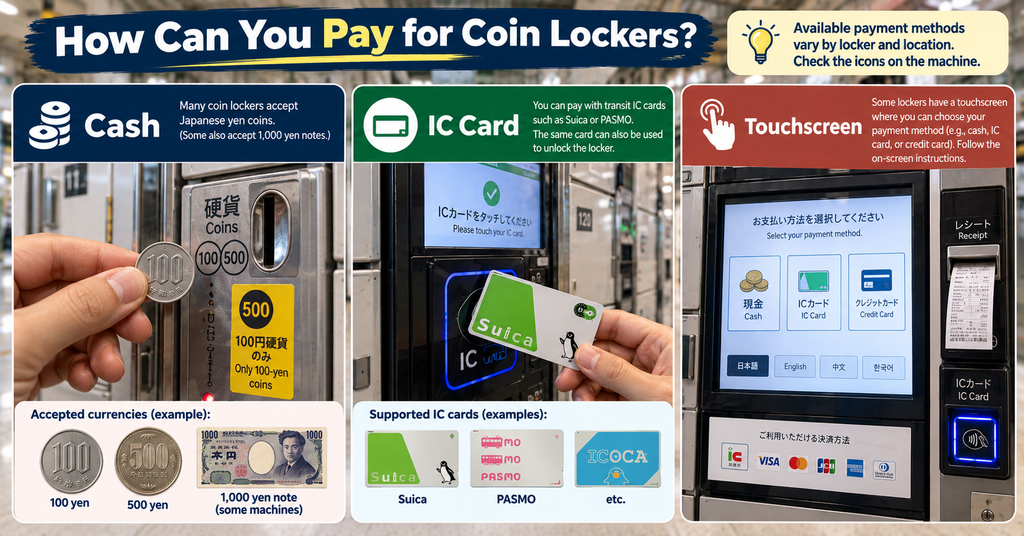
Payment methods for coin lockers in Japan vary depending on the locker type and location.
Traditional lockers usually accept coins, while many newer electronic lockers allow travelers to pay with an IC card.
Always check the payment symbols or instructions on the locker before storing your luggage.
Cash
Many traditional coin lockers require cash, especially ¥100 coins.
Some electronic lockers also accept banknotes and provide change, but this depends on the machine.
If you plan to use an older locker, keeping a few coins with you can be helpful.
IC Cards
Many modern coin lockers accept transportation IC cards such as Suica and PASMO.
In these lockers, you can usually tap your IC card to pay and then use the same card to unlock the locker when you return.
Make sure you have enough balance on the card before storing your luggage.
Touchscreen Lockers
Newer locker systems often use a touchscreen instead of a traditional key.
The screen usually provides step-by-step instructions and may offer English language support.
Available payment methods vary by machine, but they may include cash or IC cards. After payment, you may receive a receipt or PIN code that you will need when collecting your luggage.
How Long Can You Use a Coin Locker?
Coin lockers in Japan are generally intended for short-term storage rather than long-term luggage storage.
The maximum storage period depends on the station and locker operator, so always check the instructions displayed on the locker before leaving your luggage.
Some locker systems allow storage for up to several days, while others may have shorter limits.
Additional fees may be charged when your luggage is left overnight or kept beyond the original rental period.
If you need to store luggage for several days, a luggage storage service or luggage delivery service may be a better option.
What If All the Coin Lockers Are Full?
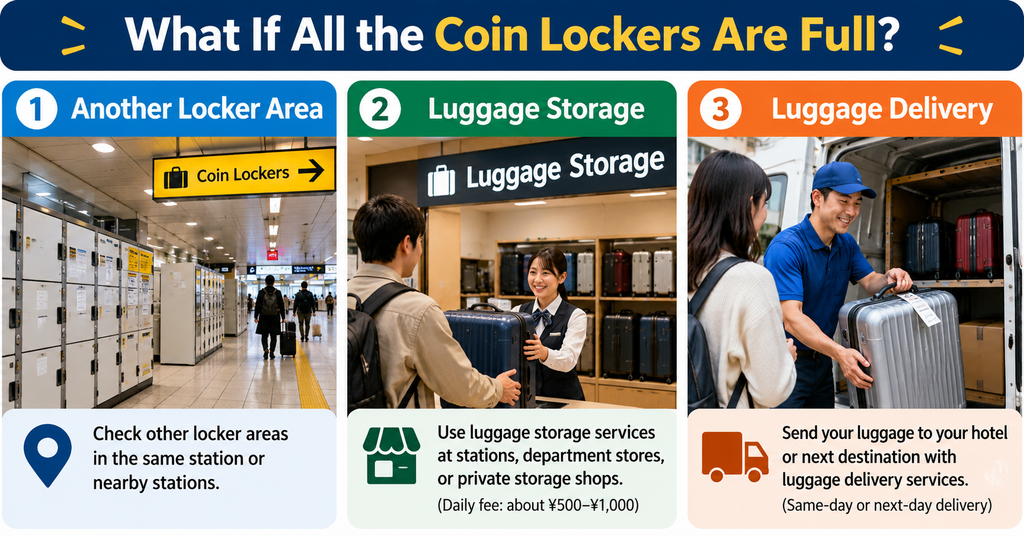
Coin lockers at major stations can fill up quickly, especially on weekends, holidays, and during busy travel seasons.
If you cannot find an available locker, do not worry. There are usually several other options nearby.
Trying a different station exit, using a luggage storage service, or sending your luggage to your hotel can all be useful alternatives.
For more information about luggage storage options in Japan, check the Japan National Tourism Organization’s luggage storage guide.
Check Another Station Exit
Large stations often have coin lockers in several different areas.
If the lockers near one ticket gate or exit are full, check another part of the station.
You may find more lockers near underground passages, other exits, or nearby train lines.
Use Luggage Storage Services
Many major stations, airports, shopping areas, and tourist districts also offer staffed luggage storage services.
These services can be useful when large lockers are full or when your suitcase is too big to fit inside a locker.
Opening hours, prices, and storage rules vary by location, so check the details before leaving your luggage.
Send Your Luggage Instead
Another option is to use a luggage delivery service.
In Japan, you can send suitcases between hotels, airports, and other locations, which can make long-distance travel much easier.
This is especially useful if you are traveling with large luggage or moving between several cities.
Important Coin Locker Tips for Travelers
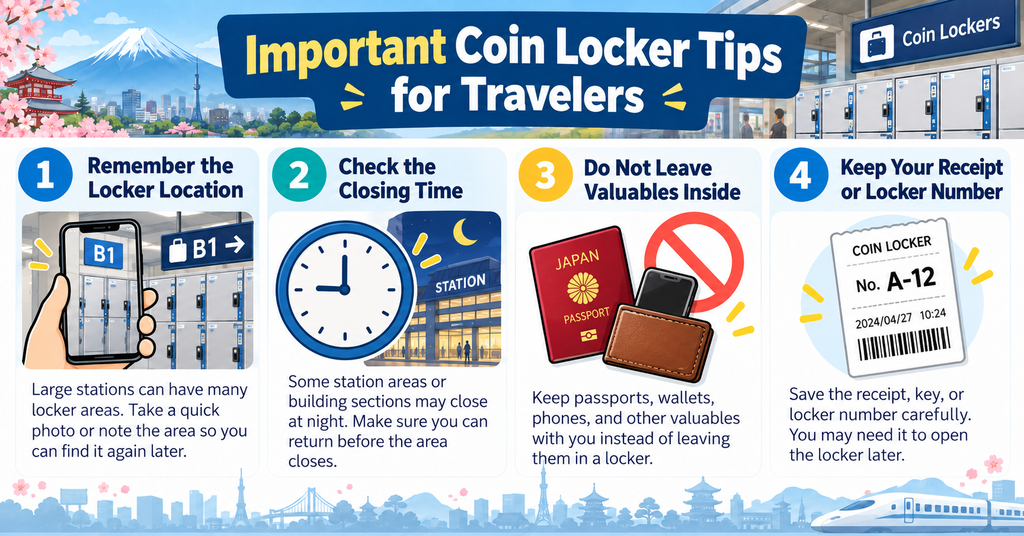
Coin lockers are convenient, but a few simple precautions can help you avoid problems.
The most common issues are forgetting where the locker is, losing the receipt or key, and returning after the station or facility has closed.
Before leaving your luggage, take a moment to check the locker location, access hours, and retrieval method.
Remember the Locker Location
Large train stations in Japan can have many different locker areas.
After storing your luggage, take a photo of the locker, nearby signs, station exit number, or surrounding area.
This can save you a lot of time when you return, especially in large stations such as Tokyo or Shinjuku.
Check the Closing Time
Some coin lockers are located inside stations, shopping malls, or other facilities that may close at night.
If the building or station area closes, you may not be able to access your luggage until the next day.
Always check the opening hours before using a locker, especially if you plan to return late in the evening.
Do Not Leave Valuables Inside
Avoid storing passports, large amounts of cash, important documents, or other valuable items in a coin locker.
Keep essential belongings with you whenever possible.
Coin lockers are useful for luggage and everyday travel items, but valuables are better kept in a secure place or carried with you.
Keep Your Receipt or Locker Number
If you use an electronic locker, keep the receipt, PIN code, or locker number until you collect your luggage.
If you use an IC card, remember which card you used because you may need the same card to open the locker.
Keeping this information safe will make it much easier to retrieve your belongings later.
Coin Lockers vs Luggage Delivery in Japan
Coin lockers and luggage delivery services are both convenient ways to travel around Japan without carrying heavy bags, but they are useful in different situations.
Coin lockers are best for short-term storage when you only need to leave your luggage for a few hours. They are especially convenient when sightseeing before hotel check-in, after check-out, or during a stop between train journeys.
Luggage delivery services are better for longer trips, large suitcases, or travel between different cities. Instead of carrying your luggage on trains, you can send it directly to your hotel, airport, or another destination.
If you only need temporary storage, a coin locker is usually the simpler option. If you want to travel hands-free for a longer period, luggage delivery may be more convenient.
Final Tips for Using Coin Lockers in Japan
Coin lockers in Japan are a simple and convenient way to explore without carrying heavy luggage.
Before using one, check the locker size, price, payment method, storage limit, and access hours.
At large stations, remember to take a photo of the locker location so you can find it easily later.
If the lockers are full or your luggage is too large, consider using a luggage storage counter or luggage delivery service instead.
With a little planning, coin lockers can make traveling around Japan much easier and more comfortable.