Rental Car in Japan: A Complete Guide for Travelers
Renting a car in Japan can be a great way to explore places that are difficult to reach by train or bus.
It is especially useful in areas such as Hokkaido, Okinawa, rural towns, and mountain regions where public transportation may be limited.
However, driving in Japan can feel different from driving in other countries. You need the correct license or permit, cars drive on the left side of the road, expressways often use ETC, and parking rules can be unfamiliar.
In this guide, you will learn how to rent a car in Japan, what documents you need, important driving rules, how ETC and parking work, how to use gas stations, what insurance to consider, and useful tips for travelers.
Local Tip: A rental car is usually more useful in Hokkaido, Okinawa, rural towns, and mountain areas than in central Tokyo or Osaka. In major cities, trains are often easier once you factor in traffic and parking.
- Can Tourists Rent a Car in Japan?
- What You Need to Rent a Car in Japan
- How to Rent a Car in Japan
- Driving Rules in Japan
- Using Expressways and ETC in Japan
- Parking in Japan
- Gas Stations in Japan
- Rental Car Insurance in Japan
- Driving in Snow and Winter Conditions
- When Is Renting a Car Useful in Japan?
- When You Probably Do Not Need a Rental Car
- Tips for Renting a Car in Japan
- Final Tips for Driving in Japan
Can Tourists Rent a Car in Japan?
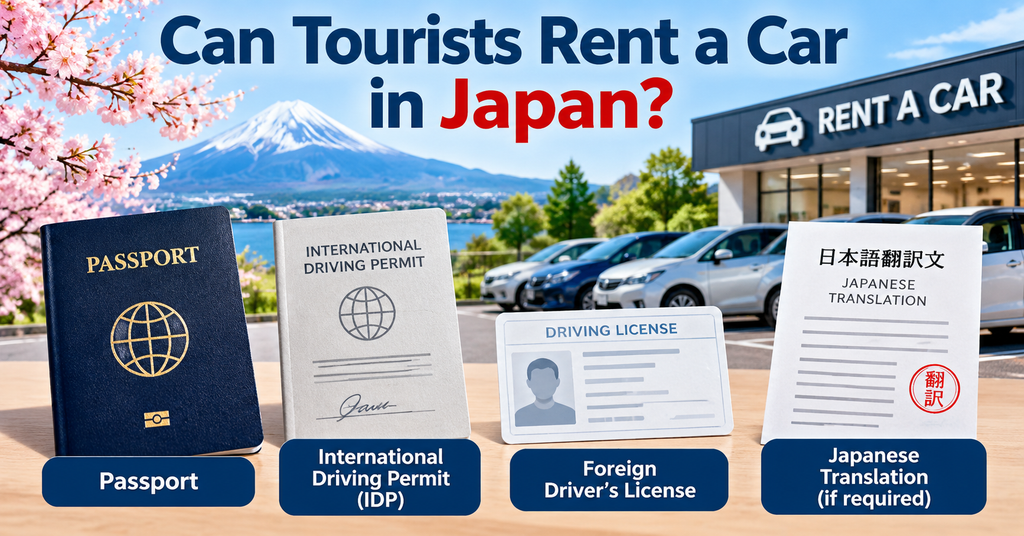
Yes, foreign tourists can rent and drive a car in Japan if they have the correct documents and meet the rental company’s requirements.
However, your home country’s driver’s license alone is usually not enough.
Depending on where your license was issued, you may need a valid International Driving Permit or your original driver’s license together with an official Japanese translation.
Always check the requirements before traveling because the rules depend on the country or region that issued your license.
Who Can Rent a Car in Japan?
You generally need to hold a license that is legally valid for driving in Japan and meet the rental company’s age and booking requirements.
Most overseas visitors use either an International Driving Permit or an eligible foreign driver’s license with a Japanese translation.
You should also carry your passport because rental companies may use it to confirm your identity and entry date.
International Driving Permit Requirements
For many travelers, the easiest way to drive in Japan is with an International Driving Permit, or IDP.
Japan accepts International Driving Permits that follow the 1949 Geneva Convention format.
The permit must be issued by an authorized organization in your country or region before you travel to Japan.
Digital or smartphone-based permits are not accepted, so you should carry the original paper booklet.
An International Driving Permit is generally valid for up to one year after entering Japan, as long as the permit itself is still valid.
For the latest requirements for driving in Japan with a foreign license or International Driving Permit, check the official National Police Agency information.
Countries That Need a Japanese Translation
Travelers from some countries and regions follow a different rule instead of using an International Driving Permit.
If your driver’s license was issued in Switzerland, Germany, France, Belgium, Monaco, or Taiwan, you can drive in Japan with your original license and an official Japanese translation.
The translation must be prepared by an organization authorized under Japanese rules.
Carry both the original driver’s license and the Japanese translation while driving.
What You Need to Rent a Car in Japan
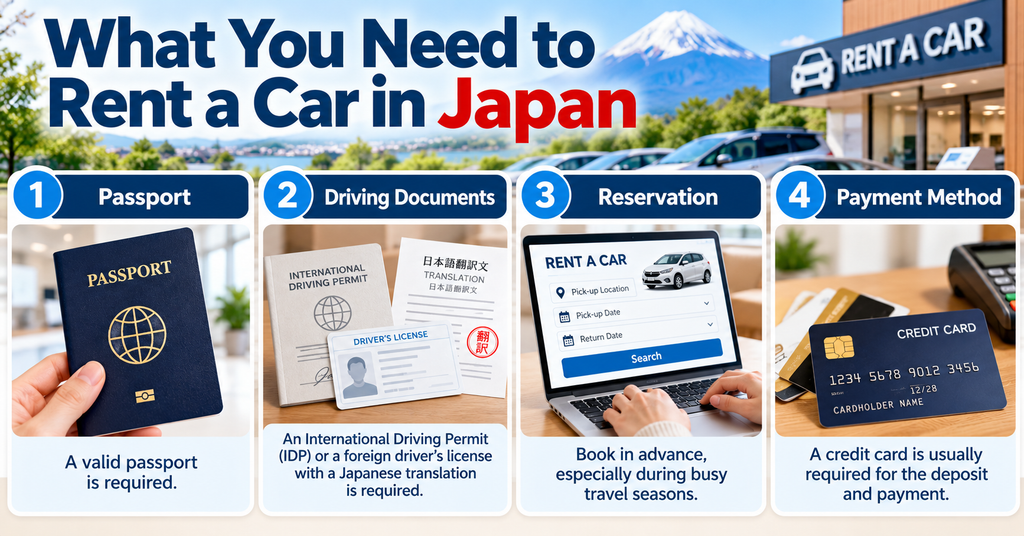
Before picking up a rental car in Japan, make sure you have all the required documents and reservation information ready.
The exact requirements can vary by rental company, but foreign travelers generally need a passport and a valid document that allows them to drive legally in Japan.
It is also a good idea to prepare your reservation details and payment method before arriving at the rental counter.
Passport
Bring your passport when you pick up your rental car.
Rental companies may use it to confirm your identity and the date you entered Japan.
This is important because the period during which you can drive in Japan with an International Driving Permit is linked to your date of entry.
If you enter Japan through an automated immigration gate, you may not automatically receive an entry stamp in your passport.
If you plan to rent a car, having proof of your entry date can make the rental process easier.
Valid Driver’s License or International Driving Permit
You must bring the original documents that allow you to drive legally in Japan.
For many travelers, this means carrying a valid International Driving Permit issued under the 1949 Geneva Convention together with your passport.
Travelers from Switzerland, Germany, France, Belgium, Monaco, and Taiwan generally need their original driver’s license and an official Japanese translation instead.
Do not rely on a photo, copy, or digital version of your driving documents.
Check the requirements for your country or region before your trip.
Credit Card and Reservation Information
Bring your reservation confirmation and the payment method you plan to use.
A credit card is convenient and widely used by major rental car companies in Japan.
Some companies also allow other payment methods, but the rules can vary depending on the company, vehicle type, location, or booking method.
If you registered a credit card when making your reservation, check whether the rental company requires the same card or cardholder at pickup.
Keep your reservation number, pickup location, pickup time, and return details easy to access on your phone.
How to Rent a Car in Japan
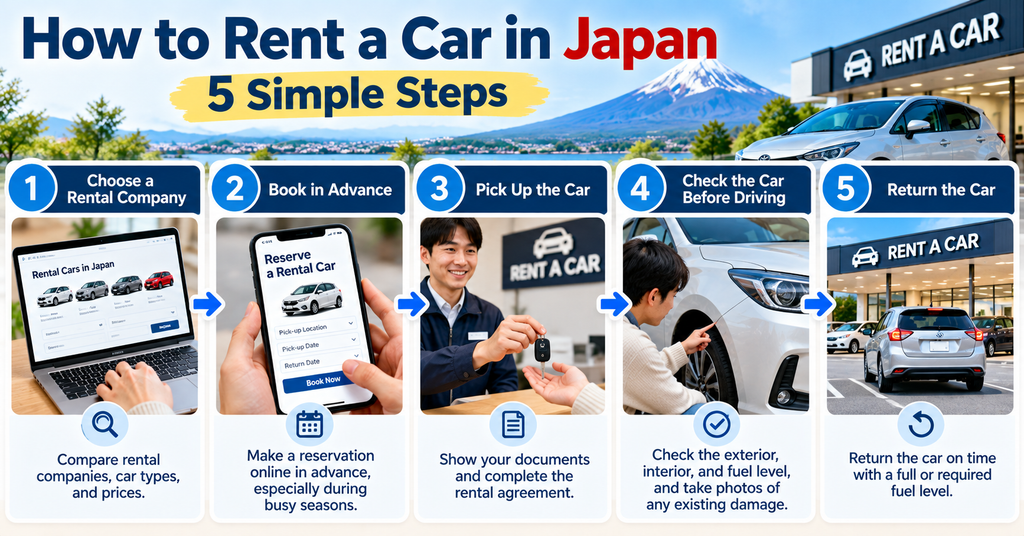
Renting a car in Japan is usually straightforward if you prepare your documents and reservation details in advance.
The exact process varies by rental company, but most travelers follow a similar sequence from booking the car to returning it.
Here is a simple step-by-step guide.
For useful navigation and transportation apps during your trip, check our guide to the best Japan travel apps for travelers.
Step 1: Choose a Rental Car Company
Start by choosing a rental car company that operates in the area where you plan to travel.
Major companies have locations at airports, train stations, and popular tourist destinations.
Compare vehicle sizes, prices, insurance options, ETC card availability, winter equipment, and whether one-way rentals are available.
If you are traveling with large suitcases, make sure the vehicle has enough luggage space before booking.
Step 2: Book Your Car
Book your rental car online before your trip whenever possible.
Choose your pickup and return locations, dates, times, vehicle class, and any optional equipment you need.
Useful options may include an ETC card, child seat, winter tires, or a different return location.
Availability can be limited during busy travel periods, so booking early is recommended.
Step 3: Pick Up the Car
Arrive at the rental location with your passport, driving documents, reservation information, and payment method.
The staff will check your documents and explain the rental agreement, insurance, return time, and other important details.
Before leaving, make sure you understand how to operate the car, including the navigation system, lights, parking brake, and ETC equipment if provided.
Ask the staff any questions before you start driving.
Step 4: Check the Car Before Driving
Inspect the vehicle before leaving the rental location.
Check for scratches, dents, or other existing damage and make sure anything you notice is recorded by the rental company.
Confirm which type of fuel the vehicle uses and where the fuel door is located.
It is also a good idea to adjust the mirrors, seat, and navigation system before entering traffic.
Step 5: Return the Car
Return the car to the agreed rental location by the scheduled time.
Many rental companies require you to refuel the car before returning it, so check the fuel policy when you pick up the vehicle.
Remove all of your belongings and allow enough time for the staff to inspect the car.
If you rented an ETC card, expressway tolls may also be calculated when you return the vehicle.
Returning the car to a different location may be possible, but additional one-way fees can apply.
Driving Rules in Japan
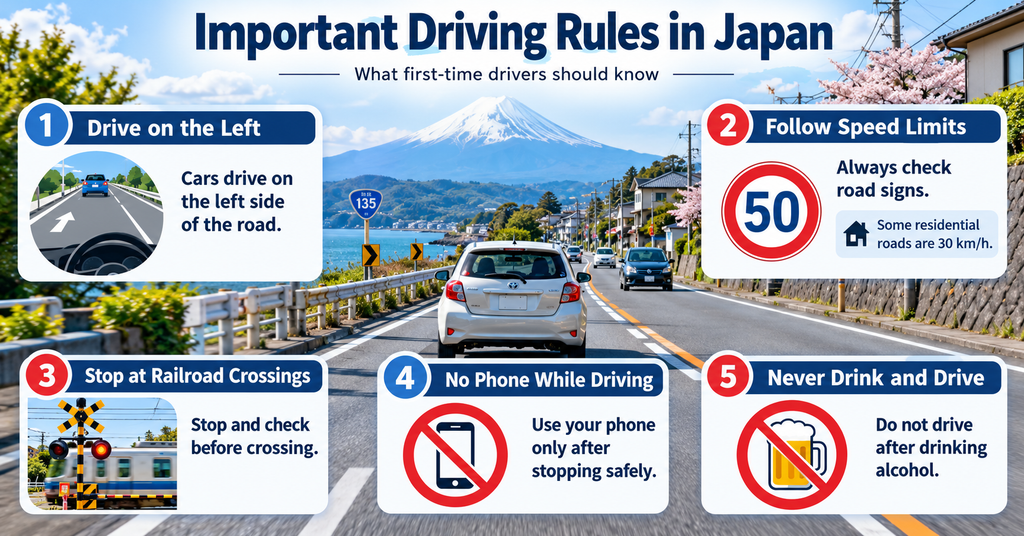
Driving rules in Japan may be different from those in your home country.
Cars drive on the left, speed limits must be followed carefully, and there are strict rules for railroad crossings, mobile phone use, and alcohol.
Pay attention to road signs and markings, and drive more carefully if you are not familiar with Japanese roads.
Drive on the Left Side of the Road
In Japan, vehicles drive on the left side of the road.
The steering wheel is usually on the right side of rental cars, although this may feel unfamiliar if you normally drive on the right.
Be especially careful when turning at intersections or entering a road after stopping, because it can be easy to move toward the wrong side out of habit.
Take your time until you become comfortable with left-side driving.
Follow Speed Limits
Always follow the speed limit shown on road signs and markings.
Speed limits vary depending on the type of road and location.
From September 1, 2026, the statutory speed limit on many residential roads without a center line or traffic lanes was reduced from 60 km/h to 30 km/h.
This does not mean that every road in Japan has a 30 km/h limit, so always check the signs and road conditions carefully.
Even when you are driving within the legal limit, slow down when roads are narrow, busy, wet, snowy, or difficult to see.
Yield to Pedestrians at Crosswalks
In Japan, pedestrians have priority at crosswalks, including those without traffic lights.
When approaching a crosswalk, slow down so you can stop safely unless it is clear that no one is crossing or about to cross.
If a pedestrian is crossing or waiting to cross, come to a complete stop before the crosswalk and let them pass.
Pay extra attention in residential areas and near schools, where pedestrians may appear unexpectedly.
Stop at Railroad Crossings
In Japan, drivers generally need to come to a complete stop before crossing a railroad crossing.
Stop before the tracks and check carefully in both directions for approaching trains.
Do not enter the crossing if there is not enough space on the other side for your car.
Railroad crossings are common in residential areas and near train stations, so watch for warning signs and signals.
Do Not Use Your Phone While Driving
Do not use a mobile phone while driving in Japan.
Holding a phone for a call or looking at the screen while the vehicle is moving can result in penalties and is extremely dangerous.
If you need to use your phone, stop the car in a safe and legal place first.
Set your navigation and destination before you start driving whenever possible.
Never Drink and Drive
Japan has strict laws against drinking and driving.
Do not drive after drinking alcohol, even if you only had a small amount.
Alcohol may remain in your body the next morning, so be careful if you drank heavily the night before.
If you plan to drink, use public transportation, a taxi, or another safe way to return to your accommodation instead of driving.
You can also check the National Police Agency’s traffic safety information before driving in Japan.
Wear Seat Belts and Use Child Seats
In Japan, all passengers must wear seat belts, including those sitting in the back seats.
Children under six years old must generally use an appropriate child safety seat. Even for older children, a child seat or booster seat is recommended if the regular seat belt does not fit properly.
If you are traveling with young children, request suitable child seats when booking your rental car. Confirm their availability in advance and make sure they are installed correctly before driving.
Using Expressways and ETC in Japan
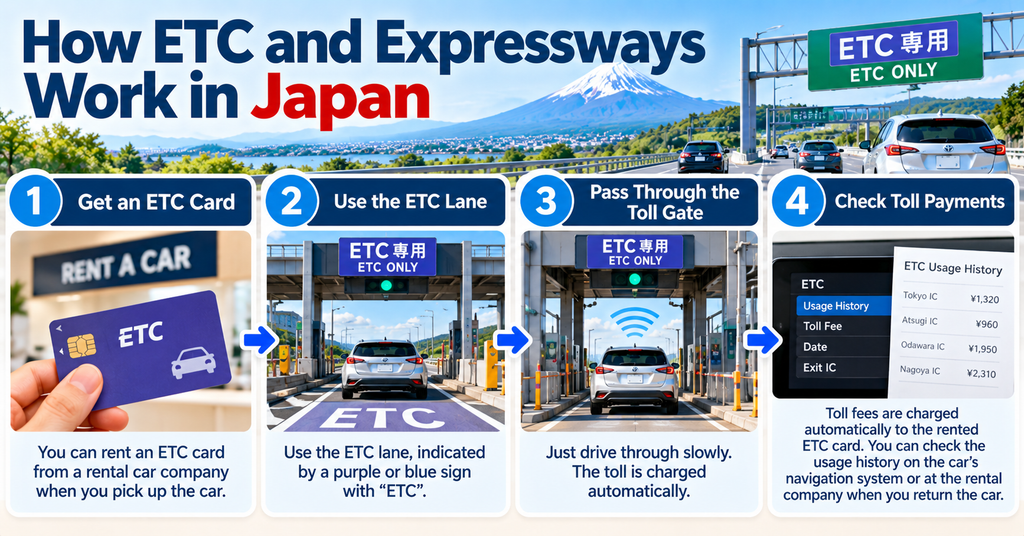
Japan has an extensive expressway network that can make long-distance driving much faster.
Most expressways require tolls, and you can usually pay either at a toll gate or by using an ETC card.
ETC is especially convenient for rental car travelers because it allows you to pass through dedicated toll gates without stopping to pay each time.
If you plan to use expressways frequently, ask your rental car company about ETC options when making your reservation.
For more information about cash, credit cards, and payment methods in Japan, see our complete guide to money and payments in Japan.
What Is ETC?
ETC stands for Electronic Toll Collection.
It is a system that allows drivers to pay expressway tolls automatically using an ETC card inserted into the vehicle’s ETC device.
With ETC, you can use dedicated ETC lanes at toll gates and continue driving without stopping to pay manually.
This can make expressway driving much easier, especially on longer road trips.
How to Rent an ETC Card
Many rental car companies in Japan offer ETC cards for rent.
Request an ETC card when making your reservation or ask the rental company when you pick up the car.
The card is inserted into the ETC device inside the vehicle before you start driving.
When you return the rental car, the rental company will usually calculate the tolls charged to the card and ask you to pay the total amount.
For more information about rental cars, ETC, toll roads, parking, and driving in Japan, see the official Japan National Tourism Organization guide.
How to Pay Expressway Tolls
Some expressway toll gates accept cash or credit cards in regular lanes, but ETC-only toll gates are becoming more common in Japan.
ETC-only toll gates require a vehicle equipped with an ETC device and a valid ETC card. If you are not renting an ETC card, check your planned route for ETC-only entrances and exits before driving.
If you accidentally enter an ETC-only toll gate without a working ETC system, do not reverse or make a U-turn. Use the lane marked “ETC/Support” or “Support,” stop, and follow the staff’s instructions.
Expressway tolls depend on the route and distance you travel, so longer trips can become expensive.
Regional Expressway Passes
Some regional expressway passes are available for international visitors traveling by rental car.
These passes allow unlimited use of eligible expressways in a specific region for a fixed period.
The nationwide Japan Expressway Pass is no longer available, but regional passes may still be offered in areas such as Hokkaido, Tohoku, San’in-Setouchi-Shikoku, and Kyushu.
Availability, prices, eligible roads, and participating rental car companies can change, so check the latest information before booking.
If you plan to drive long distances, compare the pass price with normal toll costs to see whether it makes sense for your itinerary.
Parking in Japan
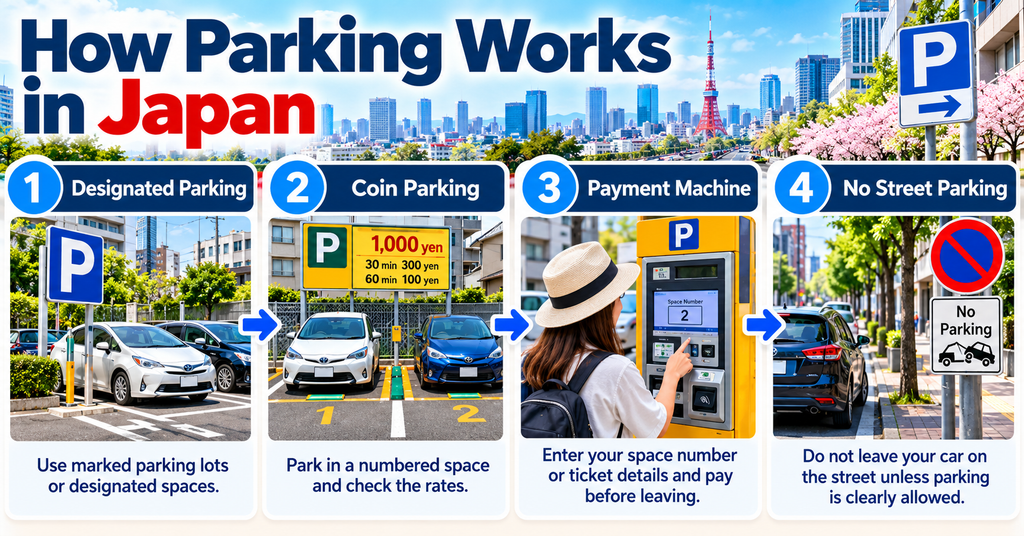
Parking in Japan can be easy in some areas and more difficult in busy city centers.
Always use a legal parking space and check the signs, time limits, and payment rules before leaving your car.
Parking fees vary widely depending on the location, especially between large cities and rural areas.
If you are unsure where to park, look for a designated parking lot near your hotel, station, or sightseeing spot.
Use Designated Parking Areas
Use designated parking areas whenever possible.
Parking on the street is not always allowed, even if there appears to be enough space.
Look for official parking signs, marked spaces, or parking lots before leaving your vehicle.
Illegal parking can result in fines or other penalties, so do not assume that an empty roadside space is safe to use.
Coin Parking
Coin parking lots are common in many Japanese cities.
You usually park in a numbered space and pay at a payment machine before leaving.
Depending on the parking lot, you may need to enter your parking space number, vehicle number, or parking ticket information.
Check the signs carefully because prices, maximum charges, and payment methods vary by parking lot.
Parking at Hotels and Tourist Attractions
Many hotels, shopping centers, and tourist attractions have their own parking areas.
Some parking is free for guests or customers, while other facilities charge a fee.
Hotels in busy city centers may have limited parking or require advance reservations.
Check the parking information before you arrive, especially if you are staying in a large city or visiting a popular attraction.
Do Not Park on the Street Without Checking
Do not park on the street unless you are sure that parking is permitted.
Japan has many no-parking and no-stopping zones, and some restrictions may apply even if there is no obvious parking lot nearby.
Pay close attention to road signs and markings before stopping your car.
If you are unsure, it is safer to use a nearby paid parking lot instead of leaving the vehicle on the roadside.
Gas Stations in Japan
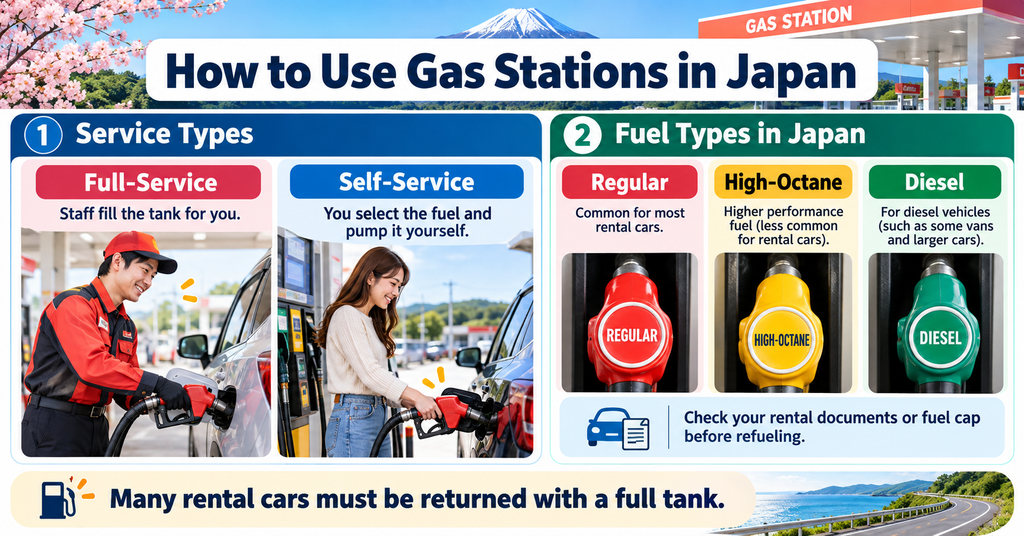
Gas stations in Japan are generally easy to use, but the system may feel unfamiliar if you are visiting for the first time.
There are both full-service and self-service stations, and you should always confirm which type of fuel your rental car uses before filling up.
Many rental car companies also require you to return the vehicle with a full tank.
Full-Service and Self-Service Gas Stations
Japan has both full-service and self-service gas stations.
At a full-service station, staff will usually guide you into position and fill the tank for you.
If you want a full tank, you can say “mantan onegaishimasu,” which means “Please fill it up.”
At self-service stations, you select the fuel type and amount using the payment screen before filling the car yourself.
Some machines have English options, but availability varies by station.
Know Which Fuel Your Car Uses
Always confirm which type of fuel your rental car uses before refueling.
In Japan, the main fuel types are regular gasoline, high-octane gasoline, and diesel.
Fuel nozzles are commonly color-coded: red for regular gasoline, yellow for high-octane gasoline, and green for diesel.
Do not rely only on the color if you are unsure.
Check the rental documents, fuel cap, or ask the rental car staff before your first refueling.
Return the Car with a Full Tank
Many rental car companies require you to return the vehicle with a full tank of fuel.
Before returning the car, look for a gas station near the rental location and fill the tank completely.
Keep the fuel receipt until you return the vehicle because some rental companies may ask to see it.
If you return the car without refueling, the rental company may charge you for the missing fuel according to its own policy.
Rental Car Insurance in Japan
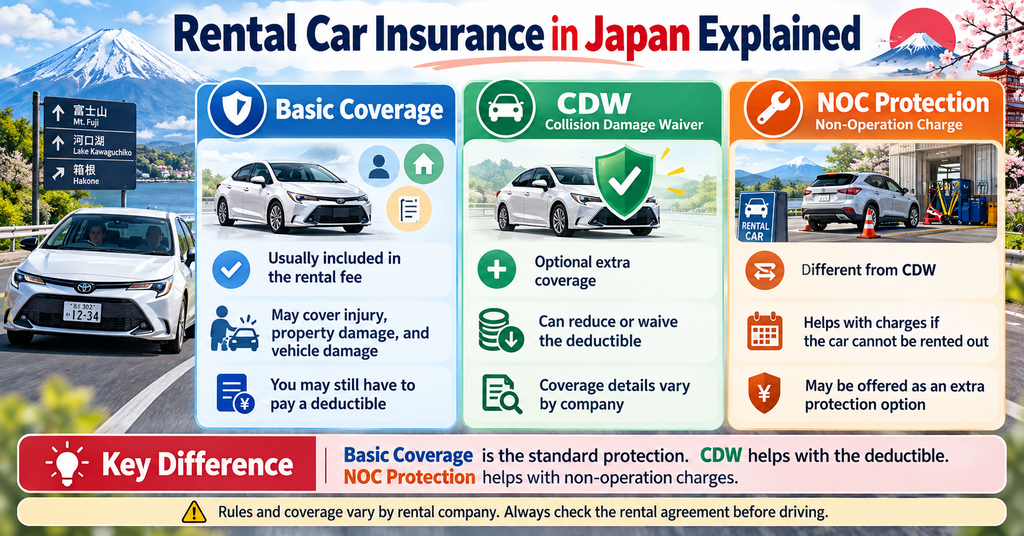
Rental car insurance and compensation can be confusing, especially if you are not familiar with the system in Japan.
Basic compensation is usually included in the rental fee, but you may still be responsible for deductibles or other charges if an accident or damage occurs.
Optional coverage can reduce some of these costs, so check what is included before you pick up the car.
Basic Insurance
Most major rental car companies include basic insurance or compensation in the rental price.
This generally covers areas such as injury to other people, damage to other property, damage to the rental car, and injuries to passengers.
However, coverage limits and deductibles vary by rental company and rental plan.
Even if basic insurance is included, you may still have to pay part of the cost if an accident occurs.
Read the rental agreement carefully and confirm what is covered before driving.
Collision Damage Waiver
A Collision Damage Waiver, or CDW, is an optional protection plan offered by many rental car companies.
It can reduce or waive the deductible that you would otherwise have to pay for property damage or damage to the rental vehicle.
CDW is not the same as insurance, and the exact coverage and price vary by company.
You usually need to add it when you rent the car, so decide whether you want the extra protection before leaving the rental counter.
Non-Operation Charges
A Non-Operation Charge, or NOC, is different from the deductible covered by CDW.
If the rental car needs repairs or cleaning after an accident, theft, damage, or another problem, the rental company may charge you for the period when the vehicle cannot be rented to other customers.
CDW does not always cover the NOC.
Some rental companies offer an additional protection plan that can reduce or waive this charge.
Check whether NOC protection is included before choosing your insurance options.
Insurance, CDW, and NOC rules vary by rental company, so always check the coverage details before booking.
Driving in Snow and Winter Conditions
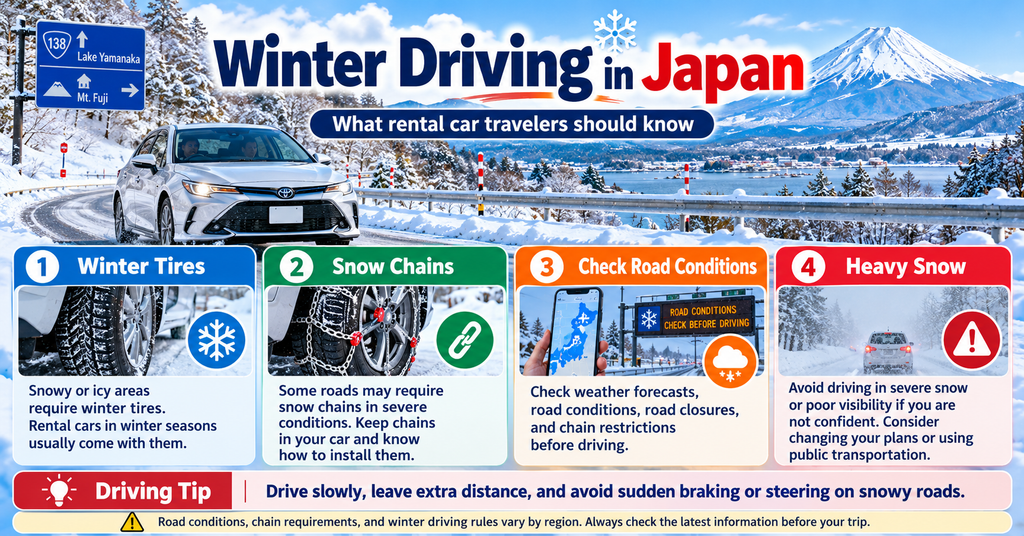
Winter driving in Japan requires extra preparation, especially in areas that receive heavy snow or have icy roads.
If you plan to drive in snowy regions, make sure your rental car is equipped for winter conditions and check the latest weather and road information before leaving.
Road closures, chain restrictions, and dangerous driving conditions can occur during heavy snowfall.
Winter Tires and Snow Chains
If you are driving in an area where snow or ice is expected, choose a rental car equipped with winter tires.
Some roads may also require tire chains during severe winter conditions.
Ask your rental car company whether winter tires and chains are included or need to be added as an option.
Do not attempt to drive on snowy or icy roads with standard summer tires.
Check Road Conditions Before Driving
Check the weather forecast and current road conditions before starting a winter drive.
Heavy snow can cause road closures, chain restrictions, traffic delays, and poor visibility.
Conditions can also change quickly in mountain areas.
If severe weather is expected, consider changing your route, delaying your trip, or using public transportation instead.
Before driving on expressways in winter, check the latest weather, road conditions, and traffic restrictions.
When You Should Avoid Driving
Avoid driving if heavy snow, strong winds, poor visibility, or dangerous road conditions are expected.
Even with winter tires, snowy and icy roads require slower speeds, longer following distances, and careful steering and braking.
Avoid sudden acceleration, hard braking, and sharp steering.
If you are not confident driving in winter conditions, choosing trains, buses, or another form of transportation may be the safer option.
When Is Renting a Car Useful in Japan?
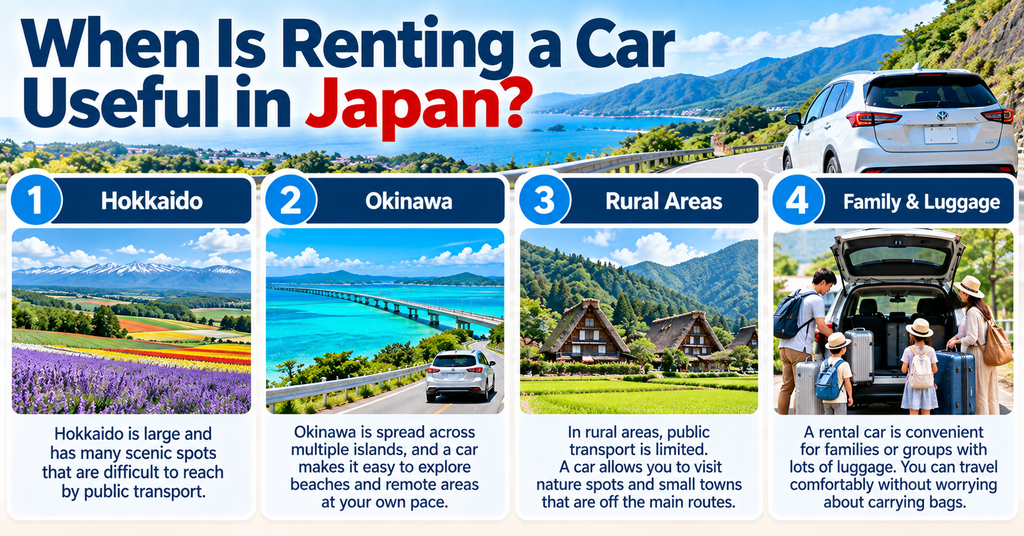
Renting a car is not necessary for every trip to Japan, but it can be extremely useful in certain areas.
A rental car gives you more flexibility when public transportation is limited, when attractions are spread far apart, or when you are traveling with several people or a lot of luggage.
It is especially useful in Hokkaido, Okinawa, rural areas, and mountain regions.
Hokkaido
Hokkaido is one of the most popular places in Japan for road trips.
Cities and sightseeing spots can be far apart, and public transportation may be less frequent outside major cities such as Sapporo.
A rental car can make it easier to visit scenic areas, national parks, lakes, flower fields, and smaller towns at your own pace.
However, winter driving can be difficult, so prepare carefully if you visit during the snowy season.
Okinawa
A rental car can be very convenient in Okinawa, especially outside central Naha.
Many beaches, scenic viewpoints, resorts, and attractions are easier to reach by car than by public transportation.
Driving also gives you more flexibility to stop at smaller beaches, cafes, and local attractions along the way.
Traffic can become busy around Naha and popular tourist areas, so allow extra travel time.
Rural and Mountain Areas
Rental cars are especially useful in rural and mountain areas where trains and buses may run only a few times per day.
Some temples, hiking areas, hot springs, lakes, and scenic viewpoints can be difficult to reach without a car.
Driving allows you to visit several places in one day without planning your entire schedule around public transportation.
Check road conditions in advance because mountain roads can be narrow, winding, or affected by snow.
Traveling with Family or Luggage
A rental car can also be useful when traveling with family, children, or a lot of luggage.
You can move directly between hotels and attractions without carrying suitcases through busy stations or making several train transfers.
If several people are traveling together, sharing the rental and fuel costs may also make driving more practical.
Choose a vehicle with enough passenger and luggage space before making your reservation.
When You Probably Do Not Need a Rental Car
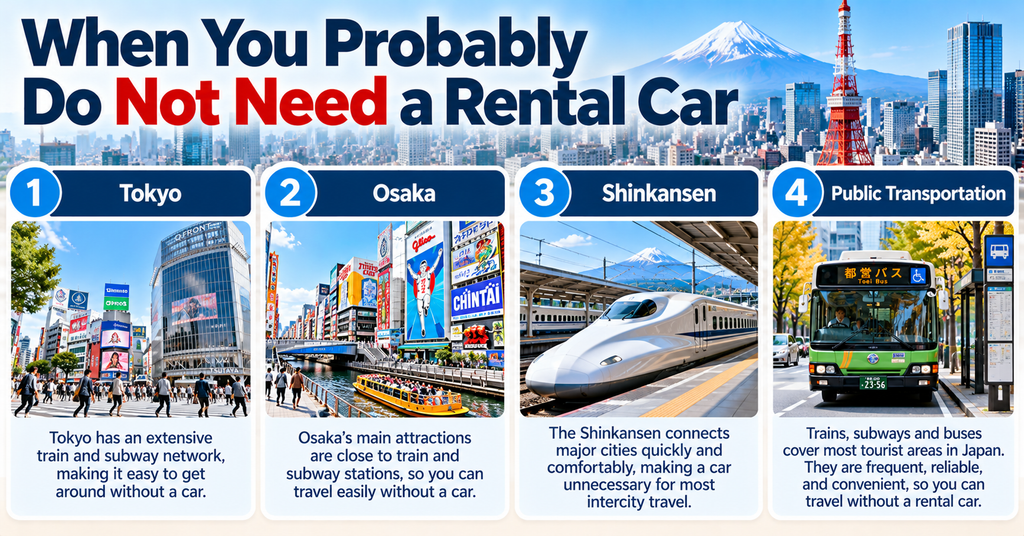
A rental car can be very useful in some parts of Japan, but it is not always the best choice.
In major cities and along popular train routes, public transportation is often faster, easier, and more convenient than driving.
You may also avoid parking fees, traffic, tolls, and the stress of navigating unfamiliar roads.
If you only need a car for a short trip in a city, taking a taxi may be easier than renting and parking a car.
Tokyo, Osaka, and Other Major Cities
You usually do not need a rental car when sightseeing in major cities such as Tokyo or Osaka.
Trains and subways cover most popular areas, and traffic and parking can make driving less convenient.
Parking fees can also be expensive in busy city centers.
For most first-time visitors, public transportation is usually the easier option for city sightseeing.
Trips Along Major Train Routes
A rental car may also be unnecessary if your itinerary mainly follows major train and Shinkansen routes.
Cities such as Tokyo, Kyoto, Osaka, Nagoya, Hiroshima, and Fukuoka are well connected by rail.
Using trains can save you from dealing with expressway tolls, parking, fuel, and rental car return times.
Consider renting a car only for the part of your trip where public transportation becomes less convenient.
Tips for Renting a Car in Japan
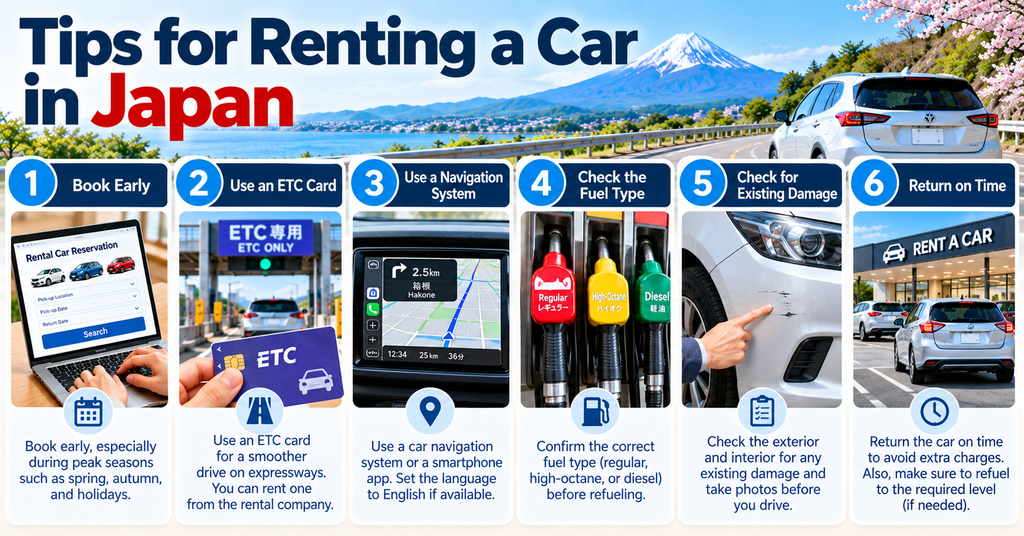
Book your rental car early if you are traveling during weekends, holidays, or busy travel seasons.
Choose a vehicle that is large enough for both passengers and luggage, especially if you are traveling with several suitcases.
Check whether the rental car has an English navigation system or use a navigation app on your phone.
If you plan to use expressways, ask about renting an ETC card before your trip.
Take photos of the car before driving away so you have a record of any existing scratches or damage.
Confirm the fuel type, return location, return time, and refueling policy before leaving the rental office.
Allow extra time when returning the car because traffic, refueling, and the final vehicle inspection may take longer than expected.
Keep your rental agreement, emergency contact information, and insurance details somewhere easy to access during your trip.
If you are not confident about driving in heavy traffic, snow, or unfamiliar mountain roads, choose public transportation instead.
Final Tips for Driving in Japan
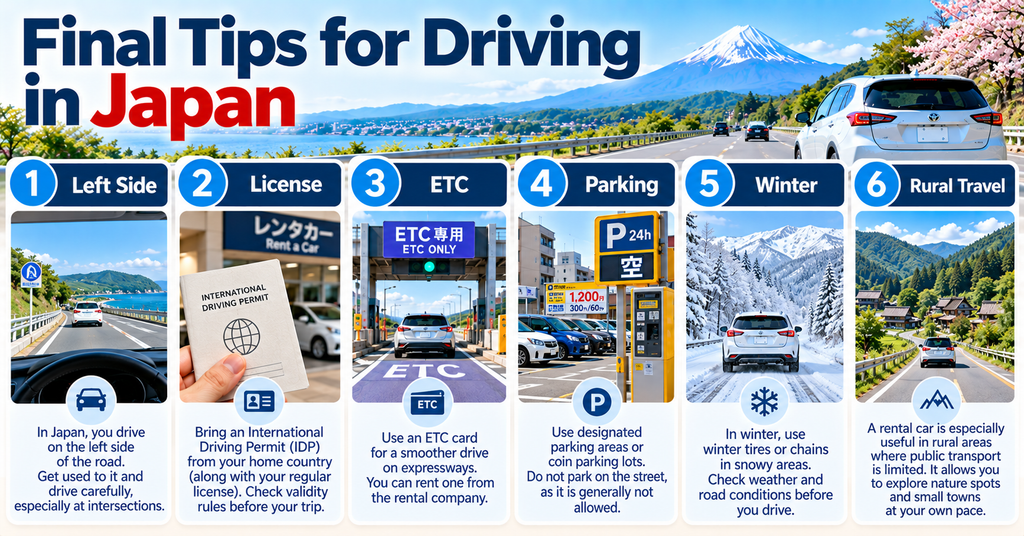
Renting a car in Japan can be a great way to explore areas that are difficult to reach by train or bus.
Before driving, make sure you have the correct license or permit, understand the basic traffic rules, and know how ETC, parking, fuel, and insurance work.
Drive on the left, follow speed limits, stop at railroad crossings, and never use your phone or drink alcohol while driving.
If you are traveling in winter, prepare for snow and icy roads and check the latest weather and road conditions before leaving.
A rental car is especially useful in places such as Hokkaido, Okinawa, and rural areas, but public transportation may be more convenient in large cities.
With the right preparation, driving in Japan can give you more freedom and make it easier to discover places beyond the major train routes.
If this is your first trip to Japan, you may also find our guide to essential things to know before visiting Japan helpful.