Public Toilets in Japan: A Complete Guide for Tourists
Public toilets in Japan are generally easy to find and often free to use.
You can find them at train stations, airports, shopping malls, parks, tourist attractions, and many other places.
However, Japanese toilets may look different from what you are used to.
Some toilets have electronic bidet seats with many buttons. Others may be traditional squat toilets.
You may also see unfamiliar signs, flushing controls, or emergency buttons.
In this guide, we explain where to find public toilets in Japan and how to use them. We also cover washlet buttons, toilet paper rules, signs, and basic toilet etiquette.
Knowing these simple tips can make using toilets in Japan much easier during your trip.
If this is your first trip to Japan, see our guide to 20 essential things to know before visiting Japan.
Local Tip: Train stations, department stores, shopping malls, and larger parks are usually reliable places to look for a toilet. If you are sightseeing in a busy area, using one when you see it can save you from searching later.
- Are Public Toilets Easy to Find in Japan?
- Where Can You Find Public Toilets in Japan?
- How to Use a Japanese Toilet
- How to Use a Washlet in Japan
- Toilet Paper Rules in Japan
- Useful Toilet Signs and Symbols in Japan
- Japanese Toilet Etiquette for Tourists
- What to Do If You Cannot Find a Toilet
- Public Toilets in Japan FAQ
- Final Tips for Using Public Toilets in Japan
Are Public Toilets Easy to Find in Japan?
Yes. Public toilets are generally easy to find in Japan, especially in cities and popular tourist areas.
Train stations, airports, shopping malls, department stores, parks, and major attractions often have toilets for visitors.
Many public toilets are free to use.
Signs usually show simple symbols for men, women, and accessible toilets. You may also see the words “Toilet,” “Restroom,” or “WC.”
Toilet facilities can vary by location. Large stations and newer buildings often have modern Western-style toilets.
Older facilities may still have Japanese squat toilets.
If you cannot find a toilet, look for signs inside a nearby station, shopping center, or public facility.
Where Can You Find Public Toilets in Japan?
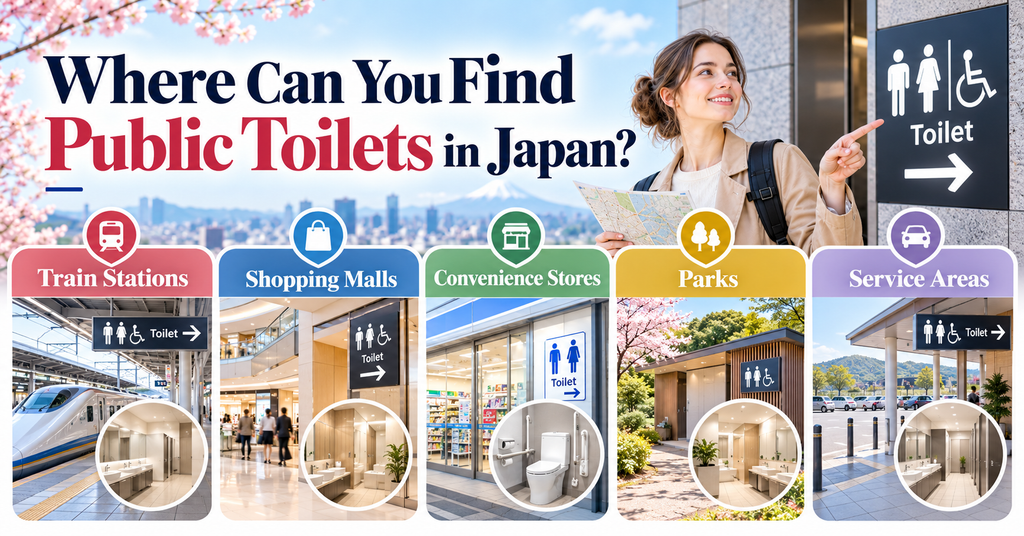
Public toilets in Japan can be found in many places.
Train stations, shopping malls, department stores, parks, tourist attractions, and highway rest areas usually have toilets for visitors.
Airports and large transportation hubs also have many restroom facilities.
Convenience stores may have toilets as well. However, availability depends on the store.
If you are in a busy city, you usually do not need to walk far to find a toilet.
In smaller towns or rural areas, toilets may be less frequent. It is a good idea to use one when you see it.
Train Stations
Train stations are one of the easiest places to find toilets in Japan.
Large stations often have several restroom areas.
Some toilets are located inside the ticket gates. Others may be outside the gates.
If the toilet is inside the gate, you may need a valid ticket or IC card to enter.
Look for signs that say “Toilet” or show restroom symbols.
Major stations often have Western-style toilets, accessible toilets, and baby changing facilities.
If you are using Japanese trains for the first time, see our beginner’s guide to using trains in Japan.
Shopping Malls and Department Stores
Shopping malls and department stores usually have clean and modern toilets.
You can often find restrooms on several floors.
These facilities are also more likely to have Western-style toilets and washlets.
Accessible toilets and baby changing areas are common in larger buildings.
Floor maps and signs usually show where the nearest restroom is located.
Convenience Stores
Many convenience stores in Japan have toilets for customers.
However, not every store allows public use.
Some toilets may only be available during certain hours. Others may be closed because of store policy or location.
If you are not sure, look for a toilet sign or ask a staff member.
It is polite to buy something small if you use a convenience store toilet.
Parks and Tourist Attractions
Many parks and tourist attractions have public toilets.
You can often find them near entrances, parking areas, visitor centers, or rest areas.
Toilet quality can vary.
Popular attractions usually have modern facilities. Smaller parks may have older toilets.
Some outdoor areas may also have Japanese squat toilets.
Use the restroom before entering remote hiking areas or places with few facilities.
Highway Service Areas and Rest Stops
Highway service areas and rest stops in Japan usually have large restroom facilities.
They are useful during road trips and long-distance bus journeys.
Many facilities have Western-style toilets, washlets, accessible toilets, and baby changing areas.
Some service areas also have restaurants, shops, and convenience stores.
Roadside stations, known as michi-no-eki, are another useful place to find toilets while traveling by car.
How to Use a Japanese Toilet
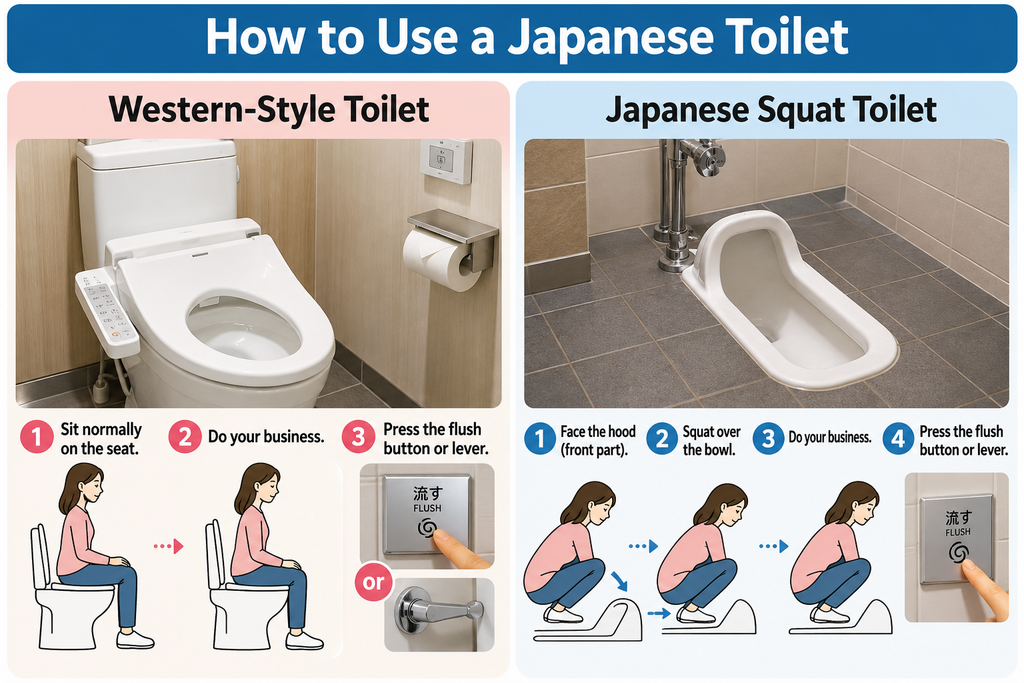
Most toilets in Japan are easy to use once you know the basic controls.
You will mainly see two types of toilets: Western-style toilets and Japanese squat toilets.
Western-style toilets are now very common, especially in cities, hotels, airports, stations, and shopping centers.
Some toilets also have electronic bidet seats with extra functions.
Older facilities may still have squat toilets.
Before using the toilet, check the signs and controls around the seat.
The flushing button or lever may be on the wall, on the toilet, or on an electronic control panel.
For more information, see the Japan National Tourism Organization’s guide to Japanese toilets.
Western-Style Toilets
Western-style toilets in Japan are similar to toilets found in many other countries.
You sit on the toilet seat as usual.
Many newer toilets have heated seats and bidet functions.
The flushing control may be a lever, button, sensor, or wall switch.
Look for words such as “Flush” or symbols that show water flow.
Some toilets have separate buttons for a large flush and a small flush.
Do not press unfamiliar buttons unless you know what they do.
Japanese Squat Toilets
Japanese squat toilets are still found in some older stations, parks, and public facilities.
To use one, face the raised hood or front part of the toilet.
Stand with your feet on both sides of the bowl and squat down.
Keep your balance and make sure your clothes do not touch the floor.
The flush may be operated by a lever, pedal, or wall button.
If you prefer a Western-style toilet, check another stall. Many public restrooms now offer both types.
How to Use a Washlet in Japan
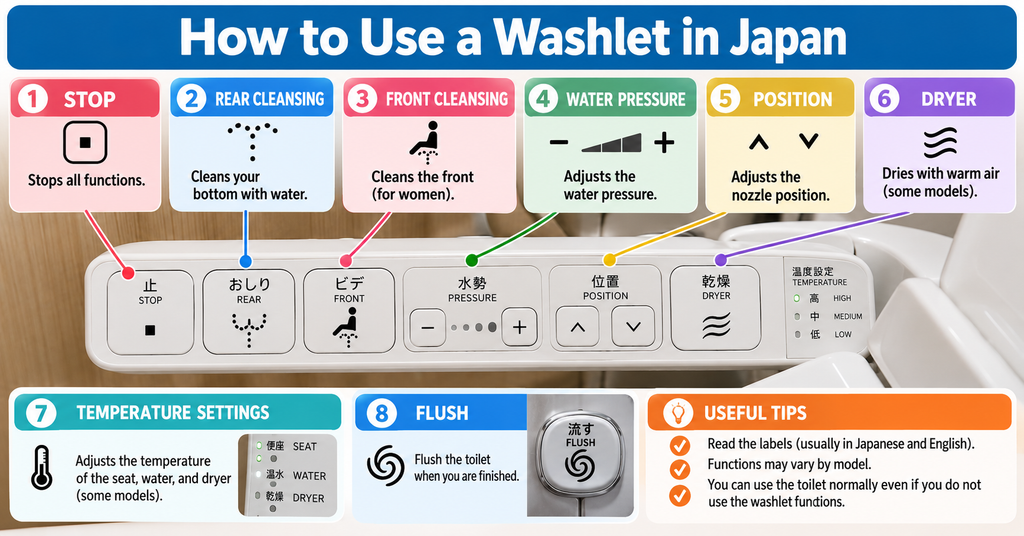
Many modern toilets in Japan have electronic bidet seats, often called washlets.
These toilets can have several buttons for washing, water pressure, seat temperature, and other functions.
At first, the control panel may look complicated.
However, you only need to understand a few basic buttons.
The most important functions are usually washing and stopping.
Some newer toilets also use simple symbols, which makes them easier for international visitors to use.
You can also see TOTO’s official Washlet guide for examples of common toilet controls.
Common Washlet Buttons
Washlet controls vary by model, but several functions are common.
The “Stop” button ends the washing function.
A rear washing button sprays water from behind.
Some toilets also have a front washing function.
You may also see buttons for water pressure, nozzle position, or seat temperature.
Do not worry if you do not use every function.
For most travelers, knowing how to start washing and how to stop it is enough.
What If You Cannot Read the Controls?
Many newer toilets use symbols as well as Japanese text.
Look for a square stop symbol or a button marked “Stop.”
Washing buttons often show simple water spray symbols.
If the controls are difficult to understand, do not press random buttons.
You can simply use the toilet without using the bidet functions.
In major stations, airports, hotels, and shopping malls, English labels are becoming more common.
Toilet Paper Rules in Japan
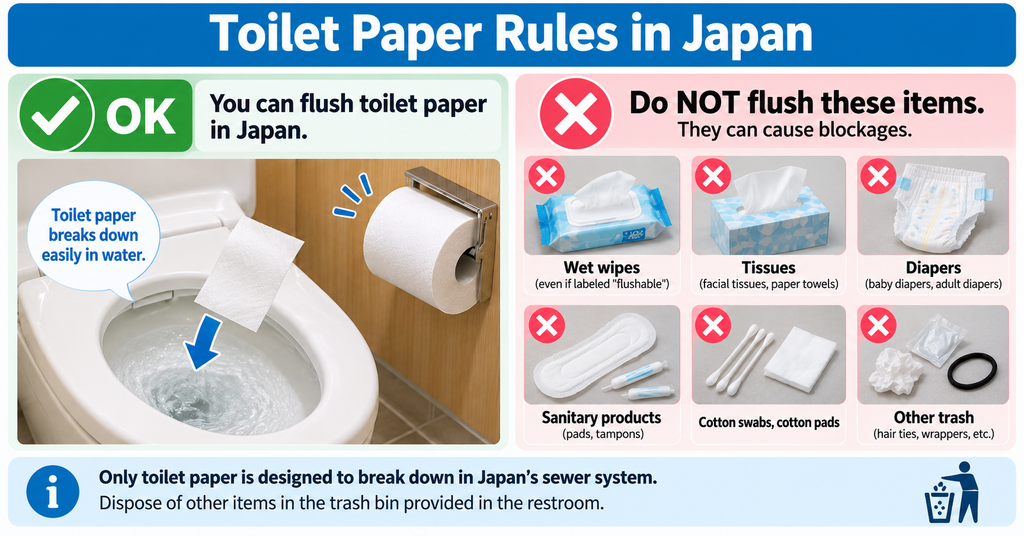
Toilet paper rules in Japan are simple.
In most toilets, used toilet paper should be flushed down the toilet.
You usually do not need to put toilet paper in a trash bin.
This may be different from some countries where toilet paper is placed in a separate bin.
Trash bins inside toilet stalls are mainly for sanitary products.
Only flush toilet paper unless a sign says otherwise.
Can You Flush Toilet Paper in Japan?
Yes. Toilet paper can normally be flushed in Japan.
Place used toilet paper in the toilet bowl and flush it.
Do not put tissues, wet wipes, diapers, or other items into the toilet.
These items may cause blockages.
If you see a special sign near the toilet, follow the instructions shown there.
What If There Is No Toilet Paper?
Most public toilets in Japan provide toilet paper.
However, some older or remote facilities may run out.
Check the stall before you use the toilet.
It can be useful to carry a small pack of tissues while traveling.
Be careful with regular pocket tissues. Some types are not designed to dissolve in water.
If there is no toilet paper, avoid flushing ordinary tissues unless the packaging says they are flushable.
Useful Toilet Signs and Symbols in Japan
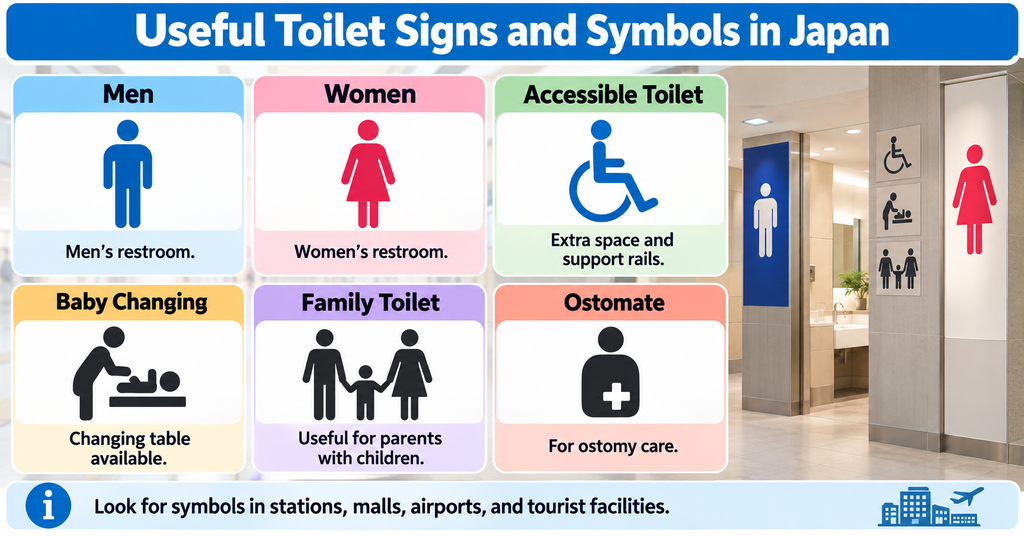
Toilet signs in Japan usually use simple symbols that are easy to recognize.
You will often see separate symbols for men, women, and accessible toilets.
Many facilities also show English words such as “Toilet,” “Restroom,” or “Accessible Toilet.”
Some newer facilities use pictograms for baby changing areas, ostomate facilities, and family toilets.
If you are not sure which restroom to use, check the symbols near the entrance.
Large stations, airports, and shopping malls usually have clear signs in both Japanese and English.
You can check the standard toilet pictograms used in Japan on the Japan Restroom Industry Association website.
Men, Women, and Accessible Toilets
Men’s and women’s toilets are usually marked with familiar person symbols.
Accessible toilets are often marked with a wheelchair symbol.
These toilets may have more space, handrails, and other support equipment.
Some accessible toilets are designed for several types of users.
They may include facilities for wheelchair users, people with ostomies, parents with children, or elderly visitors.
For more information, see JNTO’s guide to accessible public toilets in Japan.
Baby Rooms and Changing Tables
Baby changing tables are common in many large public facilities.
You can often find them in shopping malls, department stores, airports, and major train stations.
Some restrooms have changing tables inside.
Larger facilities may also have separate baby rooms.
These rooms may include changing spaces, nursing areas, sinks, and hot water for baby formula.
Look for signs with a baby or changing table symbol.
Japanese Toilet Etiquette for Tourists
Public toilets in Japan are generally clean, and users are expected to help keep them that way.
Basic toilet etiquette is simple.
Use the toilet carefully, flush after use, and leave the space clean for the next person.
Do not leave trash inside the stall unless there is a proper bin.
You may also see special buttons or equipment that are not common in your home country.
Take a moment to check the signs before using them.
For more everyday manners, see our guide to essential Japanese etiquette for tourists.
Keep the Toilet Clean
Try to leave the toilet as clean as you found it.
Make sure you flush after use.
Do not leave toilet paper, water, or personal items on the floor.
Use the trash bin for items that should not be flushed.
If the toilet has a seat cleaner or disinfectant, you can use it before sitting down.
Do Not Flush Anything Except Toilet Paper
Only flush toilet paper unless a sign says otherwise.
Do not flush wet wipes, tissues, diapers, sanitary products, or other trash.
These items can block the toilet.
Use the correct trash bin if one is available.
If you are unsure, check the signs inside the stall.
Be Careful With Emergency Buttons
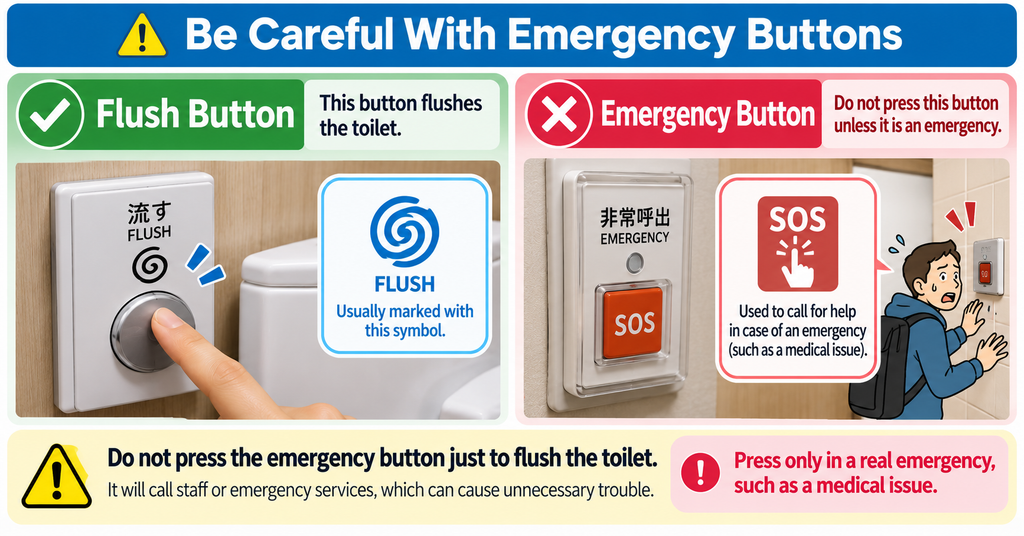
Some toilets in Japan have emergency call buttons inside the stall.
These buttons may look similar to flushing controls.
Do not press them unless you need assistance.
Emergency buttons are often marked with a bell, phone, or emergency symbol.
Check the label before pressing any unfamiliar button.
If you press one by mistake, tell a staff member as soon as possible.
What to Do If You Cannot Find a Toilet
If you cannot find a toilet, try a nearby train station, shopping mall, department store, or public facility.
Large convenience stores may also have toilets, but availability depends on the store.
You can also check a map app for nearby restrooms.
If you need reliable mobile data for maps during your trip, see our Japan eSIM guide.
In tourist areas, visitor information centers can often help.
If you need to ask for help, see our guide to 52 useful Japanese phrases for travelers.
If you are in a rural area, use a restroom when you see one.
Toilets may be farther apart outside large cities.
For road trips, highway service areas and roadside stations are useful places to stop.
Public Toilets in Japan FAQ
Here are some common questions travelers have about public toilets in Japan.
Most toilets are easy to use once you understand the basic signs and controls.
Facilities can vary depending on the location.
Large stations, airports, shopping malls, and newer buildings usually have the most modern restroom facilities.
Are Public Toilets Free in Japan?
Yes. Most public toilets in Japan are free to use.
You usually do not need coins or a payment card.
Free toilets are common at train stations, airports, shopping malls, parks, and tourist attractions.
Some private facilities may have different rules, but paid public toilets are uncommon.
Are Japanese Public Toilets Clean?
Many public toilets in Japan are clean and well maintained.
Newer stations, airports, shopping malls, and department stores often have very modern facilities.
However, cleanliness can vary by location.
Older parks or remote facilities may be more basic.
It is still a good idea to carry tissues and hand sanitizer when traveling.
Can I Use a Convenience Store Toilet?
Sometimes.
Many convenience stores have toilets for customers, but public access is not guaranteed.
Some stores may restrict toilet use because of location, opening hours, or store policy.
Look for a toilet sign or ask a staff member if you are unsure.
It is polite to buy something small if you use the toilet.
Are Squat Toilets Still Common in Japan?
Squat toilets still exist in Japan, but they are less common than Western-style toilets.
You may still find them in older stations, parks, temples, or public facilities.
Many modern restrooms now offer Western-style toilets.
If you prefer not to use a squat toilet, check another stall.
Do Japanese Toilets Have Bidets?
Many modern toilets in Japan have built-in bidet functions.
These electronic toilet seats may offer rear washing, front washing, water pressure controls, and heated seats.
However, not every toilet has these features.
Older or simpler public toilets may only have basic flushing functions.
You can use the toilet normally even if you do not use the bidet.
Final Tips for Using Public Toilets in Japan
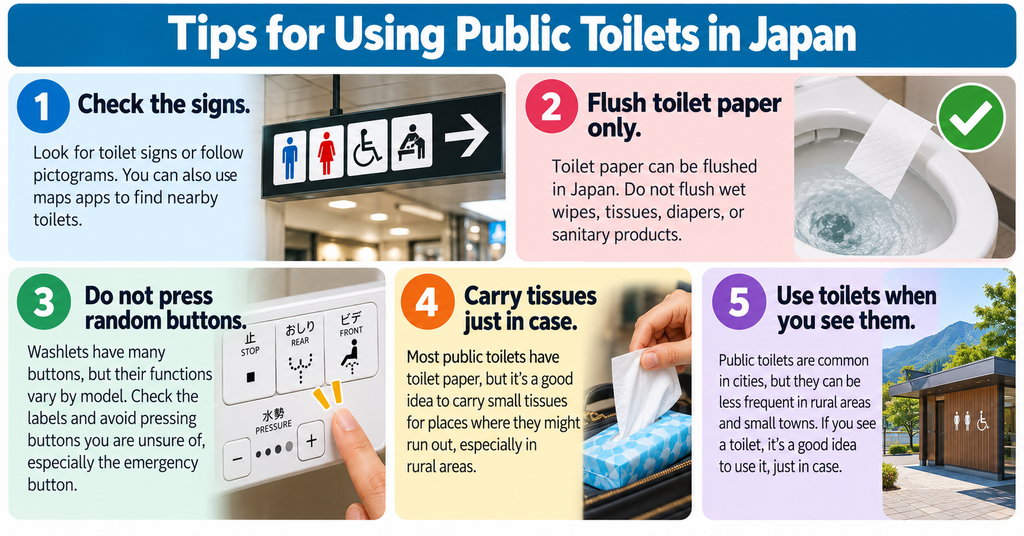
Public toilets in Japan are generally easy to find and simple to use.
Large stations, airports, shopping malls, and tourist attractions usually have modern restroom facilities.
If you see unfamiliar buttons, check the labels before pressing them.
Remember that toilet paper can normally be flushed in Japan.
Do not flush wet wipes, tissues, diapers, or other trash.
Convenience store toilets are useful, but access depends on the store.
In rural areas, use a restroom when you have the chance.
Once you understand the basic signs, washlet controls, and etiquette, using public toilets in Japan becomes much easier.