52 Useful Japanese Phrases and Conversations!
Knowing a few Japanese travel phrases can make your trip to Japan much easier.
You do not need to speak fluent Japanese to travel around Japan. However, simple phrases such as Sumimasen (Excuse me), Arigatou gozaimasu (Thank you), and Kore o onegai shimasu (This one, please) can be extremely useful at restaurants, train stations, hotels, shops, and tourist attractions.
Even if your pronunciation is not perfect, making an effort to speak a little Japanese can help make everyday interactions smoother.
In this guide, you will learn 52 useful Japanese phrases for travelers, organized by situation so you can quickly find the words you need during your trip.
You will also find simple conversation examples, pronunciation tips, and a few emergency phrases worth saving on your phone.
If this is your first trip to Japan, you may also want to read our guide to Japanese etiquette for tourists before you go.
Local Tip: When traveling, a few short phrases used confidently are more practical than memorizing a long list. Start with sumimasen, arigatou gozaimasu, onegai shimasu, and simple phrases for directions, ordering, and emergencies.
- Japanese Travel Phrases: 5 Phrases to Learn First
- How to Read the Japanese Phrases in This Guide
- Basic Japanese Travel Phrases
- Japanese Phrases for Asking for Help and Directions
- Japanese Phrases for Hotels and Ryokan
- Japanese Travel Phrases for Restaurants
- Japanese Phrases for Trains and Stations
- Japanese Phrases for Sightseeing and Shopping
- Bonus Japanese Phrases for Emergencies
- What If You Cannot Communicate in Japanese?
- 5 Simple Japanese Travel Conversations
- Japanese Travel Phrases FAQ
- Final Tips for Using Japanese Travel Phrases
Japanese Travel Phrases: 5 Phrases to Learn First
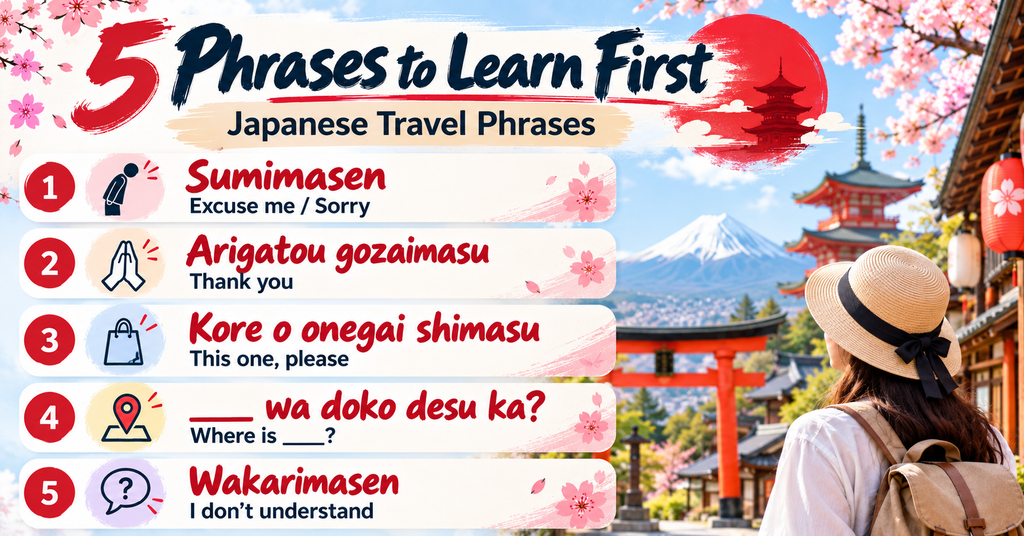
You do not need to memorize all 52 phrases before arriving in Japan.
If you only remember five, start with these.
| Japanese | Romanization | Meaning |
|---|---|---|
| すみません | Sumimasen | Excuse me / Sorry |
| ありがとうございます | Arigatou gozaimasu | Thank you |
| これをお願いします | Kore o onegai shimasu | This one, please |
| 〜はどこですか? | ___ wa doko desu ka? | Where is ___? |
| わかりません | Wakarimasen | I don’t understand |
Travel Tip: Of all the Japanese words in this guide, Sumimasen is one of the most useful. You can use it to get someone’s attention, say excuse me, or apologize politely.
How to Read the Japanese Phrases in This Guide
Each phrase includes three versions:
- Japanese: The phrase written in Japanese.
- Romanization: Japanese written with the Latin alphabet.
- English: What the phrase means.
We use simple romanization without special long-vowel symbols so the phrases are easier for travelers to read on a phone.
You do not need perfect pronunciation. Speak slowly, keep the phrase simple, and use gestures or point at your phone when necessary.
The Japan National Tourism Organization also provides an official guide to basic Japanese language for travelers.
Basic Japanese Travel Phrases
These are the basic Japanese phrases you are most likely to use throughout your trip.
| No. | Japanese | Romanization | English |
|---|---|---|---|
| 1 | おはようございます | Ohayou gozaimasu | Good morning |
| 2 | こんにちは | Konnichiwa | Hello / Good afternoon |
| 3 | こんばんは | Konbanwa | Good evening |
| 4 | ありがとうございます | Arigatou gozaimasu | Thank you |
| 5 | すみません | Sumimasen | Excuse me / Sorry |
| 6 | お願いします | Onegai shimasu | Please / I’d like… |
| 7 | はい | Hai | Yes |
| 8 | いいえ | Iie | No |
| 9 | わかりません | Wakarimasen | I don’t understand |
| 10 | もう一度お願いします | Mou ichido onegai shimasu | One more time, please |
Why Is “Sumimasen” So Useful?
Sumimasen is one of the most versatile Japanese words for travelers.
You can use it when:
- Getting a restaurant server’s attention
- Asking someone for directions
- Trying to pass someone in a crowded place
- Apologizing for a small mistake
- Starting a polite question
If you are not sure how to begin a conversation, saying Sumimasen first is usually a good starting point.
Japanese Phrases for Asking for Help and Directions
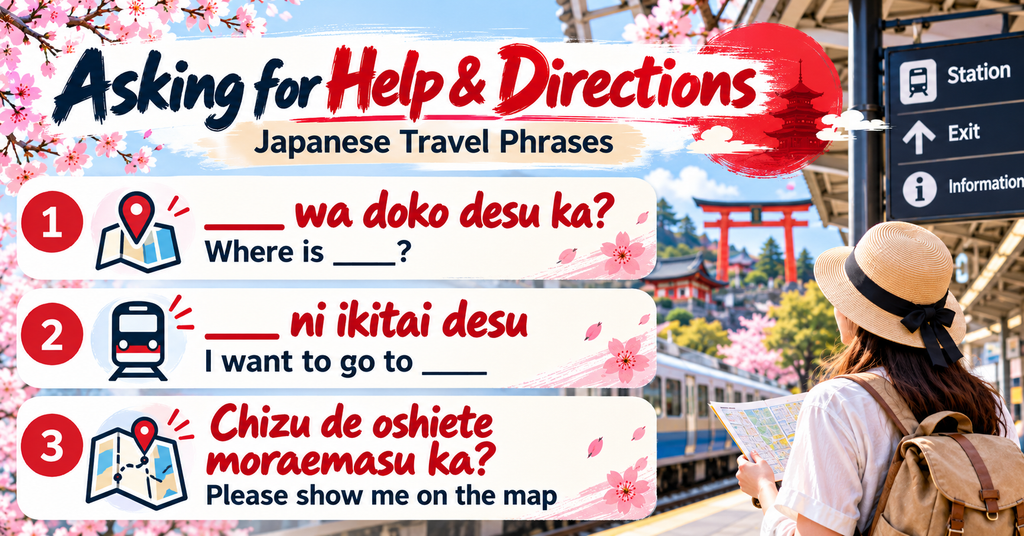
Getting lost is easy in large Japanese train stations and busy city areas.
These phrases can help you ask for directions even if the rest of the conversation happens through gestures, a map, or a translation app.
| No. | Japanese | Romanization | English |
|---|---|---|---|
| 11 | 英語は話せますか? | Eigo wa hanasemasu ka? | Do you speak English? |
| 12 | ゆっくり話してください | Yukkuri hanashite kudasai | Please speak slowly |
| 13 | 〜はどこですか? | ___ wa doko desu ka? | Where is ___? |
| 14 | ここはどこですか? | Koko wa doko desu ka? | Where am I? |
| 15 | 〜に行きたいです | ___ ni ikitai desu | I want to go to ___ |
| 16 | どう行けばいいですか? | Dou ikeba ii desu ka? | How do I get there? |
| 17 | 地図で教えてもらえますか? | Chizu de oshiete moraemasu ka? | Can you show me on the map? |
| 18 | トイレはどこですか? | Toire wa doko desu ka? | Where is the restroom? |
An Easy Pattern: “___ wa doko desu ka?”
One of the easiest sentence patterns to remember is:
___ wa doko desu ka?
Where is ___?
Simply put the place you are looking for before the phrase.
For example:
- Tokyo-eki wa doko desu ka? — Where is Tokyo Station?
- Toire wa doko desu ka? — Where is the restroom?
- Konbini wa doko desu ka? — Where is a convenience store?
Japanese Phrases for Hotels and Ryokan
Hotels in major tourist areas often provide multilingual support, but knowing a few basic phrases can still be useful.
They can be especially helpful at smaller hotels, guesthouses, and traditional Japanese inns.
| No. | Japanese | Romanization | English |
|---|---|---|---|
| 19 | チェックインをお願いします | Chekkuin o onegai shimasu | I’d like to check in |
| 20 | 予約しています | Yoyaku shiteimasu | I have a reservation |
| 21 | 名前は〜です | Namae wa ___ desu | My name is ___ |
| 22 | 荷物を預かってもらえますか? | Nimotsu o azukatte moraemasu ka? | Can you store my luggage? |
| 23 | Wi-Fiはありますか? | Waifai wa arimasu ka? | Is Wi-Fi available? |
| 24 | 大浴場はどこですか? | Daiyokujou wa doko desu ka? | Where is the large public bath? |
| 25 | チェックアウトは何時ですか? | Chekkuauto wa nanji desu ka? | What time is checkout? |
If you plan to stay at a traditional Japanese inn, see our complete guide to what a ryokan is and what to expect.
Simple Hotel Conversation
Traveler: Chekkuin o onegai shimasu.
I’d like to check in.
Traveler: Yoyaku shiteimasu.
I have a reservation.
Traveler: Namae wa Smith desu.
My name is Smith.
Showing your booking confirmation at the same time makes the process even easier.
Japanese Travel Phrases for Restaurants
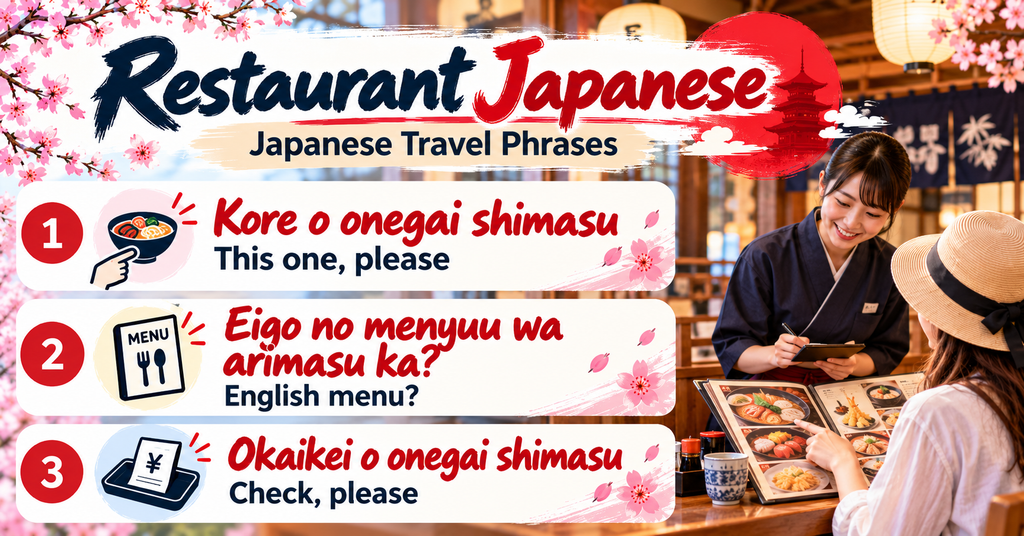
Restaurants are one of the places where a few Japanese phrases can make the biggest difference.
You can often order simply by pointing at a menu and using one short phrase.
| No. | Japanese | Romanization | English |
|---|---|---|---|
| 26 | 二人です | Futari desu | Two people |
| 27 | 英語のメニューはありますか? | Eigo no menyuu wa arimasu ka? | Do you have an English menu? |
| 28 | これをお願いします | Kore o onegai shimasu | This one, please |
| 29 | おすすめは何ですか? | Osusume wa nan desu ka? | What do you recommend? |
| 30 | 水をお願いします | Mizu o onegai shimasu | Water, please |
| 31 | これは何ですか? | Kore wa nan desu ka? | What is this? |
| 32 | これは〜が入っていますか? | Kore wa ___ ga haitteimasu ka? | Does this contain ___? |
| 33 | 〜アレルギーです | ___ arerugii desu | I am allergic to ___ |
| 34 | ベジタリアンです | Bejitarian desu | I am vegetarian |
| 35 | いただきます | Itadakimasu | Phrase said before eating |
| 36 | お会計をお願いします | Okaikei o onegai shimasu | Check, please |
| 37 | ごちそうさまでした | Gochisousama deshita | Thank you for the meal |
How to Tell Staff How Many People Are in Your Group
When entering a restaurant, staff may ask how many people are in your group.
Useful answers include:
- Hitori desu. — One person.
- Futari desu. — Two people.
- Sannin desu. — Three people.
- Yonin desu. — Four people.
The Easiest Way to Order Food in Japanese
You do not need to know the Japanese name of every dish.
Point to the item on the menu and say:
Kore o onegai shimasu.
This one, please.
This is one of the easiest and most useful phrases for eating in Japan.
For a full explanation of entering, ordering, eating, and paying, read our guide to eating at restaurants in Japan.
Important Note for Food Allergies
If you have a food allergy, do not rely only on a short Japanese phrase or translation app.
Clearly tell the staff which ingredient you need to avoid, and ask about ingredients and preparation methods when necessary.
For detailed information, read our guide to food allergies in Japan.
Simple Restaurant Conversation
Staff: Nanmei-sama desu ka?
How many people?
Traveler: Futari desu.
Two people.
Traveler: Kore o onegai shimasu.
This one, please.
Traveler: Mizu o onegai shimasu.
Water, please.
Traveler: Okaikei o onegai shimasu.
Check, please.
Keep in mind that many Japanese restaurants ask customers to take the bill to a register near the entrance rather than paying at the table.
Japanese Phrases for Trains and Stations
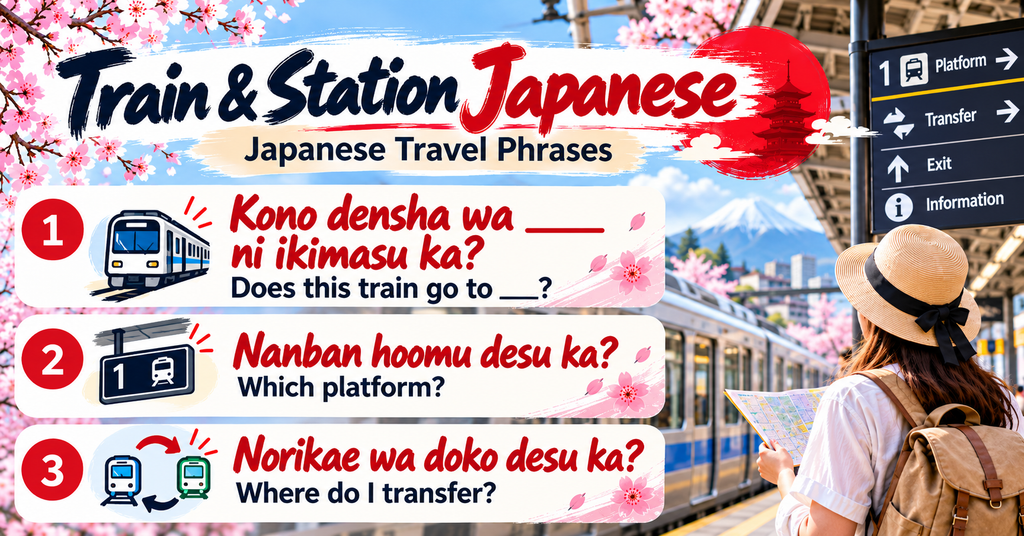
Japan’s railway system is convenient, but large stations can be confusing for first-time visitors.
These phrases can help when you cannot find the correct train, line, platform, or transfer.
| No. | Japanese | Romanization | English |
|---|---|---|---|
| 38 | 切符売り場はどこですか? | Kippu uriba wa doko desu ka? | Where is the ticket office? |
| 39 | 〜までの切符をお願いします | ___ made no kippu o onegai shimasu | A ticket to ___, please |
| 40 | この電車は〜に行きますか? | Kono densha wa ___ ni ikimasu ka? | Does this train go to ___? |
| 41 | 〜線はどこですか? | ___ sen wa doko desu ka? | Where is the ___ Line? |
| 42 | 何番ホームですか? | Nanban hoomu desu ka? | Which platform is it? |
| 43 | 乗り換えはどこですか? | Norikae wa doko desu ka? | Where do I transfer? |
| 44 | 次は〜ですか? | Tsugi wa ___ desu ka? | Is ___ the next stop? |
| 45 | ICカードは使えますか? | IC kaado wa tsukaemasu ka? | Can I use an IC card? |
Before your trip, we recommend learning the basic steps for using Japanese trains. Our beginner’s guide to using trains in Japan explains ticket gates, platforms, transfers, train types, and station exits.
If you plan to use public transportation frequently, also see our guide to IC cards such as Suica, PASMO, and ICOCA.
Simple Train Station Conversation
Traveler: Sumimasen.
Excuse me.
Traveler: Yamanote-sen wa doko desu ka?
Where is the Yamanote Line?
Traveler: Nanban hoomu desu ka?
Which platform is it?
If the conversation becomes difficult, show the station staff the destination on your phone.
The station name is often more important than speaking a complete sentence.
Japanese Phrases for Sightseeing and Shopping
These final phrases are useful at tourist attractions, museums, shops, department stores, and souvenir shops.
| No. | Japanese | Romanization | English |
|---|---|---|---|
| 46 | 写真を撮ってもいいですか? | Shashin o totte mo ii desu ka? | May I take a photo? |
| 47 | 何時からですか? | Nanji kara desu ka? | What time does it open / start? |
| 48 | これを見せてください | Kore o misete kudasai | Please show me this |
| 49 | 試着してもいいですか? | Shichaku shite mo ii desu ka? | May I try this on? |
| 50 | これはいくらですか? | Kore wa ikura desu ka? | How much is this? |
| 51 | クレジットカードは使えますか? | Kurejitto kaado wa tsukaemasu ka? | Can I use a credit card? |
| 52 | 袋をお願いします | Fukuro o onegai shimasu | A bag, please |
Ask Before Taking Photos
Photography rules depend on the location.
Some temples, museums, shops, restaurants, exhibitions, and indoor areas may restrict photography even when taking photos outside the building is allowed.
If you are unsure, look for signs or ask:
Shashin o totte mo ii desu ka?
May I take a photo?
Checking Whether Credit Cards Are Accepted
Credit cards are widely accepted in many parts of Japan, but payment options vary by business.
At a smaller restaurant or shop, you can ask:
Kurejitto kaado wa tsukaemasu ka?
Can I use a credit card?
You can also simply show your card while asking the question.
For more information about cash, cards, ATMs, and IC card payments, read our complete guide to money in Japan.
Bonus Japanese Phrases for Emergencies
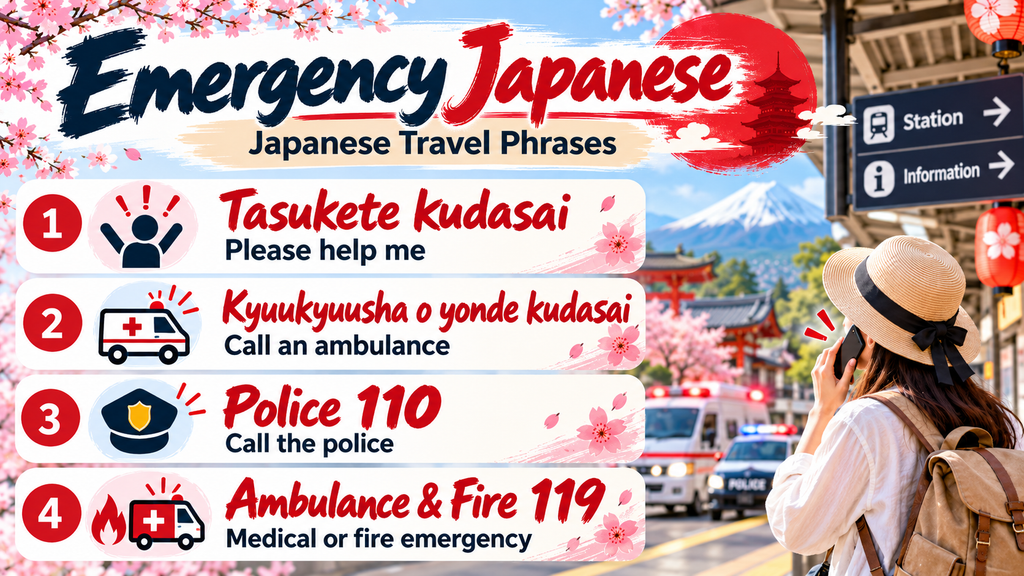
The following phrases are not included in the main 52, but they are worth saving on your phone in case something goes wrong.
| Japanese | Romanization | English |
|---|---|---|
| 助けてください | Tasukete kudasai | Please help me |
| 救急車を呼んでください | Kyuukyuusha o yonde kudasai | Please call an ambulance |
| 警察を呼んでください | Keisatsu o yonde kudasai | Please call the police |
| 病院はどこですか? | Byouin wa doko desu ka? | Where is the hospital? |
For an emergency in Japan:
- Police: 110
- Ambulance / Fire: 119
The Japan National Tourism Organization also operates the Japan Visitor Hotline for tourist information and assistance with accidents, illness, emergencies, and natural disasters.
What If You Cannot Communicate in Japanese?
Do not worry if you forget a phrase or cannot understand the reply.
Your smartphone can solve many communication problems during a trip to Japan.
Show the Japanese Text on Your Phone
You do not always need to pronounce the phrase yourself.
If communication becomes difficult, show the Japanese text from this guide directly to the person you are speaking with.
This can be especially useful for:
- Hotel requests
- Restaurant orders
- Food allergies
- Train destinations
- Shopping questions
Use a Translation App
A translation app can help with menus, signs, written notices, and short conversations.
Camera translation is particularly useful when you need to understand Japanese text quickly.
Before arriving in Japan, download the tools you expect to use and prepare offline translation when available.
For our recommended navigation, translation, transportation, and emergency apps, see our guide to the best Japan travel apps for first-time visitors.
Keep Your Sentences Simple
When communicating across a language barrier, shorter is usually easier.
Instead of trying to create a long Japanese sentence, use one simple phrase and show the relevant information.
For example:
Sumimasen.
Excuse me.
Kyoto-eki ni ikitai desu.
I want to go to Kyoto Station.
Then show Kyoto Station on your phone.
This is often easier than trying to explain your entire route in Japanese.
5 Simple Japanese Travel Conversations
Here are five short examples showing how the phrases in this guide can work together.
1. Asking for Directions
Traveler: Sumimasen.
Excuse me.
Traveler: Tokyo-eki wa doko desu ka?
Where is Tokyo Station?
Traveler: Chizu de oshiete moraemasu ka?
Can you show me on the map?
Traveler: Arigatou gozaimasu.
Thank you.
2. Checking Into a Hotel
Traveler: Chekkuin o onegai shimasu.
I’d like to check in.
Traveler: Yoyaku shiteimasu.
I have a reservation.
Traveler: Namae wa Taylor desu.
My name is Taylor.
3. Ordering at a Restaurant
Traveler: Eigo no menyuu wa arimasu ka?
Do you have an English menu?
Traveler: Kore o onegai shimasu.
This one, please.
Traveler: Mizu o onegai shimasu.
Water, please.
4. Asking About a Train
Traveler: Sumimasen.
Excuse me.
Traveler: Kono densha wa Shinjuku ni ikimasu ka?
Does this train go to Shinjuku?
Traveler: Arigatou gozaimasu.
Thank you.
5. Shopping
Traveler: Kore wa ikura desu ka?
How much is this?
Traveler: Kurejitto kaado wa tsukaemasu ka?
Can I use a credit card?
Traveler: Fukuro o onegai shimasu.
A bag, please.
Japanese Travel Phrases FAQ
Do I Need to Speak Japanese to Travel in Japan?
No. You can travel in Japan without speaking Japanese.
However, learning a few basic Japanese travel phrases can make it easier to ask questions, order food, find transportation, and communicate in smaller businesses or less touristy areas.
What Is the Most Useful Japanese Phrase for Tourists?
Sumimasen is one of the most useful words to remember.
It can mean “Excuse me” or “Sorry,” and it is commonly used to get someone’s attention before asking a question.
What Should I Say When Ordering Food in Japan?
One of the easiest phrases is:
Kore o onegai shimasu.
This one, please.
Point to the item on the menu while saying the phrase.
How Do I Ask Where Something Is in Japanese?
Use:
___ wa doko desu ka?
Where is ___?
For example:
Toire wa doko desu ka?
Where is the restroom?
Is Google Translate Useful in Japan?
Yes. Translation apps can be useful for menus, signs, hotel information, and simple conversations.
However, translations are not always perfect, so keep sentences short and confirm important information when necessary.
Final Tips for Using Japanese Travel Phrases
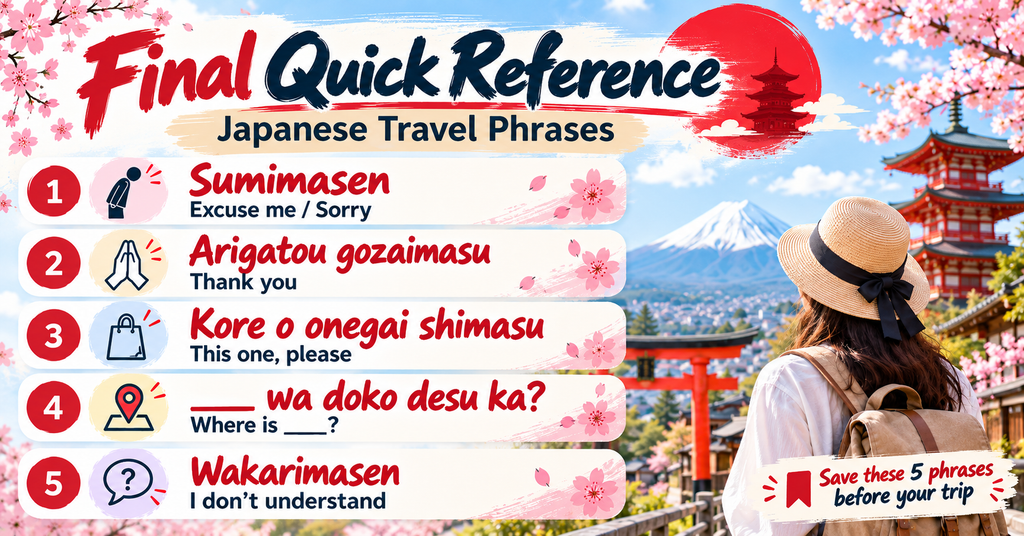
You do not need to memorize all 52 Japanese travel phrases before your trip.
Start with a few expressions that you are likely to use every day:
- Sumimasen — Excuse me
- Arigatou gozaimasu — Thank you
- Kore o onegai shimasu — This one, please
- ___ wa doko desu ka? — Where is ___?
- Wakarimasen — I don’t understand
Save this page on your phone before your trip so you can quickly find a phrase when you need it.
If speaking Japanese feels difficult, show the Japanese text directly, use a translation app, and keep your sentences simple.
A few words of Japanese can make everyday travel easier and can also lead to more enjoyable interactions during your time in Japan.
If this is your first visit, continue planning with our guide to 20 essential things to know before visiting Japan.