Food Allergies in Japan: What Travelers Need to Know
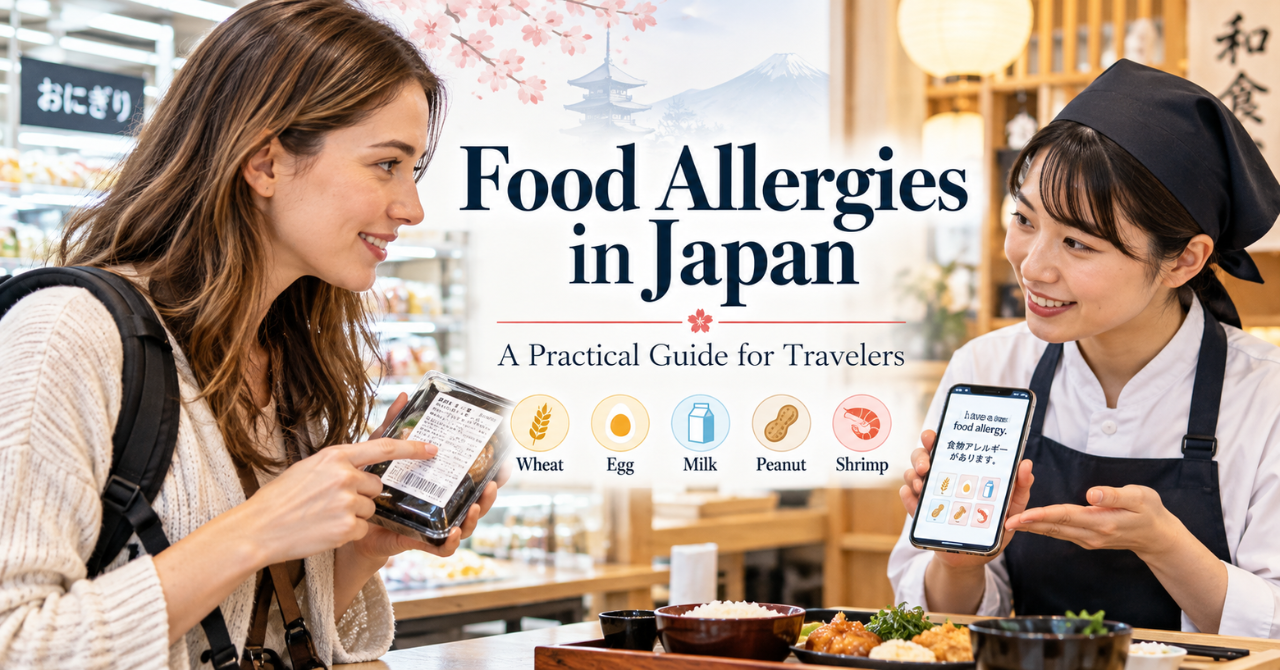
Traveling with a food allergy can make eating in a new country stressful. If you have food allergies in Japan, you may worry about reading labels, ordering at restaurants, or checking what is actually in a dish.
Japan has allergy labeling rules for packaged foods, but eating out can be more difficult. Restaurant menus do not always provide detailed allergy information, and ingredients such as soy, wheat, seafood, or nuts may be used in sauces, broths, and seasonings.
The good news is that a little preparation can make your trip much easier. In this guide, you will learn how allergy labeling works in Japan, how to communicate your allergy, which Japanese foods need extra attention, and what to do if you need help.
- Food Allergies in Japan: What Travelers Should Know First
- Common Food Allergens in Japan
- How Food Allergy Labeling Works in Japan
- How to Tell Restaurant Staff About Your Food Allergy
- Eating at Restaurants with Food Allergies in Japan
- Buying Food at Convenience Stores and Supermarkets
- Japanese Foods That Travelers with Allergies Should Check Carefully
- What to Do in an Allergic Emergency in Japan
- Tips for Traveling in Japan with Food Allergies
- Final Tips for Managing Food Allergies in Japan
Food Allergies in Japan: What Travelers Should Know First
Travelers with food allergies should know that allergy information is not provided in the same way everywhere in Japan.
Packaged processed foods sold in Japan have rules for allergen labeling. However, restaurants and many foods sold without packaging are not covered by the same mandatory allergen labeling requirements. Some restaurants provide allergy charts or ingredient information voluntarily, while others may have limited information available.
It is also important to think about cross-contact. A dish may not include your allergen as a main ingredient, but small amounts can sometimes be introduced during preparation or cooking.
If you have a serious food allergy, do not rely only on the appearance or name of a dish. Check available allergy information, clearly tell restaurant staff what you need to avoid, and ask questions when you are unsure. If the ingredients or preparation method cannot be confirmed, choosing another dish or restaurant may be the safer option.
Common Food Allergens in Japan
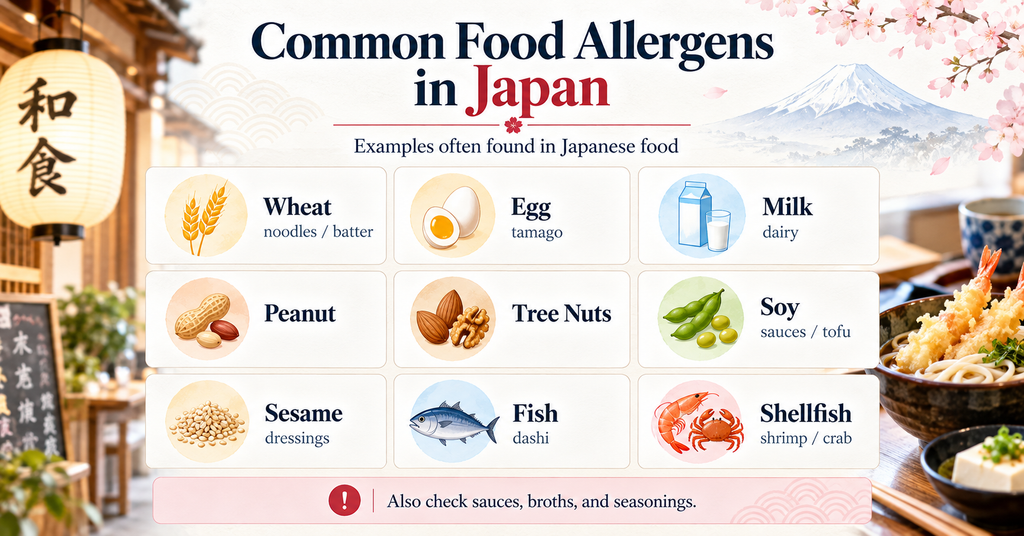
Many Japanese foods use ingredients such as wheat, soy, eggs, milk, seafood, sesame, and nuts.
Some allergens may also be found in sauces, broths, or seasonings, so they are not always obvious from the name or appearance of a dish.
Allergens You May Find in Japanese Food
As of April 1, 2026, Japan’s mandatory allergen list includes nine specified ingredients: shrimp, crab, walnut, wheat, buckwheat, egg, milk, peanut, and cashew nut.
However, the cashew nut change has a transition period through March 31, 2028. During this period, you may still encounter products that use labels based on the previous rules.
Other allergens have recommended labeling, but those labels are not mandatory.
For the latest allergen labeling rules, check the Consumer Affairs Agency’s official information on food allergy labeling.
Hidden Allergens in Sauces, Broths, and Seasonings
Always check sauces and seasonings as well as the main ingredients.
For example, soy sauce may contain wheat and soy, miso is usually made from soybeans, and some dashi broths contain fish.
Recipes can vary, so ask about the actual ingredients when you are unsure.
How Food Allergy Labeling Works in Japan
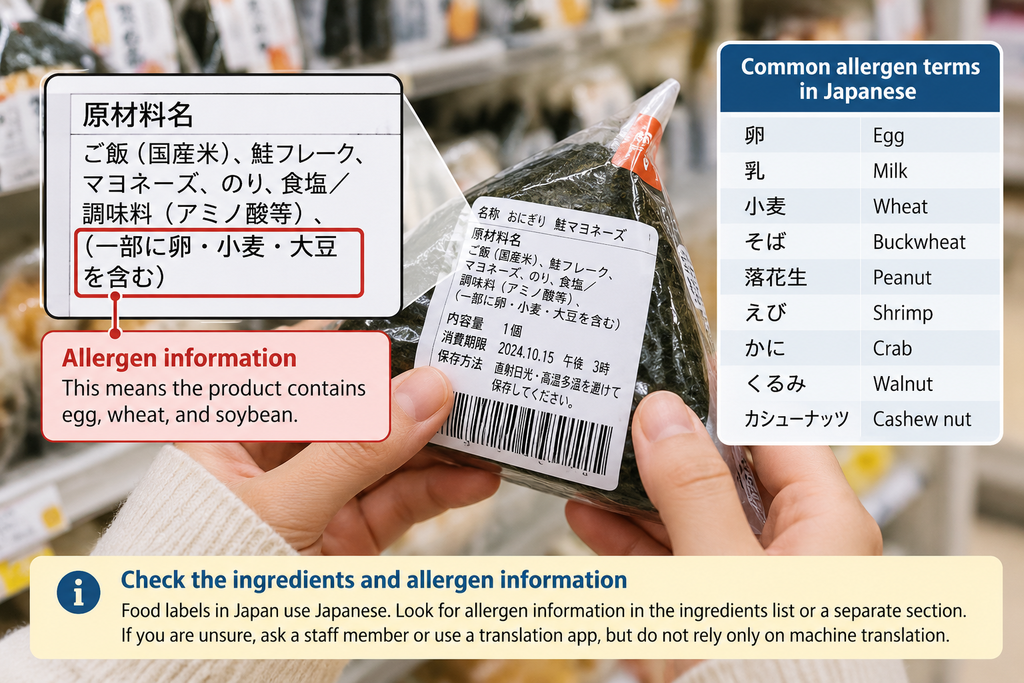
Japan has allergen labeling rules for packaged processed foods.
However, these rules do not apply in the same way to restaurant meals and some foods sold without packaging.
Travelers should understand this difference before checking food labels or ordering a meal.
Allergy Labels on Packaged Foods
Food businesses must identify nine specified allergens when they use them in packaged processed foods.
Food labels in Japan use Japanese, so travelers who cannot read Japanese may need help checking the ingredients.
The Consumer Affairs Agency also provides English information about Japan’s food labeling system.
Translation apps can also help you understand Japanese menus and food labels. See our guide to the best Japan travel apps for useful translation tools.
Use translation tools as support, but confirm the information if anything is unclear.
Why Restaurant Menus May Be Different
Restaurants do not follow the same mandatory allergen labeling rules as packaged processed foods.
Some restaurants voluntarily provide allergen charts or ingredient information, while others provide less detail.
Ask the staff directly if the menu does not give you enough information.
How to Tell Restaurant Staff About Your Food Allergy
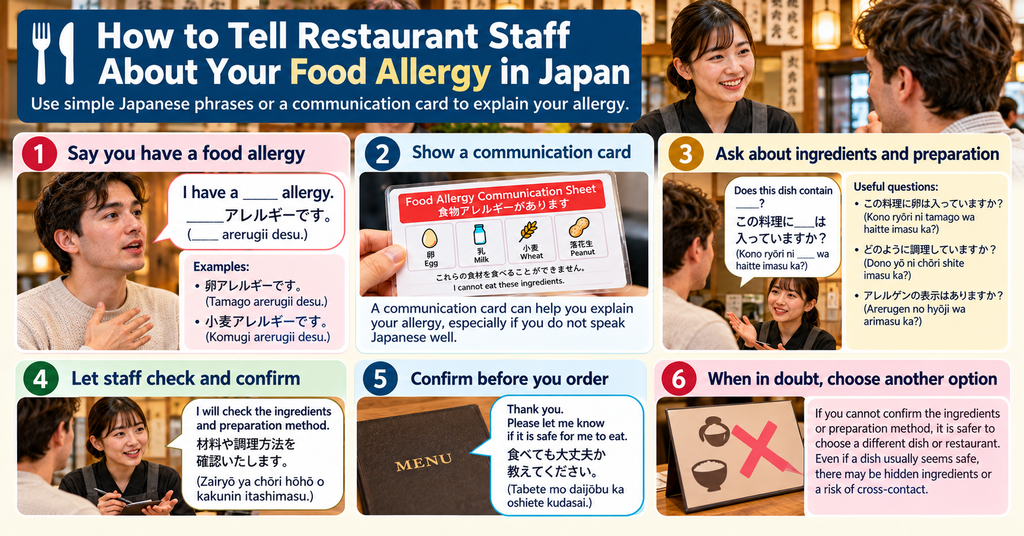
Tell the restaurant staff about your food allergy before you order.
Clearly name the ingredient you need to avoid.
Do not assume that staff will know about your allergy from the name of a dish alone.
If you have a serious allergy, explain it clearly and ask questions before choosing your meal.
Useful Japanese Phrases for Food Allergies
A few simple Japanese phrases can help you explain your allergy.
“I have a ___ allergy.”
「___アレルギーです。」
( ___arerugii desu.)
“Does this contain ___?”
「これは___が入っていますか?」
(Kore wa ___ ga haitte imasu ka?)
Always name the specific allergen instead of only saying that you have a food allergy.
For more everyday expressions, see our guide to useful Japanese phrases for travelers.
Use a Food Allergy Communication Card
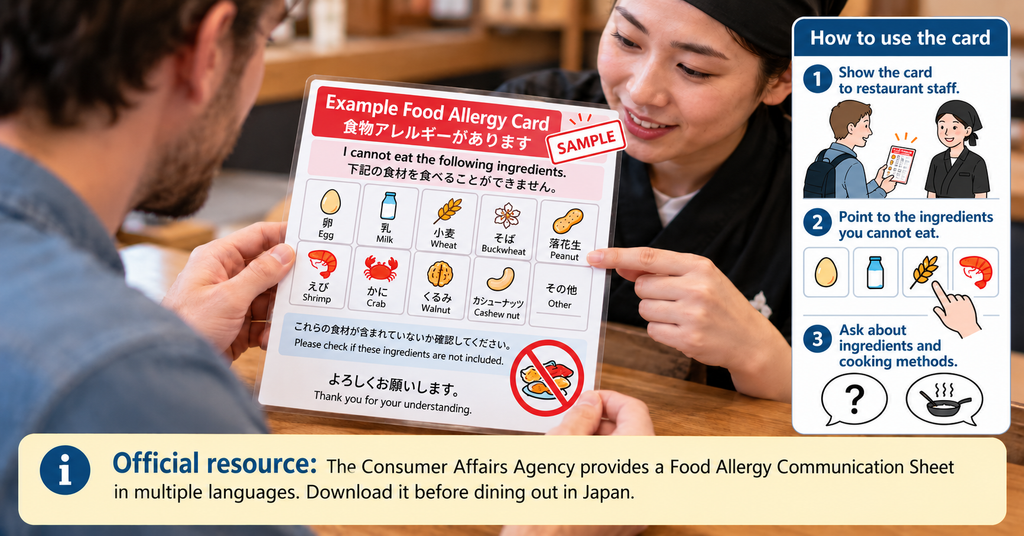
A food allergy communication sheet can make communication easier when you do not speak Japanese.
The Consumer Affairs Agency provides an English Food Allergy Communication Sheet that you can show to restaurant or store staff.
As of September 2026, the English sheet still shows the previous eight-item classification and lists cashew nut in the recommended group. Use it as a communication aid, and check the current official labeling information above for the latest mandatory list.
Download the sheet before your trip so you can use its check boxes properly.
Ask About Cross-Contact and Shared Cooking Equipment
Ingredients are not the only thing to check.
Restaurants may use the same fryers, grills, utensils, or preparation areas for different foods.
If even a small amount of your allergen can cause a reaction, ask the staff about shared cooking equipment and preparation methods.
If the restaurant cannot confirm how it prepares the food, do not assume that the dish is safe for you.
Eating at Restaurants with Food Allergies in Japan
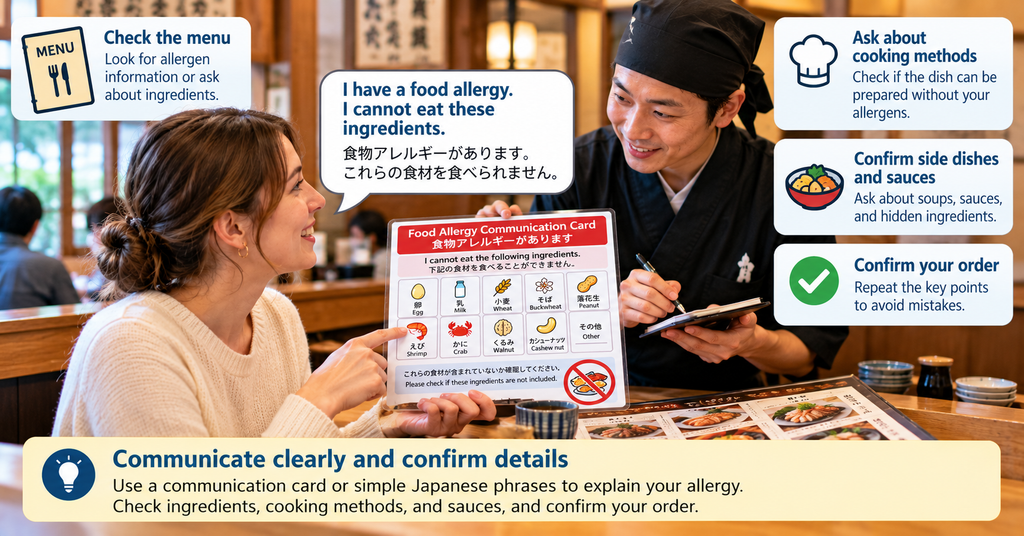
Eating out in Japan can require extra planning when you have a food allergy.
Restaurants vary in how much allergy information they provide.
Check the menu, talk to the staff, and make sure you have enough information before you order.
If you are new to dining in Japan, see our complete guide to eating at restaurants in Japan for more information about entering, ordering, and paying.
Choose Restaurants That Can Clearly Explain Ingredients
Look for restaurants that provide clear ingredient or allergen information.
Some restaurants publish allergen information on their menus or websites.
You can also contact a restaurant before visiting if you need detailed information about a dish.
If you want to contact or reserve a restaurant in advance, see our guide to booking restaurants in Japan without speaking Japanese.
Be Careful with Set Meals, Buffets, and Shared Dishes
Check every part of a set meal, not only the main dish.
Sauces, side dishes, soups, and dressings may contain ingredients that you need to avoid.
At buffets or when sharing food, serving utensils and nearby dishes may also create a risk of cross-contact.
What to Do If Staff Cannot Confirm the Ingredients
Do not guess when staff cannot confirm the ingredients or preparation method.
Choose another dish only if you can get the information you need.
If the restaurant cannot give you enough information, consider eating somewhere else.
Buying Food at Convenience Stores and Supermarkets
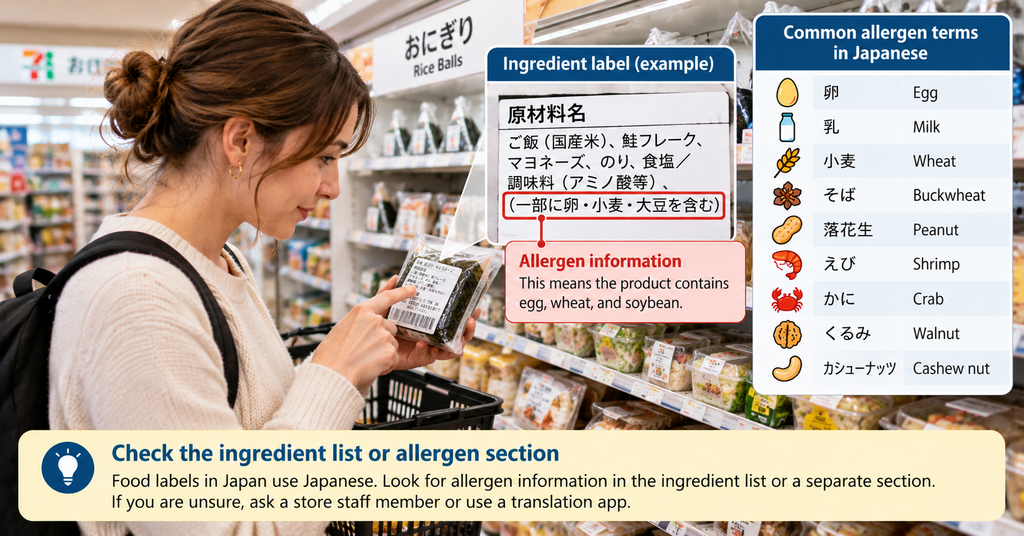
Convenience stores and supermarkets can make it easier to check food before you buy it.
Many packaged foods include ingredient and allergen information.
However, Japan requires food labels to use Japanese, so travelers may need help reading them.
Check the Ingredient and Allergy Labels
Check both the ingredient list and allergen information before buying packaged food.
Japan requires food businesses to identify the nine specified allergens when they use them in packaged processed foods.
Remember that Japan does not require mandatory labeling for every possible allergen.
If you cannot understand the label, ask for help rather than guessing.
Be Careful with Fresh and Prepared Foods
Take extra care with foods that do not have a full packaged-food label.
Bakery items, foods sold from display cases, and some freshly prepared foods may require you to ask the staff about ingredients.
Also ask about preparation methods if cross-contact could cause a reaction.
If you cannot confirm the information you need, choose another food.
Japanese Foods That Travelers with Allergies Should Check Carefully
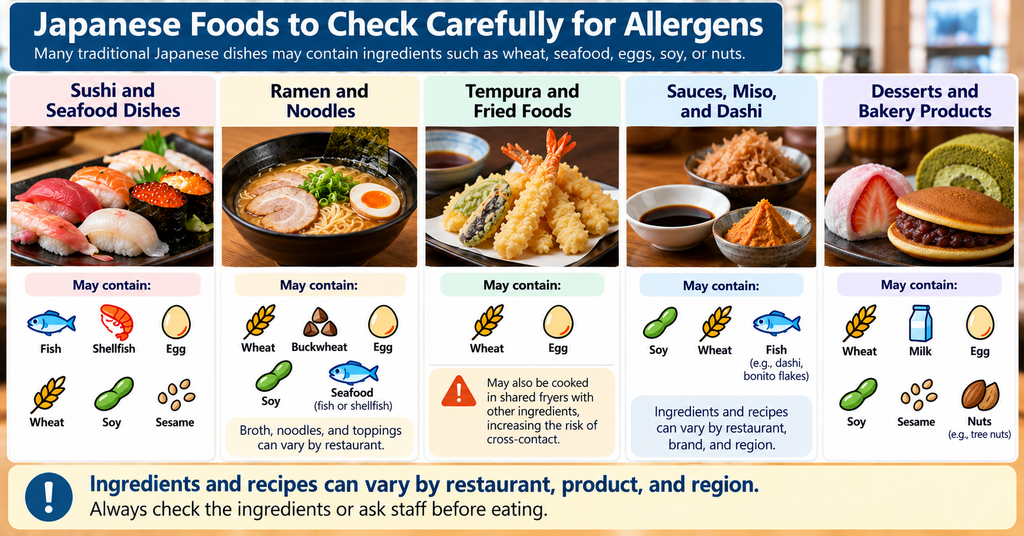
Japanese food can contain allergens in places you may not expect.
Broths, sauces, toppings, and seasonings can add ingredients that are not obvious from the appearance of a dish.
Recipes also vary between restaurants, so always check the actual ingredients when you have a food allergy.
Ramen and Noodles
Check the noodles, broth, sauce, and toppings separately.
Many ramen and udon noodles contain wheat. Soba noodles contain buckwheat and may also contain wheat.
Ramen broths and seasonings vary widely and may contain ingredients such as soy, wheat, seafood, sesame, or egg.
Ask the restaurant about the full dish and any shared cooking equipment if cross-contact is a concern.
Sushi and Seafood Dishes
Do not assume that sushi contains only rice and raw fish.
Sushi may include fish, shellfish, egg, soy, wheat, sesame, or other ingredients depending on the topping, sauce, and seasoning.
Soy sauce commonly contains soy and wheat, so check it separately if either is an allergen for you.
If cross-contact is a concern, ask how the restaurant prepares your order.
Tempura and Fried Foods
Check both the batter and the ingredients inside fried foods.
Tempura batter often contains wheat and may contain egg.
Restaurants may also use the same frying oil for different foods.
Ask about the batter, dipping sauce, and shared fryer if any of these could affect your allergy.
Sauces, Miso, and Dashi
Sauces and broths can contain allergens that are easy to overlook.
Soy sauce commonly contains soy and wheat, while miso usually contains soybeans.
Dashi can use ingredients such as bonito, dried sardines, or kelp. Restaurants may combine several ingredients in one broth.
Ask what the restaurant uses instead of assuming that every sauce or dashi has the same recipe.
Desserts and Bakery Products
Check desserts and bakery products carefully before eating them.
Bread, cakes, pastries, and other sweets may contain wheat, milk, egg, soy, sesame, or nuts.
Japanese sweets can also contain ingredients such as soybean flour, sesame, or nuts depending on the recipe.
Check the label or ask the staff about the specific product before you eat it.
What to Do in an Allergic Emergency in Japan
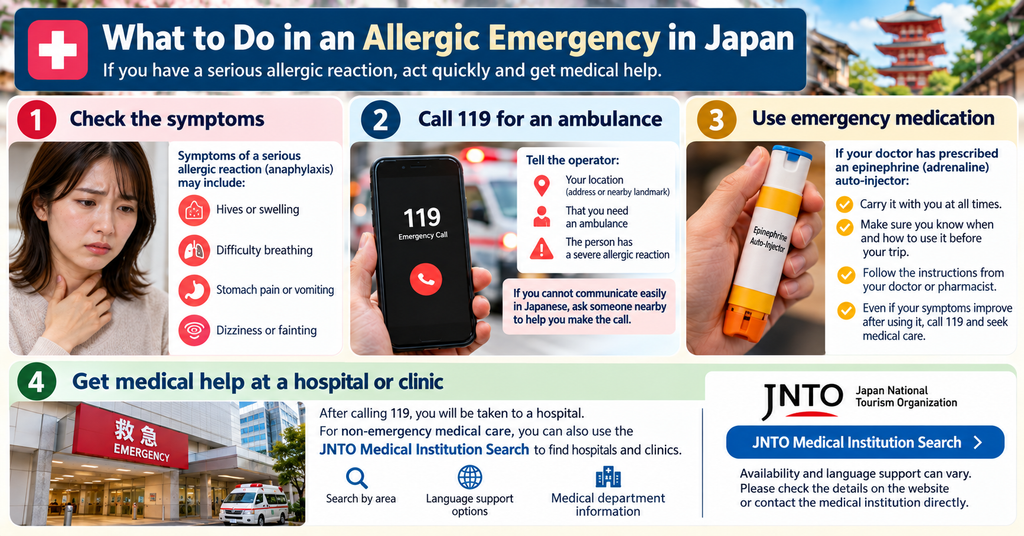
A severe allergic reaction can become an emergency very quickly.
Prepare before your trip so you know what to do and where to get help.
If you suspect anaphylaxis or develop severe symptoms, seek emergency medical help immediately.
Carry Your Medication with You
Keep any prescribed emergency allergy medication with you while traveling.
If your doctor has prescribed an epinephrine (adrenaline) auto-injector, make sure you know when and how to use it before your trip.
Follow the instructions from your doctor or pharmacist.
Also keep your allergy information somewhere easy to find in case you need help.
Call 119 in an Emergency
Call 119 if you need an ambulance in Japan.
Tell the operator where you are and that you need an ambulance.
If you use a prescribed epinephrine (adrenaline) auto-injector, call 119 and seek medical care even if your symptoms improve.
If you cannot communicate easily in Japanese, ask someone nearby to help you make the call.
The Fire and Disaster Management Agency provides an English guide explaining how to call an ambulance in Japan.
Get Help from Hotel Staff or People Nearby
Ask hotel staff, restaurant staff, or someone nearby for help if you have trouble communicating.
Show them your allergy card or medical information if you can.
For non-emergency medical care, you can also use JNTO’s Medical Institution Search to search by area, language, and medical department.
Availability and language support can vary, so check with the medical institution when possible.
Tips for Traveling in Japan with Food Allergies
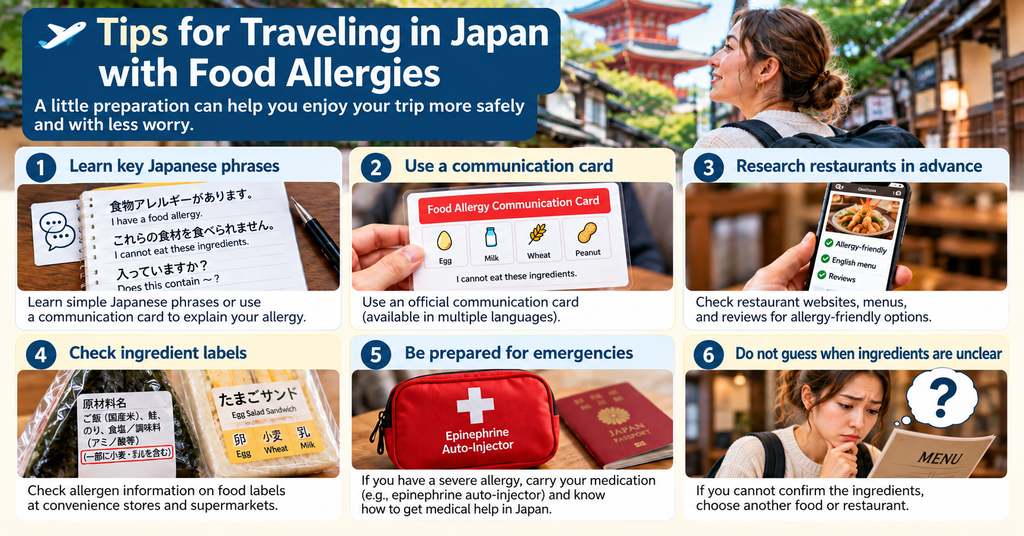
Prepare before you arrive in Japan.
Save a food allergy communication card on your phone and keep a backup copy that you can show to staff.
Research restaurants before visiting and check whether they provide allergen information.
Carry suitable snacks or food for situations where you cannot find a meal that meets your needs.
Keep your medication and emergency information with you whenever you go out.
Final Tips for Managing Food Allergies in Japan
Traveling in Japan with food allergies takes extra preparation, but clear communication can make a big difference.
Check labels carefully, ask questions at restaurants, and do not guess when you cannot confirm an ingredient.
Keep your allergy information and medication with you, and know how to get help in an emergency.
With the right preparation, you can enjoy Japanese food with more confidence during your trip.