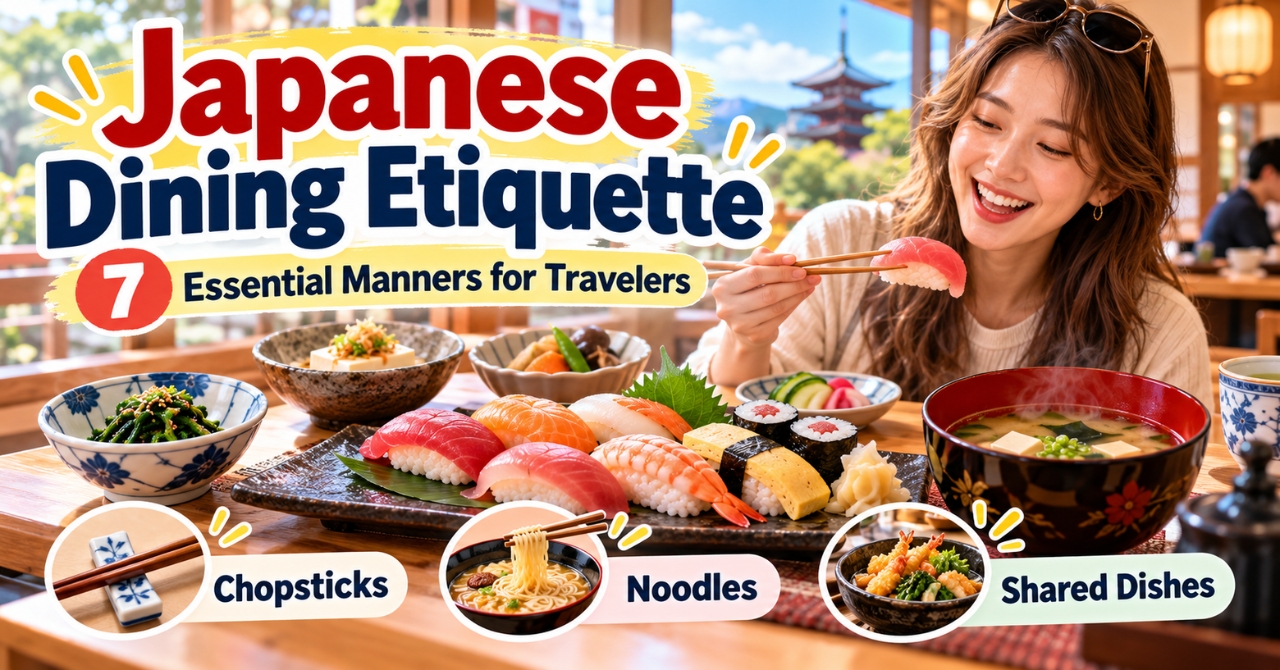
Japanese Dining Etiquette: 7 Essential Manners
Eating in Japan is one of the highlights of any trip, but some dining customs may feel unfamiliar at first.
Do you need to say “Itadakimasu”? Is it rude to slurp ramen? Can you eat sushi with your hands? And which chopstick habits should you avoid?
The good news is that Japanese dining etiquette is not about memorizing dozens of strict rules. For international visitors, a few basic manners are enough to help you feel comfortable and show consideration for the people around you.
In this guide, we explain seven essential Japanese dining manners, including oshibori, chopsticks, noodles, shared dishes, and food waste.
If you also want to learn how to enter, order, and pay at restaurants, see our complete guide to eating at restaurants in Japan.
From a Local Perspective: Japanese dining etiquette is less about performing every custom perfectly and more about avoiding a few obvious taboos and showing consideration for the people around you. Visitors are not expected to know every local habit.
- Japanese Dining Etiquette at a Glance
- What Is Japanese Dining Etiquette Really About?
- Use the Oshibori Mainly for Your Hands
- “Itadakimasu” and “Gochisousama” Are Appreciative Phrases
- Avoid the Most Important Chopstick Taboos
- Small Rice and Soup Bowls Are Commonly Held
- Slurping Noodles Is Okay — But You Do Not Have To
- Transfer Food from Shared Dishes to Your Own Plate
- Order What You Can Reasonably Finish
- Other Japanese Dining Customs Travelers Often Ask About
- Quick Japanese Dining Etiquette Checklist
- You Do Not Need Perfect Japanese Table Manners
- Final Tips
Japanese Dining Etiquette at a Glance
| Dining Custom | What to Know |
|---|---|
| Oshibori | Use it mainly to clean your hands |
| Itadakimasu | A phrase of appreciation before eating |
| Chopsticks | Avoid major funeral-related taboos |
| Small bowls | Rice and soup bowls are commonly held |
| Noodles | Slurping is acceptable but not required |
| Shared dishes | Transfer food to your own plate first |
| Food waste | Order a reasonable amount and avoid unnecessary leftovers |
What Is Japanese Dining Etiquette Really About?
Japanese dining manners are generally based on consideration, appreciation, cleanliness, and respect for the food and the people who prepared it.
You do not need perfect table manners to eat comfortably in Japan, and tourists are not expected to understand every traditional rule.
It is more useful to know a few important customs and then follow the atmosphere and instructions of the restaurant you are visiting.
Japanese food culture is also internationally recognized. Washoku, the traditional dietary cultures of Japan, was inscribed on UNESCO’s Representative List of the Intangible Cultural Heritage of Humanity in 2013.
You can learn more from the official UNESCO Washoku page.
Use the Oshibori Mainly for Your Hands
At many Japanese restaurants, you may receive an oshibori, or wet towel, shortly after sitting down.
It may be warm, cold, disposable, or made from cloth depending on the restaurant.
The main purpose of the oshibori is to clean your hands before eating.
Avoid using it to wipe the table. It is also generally better not to use it extensively on your face or neck, especially at more formal restaurants.
After using the oshibori, fold it loosely and place it beside your setting or back on its tray.
The JNTO guide to Japanese customs and etiquette also recommends using oshibori for your hands rather than your face.
“Itadakimasu” and “Gochisousama” Are Appreciative Phrases
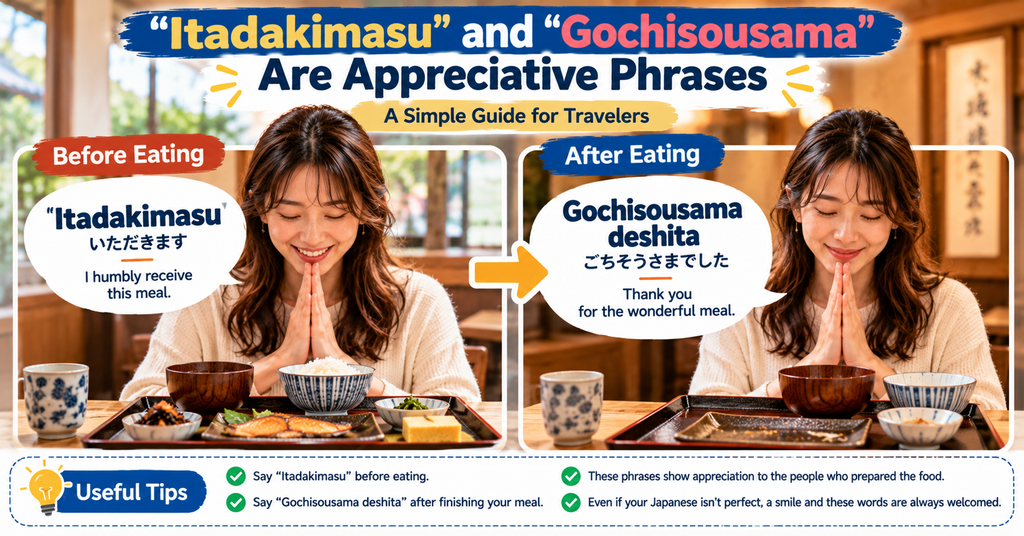
You may hear people in Japan say “Itadakimasu” before eating.
There is no perfect one-word English translation, but it is a way of expressing appreciation before beginning a meal.
After eating, you may hear:
“Gochisousama deshita.”
This expresses appreciation for the meal and may also be said to restaurant staff when leaving.
Do Tourists Have to Say Them?
No.
International visitors are not expected to say “Itadakimasu” or “Gochisousama deshita.”
However, if you would like to use them, doing so can be a nice way to participate in Japanese dining culture.
A simple “Arigatou gozaimasu” when leaving a restaurant is also perfectly appropriate.
Avoid the Most Important Chopstick Taboos
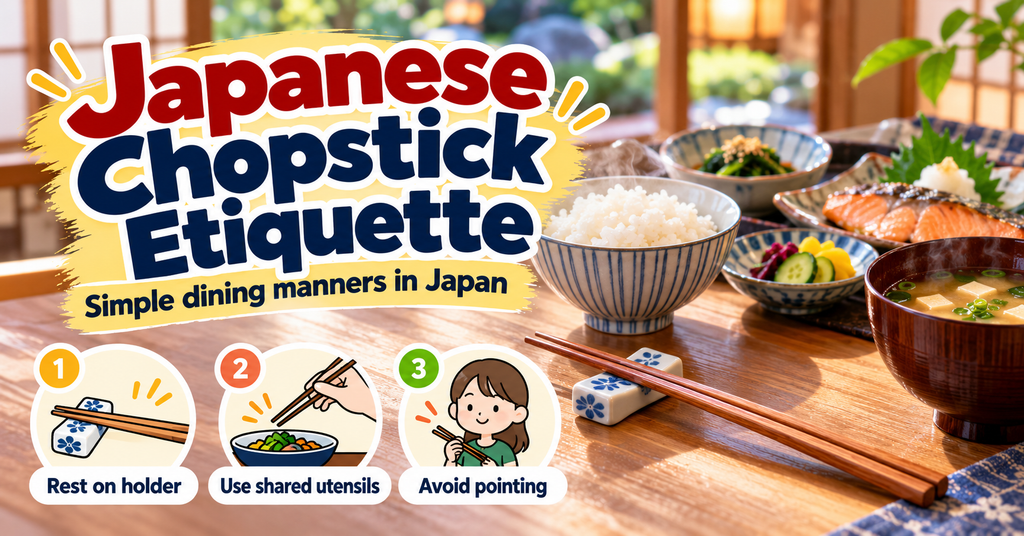
You do not need perfect chopstick technique to eat in Japan.
However, there are several important habits that are worth avoiding.
Do Not Stick Chopsticks Vertically into Rice
Never leave your chopsticks standing upright in a bowl of rice.
This resembles a practice associated with Japanese funeral rituals and is one of the best-known chopstick taboos.
Do Not Pass Food from Chopsticks to Chopsticks
Avoid directly passing a piece of food from your chopsticks to another person’s chopsticks.
This also resembles a ritual associated with Japanese funerals.
Do Not Point or Gesture with Chopsticks
Avoid pointing at people or objects with your chopsticks.
You should also avoid waving them around while talking or using them to pull dishes toward you.
Try Not to Stab Food
Chopsticks are designed to pick up food rather than spear it.
If something is difficult to pick up, do your best, but there is no need to panic if your chopstick skills are not perfect.
What If You Cannot Use Chopsticks?
You can ask whether a fork, spoon, or other utensil is available.
Some traditional restaurants may not have every type of Western cutlery, but asking politely is completely fine.
For an official explanation of Japanese table manners and chopstick etiquette, see the JNTO Japanese Food Etiquette guide.
Small Rice and Soup Bowls Are Commonly Held
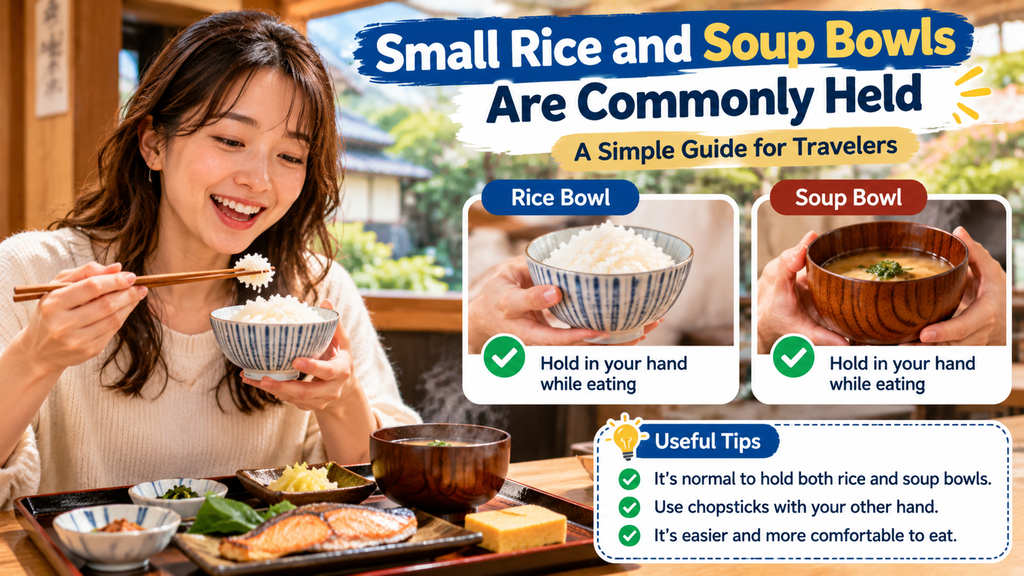
Japanese tableware may be used differently from what you are accustomed to at home.
Small bowls, especially rice bowls and miso soup bowls, are commonly lifted and held in one hand while eating.
This makes it easier to bring food toward your mouth without leaning far over the table.
Large plates, serving dishes, and heavier bowls are generally left on the table.
How Do You Drink Miso Soup?
Miso soup is traditionally served without a spoon at many Japanese restaurants.
You can lift the bowl with both or one hand and drink the soup directly from the bowl.
Use your chopsticks to eat tofu, vegetables, seaweed, or other solid ingredients.
Slurping Noodles Is Okay — But You Do Not Have To
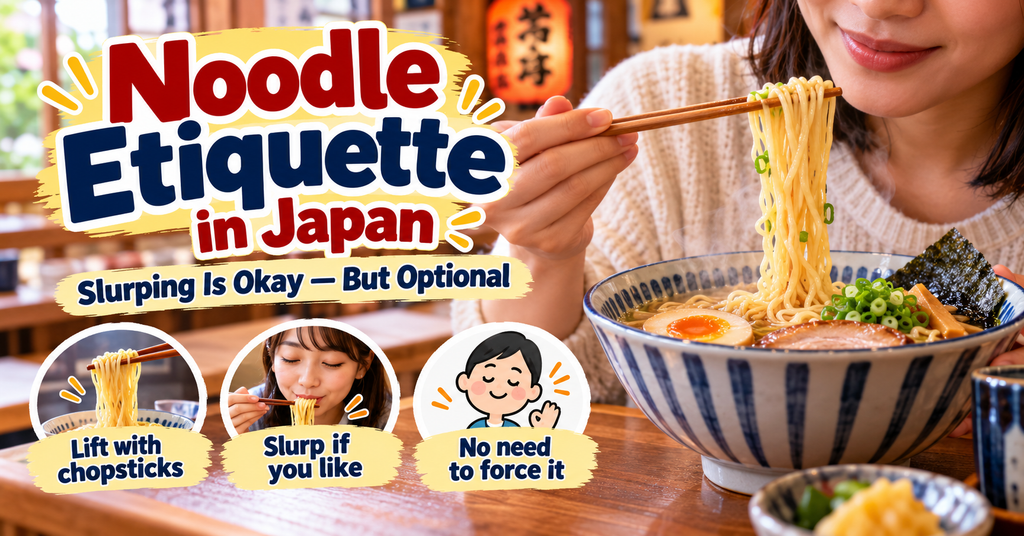
One of the dining customs that surprises many international visitors is noodle slurping.
At ramen, soba, and udon restaurants, it is common to hear people slurping their noodles.
In Japan, this is generally not considered rude.
However, you do not need to slurp your noodles.
If eating quietly feels more comfortable, that is completely fine too.
The important point is simply not to be surprised if the person sitting next to you is eating noodles much more loudly than you are used to.
JNTO also notes that slurping noodles is common in Japan, but whether you choose to slurp is up to you. See the official JNTO customs and manners guide.
Transfer Food from Shared Dishes to Your Own Plate
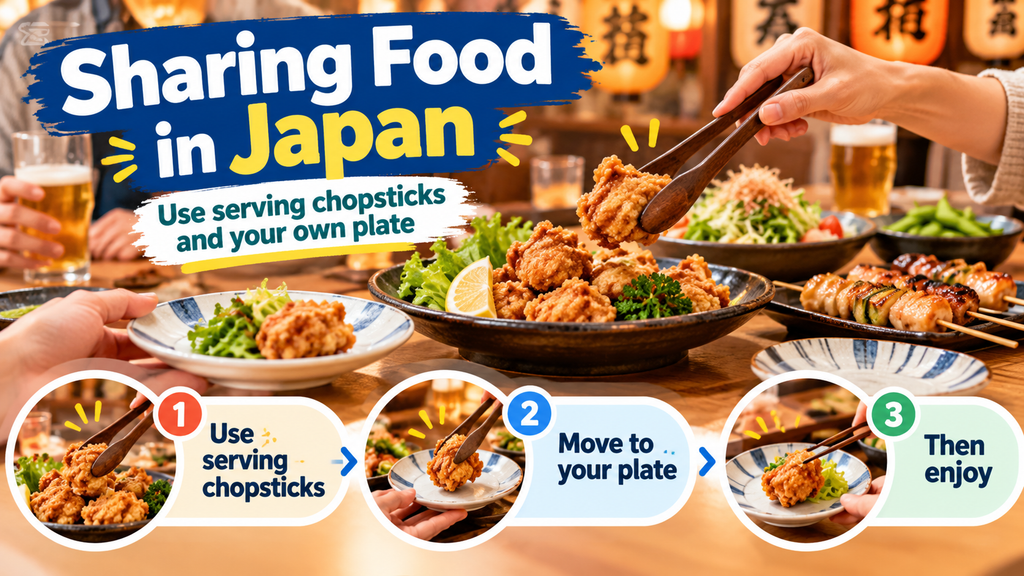
At izakaya, yakiniku restaurants, hot pot restaurants, and meals with friends, several dishes may be shared by everyone at the table.
Instead of repeatedly eating directly from a large communal dish, take a portion and place it on your own small plate first.
If serving chopsticks or other shared utensils are provided, use them.
This is especially useful when eating with a group and helps keep the meal comfortable for everyone.
At some casual restaurants, people may use their own chopsticks to take shared food depending on the group and situation. When dedicated serving utensils are provided, however, they are the safest and most considerate choice.
Order What You Can Reasonably Finish
Avoiding unnecessary food waste is generally appreciated in Japan.
This does not mean you must force yourself to finish food if you are full, unwell, or unable to eat an ingredient.
Instead, try to order a reasonable amount, especially when ordering several shared dishes at an izakaya or other restaurant.
You can always order additional dishes later at many casual restaurants.
What If You Have Allergies or Dietary Restrictions?
Never force yourself to eat something that may be unsafe for you simply because you are worried about etiquette.
If you have a serious allergy or dietary restriction, communicate it to the restaurant before ordering whenever possible.
Safety is more important than finishing every item on your plate.
Other Japanese Dining Customs Travelers Often Ask About
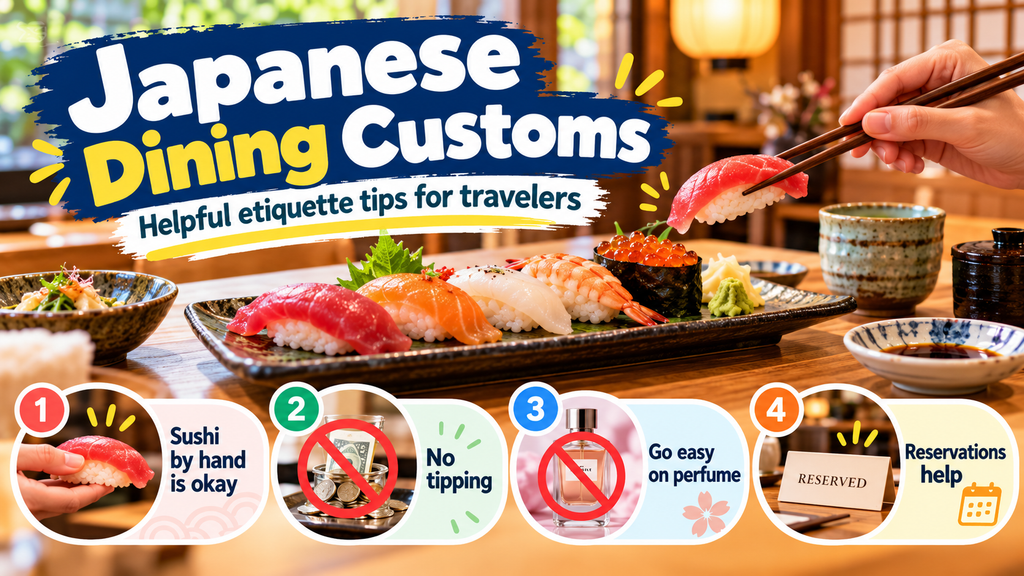
Can You Eat Sushi with Your Hands?
Yes.
Nigiri sushi can be eaten with either chopsticks or your hands.
You may see Japanese diners use both methods depending on the restaurant, the type of sushi, and personal preference.
Should You Tip at Japanese Restaurants?
In most Japanese restaurants, tipping is not expected.
You normally pay the amount shown on your bill without adding a percentage for the server.
Trying to leave cash on the table may occasionally create confusion because staff may think you accidentally left money behind.
For official information, see the JNTO guide to tipping in Japan.
Should You Avoid Strong Perfume?
At restaurants where delicate aromas are an important part of the experience — especially high-end sushi or kaiseki restaurants — strong perfume or heavily scented products can interfere with the food.
Some restaurants may specifically ask guests to avoid strong fragrances.
Even when there is no formal rule, keeping fragrance light is a considerate choice at small counter restaurants.
What About Restaurant Reservations?
If you make a reservation, arrive on time whenever possible.
Small restaurants may prepare ingredients and seats specifically for booked guests, so late cancellations and no-shows can create significant problems.
If your plans change, cancel according to the restaurant’s policy as early as possible.
For help making reservations, see our guide to booking restaurants in Japan without speaking Japanese.
Quick Japanese Dining Etiquette Checklist
| Do | Avoid |
|---|---|
| Use the oshibori for your hands | Wiping the table with it |
| Rest chopsticks properly | Sticking them vertically into rice |
| Lift small rice and soup bowls | Leaning far over the table unnecessarily |
| Eat noodles in the way that feels comfortable | Thinking you must slurp |
| Use serving utensils when provided | Eating repeatedly from communal dishes |
| Order a reasonable amount | Ordering excessive food that will be wasted |
| Pay the amount shown on your bill | Assuming you need to tip |
You Do Not Need Perfect Japanese Table Manners
Japanese dining etiquette may look complicated when you see a long list of rules online, but international visitors do not need to memorize everything.
The most useful things to remember are simple:
- Use the oshibori mainly for your hands.
- Avoid the major chopstick taboos.
- Slurping noodles is acceptable but optional.
- Be considerate when sharing food.
- Try not to order more than you can reasonably eat.
If you make a small mistake, there is no need to panic. Pay attention to the restaurant, follow staff instructions, and enjoy the experience.
For broader customs beyond restaurants, see our complete Japanese etiquette guide for tourists.
Final Tips
Food is one of the best ways to experience Japanese culture.
Learning a few dining manners can make your restaurant experience smoother, but etiquette should not stop you from enjoying your meal.
Observe the people around you, respect the restaurant’s rules, be considerate of other diners, and enjoy discovering everything from ramen and sushi to izakaya dishes and traditional Japanese cuisine.