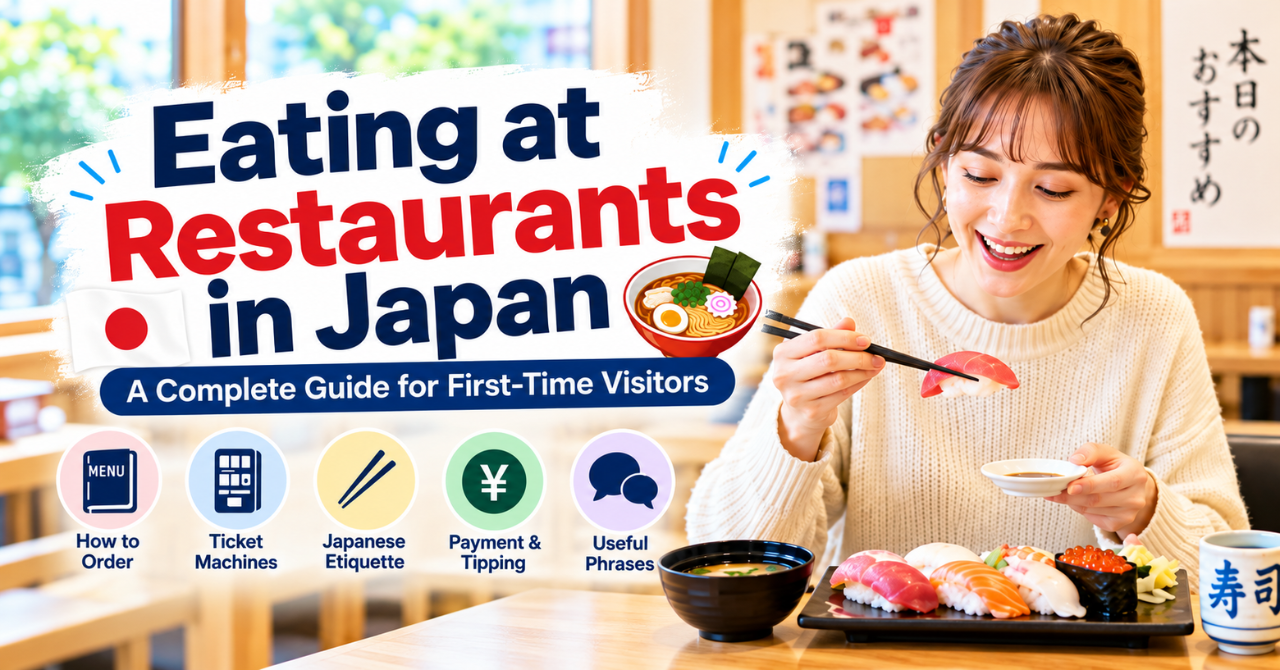
Eating at Restaurants in Japan: A Complete Guide for First-Time Visitors
- How to Enter Restaurants in Japan
- How to Order Food at Restaurants in Japan
- Restaurant Ticket Vending Machines in Japan
- Japanese Restaurant Etiquette
- Things That May Surprise You at Restaurants in Japan
- Paying at Restaurants in Japan
- Common Restaurant Mistakes to Avoid in Japan
- Final Tips for Eating at Restaurants in Japan
How to Enter Restaurants in Japan
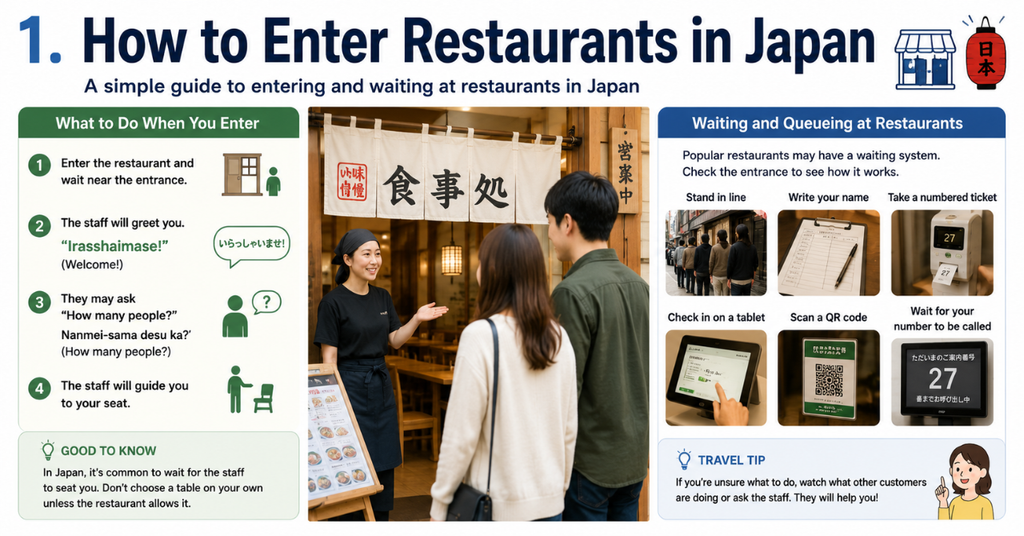
Entering a restaurant in Japan is usually simple, but the process may be a little different from what you’re used to.
At many restaurants, you don’t choose a table and sit down immediately. Instead, it’s common to wait near the entrance until a staff member greets you and shows you where to sit.
Knowing what to expect can make your first restaurant visit much easier.

What to Do When You Enter
When you enter a restaurant in Japan, wait near the entrance for a staff member rather than choosing a table yourself.
You may hear the staff say:
“Irasshaimase!” (いらっしゃいませ)
→ Welcome!
You don’t need to reply. It’s a standard greeting that customers hear when entering restaurants, shops, convenience stores, and many other businesses in Japan.
Next, the staff may ask how many people are in your group.
You might hear:
“Nanmei-sama desu ka?” (何名様ですか?)
→ How many people?
You can simply answer with the number or show the number with your fingers.
The staff will then usually guide you to your table or tell you where to sit.
Good to Know: In Japan, it’s generally better to wait for the staff to seat you unless the restaurant clearly indicates that you can choose your own seat.
Some restaurants may also have different seating options, such as counter seats, tables, or traditional tatami seating. Staff may ask which you prefer when more than one option is available.
Waiting and Queueing at Restaurants
Popular restaurants in Japan can have long lines, especially during lunch and dinner hours.
However, don’t assume that you should simply stand in line.
Depending on the restaurant, you may need to:
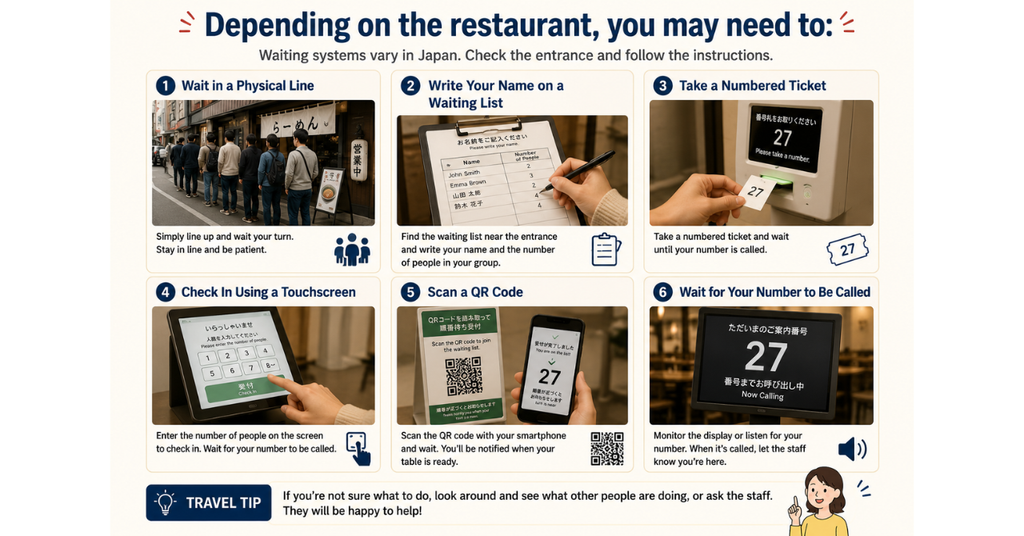
- Wait in a physical line
- Write your name on a waiting list
- Take a numbered ticket
- Check in using a touchscreen
- Scan a QR code and wait for your number to be called
Some restaurants and food courts use electronic waiting systems, so always check the entrance before joining a queue.
If there is a sign, ticket machine, tablet, or waiting list near the entrance, check it first.
Travel Tip: If you’re unsure what to do, simply wait near the entrance and watch what other customers are doing. Staff will usually help you with the next step.
Also, avoid blocking the entrance or forming your own line if a designated waiting area is provided.
Once your name or number is called, let the staff know you’re there and follow them to your seat.
Key Takeaway: When entering a restaurant in Japan, don’t rush to find your own table. Wait for the staff, check whether there is a queueing system, and follow the restaurant’s instructions.
How to Order Food at Restaurants in Japan
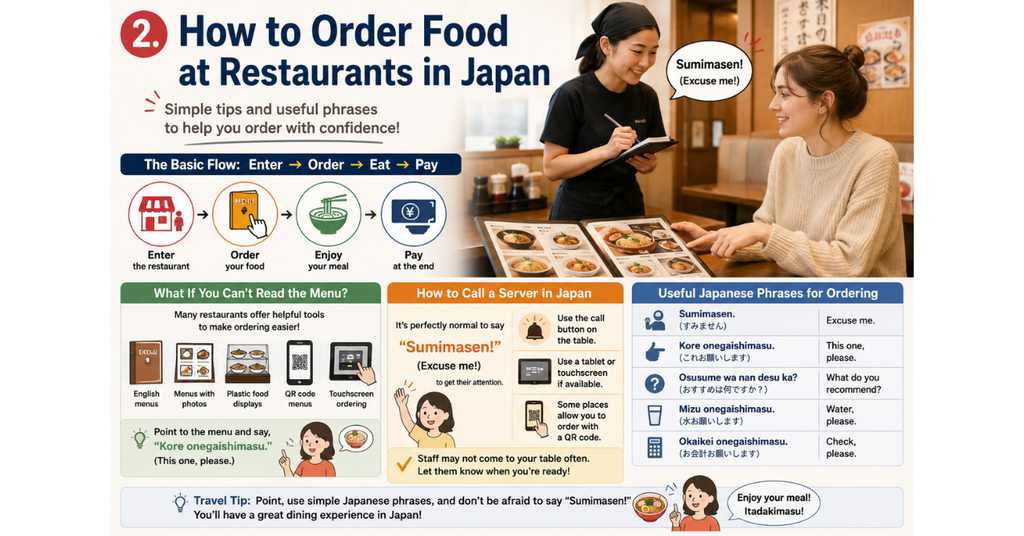
Ordering food at a restaurant in Japan may seem intimidating if you don’t speak Japanese, but in many cases, it’s easier than you might expect.
Restaurants in tourist areas often provide pictures, English menus, touchscreen ordering systems, or other tools that make ordering easier for international visitors.
And even when an English menu isn’t available, a few simple Japanese phrases can go a long way.
What If You Can’t Read the Menu?
Don’t panic if the menu is entirely in Japanese.
Depending on the restaurant, you may find:
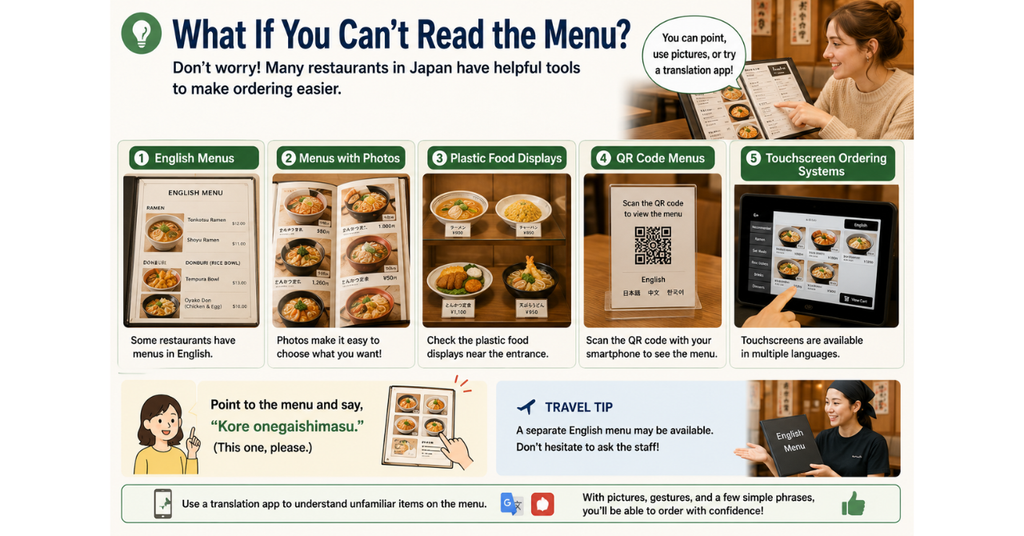
- English menus
- Menus with photos
- Plastic food displays near the entrance
- QR code menus
- Touchscreen ordering systems with multiple languages
Photos can be especially helpful. If you see what you want, pointing to the menu and saying:
“Kore onegaishimasu.” (これお願いします)
→ “This one, please.”
is usually enough.
You can also use a translation app on your smartphone to understand unfamiliar menu items.
Travel Tip: Before ordering, check whether the restaurant has an English or picture menu. Sometimes a separate English menu is available even if the one on your table is only in Japanese.
How to Call a Server in Japan
Here’s something that may surprise first-time visitors:
It’s perfectly normal to call out “Sumimasen!” to get a server’s attention in Japan.
At many Japanese restaurants, staff won’t continuously come to your table to check whether you’re ready to order.
When you’re ready, you can say:
“Sumimasen!” (すみません!)
→ “Excuse me!”
You don’t need to shout, but saying it clearly enough for the staff to hear is completely normal and isn’t considered rude.
Some restaurants also have a call button on the table.
Simply press the button when you’re ready to order, and a staff member will come to your table.
Other restaurants may use tablets, QR codes, or touchscreen systems that allow you to order without calling a server at all.
Good to Know: Don’t worry if the server doesn’t come back to your table immediately after giving you the menu. In many Japanese restaurants, customers let the staff know when they’re ready.
Useful Japanese Phrases for Ordering
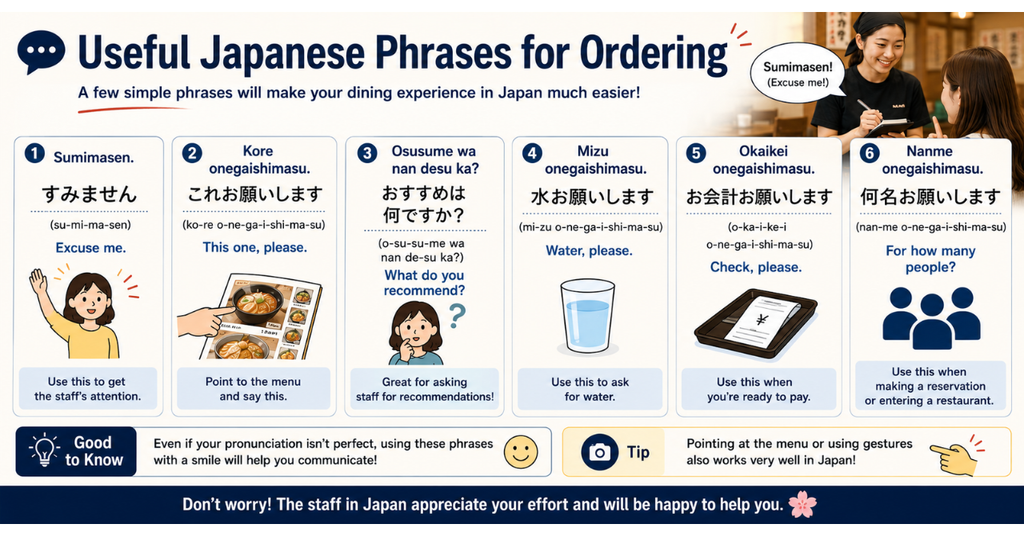
You don’t need to speak Japanese fluently to order food.
A few simple phrases can make the experience much easier:
Sumimasen. (すみません)
→ Excuse me.
Kore onegaishimasu. (これお願いします)
→ This one, please.
Osusume wa nan desu ka? (おすすめは何ですか?)
→ What do you recommend?
Mizu onegaishimasu. (水お願いします)
→ Water, please.
Okaikei onegaishimasu. (お会計お願いします)
→ Check, please.
Even if your pronunciation isn’t perfect, pointing at the menu while using a simple phrase can help communicate what you want.
Key Takeaway: You don’t need perfect Japanese to order at restaurants in Japan. Use pictures, point to the menu, learn a few simple phrases, and don’t be afraid to say “Sumimasen!” when you need the staff.
Restaurant Ticket Vending Machines in Japan
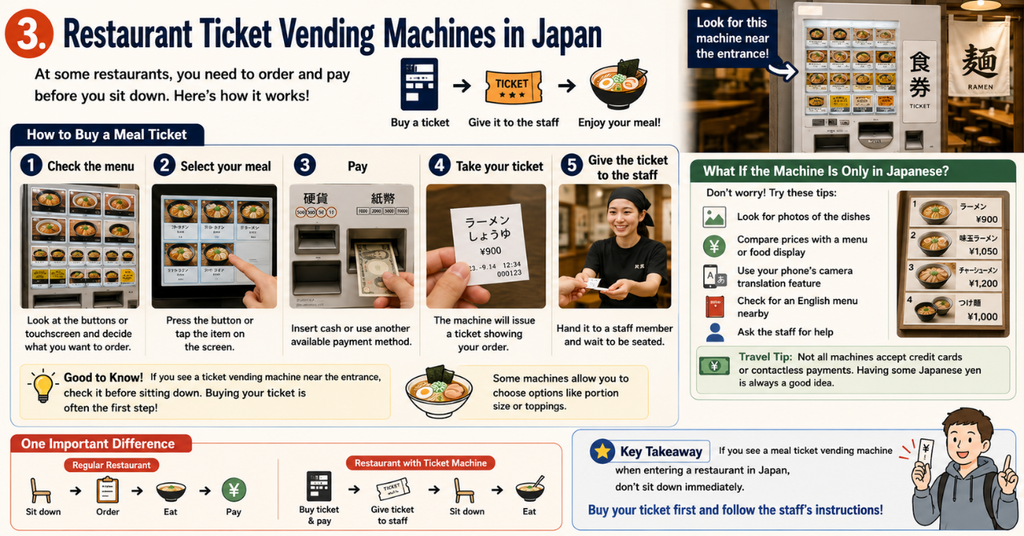
At some restaurants in Japan, you may need to order and pay for your meal before you sit down.
Instead of giving your order directly to a server, you first buy a meal ticket from a vending machine near the entrance.
This system is especially common at some ramen, soba, udon, curry, and other casual restaurants.
It may look confusing at first, but once you understand the basic process, it’s usually quite simple.
How to Buy a Meal Ticket
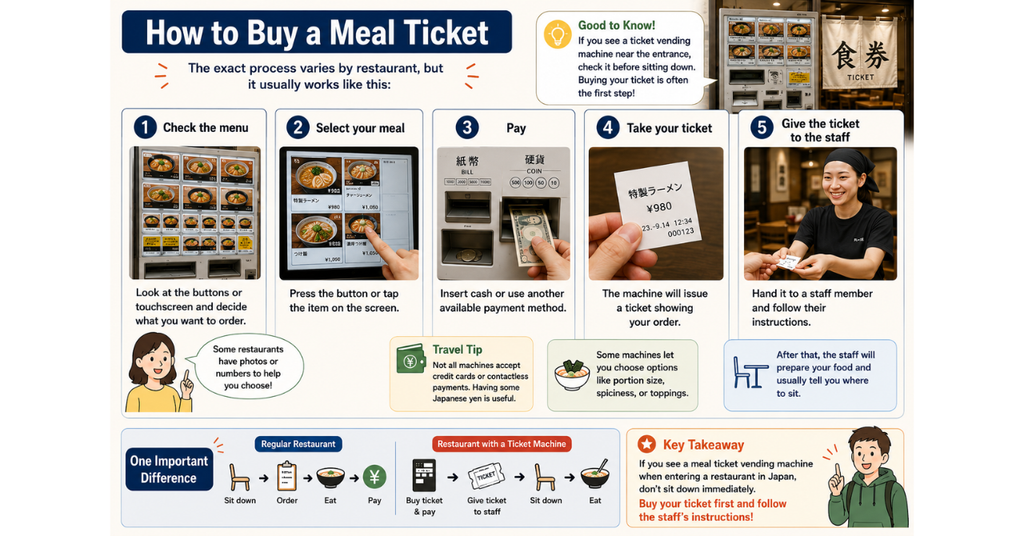
The exact process varies by restaurant, but it usually works like this:
1. Check the menu
Look at the buttons or touchscreen and decide what you want to order.
2. Select your meal
Press the button or tap the item on the screen.
3. Pay
Insert cash or use another available payment method.
4. Take your meal ticket
The machine will issue a ticket showing your order.
5. Give the ticket to the staff
Hand it to a staff member or follow the restaurant’s instructions.
After that, the staff will prepare your food and usually tell you where to sit.
Some restaurants may ask you to choose extras such as portion size or toppings when using the machine.
Good to Know: If you see a ticket vending machine near the entrance, check it before sitting down. At these restaurants, buying your ticket is often the first step.
Japanese Restaurant Etiquette
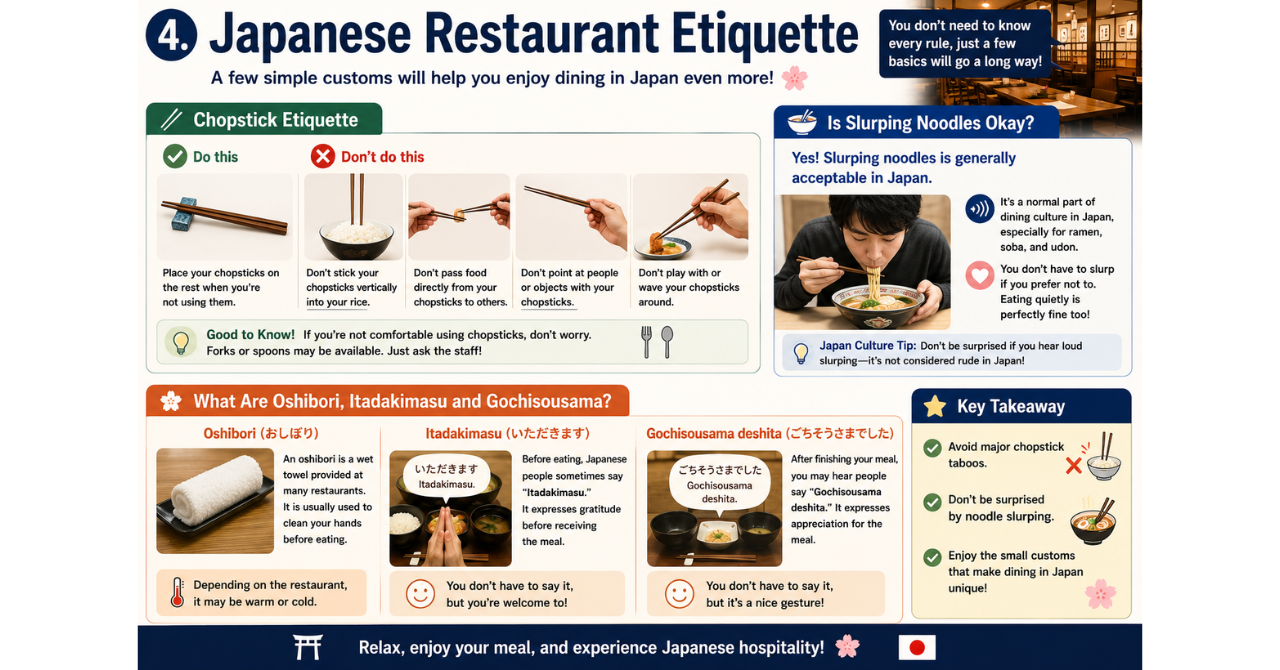
Dining etiquette in Japan is generally not difficult, and tourists are not expected to know every rule.
However, learning a few basic customs can help you feel more comfortable and avoid some common mistakes.
Some Japanese dining habits may even be very different from what you’re used to — especially when it comes to chopsticks and noodles.
Chopstick Etiquette
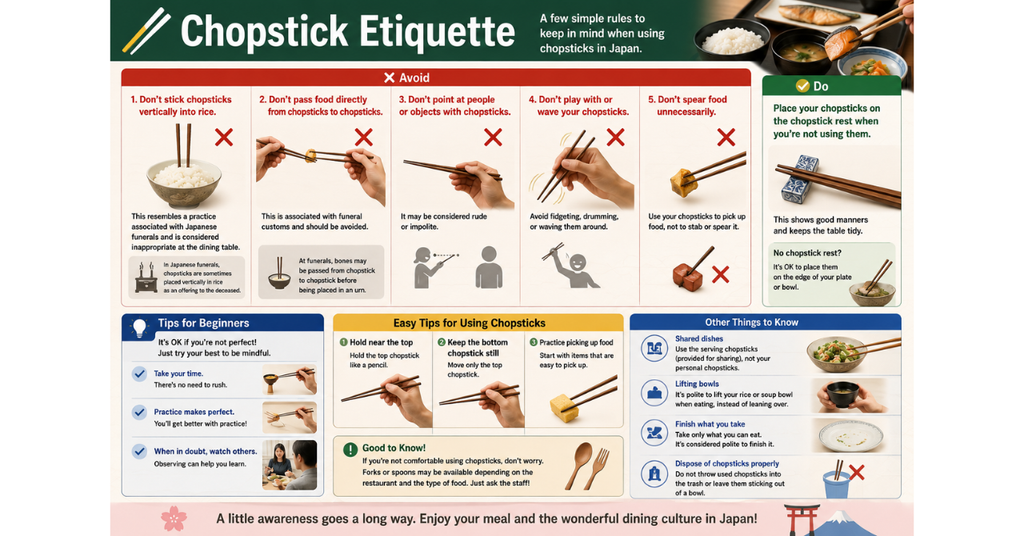
Chopsticks are commonly used at restaurants throughout Japan.
You don’t need perfect chopstick skills, but there are a few important things you should avoid.
Don’t stick your chopsticks vertically into a bowl of rice.
This resembles a practice associated with Japanese funerals and is considered inappropriate at the dining table.
You should also avoid:
- Passing food directly from your chopsticks to another person’s chopsticks
- Pointing at people or objects with your chopsticks
- Playing with or waving your chopsticks around
- Spearing food unnecessarily with your chopsticks
When you’re not using them, place your chopsticks on the chopstick rest if one is provided.
Good to Know: If you’re not comfortable using chopsticks, don’t worry. Depending on the restaurant and the type of food, forks or spoons may be available. You can simply ask the staff.
Is Slurping Noodles Okay?
Yes! Slurping noodles is generally acceptable in Japan.
When eating ramen, soba, or udon, you may hear people making noticeable slurping sounds.
Unlike in some countries where eating loudly may be considered rude, slurping noodles is a normal part of dining culture in Japan.
However, you don’t have to slurp.
If you prefer to eat your noodles quietly, that’s completely fine too.
Japan Culture Tip: Don’t worry if the person next to you is loudly slurping their ramen — they’re probably not being rude!
What Are Oshibori, Itadakimasu and Gochisousama?
There are a few small dining customs you may notice shortly after entering a restaurant.
Oshibori (おしぼり)
An oshibori is a wet towel provided at many restaurants.
It is usually used to clean your hands before eating.
Depending on the restaurant, it may be warm or cold.
Itadakimasu (いただきます)
Before eating, Japanese people sometimes say:
“Itadakimasu.”
There isn’t a perfect English translation, but it’s a way of expressing appreciation before beginning a meal.
As a tourist, you don’t have to say it, but you’re welcome to.
Gochisousama deshita (ごちそうさまでした)
After finishing your meal, you may hear people say:
“Gochisousama deshita.”
It expresses appreciation for the meal and is sometimes said to restaurant staff when leaving.
Again, tourists aren’t required to say it, but using it can be a nice gesture.
Key Takeaway: You don’t need to memorize every Japanese dining rule. Avoid the major chopstick taboos, don’t be surprised by noodle slurping, and enjoy experiencing the small customs that make dining in Japan unique.
Things That May Surprise You at Restaurants in Japan
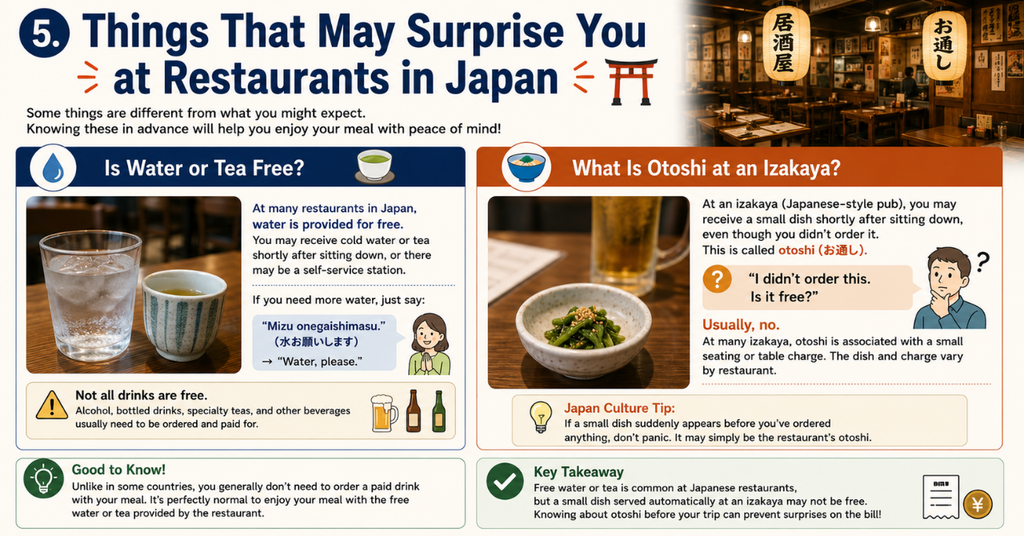
Dining at restaurants in Japan comes with a few customs that may surprise first-time visitors.
Some things that seem unusual at first — such as receiving a small dish you didn’t order — are simply a normal part of Japanese dining culture.
Knowing about them beforehand can help you avoid confusion when the bill arrives.
Is Water or Tea Free?
At many restaurants in Japan, water is provided for free.
Depending on the restaurant, you may receive cold water or tea shortly after sitting down, or there may be a self-service water station.
If you need more water, you can say:
“Mizu onegaishimasu.” (水お願いします)
→ “Water, please.”
However, don’t assume that every drink on the table is free.
Alcohol, bottled drinks, specialty teas, and other beverages usually need to be ordered and paid for.
Good to Know: Unlike in some countries, you generally don’t need to order a paid drink with your meal. It’s perfectly normal to eat your meal with the complimentary water or tea provided by the restaurant.
What Is Otoshi at an Izakaya?
If you visit an izakaya — a Japanese-style pub — you may receive a small dish shortly after sitting down, even though you didn’t order it.
This is called otoshi (お通し).
For first-time visitors, this can be confusing:
“I didn’t order this. Is it free?”
Usually, no.
At many izakaya, otoshi is associated with a small seating or table charge. The dish and charge vary by restaurant.
Think of it less like a free appetizer and more like part of the restaurant’s seating system.
This is a normal practice at many izakaya and isn’t necessarily a mistake on your bill.
Japan Culture Tip: If a small dish suddenly appears at an izakaya before you’ve ordered anything, don’t panic. It may simply be the restaurant’s otoshi.
Policies vary between restaurants, so if you’re unsure about the charge, it’s okay to ask the staff before ordering.
Key Takeaway: Free water or tea is common at Japanese restaurants, but a small dish served automatically at an izakaya may not be free. Knowing about otoshi before your trip can prevent one of the most common restaurant surprises in Japan.
Paying at Restaurants in Japan
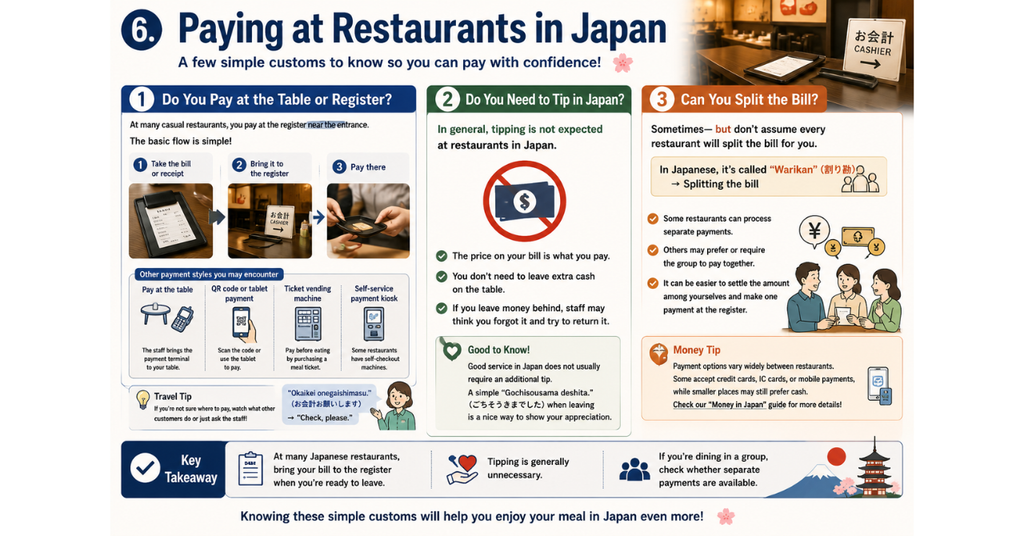
Paying at restaurants in Japan can be slightly different from what you’re used to.
At many restaurants, you pay at the register near the entrance instead of paying at your table. Payment methods also vary by restaurant, so it’s helpful to check before ordering.
Do You Pay at the Table or Register?
At many casual restaurants in Japan, the staff will leave a small bill or receipt at your table.
When you’re ready to leave:
1. Take the bill or receipt
2. Bring it to the register
3. Pay there
The register is often located near the restaurant entrance.
However, this isn’t universal. Some restaurants may:
- Bring the payment terminal to your table
- Ask you to pay at the table
- Use a QR code or tablet for payment
- Require payment before eating, such as at restaurants with ticket vending machines
Travel Tip: If you’re unsure where to pay, watch what other customers do or simply ask the staff:
“Okaikei onegaishimasu.” (お会計お願いします)
→ “Check, please.”
Do You Need to Tip in Japan?
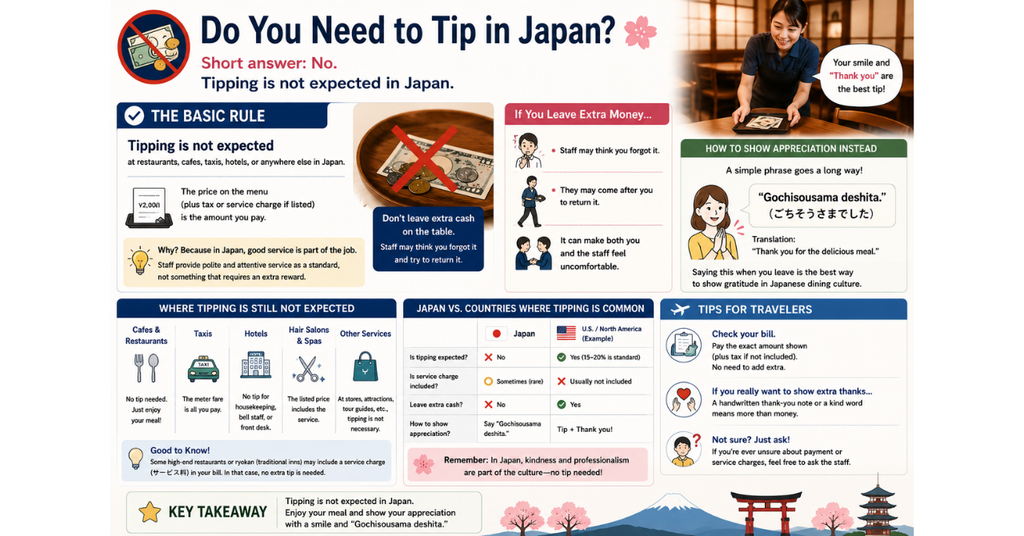
In general, tipping is not expected at restaurants in Japan.
The price on your bill is normally what you pay, although some restaurants may have separate service charges or other fees.
You don’t need to leave extra cash on the table for your server.
In fact, if you accidentally leave money behind, staff may think you forgot it and try to return it to you.
This can be surprising for visitors from countries where tipping is customary.
Good to Know: Good service in Japan does not usually require an additional tip. A simple:
“Gochisousama deshita.” (ごちそうさまでした)
when leaving is a nice way to show your appreciation.
Can You Split the Bill?
Sometimes — but don’t assume every restaurant will split the bill for you.
In Japanese, splitting the bill is often called:
“Warikan” (割り勘)
→ Splitting the bill
Some restaurants can process separate payments, while others may prefer or require the group to pay together.
If you’re dining with several people, it can be easier to settle the amount among yourselves and make one payment at the register.
Policies vary, so ask the staff if you’re unsure.
Money Tip: Payment options vary widely between restaurants. Some accept credit cards, IC cards, or mobile payments, while smaller establishments may still prefer cash.
For a detailed explanation of cash, cards, IC cards, ATMs, and mobile payments, see our Money in Japan guide.
Key Takeaway: At many Japanese restaurants, bring your bill to the register when you’re ready to leave. Tipping is generally unnecessary, and if you’re dining in a group, check whether separate payments are available.
Common Restaurant Mistakes to Avoid in Japan
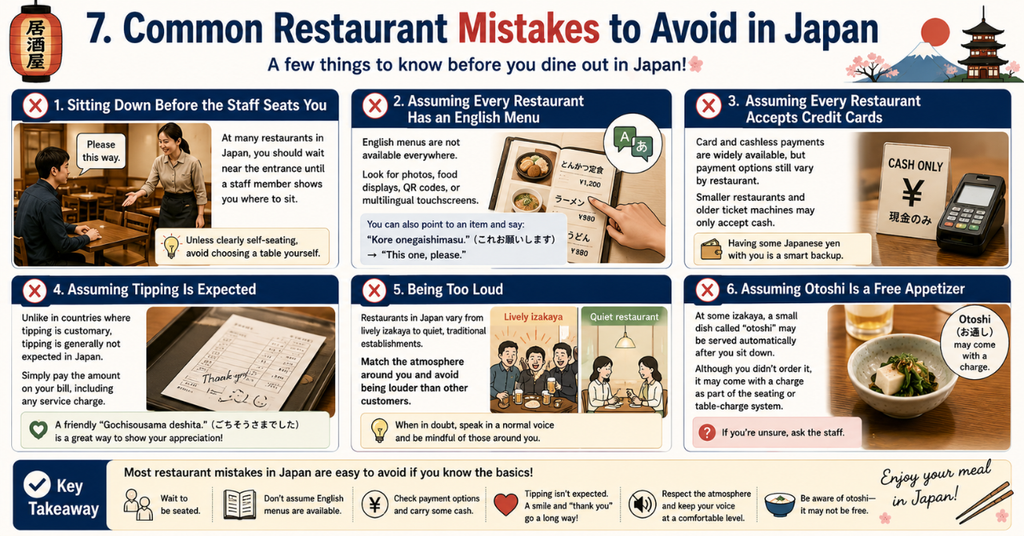
Japanese restaurants are generally easy to use once you know the basic customs.
However, first-time visitors sometimes make small mistakes simply because restaurant etiquette and payment systems can be different from those in their home countries.
Here are some common mistakes to avoid.
❌ Sitting Down Before the Staff Seats You
At many restaurants in Japan, you should wait near the entrance until a staff member shows you where to sit.
Unless the restaurant clearly indicates self-seating, avoid choosing a table yourself.
❌ Assuming Every Restaurant Has an English Menu
English menus are becoming more common, especially in popular tourist areas, but they aren’t available everywhere.
If you can’t read the menu, look for photos, food displays, QR codes, or multilingual touchscreen options.
You can also point to an item and say:
“Kore onegaishimasu.” (これお願いします)
→ “This one, please.”
❌ Assuming Every Restaurant Accepts Credit Cards
Card and cashless payments are widely available, but payment options still vary by restaurant.
Smaller restaurants and older ticket vending machines may have more limited payment options.
Having some Japanese yen with you can be useful as a backup.
❌ Assuming Tipping Is Expected
Unlike in countries where tipping is customary, tipping is generally not expected at restaurants in Japan.
Simply pay the amount on your bill, including any applicable service charges.
A friendly:
“Gochisousama deshita.” (ごちそうさまでした)
is a great way to show your appreciation after the meal.
❌ Being Too Loud
Restaurants in Japan vary from lively izakaya to quiet traditional establishments, so there isn’t one universal rule about noise.
However, it’s a good idea to match the atmosphere around you and avoid being noticeably louder than other customers.
❌ Assuming Otoshi Is a Free Appetizer
At some izakaya, a small dish called otoshi may be served automatically after you sit down.
Although you didn’t order it, it may come with a charge as part of the restaurant’s seating or table-charge system.
If you’re unsure, ask the staff.
Key Takeaway: Most restaurant mistakes in Japan are easy to avoid. Wait to be seated, don’t assume English menus or cashless payment are always available, remember that tipping isn’t generally expected, and be aware of customs such as otoshi.
Final Tips for Eating at Restaurants in Japan
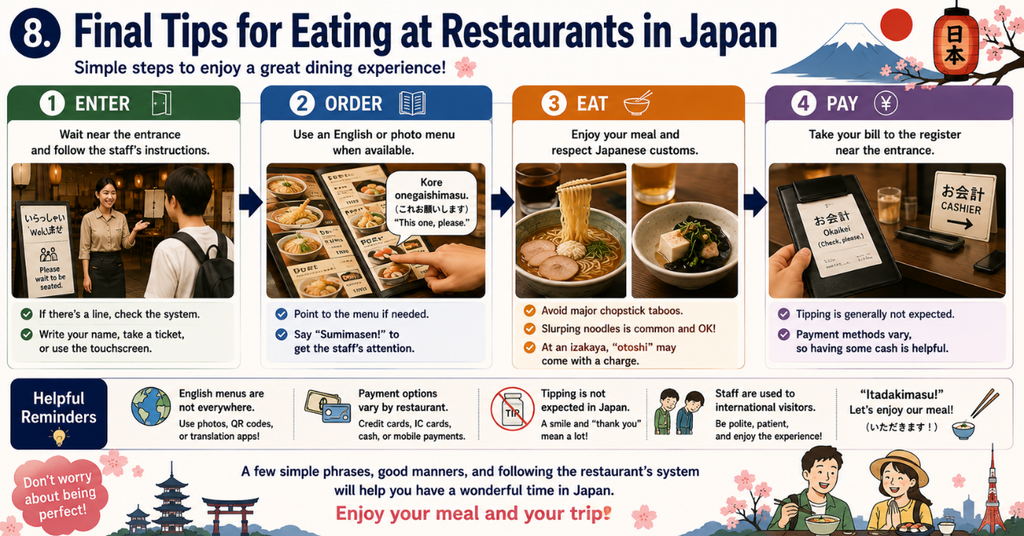
Eating at restaurants in Japan may feel a little unfamiliar at first, but most dining customs are easy to understand once you know the basics.
You don’t need to memorize every rule or speak fluent Japanese.
Just remember this simple flow:
Enter → Order → Eat → Pay
① Enter
Wait near the entrance and follow the staff’s instructions. If there’s a queue, check whether you need to write your name, take a ticket, or use a touchscreen.
② Order
Use an English or photo menu when available. If you need help, point to the menu and say:
“Kore onegaishimasu.” (これお願いします)
→ “This one, please.”
And don’t be afraid to say “Sumimasen!” when you need the staff’s attention.
③ Eat
Enjoy your meal and keep a few basic customs in mind. Avoid major chopstick taboos, and don’t be surprised if you hear people slurping noodles.
At an izakaya, remember that an automatically served otoshi may come with a charge.
④ Pay
At many restaurants, you’ll take your bill to the register near the entrance.
Tipping is generally not expected, and payment methods vary, so having some cash available as a backup can be helpful.
Most importantly, don’t worry about doing everything perfectly.
Restaurant staff in Japan are used to serving international visitors, especially in popular tourist areas. A few simple Japanese phrases, polite manners, and a willingness to follow the restaurant’s system will go a long way.
Now you’re ready to enjoy everything from ramen and sushi to izakaya and local restaurants across Japan!
Enjoy your meal — or as you might hear in Japan, “Itadakimasu!”