Japanese Etiquette for Tourists: Essential Manners to Know Before Visiting Japan
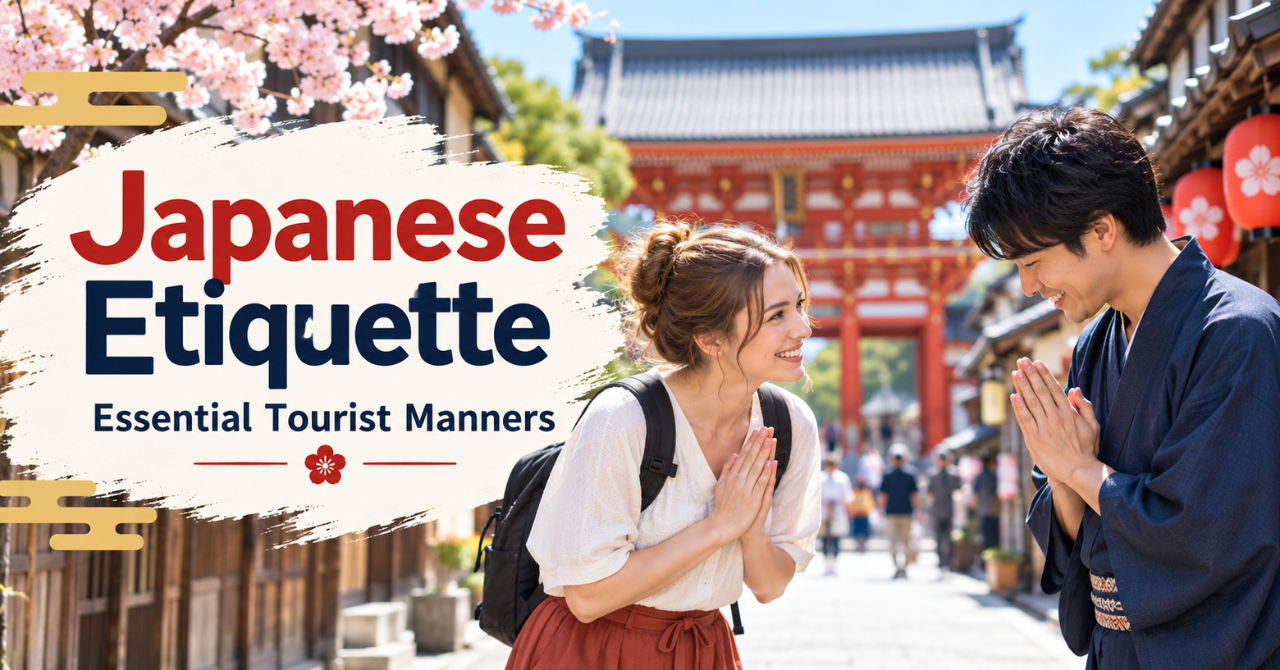
Visiting Japan for the first time is exciting, but you may wonder about the country’s unique customs and social rules.
Should you bow when greeting someone? Is it okay to talk on the train? When should you take off your shoes? And what should you know before visiting a shrine, temple, or onsen?
The good news is that you don’t need to memorize every Japanese custom before your trip.
Most Japanese etiquette for tourists comes down to a simple idea: be considerate of the people around you and respect the rules of each place.
In this guide, we’ll cover the essential manners travelers should know, including public transportation etiquette, shoe rules, shrine and temple customs, onsen etiquette, and behavior in public places.
We’ll also explain some common mistakes first-time visitors make—and how to avoid them.
With a little preparation, you can travel around Japan confidently, show respect for local culture, and focus on enjoying your trip.
- Basic Japanese Etiquette for Tourists
- Public Transportation Etiquette in Japan
- When and Where to Take Off Your Shoes in Japan
- Shrine and Temple Etiquette in Japan
- Onsen Etiquette for Tourists
- Etiquette in Public Places in Japan
- Common Etiquette Mistakes Tourists Make in Japan
- Final Japanese Etiquette Tips for Tourists
Basic Japanese Etiquette for Tourists
Japan has many customs and social rules that may feel different from those in your home country.
But don’t worry—you don’t need to memorize every rule before your trip.
One of the most important ideas behind Japanese etiquette is simple: be considerate of the people around you.
If you’re unsure what to do, staying polite, observing what local people are doing, and following signs or instructions will usually help you avoid problems.
Bowing and Greetings in Japan
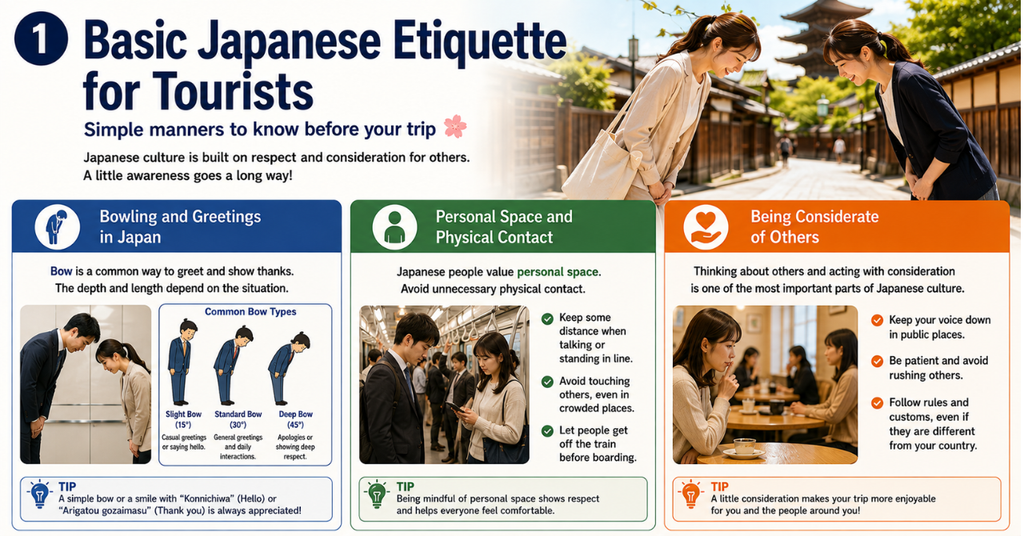
Bowing is a common way to greet, thank, or apologize to someone in Japan.
As a tourist, you do not need to worry about bowing at the perfect angle. A small, polite bow is usually enough in everyday situations.
Hotel staff, restaurant employees, or shop workers may bow to you, and you can simply respond with a small bow or a friendly “Arigatou gozaimasu.”
Personal Space and Physical Contact
Japanese social interactions often involve less physical contact than visitors from some countries may be used to.
For example, hugging, kissing on the cheek, or touching someone during a first meeting is less common in everyday interactions.
You also don’t need to shake hands with everyone you meet. A small bow or polite greeting is perfectly fine.
This doesn’t mean physical contact is considered rude in every situation. Customs vary between people, generations, and social settings.
The easiest approach for travelers is to observe the other person and follow their lead.
Being Considerate of Others
One idea connects many Japanese manners:
Try not to inconvenience the people around you.
You may notice this in many everyday situations.
People often queue in an orderly way, keep their voices relatively low on public transportation, avoid blocking busy walkways, and follow local rules even when they aren’t immediately obvious.
For travelers, this doesn’t mean worrying about every small mistake.
A simple rule works surprisingly well:
Observe → Respect → Follow
👀 Observe what people around you are doing.
🤝 Respect other people and shared spaces.
➡️ Follow signs, instructions, and local customs when possible.
Good to Know:If you’re unsure about a Japanese custom, don’t panic. Being polite and making an effort to respect the people around you is more important than knowing every rule perfectly.
Key Takeaway:You don’t need to become an expert in Japanese etiquette before visiting Japan. Start with kindness, consideration, and awareness of the people around you.
Public Transportation Etiquette in Japan
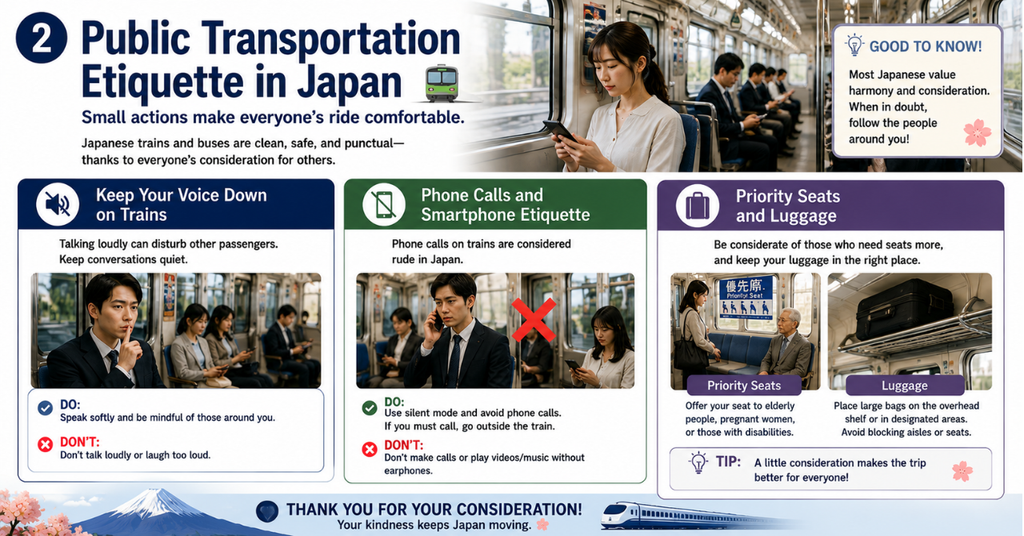
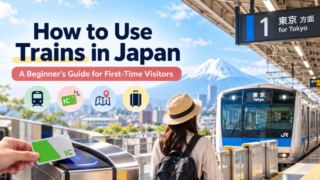
Japan’s trains and subways are known for being convenient, clean, and efficient.
But first-time visitors may notice something else: even crowded trains can be surprisingly quiet.
You don’t need to stay completely silent, but being considerate of other passengers is an important part of public transportation etiquette in Japan.
Keep Your Voice Down on Trains
Talking with your travel companions is perfectly fine, but try to keep your voice at a moderate level, especially on commuter trains and subways.
You may notice that many passengers spend their journey quietly reading, using their phones, or simply resting.
The atmosphere can be especially quiet during morning and evening commutes.
Good to Know:
This doesn’t mean every train in Japan is silent. Groups of friends, families, and tourists naturally talk. The key is simply to avoid being noticeably louder than the people around you.
On long-distance trains such as the Shinkansen, conversations are also common, but it’s still a good idea to be mindful of your volume.
Phone Calls and Smartphone Etiquette
One difference that surprises many international visitors is how uncommon it is to hear people talking on the phone inside commuter trains.
In general, avoid making or taking voice calls while riding trains and subways.
Instead, use text messages or wait until you get off the train to make your call.
You’ll often see passengers switch their phones to silent mode so notification sounds don’t disturb others.
Using your smartphone itself is completely normal—you’ll see plenty of people browsing, messaging, watching videos, or playing games.
Just remember to use headphones or keep the sound turned off.
Travel Tip:If you receive an important call, it’s usually better to get off at the next station and take the call away from crowded boarding areas.
Priority Seats and Luggage
Most trains in Japan have designated priority seats, often marked with signs or symbols.
These seats are intended primarily for passengers who may need them, such as:
- Elderly passengers
- Pregnant passengers
- Passengers with disabilities
- Passengers with injuries
- Adults traveling with small children
If you’re sitting in a priority seat and someone appears to need it more than you do, offering your seat is a considerate choice.
What About Large Luggage?
Large suitcases can take up a surprising amount of space on crowded trains.
Whenever possible, avoid placing luggage where it blocks doors, aisles, or other passengers.
Use luggage racks when available, keep smaller bags close to you, and be especially mindful during rush hour.
On some Shinkansen routes, oversized baggage may require advance seat reservations, so check the rules if you’re traveling with very large luggage.
Good to Know:
Morning and evening rush hours can be extremely crowded in major cities such as Tokyo and Osaka. If you’re carrying large suitcases, traveling outside peak commuting times can make the journey much easier.
Key Takeaway
You don’t have to be completely silent on Japanese trains.
Just remember:
Keep your voice down → Avoid phone calls → Use headphones → Be mindful of priority seats → Don’t block the way with luggage
A little consideration goes a long way toward making the journey comfortable for everyone.
When and Where to Take Off Your Shoes in Japan
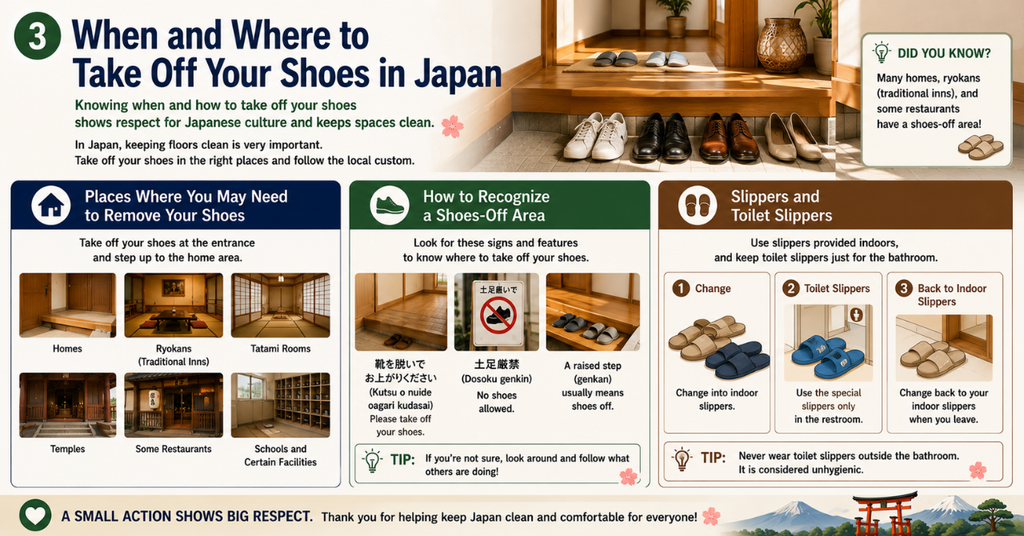
One of the most famous Japanese customs is taking off your shoes before entering certain indoor spaces.
However, this doesn’t mean you need to remove your shoes every time you enter a building in Japan.
Hotels, shops, department stores, train stations, and most restaurants allow you to keep your shoes on.
The important thing is knowing when to take them off—and how to recognize a shoes-off area.
Places Where You May Need to Remove Your Shoes
You may be asked to remove your shoes in places such as:
- Japanese homes
- Traditional ryokan
- Tatami rooms
- Some temples and historic buildings
- Some traditional restaurants
- Certain onsen facilities
A useful rule to remember is:
If you’re about to step onto tatami, check your shoes first.
Tatami mats are traditionally used without outdoor shoes, and you generally shouldn’t walk on them wearing slippers either.
At Japanese homes and some traditional accommodations, you’ll often remove your shoes in an entrance area called the genkan (玄関).
After removing your shoes, step up onto the indoor floor without stepping there in your outdoor shoes.
Good to Know:
If slippers are provided, you can usually put them on after removing your shoes. However, slippers should normally be removed before stepping onto tatami.
How to Recognize a Shoes-Off Area
Don’t worry—you usually won’t have to guess.
Look for clues such as:
- A step between the entrance and indoor floor
- Shoes already lined up near the entrance
- Shoe lockers or shelves
- Slippers provided for guests
- Signs asking visitors to remove their shoes
- Tatami flooring ahead
If you see several pairs of shoes near an entrance, that’s a pretty strong clue that yours should come off too.
When you’re unsure, observe what other people are doing or ask the staff.
You can simply point to your shoes and ask:
“Kutsu?” (靴?)
or use a translation app if necessary.
Following the people around you is often the easiest solution.
Slippers and Toilet Slippers
Here’s one Japanese custom that can easily catch first-time visitors off guard:
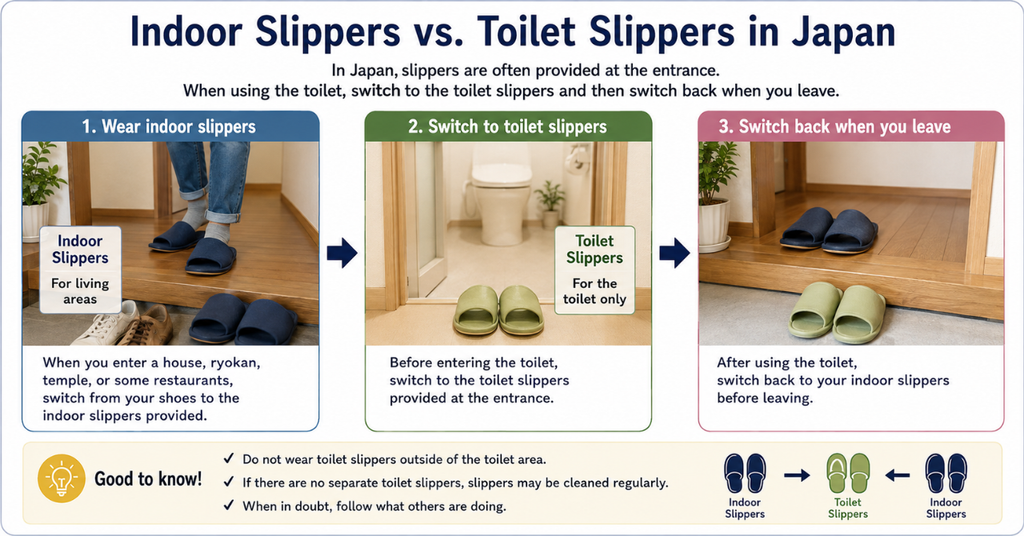
Some places have separate slippers specifically for the toilet.
You may find them in traditional ryokan, Japanese homes, older restaurants, and other facilities.
The basic system is simple:
Indoor slippers → Toilet slippers → Indoor slippers
When you enter the restroom, leave your regular indoor slippers outside and change into the toilet slippers.
When you leave, change back again.
And yes—forgetting and walking around the building in toilet slippers is a classic mistake! 😅
The slippers are separated for hygiene reasons, so remember to leave the toilet slippers inside the restroom for the next person.
Key Takeaway
Japan’s shoe etiquette becomes much easier when you remember three things:
👟 Look at the entrance
🧦 Never wear outdoor shoes on tatami
🚻 Don’t forget to change out of toilet slippers
When in doubt, simply look at what the people around you are doing.
Shrine and Temple Etiquette in Japan
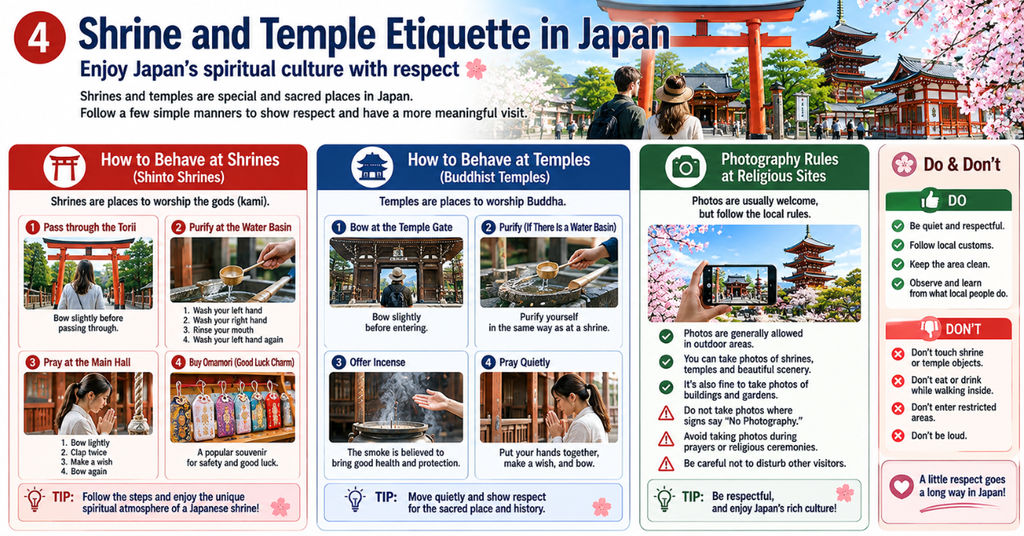
Shrines and temples are among the most popular places to visit in Japan, but they are more than just beautiful tourist attractions.
They are religious and sacred places, and many local people visit them to pray.
Fortunately, visitors don’t need to memorize complicated rituals. A few basic manners will help you visit respectfully and confidently.
One important thing to understand is that Shinto shrines and Buddhist temples are different, so their customs may also differ.
How to Behave at Shrines
Shinto shrines are usually easy to recognize by their torii gates.
When visiting a shrine, you may see Japanese visitors bow slightly before passing through the torii. This is a traditional way of showing respect when entering the sacred area.
At many shrines, you’ll also find a purification fountain called a temizuya (手水舎) or chozuya (手水舎).
Visitors traditionally use the water to purify their hands before praying.
When you reach the main worship area, a common prayer sequence is:
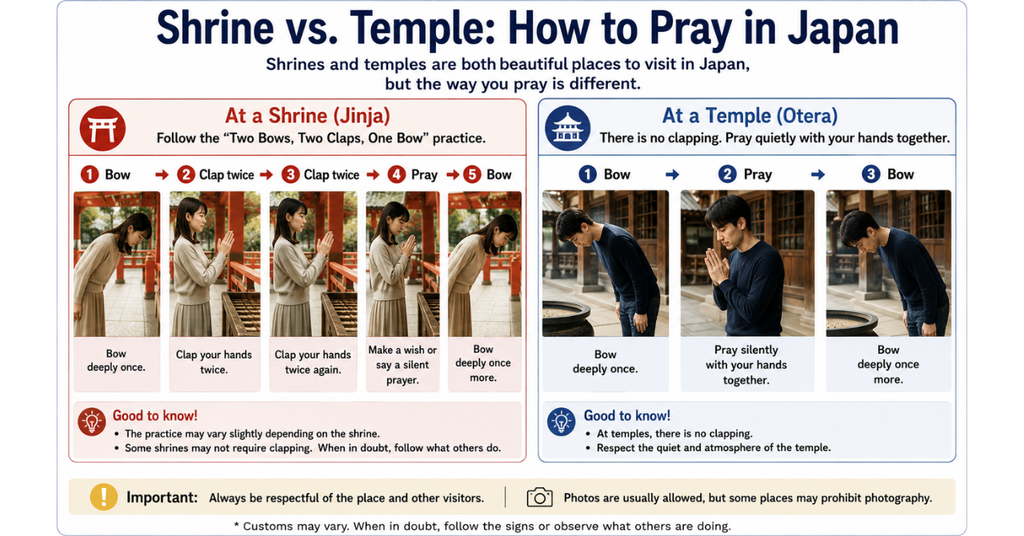
① Put an offering into the offering box
② Bow twice
③ Clap twice
④ Make your prayer
⑤ Bow once
This is often described as:
Two bows → Two claps → One bow
However, customs can vary between shrines, so follow any instructions displayed at the site.
Good to Know:
When walking along the approach to a shrine, you may see people avoiding the exact center of the path because it is traditionally associated with the passage of the kami.
As a tourist, you don’t need to worry excessively about every step—simply walk respectfully and avoid blocking other visitors.
How to Behave at Temples
Buddhist temples usually do not have the same worship procedure as Shinto shrines.
One of the most important differences is:
You generally don’t clap your hands when praying at a Buddhist temple.
At the worship area, you may make an offering, quietly put your hands together, and bow or pray.
Some temples also have large incense burners.
Visitors may purchase incense, light it, and place it in the burner before praying. If incense is available, follow the instructions at that particular temple.
You may also see visitors collecting goshuin (御朱印)—special seals and calligraphy offered at many shrines and temples.
These make meaningful travel keepsakes, but remember that goshuin have religious and cultural significance rather than being ordinary souvenir stamps.
Shrine vs. Temple: The Easy Rule to Remember
For first-time visitors, here’s the simplest distinction:
⛩️ Shrine → Bow twice, clap twice, bow once
🙏 Temple → Pray quietly without clapping
Individual sites may have their own customs, so posted instructions always take priority.
Photography Rules at Religious Sites
Japan’s shrines and temples can be incredibly photogenic, and photography is often allowed in outdoor areas.
However, don’t assume you can take photos everywhere.
Photography may be restricted:
- Inside temple halls
- Near sacred objects
- In certain worship areas
- During ceremonies
- In areas marked No Photography
Always look for signs before taking photos indoors.
You should also be considerate when photographing people who are praying.
Avoid stepping directly in front of someone, interrupting a ceremony, or treating an active worship area like a photo set.
Drones, tripods, and other equipment may also be restricted depending on the site.
Travel Tip:
When you’re unsure whether photography is allowed, check the signs or ask the staff before taking the photo.
Key Takeaway
You don’t need to perform every religious custom perfectly to visit a Japanese shrine or temple respectfully.
Remember these basics:
⛩️ Shrines and temples are sacred places
👏 Don’t use shrine-style clapping at temples
📷 Check before taking photos
🤫 Keep your voice down around people who are praying
➡️ Follow the rules of the individual site
A little respect allows you to enjoy the history, architecture, and spiritual atmosphere without worrying about getting every detail perfect.
Onsen Etiquette for Tourists
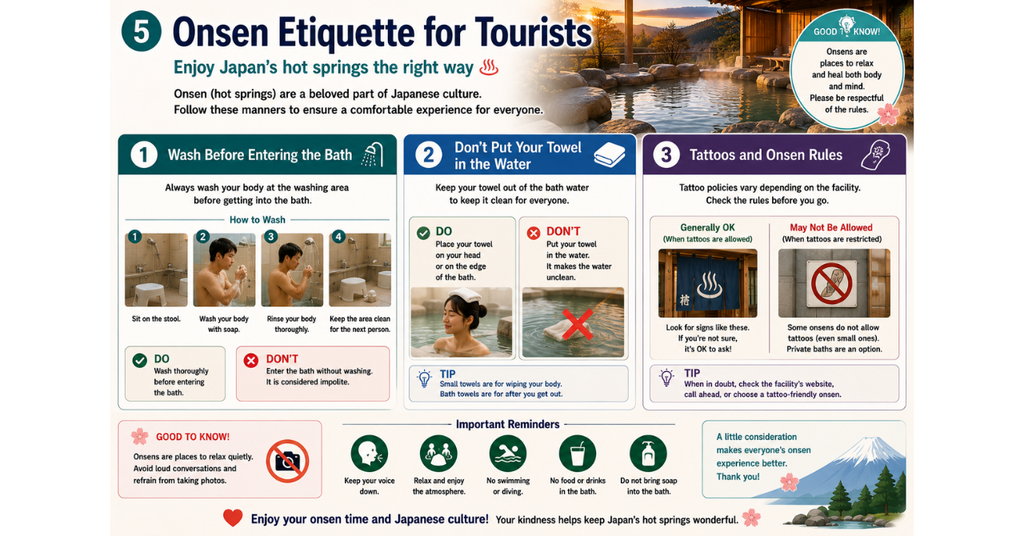
Visiting an onsen (Japanese hot spring) can be one of the most memorable experiences of a trip to Japan.
However, Japanese bathing culture has several customs that may be very different from what you’re used to.
The most important thing to understand is that an onsen is for relaxing and soaking—not for washing your body in the bath itself.
Once you know a few basic rules, using an onsen is actually quite simple.
Wash Before Entering the Bath
This is probably the most important onsen rule to remember:
Wash your body before getting into the shared bath.
After entering the bathing area, you’ll usually find washing stations equipped with:
- Small stools
- Handheld showers
- Shampoo
- Conditioner
- Body soap
Sit at a washing station and thoroughly wash and rinse your body before entering the bath.
The shared bath should be kept clean for everyone.
You may also see people briefly rinsing themselves with hot water before entering. This is known as kakeyu (かけ湯).
Good to Know:
In most traditional onsen, you enter the bathing area without a swimsuit.
Men’s and women’s bathing areas are usually separated, and you normally leave your clothes and large belongings in the changing room.
It may feel unfamiliar at first, but communal nude bathing is a normal part of Japanese onsen culture.
Don’t Put Your Towel in the Water
Onsen visitors often carry a small towel into the bathing area.
You can use it while washing yourself or carry it with you as you move between baths.
However:
Don’t put your towel into the shared bath water.
When soaking, you can leave the towel beside the bath where permitted or fold it and place it on your head—a sight that many visitors associate with Japanese hot springs.
The important thing is simply to keep the towel out of the bath water.
You should also avoid:
- Swimming in the bath
- Splashing other guests
- Using soap or shampoo inside the bath
- Taking photos in the bathing area
- Speaking excessively loudly
An onsen is generally a place to relax quietly.
Tattoos and Onsen Rules
Tattoo policies are one of the most important things international travelers should check before visiting an onsen.
Historically, tattoos have had negative associations in Japan, and some onsen facilities still restrict entry for guests with tattoos.
However, policies vary significantly.
Depending on the facility:
- Tattoos may be completely allowed
- Small tattoos may be accepted
- You may be allowed to cover a tattoo with a patch
- Tattooed guests may be restricted from communal baths
- Private baths may be available instead
Some onsen and sento are increasingly welcoming to tattooed visitors, but you should never assume the policy is the same everywhere.
Travel Tip:
If you have tattoos, check the facility’s official rules before you visit. Look for information such as “tattoo-friendly,” “tattoos allowed,” or instructions about tattoo-covering stickers.
A private bath (kashikiri-buro / 貸切風呂) can also be a useful option at facilities where communal bathing restrictions apply.
Key Takeaway
You don’t need to know every detail of Japanese bathing culture before visiting an onsen.
Remember these essentials:
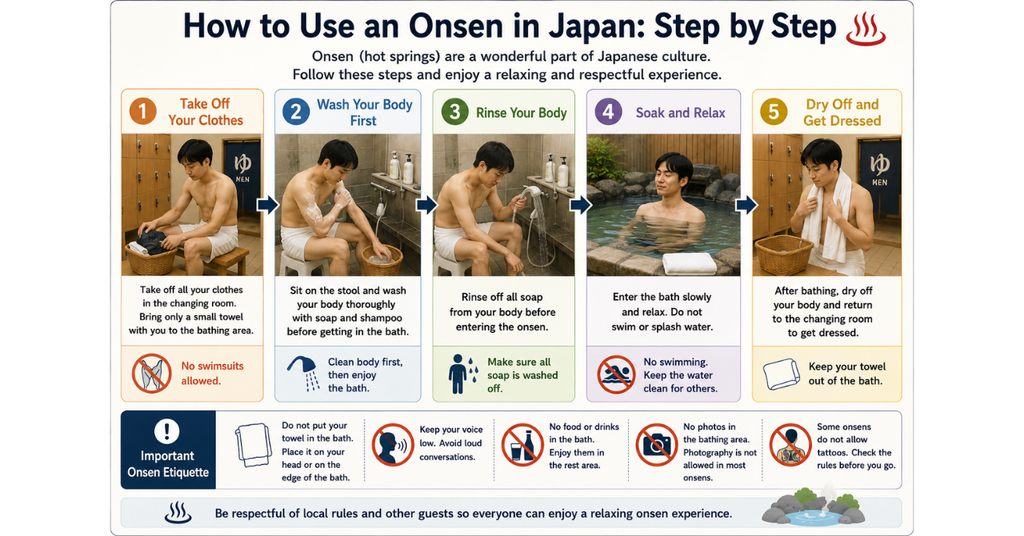
🚿 Wash before entering the bath
🩱 Don’t wear a swimsuit unless the facility specifically allows or requires one
🧖 Keep your towel out of the water
📷 Don’t take photos in the bathing area
♨️ Relax quietly and respect other guests
🖋️ Check tattoo rules before visiting
Follow these basics and you’ll be ready to enjoy one of Japan’s most relaxing cultural experiences.
Etiquette in Public Places in Japan
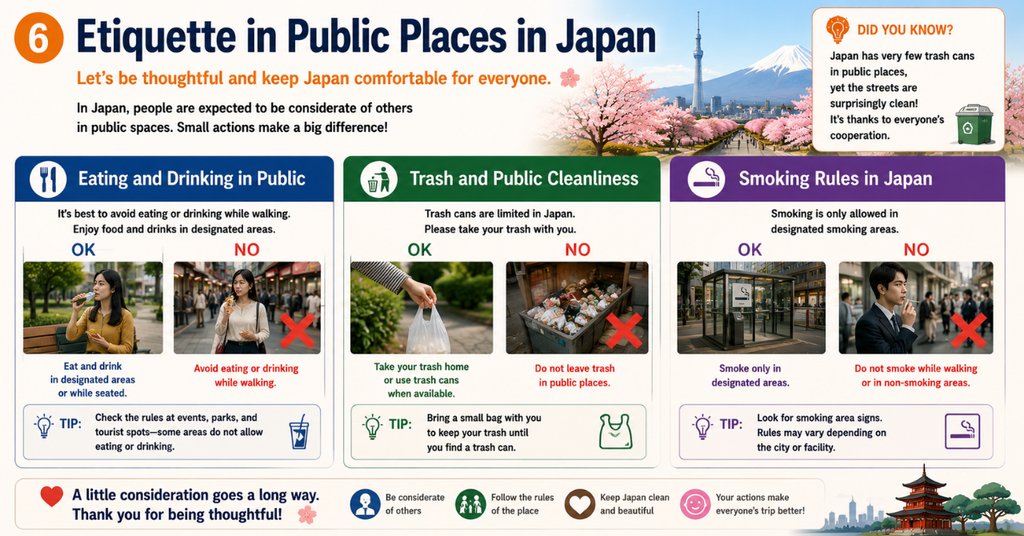
Japan is often known for its clean and orderly public spaces.
For travelers, however, some everyday habits may feel a little different from what they’re used to—especially when it comes to eating in public, disposing of trash, and smoking.
The rules aren’t exactly the same everywhere, so the most important thing is to pay attention to signs and the people around you.
Eating and Drinking in Public
You may have heard that you shouldn’t eat while walking in Japan.
But this isn’t a universal rule.
Eating and drinking in public is perfectly normal in many situations. For example, enjoying food at a festival, sitting in a park, or eating a meal on certain long-distance trains can be completely acceptable.
However, eating while walking may be discouraged in some crowded tourist areas, shopping streets, markets, or around religious sites.
There are also practical reasons to avoid it in busy places—you could bump into someone or spill food on other people.
Good to Know:
If you’ve just bought food from a street vendor, look for a designated eating area or check whether people are eating nearby.
When you’re unsure, stop somewhere appropriate and enjoy your food before continuing.
Trash and Public Cleanliness
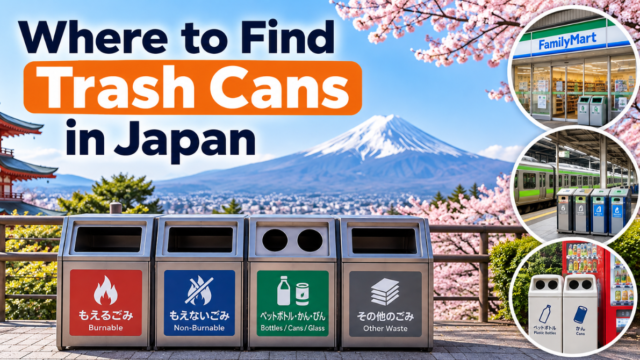
One thing that surprises many first-time visitors is that public trash cans can be surprisingly difficult to find in Japan.
You might walk through a clean street or train station without seeing a trash can nearby.
So what should you do?
A useful habit is to carry a small plastic bag with you.
If you can’t find an appropriate trash can, keep your trash with you until you find somewhere you can dispose of it properly.
You’ll also notice that trash may need to be separated into categories such as cans, plastic bottles, and other waste.
Follow the labels on the bins rather than assuming every trash can accepts everything.
Travel Tip:
Don’t leave trash next to a full bin or somewhere simply because you can’t find a trash can.
When necessary, carrying it back to your accommodation is a simple solution.
Smoking Rules in Japan
Smoking rules in Japan can be confusing because they vary depending on the location and type of facility.
In many places, smoking is restricted indoors, and cities may also have rules limiting smoking on streets or in busy public areas.
You’ll often find designated smoking rooms or smoking areas instead.
If you smoke, look for signs showing where smoking is permitted rather than assuming you can smoke outdoors anywhere.
And if you’re a non-smoker, don’t be surprised if you occasionally encounter designated smoking rooms or certain establishments where different rules apply.
Good to Know:
Smoking regulations can vary by city and facility, so local signs and instructions should always take priority.
Key Takeaway
Public etiquette in Japan isn’t about memorizing dozens of strict rules.
Remember these basics:
🍡 Eating while walking isn’t universally prohibited—check the situation
🗑️ Be prepared to carry your trash if no bin is available
♻️ Follow the labels when disposing of waste
🚭 Smoke only where it is permitted
👀 Pay attention to local signs and rules
When you’re unsure, observing the situation around you is usually a good guide.
Common Etiquette Mistakes Tourists Make in Japan
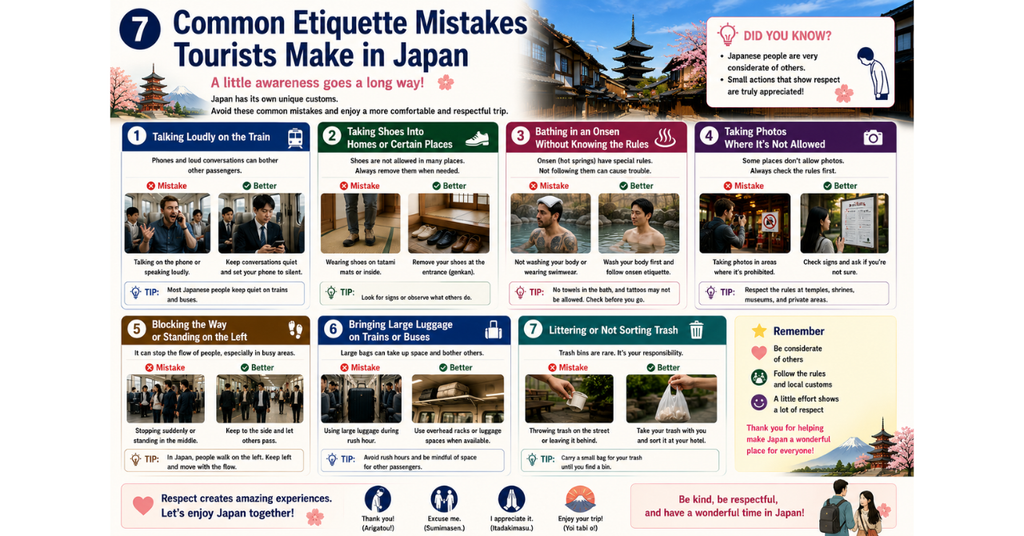
Japanese etiquette can seem complicated at first, but most visitors don’t need to worry about making small mistakes.
What matters most is being aware of your surroundings and respecting local rules.
Here are some common mistakes that are easy to avoid.
❌ Talking loudly on trains
You don’t need to stay completely silent, but loud conversations can disturb other passengers.
Voice calls are also generally discouraged on commuter trains and subways.
Instead: Keep conversations at a moderate volume, use headphones for audio, and avoid phone calls where they are discouraged.
❌ Making phone calls on public transport
Making phone calls on trains and buses is generally discouraged in Japan, especially on commuter trains and subways.
Even if you speak quietly, phone conversations can disturb other passengers in the shared space.
Instead: Put your phone on silent mode, use text messages when possible, and wait until you get off before making or answering a call.
❌ Wearing shoes where they should be removed
Walking onto tatami or into certain indoor spaces while wearing outdoor shoes is an easy mistake to make.
Instead: Look for shoes near the entrance, slippers, shoe lockers, signs, or a raised indoor floor.
When you’re unsure, check what other visitors are doing.
❌ Entering an onsen without washing first
The shared bath at an onsen is for soaking—not washing.
Getting directly into the bath without washing first can go against normal bathing etiquette.
Instead: Wash and rinse your body at the washing area before entering the shared bath.
❌ Taking photos where photography is prohibited
Shrines, temples, museums, restaurants, and other attractions may have areas where photography is prohibited.
Even when photography is allowed, taking photos can sometimes interfere with worship, ceremonies, or other visitors.
Instead: Check signs before taking photos and respect restricted areas.
❌ Ignoring Onsen Tattoo Rules
Having a tattoo itself isn’t an etiquette mistake.
The problem is assuming that every onsen has the same tattoo policy.
Some facilities allow tattoos, while others have restrictions or offer alternatives such as private baths.
Instead: Check the facility’s rules before visiting.
❌ Blocking walkways with luggage
Busy stations and trains can become extremely crowded.
Stopping in front of ticket gates, doors, stairs, or narrow walkways with large suitcases can make it difficult for other people to pass.
Instead: Move to the side before checking your phone or luggage, and follow signs or staff instructions in busy areas.
❌ Leaving Trash Behind
Public trash cans can be difficult to find, but that doesn’t mean you should leave your trash behind.
Instead: Carry your trash until you find an appropriate bin and follow the disposal instructions provided.
Good to Know:Don’t worry if you accidentally make a small etiquette mistake. Most travelers aren’t expected to know every Japanese custom perfectly.
If someone points out a rule, a simple:
“Sumimasen.” (すみません)
→ Excuse me / I’m sorry.
and correcting what you’re doing is usually the best response.
Key Takeaway:Most etiquette mistakes in Japan can be avoided with one simple habit:
Look around before you act.
Pay attention to signs, follow local instructions, and be considerate of the people sharing the space with you.
Final Japanese Etiquette Tips for Tourists
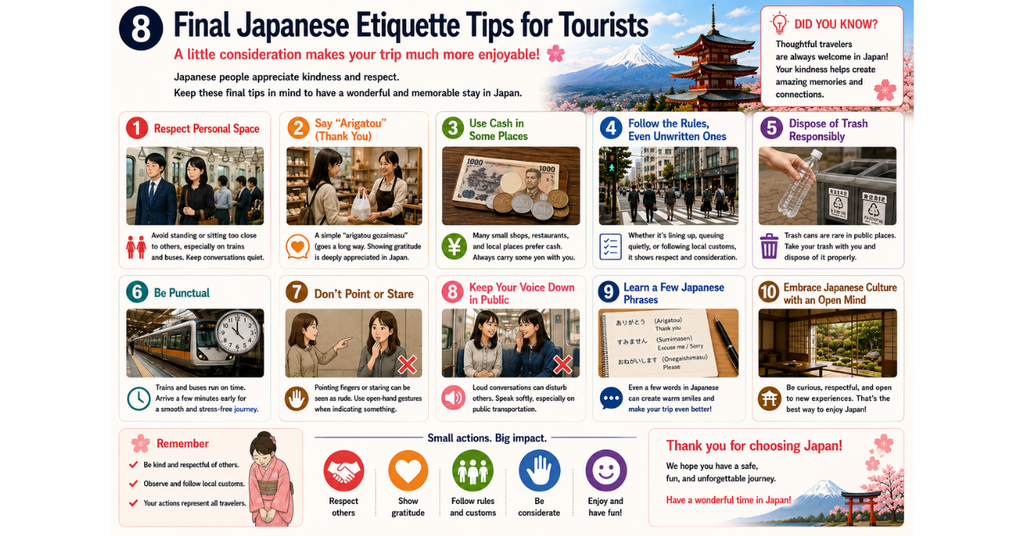
Japanese etiquette may seem complicated at first, especially when many customs are different from those in your home country.
But here’s the most important thing to remember:
You don’t need to understand every Japanese custom perfectly to enjoy your trip.
Rules and customs can vary depending on the place, so instead of trying to memorize everything, pay attention to your surroundings.
If you’re ever unsure what to do, remember these four simple steps:
Observe → Respect → Follow → Enjoy
👀 Observe
Look at what people around you are doing and check for signs or instructions.
🤝 Respect
Be considerate of other people, shared spaces, and local customs.
➡️ Follow
Follow posted rules and staff instructions, especially at places such as shrines, temples, onsen, and public transportation.
🇯🇵 Enjoy
Don’t spend your entire trip worrying about making a small mistake. Learning about unfamiliar customs is part of the experience of visiting Japan.
Even learning a few simple Japanese phrases can make everyday interactions easier.
“Arigatou gozaimasu.” (ありがとうございます)
→ Thank you.
“Sumimasen.” (すみません)
→ Excuse me / I’m sorry.
“Onegaishimasu.” (お願いします)
→ Please.
Most importantly, remember that local rules and customs can vary. When signs or staff instructions differ from something you’ve read online, follow the guidance at the place you’re visiting.
Key Takeaway
You don’t need to travel around Japan with a long list of etiquette rules in your head.
Instead, remember:
Observe the people around you, respect the space, follow local rules, and enjoy experiencing Japan.
A little awareness and consideration can help you feel more confident while discovering Japan’s culture, traditions, and everyday life.
For more useful advice before your trip, read our guide to 20 essential things to know before visiting Japan.