How Much Cash Do You Need in Japan?
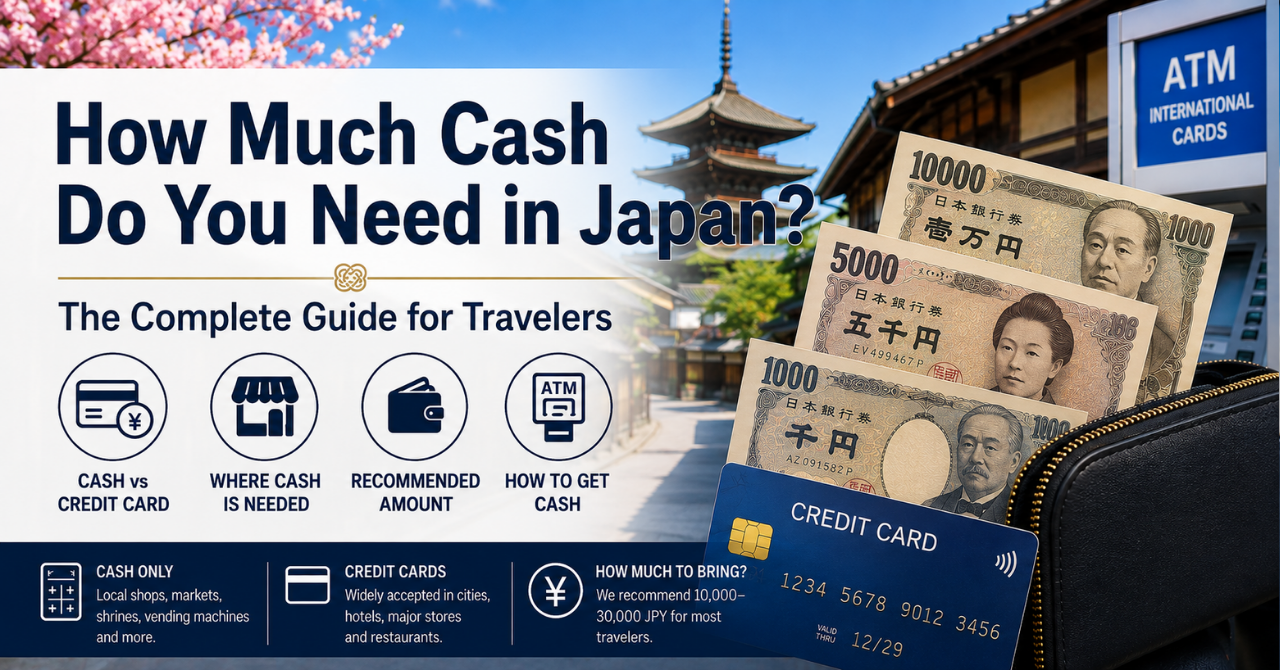
Planning a trip to Japan and wondering how much cash you should bring?
You are not alone.
Japan is often thought of as a cash-based country, but things have changed significantly in recent years. Credit cards and cashless payments are now widely accepted at hotels, convenience stores, department stores, major restaurants, and many tourist attractions.
However, Japan is not completely cashless.
You may still need Japanese yen at small restaurants, local shops, temples and shrines, rural destinations, ticket machines, and other places that do not accept international credit cards.
So, should you bring a large amount of cash?
For most travelers, there is no need to carry all of your travel money in cash. A combination of Japanese yen, a credit or debit card, and an IC card such as Suica is usually the most convenient option.
In this guide, we will explain how much cash you may want to carry, where you might need it, how to withdraw money in Japan, and a few simple tips that can make paying for things during your trip much easier.

- How Much Cash Should You Carry in Japan?
- Is Japan Still a Cash-Based Country?
- Where Will You Need Cash in Japan?
- Can You Use Credit Cards in Japan?
- What Is an IC Card and Should You Get One?
- How Much Cash Do You Need Per Day in Japan?
- How Much Cash Should You Bring for a 7-Day Trip to Japan?
- Where Can Foreign Tourists Withdraw Cash in Japan?
- Should You Exchange Money Before Coming to Japan?
- What Japanese Banknotes Should Tourists Know?
- Don’t Forget Japanese Coins
- Cash or Credit Card: Which Is Better in Japan?
- A Japanese Local’s Tips for Handling Money
- What If a Credit Card Doesn’t Work?
- The Bottom Line:How Much Cash Do You Really Need?
How Much Cash Should You Carry in Japan?
There is no single amount that works for every traveler.
Someone staying in Tokyo and paying for hotels and restaurants by credit card will need much less cash than someone visiting small towns, local restaurants, temples, or rural areas.
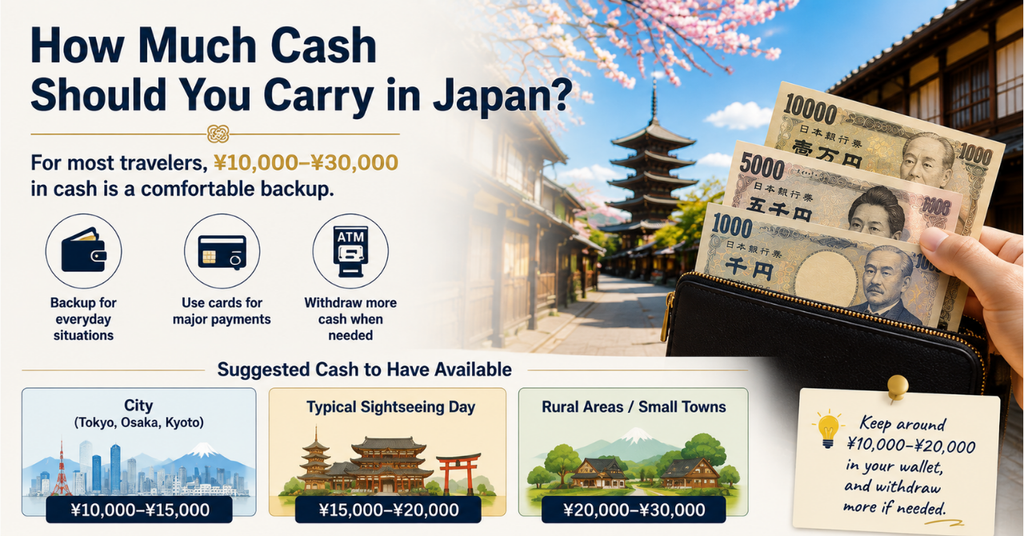
As a practical starting point, carrying around ¥10,000–¥30,000 in cash can give many travelers a comfortable backup for everyday situations.
You do not necessarily need to carry this entire amount every day.
For example, you might keep around ¥10,000–¥20,000 in your wallet and withdraw additional cash when necessary.
Think of cash as your backup rather than your only payment method.
A Simple Example
Imagine you are spending one day sightseeing in Japan.
You might use a credit card for:
- Your hotel
- A large restaurant
- Shopping at a department store
- Convenience store purchases
But you may use cash for:
- A small local restaurant
- Temple or shrine admission
- A vending machine
- A small souvenir shop
- A train or bus that does not accept your preferred payment method
Having some yen in your wallet means you will not have to worry every time you see a “Cash Only” sign.
Is Japan Still a Cash-Based Country?
Japan is much more cashless than it used to be.
International credit, debit and prepaid cards are generally accepted throughout the country, and major hotels, department stores, shopping centers and many restaurants in urban areas accept cards.
Contactless payments have also become increasingly common.
However, the Japan National Tourism Organization (JNTO) still advises travelers to keep some cash available because cash-only businesses remain, particularly in rural or remote areas.
That creates an important rule for travelers:
Do not travel around Japan with only one payment method.
A credit card may work perfectly for most of the day, but having cash available can save you from an inconvenient situation.
Where Will You Need Cash in Japan?
This is probably more important than asking whether Japan is a “cash society.”
The answer depends heavily on where you go.
Tokyo, Osaka, Kyoto and other major cities generally offer many cashless payment options.
Once you travel outside major cities, however, cash can become more important.
JNTO specifically notes that some places in rural areas may still accept only cash, including some accommodations.
Places Where Cash Can Be Useful
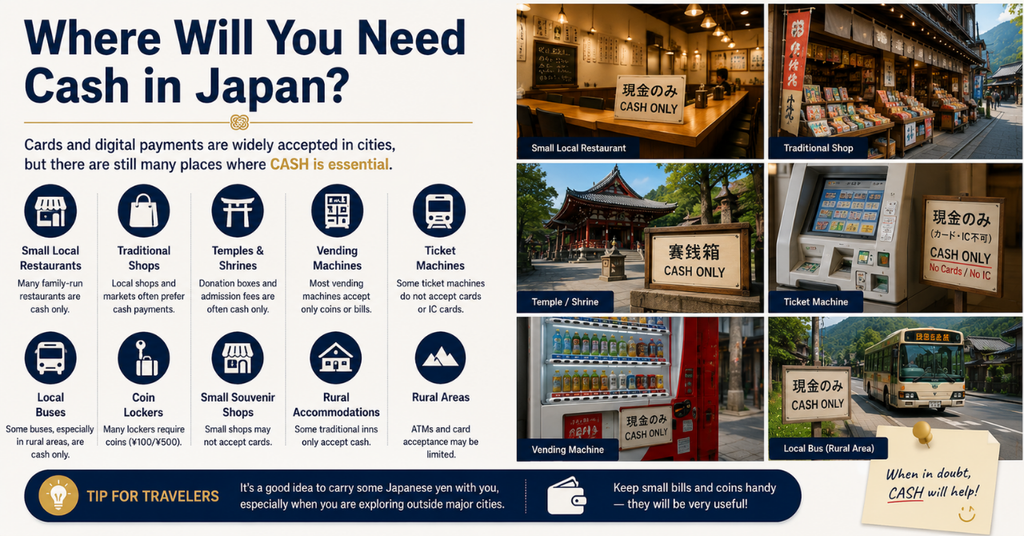
You may encounter cash-only payments at:
- Small family-run restaurants
- Traditional shops
- Local markets
- Temples and shrines
- Small tourist attractions
- Rural accommodations
- Local buses
- Older ticket machines
- Coin lockers
- Vending machines
- Small souvenir stores
This does not mean every place in these categories is cash-only.
Many now accept cards or IC payments.
The important thing is that you should not assume that every business accepts your credit card.
When you are unsure, look for Visa, Mastercard, JCB or other payment logos near the entrance or cash register.
You can also ask:
“Credit card OK?”
Even if you do not speak Japanese, this simple question will usually be understood.
Can You Use Credit Cards in Japan?
Yes.
For most international travelers, a credit card can be the main payment method during a trip to Japan.
According to JNTO, internationally branded credit, debit and prepaid cards are generally accepted throughout Japan. Major hotels, department stores, large shopping centers and restaurants in urban areas commonly accept cards.
Visa and Mastercard are especially useful to carry, while other international brands are also accepted at many businesses.
However, acceptance can vary from store to store.
This is why having both a card and some Japanese yen is safer than relying entirely on either one.
A Good Payment Setup for Japan
For many travelers, a convenient combination is:
Credit card
→ Hotels, larger restaurants, shopping and major purchases
Cash
→ Small businesses, rural destinations and backup payments
IC card
→ Trains, buses, convenience stores, vending machines and small everyday purchases
With these three options, you will be prepared for most payment situations during your trip.
What Is an IC Card and Should You Get One?
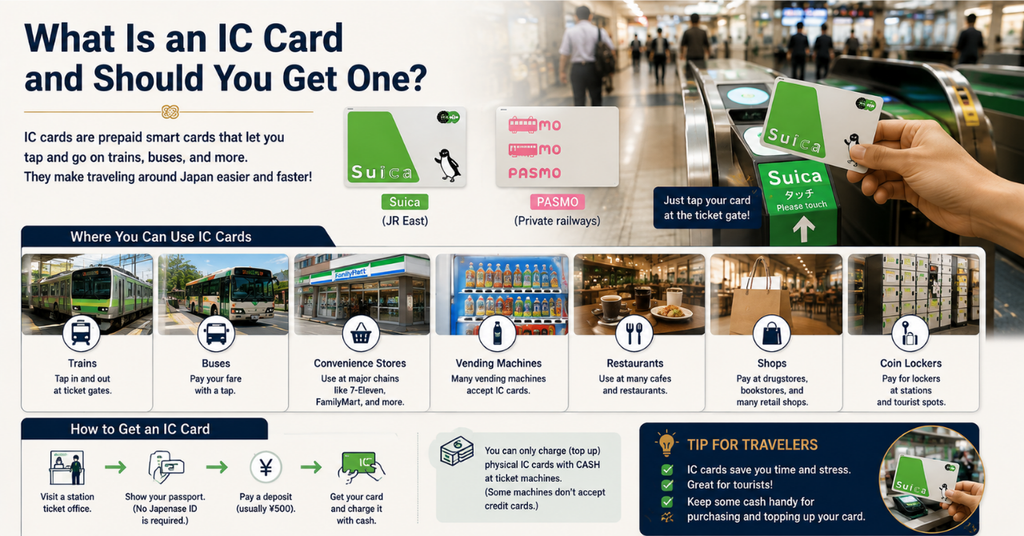
If you plan to use public transportation frequently, an IC card can make traveling around Japan much easier.
Popular examples include Suica and PASMO.
Instead of buying a train ticket every time you travel, you can simply tap the card at the ticket gate.
But IC cards are useful for much more than trains.
Depending on the location, you can also use them at:
- Convenience stores
- Vending machines
- Restaurants
- Shops
- Coin lockers
- Buses
JNTO notes that interoperable IC cards such as Suica and PASMO can be used across many public transportation systems and at participating stores around Japan.
One Important Thing Tourists Often Miss
Do not assume that you can always use your international credit card to add money to a physical IC card.
JNTO notes that some station ticket machines require cash when purchasing or topping up physical IC cards.
This is another reason why keeping a few ¥1,000 notes in your wallet can be surprisingly useful.
How Much Cash Do You Need Per Day in Japan?
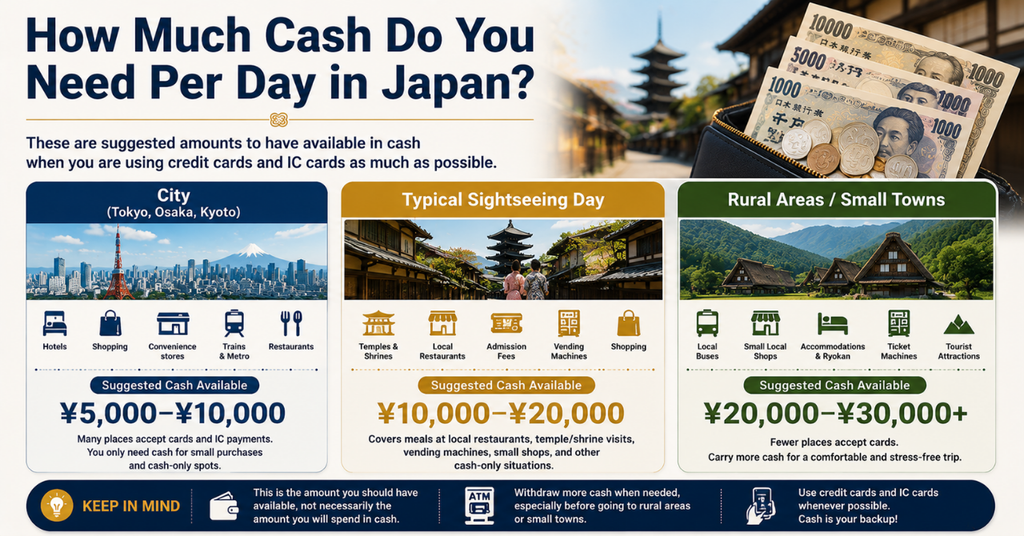
Instead of thinking about the total amount for your entire vacation, it can be easier to think about your daily cash requirement.
For a traveler who uses credit cards whenever possible, a rough emergency-and-small-purchase budget could look like this:
| Travel Style | Suggested Cash Available |
|---|---|
| Mostly Tokyo/Osaka + cards | ¥5,000–¥10,000 |
| Typical sightseeing day | ¥10,000–¥20,000 |
| Rural areas / small towns | ¥20,000–¥30,000 |
| Cash-heavy travel day | ¥30,000+ |
These amounts are not a fixed daily spending budget.
You do not need to spend ¥20,000 in cash every day.
Instead, think of this as an amount you may want to have available depending on where you are traveling.
For example, if you leave Tokyo for a small mountain town, carrying more cash than usual may be a good idea because there may be fewer ATMs and fewer businesses accepting international cards.
How Much Cash Should You Bring for a 7-Day Trip to Japan?
Suppose you are visiting Japan for one week.
You do not necessarily need to arrive with seven days’ worth of cash in your wallet.
A more practical strategy is:
Bring or withdraw around ¥20,000–¥30,000 at the beginning of your trip, use cards where convenient, and withdraw additional yen if your cash starts running low.
This reduces the need to carry a large amount of money while still giving you enough flexibility.
For a typical trip such as:
Tokyo → Kyoto → Osaka
credit cards and IC cards can handle a large percentage of everyday payments.
On the other hand, an itinerary such as:
Tokyo → rural Nagano → traditional onsen town → countryside
may require more cash.
So the best answer to “How much cash do I need?” is actually:
It depends more on where you are going than how many days you are staying.
Where Can Foreign Tourists Withdraw Cash in Japan?
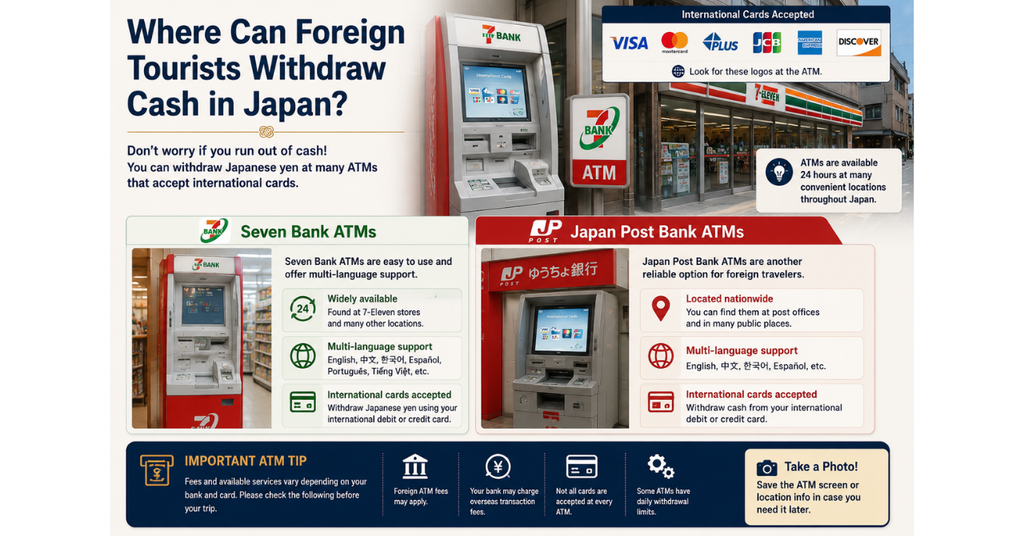
Running out of yen does not mean your trip is ruined.
International travelers can withdraw Japanese yen from compatible ATMs throughout Japan.
Two particularly useful options are:
Seven Bank ATMs
Seven Bank ATMs are commonly found inside 7-Eleven convenience stores and other locations.
JNTO specifically recommends Seven Bank as an option for travelers using cards issued overseas. Its traveler information also notes multilingual support on compatible ATMs.
Japan Post Bank ATMs
Japan Post Bank is another useful option for withdrawing Japanese yen with international cards.
JNTO lists both Japan Post Bank and Seven Bank as places where international travelers can withdraw cash.
Because convenience stores are widespread in Japan, withdrawing a smaller amount when needed can often be easier than carrying your entire vacation budget from the first day.
Important ATM Tip
Your own bank or card issuer may charge:
- International withdrawal fees
- Foreign transaction fees
- Currency conversion fees
ATM availability and card compatibility can also vary.
Check your bank’s international withdrawal rules before leaving home.
Should You Exchange Money Before Coming to Japan?
You do not necessarily need to exchange your entire travel budget before arriving in Japan.
Some travelers prefer to bring a small amount of yen from home so they have money immediately after arriving.
Others withdraw yen from an ATM after arriving in Japan.
Either approach can work.
A convenient strategy is to make sure you have enough money for your first day, then use cards and ATMs as needed.
For example, having ¥10,000–¥20,000 available when you arrive can cover small purchases, transportation or unexpected cash-only situations while you settle in.
The exchange rate and fees will depend on your bank, card and currency exchange provider, so compare those costs before choosing where to exchange a large amount.
What Japanese Banknotes Should Tourists Know?
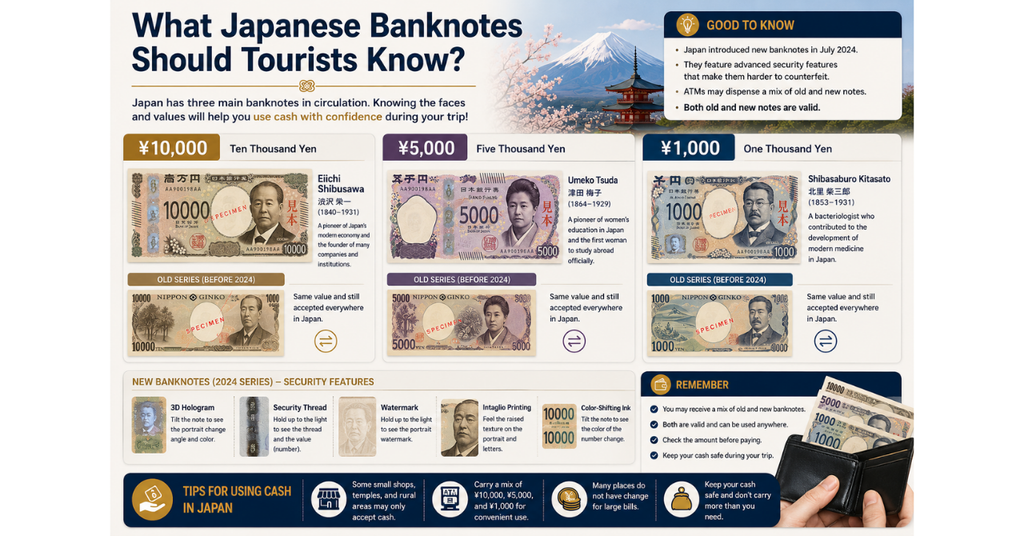
Japan currently issues four denominations of banknotes:
¥1,000 / ¥2,000 / ¥5,000 / ¥10,000
However, ¥2,000 notes are much less commonly encountered than the other three denominations.
Japan introduced new ¥10,000, ¥5,000 and ¥1,000 banknotes on July 3, 2024. The new notes feature:
- ¥10,000 — Eiichi Shibusawa
- ¥5,000 — Umeko Tsuda
- ¥1,000 — Shibasaburo Kitasato
The Bank of Japan confirms these as the current designs.
Are Old Japanese Banknotes Still Valid?
Yes.
This is especially useful for travelers who have leftover yen from an earlier trip.
The previous ¥10,000, ¥5,000 and ¥1,000 notes did not suddenly become worthless when the new banknotes were introduced.
The Bank of Japan confirms that previously issued banknotes that remain valid can continue to be used as legal tender.
So if you still have a ¥1,000 note featuring Hideyo Noguchi or a ¥10,000 note featuring Yukichi Fukuzawa from an earlier trip, you may still be able to use it.
Don’t Forget Japanese Coins
Coins are more useful in Japan than many first-time visitors expect.
Japanese coins currently in everyday circulation include:
¥1 / ¥5 / ¥10 / ¥50 / ¥100 / ¥500
You may accumulate quite a few of them during your trip.
Keep some ¥100 and ¥500 coins rather than trying to get rid of all your change immediately.
They can be particularly handy for vending machines, lockers and other small payments.
A small coin section in your wallet can actually be very useful when traveling around Japan.
Cash or Credit Card: Which Is Better in Japan?
Neither one is always better.
The easiest way to travel is to use both.
| Situation | Recommended Payment |
|---|---|
| Hotel | Credit card |
| Department store | Credit card |
| Convenience store | Card / IC card / Cash |
| Major restaurant | Credit card |
| Small local restaurant | Cash backup recommended |
| Temple or shrine | Cash recommended |
| Vending machine | IC card / Cash |
| Train or subway | IC card |
| Rural destination | Carry extra cash |
| Emergency backup | Cash |
The goal is not to avoid cash.
It is also not necessary to pay for everything in cash.
Use whichever payment method is most convenient while keeping another option available.
A Japanese Local’s Tips for Handling Money
As someone from Japan, there are a few simple habits I would recommend to international travelers.
1. Keep Several ¥1,000 Notes
A ¥10,000 note is perfectly normal currency, but smaller notes are easier for small purchases.
Having several ¥1,000 notes is particularly convenient when using ticket machines, paying small admission fees or visiting local businesses.
2. Don’t Wait Until You Have Zero Cash
If you are down to your last ¥1,000, that is a good time to find an ATM.
This becomes even more important before heading into rural areas.
3. Check Before Ordering at a Small Restaurant
If you only have a card, look for payment logos before ordering.
When in doubt, simply ask:
“Card OK?”
4. Carry More Cash on Rural Travel Days
Tokyo is not representative of every part of Japan.Payment options can change quickly once you travel into smaller towns, mountains or countryside destinations.
5. Keep More Than One Payment Method
Do not keep your only credit card and all of your cash in the same place.Having a backup card or emergency cash stored separately can be helpful if you lose your wallet.
What If a Credit Card Doesn’t Work?
Even when a store accepts international cards, a payment can occasionally fail.
It could be the terminal, your card issuer, security settings or another temporary problem.
Do not panic.
Try another card if you have one, or simply pay with cash.
This is exactly why carrying ¥10,000 or more as a backup can make traveling in Japan much less stressful.
Before your trip, it is also worth checking whether your bank requires international transactions to be enabled.
The Bottom Line:How Much Cash Do You Really Need?
Japan is no longer a place where international travelers need to pay for everything with cash.
Credit cards, contactless payments and IC cards are widely useful, particularly in major cities.
At the same time, cash has not disappeared.
Small restaurants, traditional businesses, temples, shrines and rural destinations are some of the situations where having Japanese yen can still be important. JNTO therefore recommends keeping some cash available even as cashless payments become more widespread.
For many travelers, a practical approach is:
Keep around ¥10,000–¥30,000 in cash available, use a credit card for larger purchases, use an IC card for transportation and small payments, and withdraw additional yen when necessary.
Most importantly, do not worry too much about getting the exact amount right before your flight.
You can withdraw cash after arriving in Japan, and using several payment methods gives you much more flexibility.
With a little preparation, paying for things in Japan is actually quite simple.
Enjoy your trip to Japan!