10 Day Japan Itinerary: The Ultimate First-Time Route
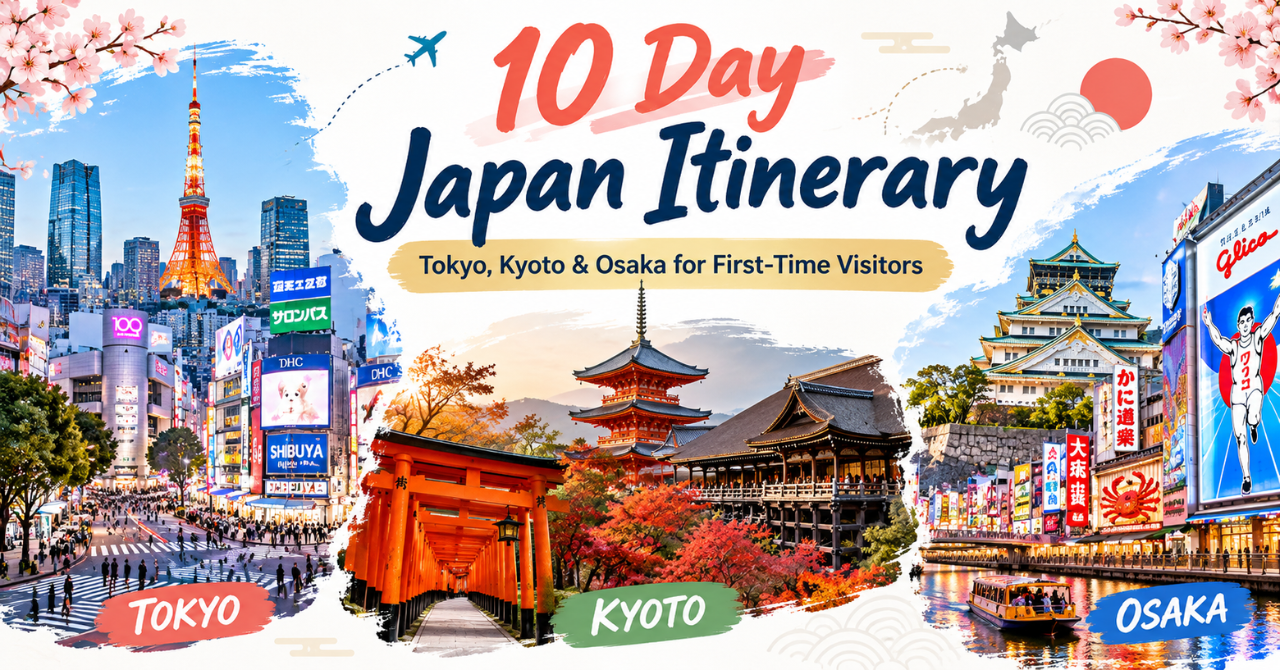
Planning your first trip to Japan can feel overwhelming, especially when you want to visit Tokyo, Kyoto, and Osaka in a limited amount of time.
A 10 day Japan itinerary gives you enough time to see the main highlights without changing hotels every day.
This route focuses on Tokyo, Kyoto, Nara, and Osaka.
You will explore modern city areas, historic temples, traditional neighborhoods, local food districts, and some of Japan’s most famous sights.
This guide shows you how to spend each day, where to stay, how to travel between cities, and what to know before your trip.
- Is 10 Days Enough for a First Trip to Japan?
- 10 Day Japan Itinerary at a Glance
- Day 1: Arrive in Tokyo and Explore Shibuya
- Day 2: Asakusa, Ueno, and Akihabara
- Day 3: Meiji Jingu, Harajuku, and Shinjuku
- Day 4: Explore More of Tokyo or Take a Day Trip
- Day 5: Travel from Tokyo to Kyoto
- Day 6: Kiyomizu-dera, Higashiyama, and Gion
- Day 7: Arashiyama and Kinkaku-ji
- Day 8: Visit Nara and Travel to Osaka
- Day 9: Osaka Castle, Dotonbori, and Shinsekai
- Day 10: Last-Minute Shopping and Departure
- Where to Stay During This 10 Day Japan Itinerary
- How to Get Around Japan During This Itinerary
- How Much Does a 10 Day Trip to Japan Cost?
- 10 Day Japan Itinerary FAQ
- Final Tips for Your 10 Day Japan Itinerary
Is 10 Days Enough for a First Trip to Japan?
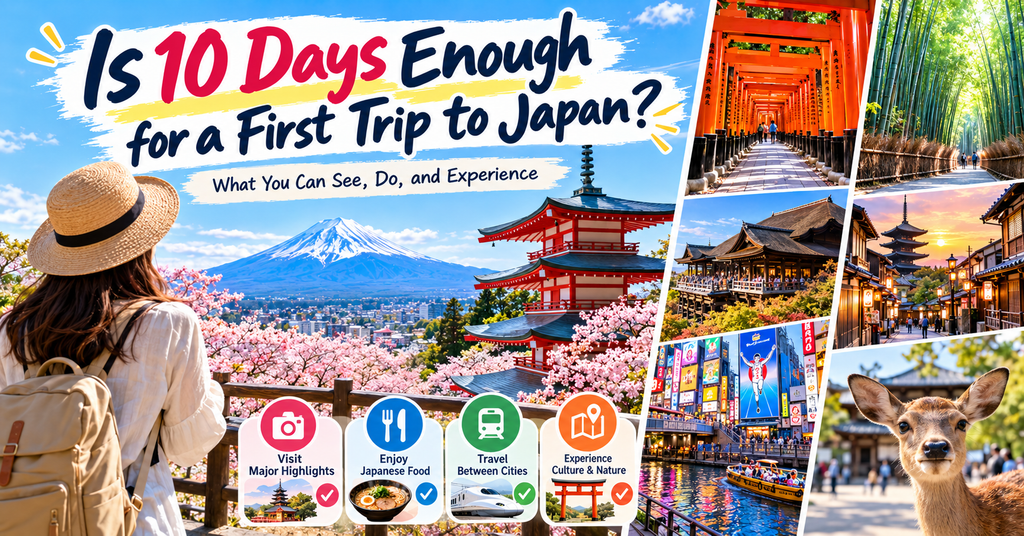
Yes. Ten days is enough for a first trip to Japan if you keep the route simple.
Tokyo, Kyoto, and Osaka fit well into a 10 day itinerary because the Shinkansen connects the cities quickly.
You can spend several days in Tokyo, explore Kyoto at a slower pace, visit Nara, and finish your trip in Osaka.
The key is to avoid adding too many overnight stops.
You may see itineraries that include Hakone, Hiroshima, or other cities, but adding too many places can make the trip feel rushed.
For a first visit, focusing on a few major areas gives you more time to enjoy each destination.
10 Day Japan Itinerary at a Glance
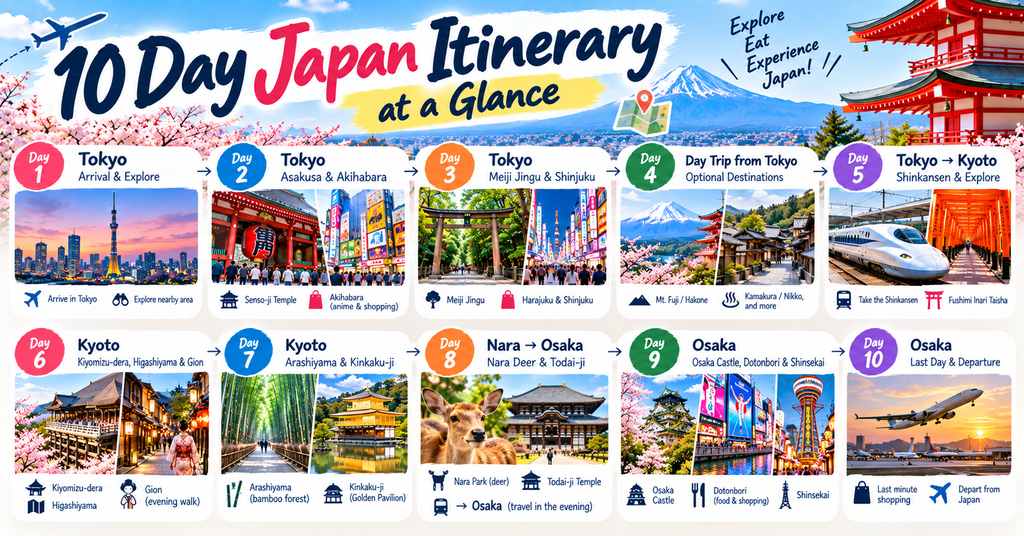
Here is a simple overview of this 10 day Japan itinerary.
The route starts in Tokyo, continues to Kyoto, includes a day in Nara, and finishes in Osaka.
This plan keeps hotel changes to a minimum and groups nearby sights together whenever possible.
- Arrive in Tokyo and explore Shibuya.
- Visit Asakusa, Ueno, and Akihabara.
- Explore Meiji Jingu, Harajuku, and Shinjuku.
- Spend another day in Tokyo or take a day trip.
- Travel to Kyoto and visit Fushimi Inari Taisha.
- Explore Kiyomizu-dera, Higashiyama, and Gion.
- Visit Arashiyama and Kinkaku-ji.
- Explore Nara, then travel to Osaka.
- Visit Osaka Castle, Dotonbori, and Shinsekai.
- Enjoy last-minute shopping and depart.
Day 1: Arrive in Tokyo and Explore Shibuya
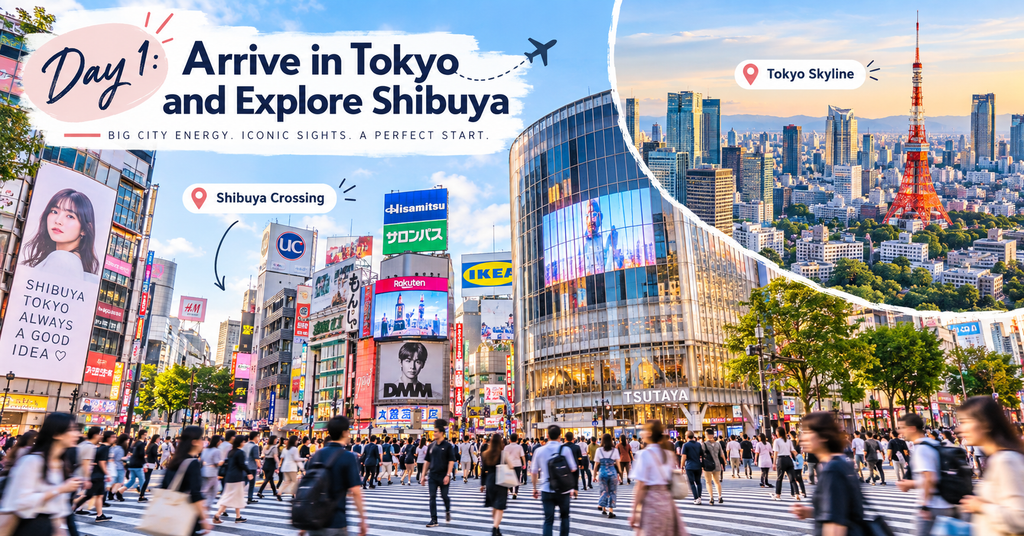
Your first day in Japan should stay simple.
After arriving in Tokyo, check in to your hotel, leave your luggage, and give yourself some time to adjust.
If you still have energy, spend the evening in Shibuya.
This area gives you an exciting first look at modern Tokyo without requiring a complicated route.
Arrive and Check In
After arriving at Narita Airport or Haneda Airport, travel to your hotel and check in.
Try to stay near a major station such as Shinjuku, Shibuya, Tokyo, or Ueno if you want easy transportation during your stay.
If you arrive before check-in time, most hotels can hold your luggage for you.
Avoid planning too many attractions on your first day, especially after a long international flight.
Shibuya Crossing and Shibuya Sky
In the evening, head to Shibuya.
Start with Shibuya Crossing, one of Tokyo’s most famous city scenes.
You can also walk around Shibuya Center-gai, visit nearby shops, or stop for dinner in the area.
If you want a panoramic city view, visit Shibuya Sky.
Book a timed ticket in advance, especially if you want to visit around sunset.
Check the official SHIBUYA SKY website for current tickets and opening hours.
Afterward, return to your hotel and rest for the next day.
Day 2: Asakusa, Ueno, and Akihabara
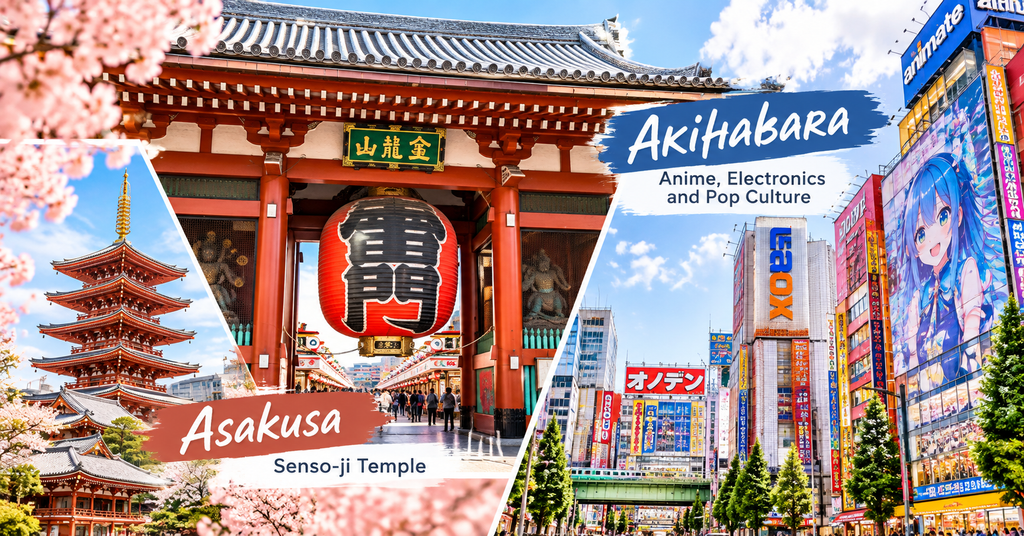
Day 2 focuses on three popular areas in eastern Tokyo.
Start with traditional Asakusa, continue to Ueno, and finish the day in Akihabara.
These areas are close enough to combine without spending too much time on trains.
Morning: Asakusa and Senso-ji
Start your morning in Asakusa.
Walk through Kaminarimon Gate and Nakamise Street before visiting Senso-ji, one of Tokyo’s most famous temples.
Take your time exploring the temple grounds and nearby traditional streets.
Arriving early helps you avoid the busiest crowds.
Afternoon: Ueno
Next, travel to Ueno.
Walk through Ueno Park or visit one of the museums in the area if you are interested in art, history, or science.
You can also explore Ameyoko, a lively shopping street filled with food stalls, small shops, and casual restaurants.
Stop here for lunch before continuing to Akihabara.
Evening: Akihabara
Finish the day in Akihabara.
The area is famous for anime, manga, video games, electronics, and Japanese pop culture.
Browse large electronics stores, visit specialty shops, or explore arcades.
Even if you are not a big anime fan, Akihabara offers a very different side of Tokyo and is worth seeing at least once.
Day 3: Meiji Jingu, Harajuku, and Shinjuku
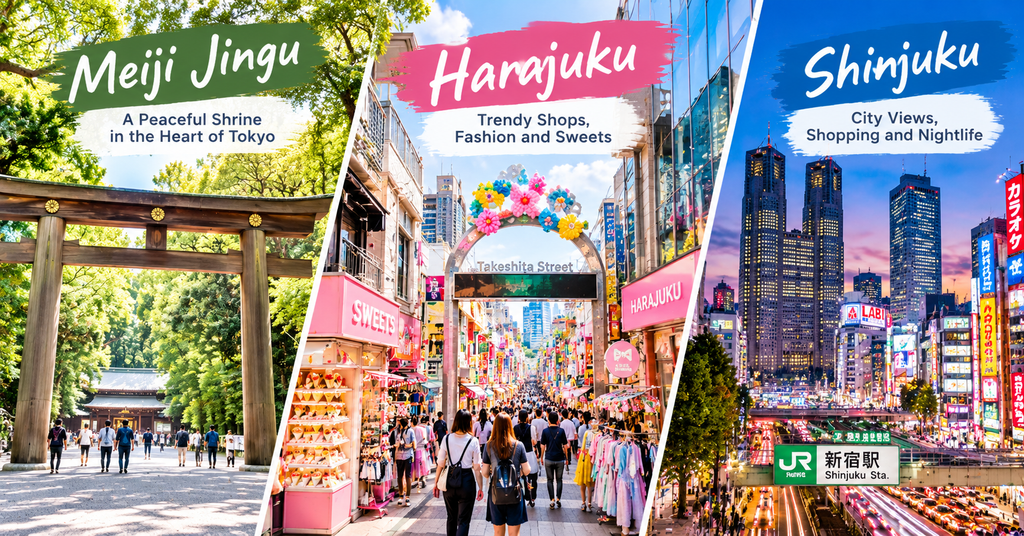
Day 3 shows you three very different sides of Tokyo.
Start with the quiet forest around Meiji Jingu, explore the fashion and shopping streets of Harajuku, and finish the day in lively Shinjuku.
The areas are close together, so you can move between them without wasting much time.
Morning: Meiji Jingu
Start your morning at Meiji Jingu.
The shrine sits inside a large forest next to Harajuku, which makes it feel surprisingly peaceful compared with the surrounding city.
Walk through the large torii gates, follow the forest path, and explore the main shrine area.
Visiting in the morning gives you a quieter start before Harajuku gets busy.
Afternoon: Harajuku and Omotesando
After Meiji Jingu, walk to Harajuku.
Explore Takeshita Street for colorful shops, snacks, fashion, and youth culture.
Then head toward Omotesando for a more modern and stylish atmosphere.
The area has cafes, clothing stores, and interesting architecture, so you can easily spend a few hours exploring.
Evening: Shinjuku
Finish the day in Shinjuku.
Walk around the bright streets near Shinjuku Station, explore Kabukicho, or enjoy dinner at one of the many restaurants in the area.
For a city view, you can visit the Tokyo Metropolitan Government Building, which has free observation decks.
Shinjuku becomes especially lively after dark, making it a good place to end the day.
Day 4: Explore More of Tokyo or Take a Day Trip
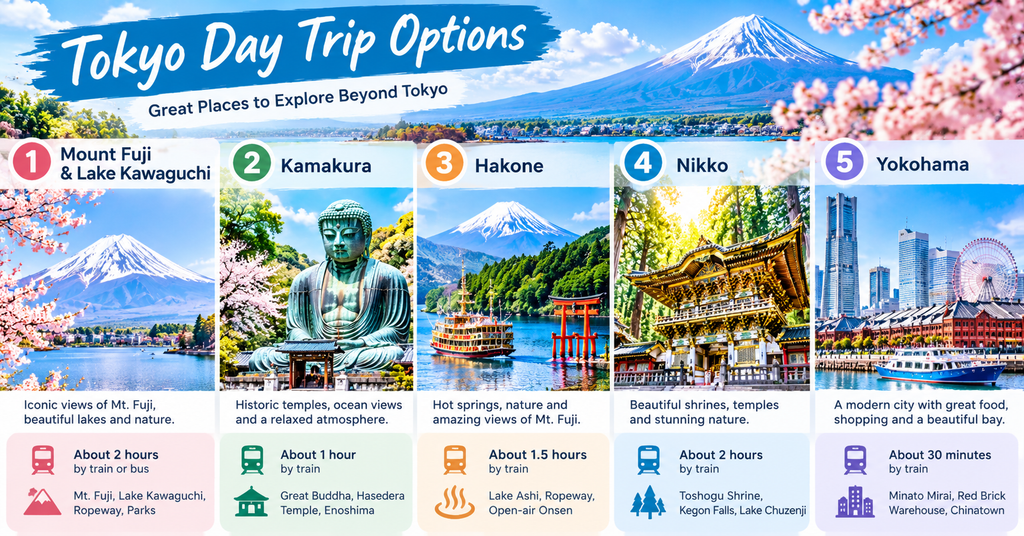
Day 4 gives you some flexibility.
You can spend another day exploring Tokyo or take a day trip if you want to see a different side of Japan.
Choose the option that best matches your interests and energy level.
Looking for more ideas? Check out our guide to the best day trips from Tokyo.
Option 1: Spend Another Day in Tokyo
If you want to stay in Tokyo, use this day to explore areas you have not visited yet.
You could visit Odaiba, Ginza, Tokyo Station, Tsukiji Outer Market, or teamLab Planets.
You can also slow down and revisit an area you enjoyed earlier in the trip.
Keeping one flexible day in Tokyo makes the itinerary feel less rushed.
Option 2: Take a Day Trip from Tokyo
If you want to leave the city for a day, Tokyo offers several easy day trip options.
Popular choices include Kamakura, Nikko, Yokohama, and the Mount Fuji area.
Travel times and sightseeing styles vary, so choose one destination rather than trying to combine several.
Return to Tokyo in the evening and rest before traveling to Kyoto the next day.
Day 5: Travel from Tokyo to Kyoto
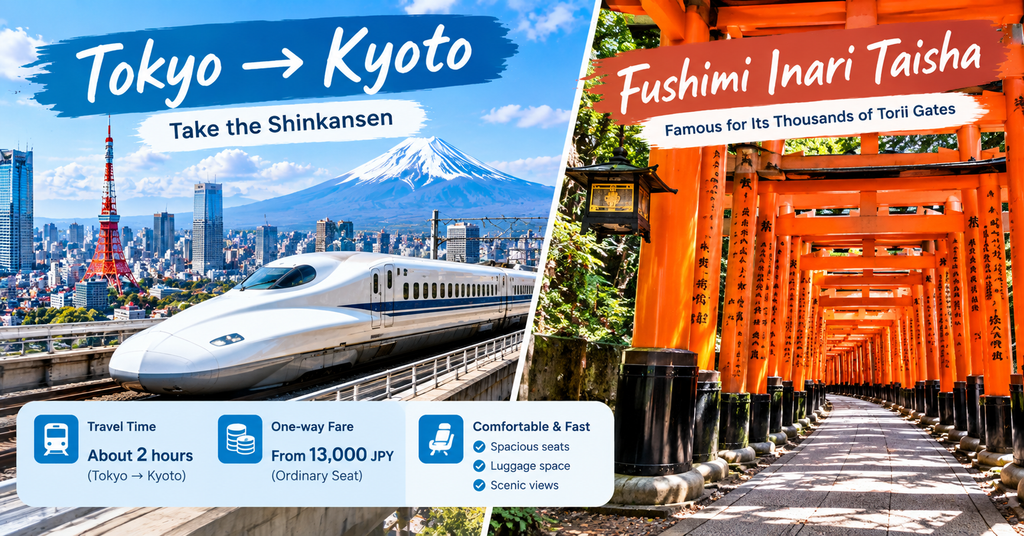
Day 5 takes you from modern Tokyo to historic Kyoto.
Travel to Kyoto in the morning, leave your luggage at your hotel, and spend the rest of the day exploring at a relaxed pace.
Fushimi Inari Taisha works well for the afternoon or early evening because you can explore as much of the shrine trail as you like.
Not sure how to use trains in Japan? Read our beginner’s guide to using trains in Japan before your trip.
Take the Shinkansen to Kyoto
Take the Shinkansen from Tokyo to Kyoto in the morning.
The journey takes roughly two to two and a half hours, depending on the train you choose.
Reserve a seat if you want a more comfortable trip, especially during weekends and busy travel periods.
After arriving at Kyoto Station, head to your hotel and leave your luggage before sightseeing.
Check the JR Central website for current Shinkansen information and reservations.
Visit Fushimi Inari Taisha
In the afternoon, visit Fushimi Inari Taisha.
The shrine is famous for its long paths lined with thousands of red torii gates.
You do not need to hike all the way to the top of Mount Inari.
Walk as far as your time and energy allow, then return to central Kyoto for dinner.
Visiting later in the day can also give you a quieter atmosphere than the busiest daytime hours.
Visit the official Fushimi Inari Taisha website for shrine information and access.
Day 6: Kiyomizu-dera, Higashiyama, and Gion
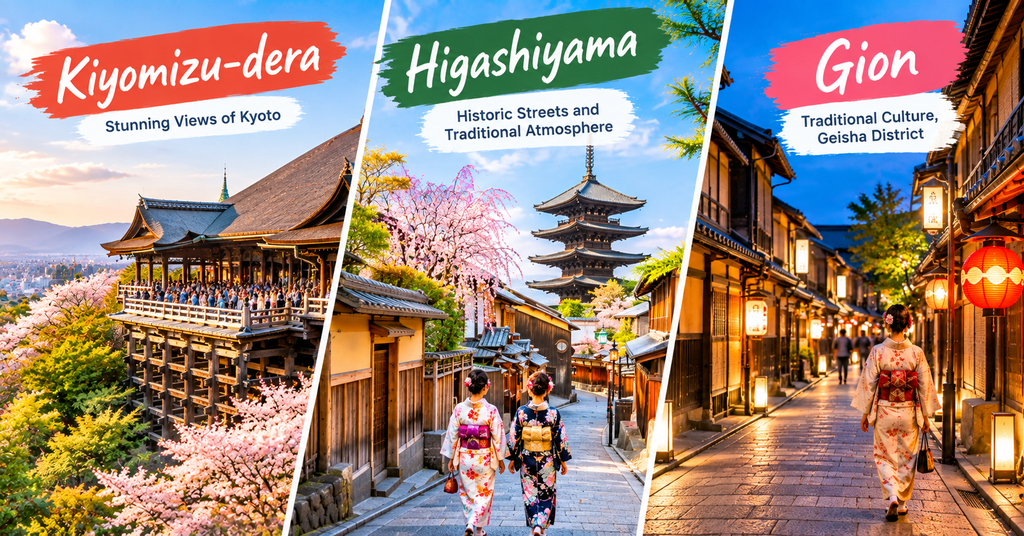
Day 6 focuses on some of Kyoto’s most famous historic areas.
Start at Kiyomizu-dera, walk through the traditional streets of Higashiyama, and finish the day in Gion.
This route lets you enjoy temples, old streets, shops, cafes, and Kyoto’s evening atmosphere without spending much time on transportation.
Morning: Kiyomizu-dera
Start the morning at Kiyomizu-dera.
The temple sits on a hillside and offers wide views over Kyoto.
Explore the temple grounds, walk along the wooden terrace, and take your time before heading back toward the historic streets below.
Arriving early helps you avoid the busiest crowds.
Check the official Kiyomizu-dera website for current opening hours and visitor information.
Afternoon: Walk Through Higashiyama
After Kiyomizu-dera, walk through the Higashiyama area.
Follow streets such as Sannenzaka and Ninenzaka, which are lined with traditional buildings, shops, cafes, and small restaurants.
You can also stop at nearby temples, shrines, or gardens if you want to explore more.
This part of Kyoto is best enjoyed slowly, so leave time to walk without a strict schedule.
Evening: Gion
Continue toward Gion in the late afternoon or evening.
Walk around Hanamikoji Street and the nearby traditional streets before finding a place for dinner.
You may also walk toward the Shirakawa area for a quieter atmosphere.
Gion is still an active neighborhood, so respect private property and avoid blocking narrow streets while taking photos.
Day 7: Arashiyama and Kinkaku-ji
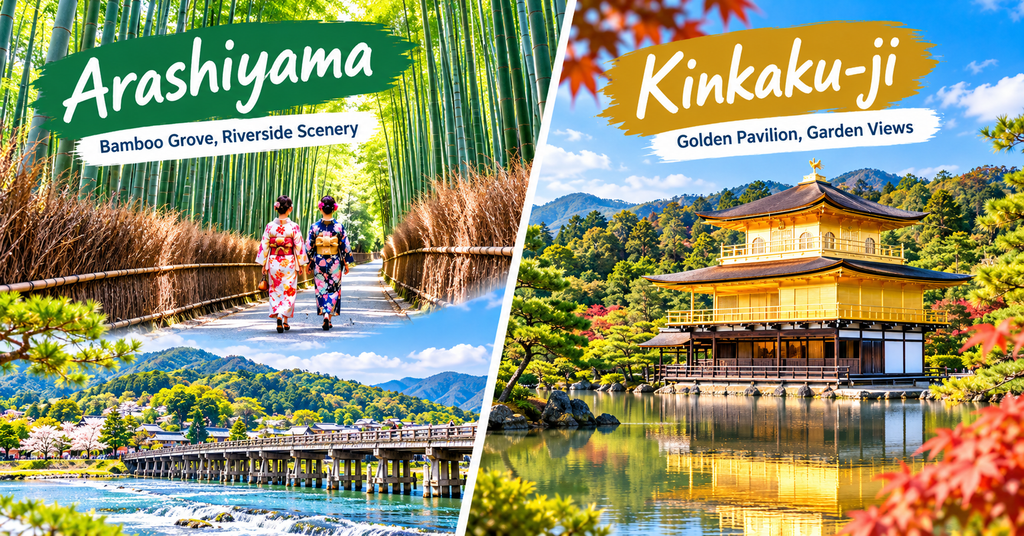
Day 7 takes you to two of Kyoto’s most famous sightseeing areas.
Start the morning in Arashiyama, where you can enjoy bamboo paths, temples, and riverside scenery.
In the afternoon, travel to Kinkaku-ji and see one of Kyoto’s most iconic temples.
Morning: Arashiyama
Start early in Arashiyama.
Walk through the famous Bamboo Grove, visit Tenryu-ji Temple, and explore the area around Togetsukyo Bridge.
If you have extra time, you can continue walking through quieter streets or visit a nearby garden.
Arriving early helps you enjoy the area before the largest crowds arrive.
Afternoon: Kinkaku-ji
In the afternoon, travel to Kinkaku-ji.
The temple is famous for its gold-covered exterior and its reflection on the surrounding pond.
Follow the walking route around the grounds and enjoy the different views of the temple.
Kinkaku-ji does not take a full day to visit, so it fits well after a morning in Arashiyama.
Day 8: Visit Nara and Travel to Osaka
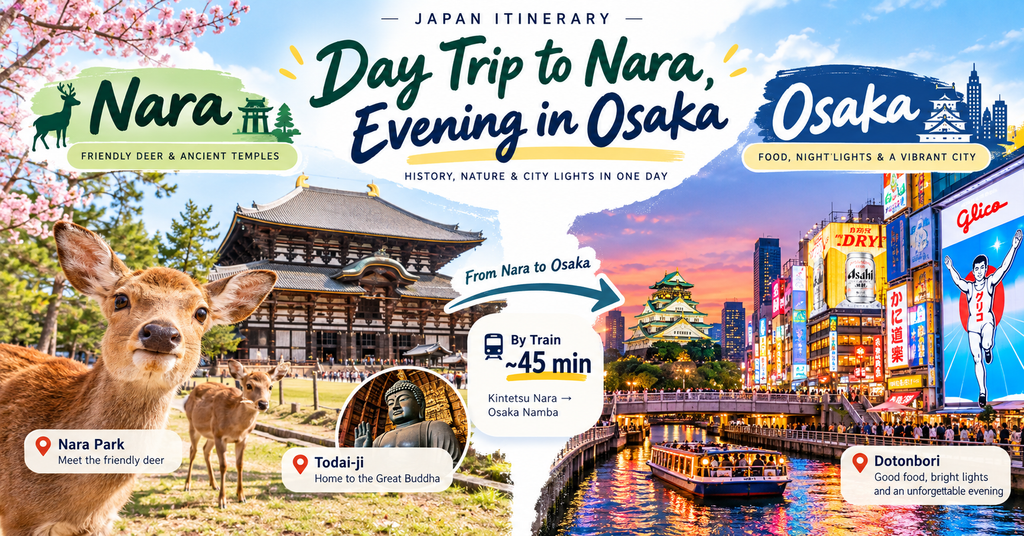
Day 8 takes you from Kyoto to Nara and then to Osaka.
Spend most of the day exploring Nara’s famous temples, park, and deer before continuing to Osaka in the evening.
This route lets you visit Nara without adding another hotel stay.
Morning and Afternoon: Nara
Travel from Kyoto to Nara in the morning.
Start around Nara Park, where you can see the famous free-roaming deer.
Continue to Todai-ji Temple to see the Great Buddha, then explore nearby shrines, gardens, and walking paths.
If you are traveling with large luggage, consider using a station locker or luggage delivery service so you can explore more comfortably.
Take your time in Nara rather than trying to visit every attraction in one day.
Evening: Travel to Osaka
In the late afternoon or early evening, travel from Nara to Osaka.
Check in to your hotel and spend the rest of the evening relaxing or exploring the neighborhood.
If you stay near Namba, you can easily walk to Dotonbori for dinner and enjoy Osaka’s lively atmosphere at night.
Save the main sightseeing for Day 9.
Day 9: Osaka Castle, Dotonbori, and Shinsekai
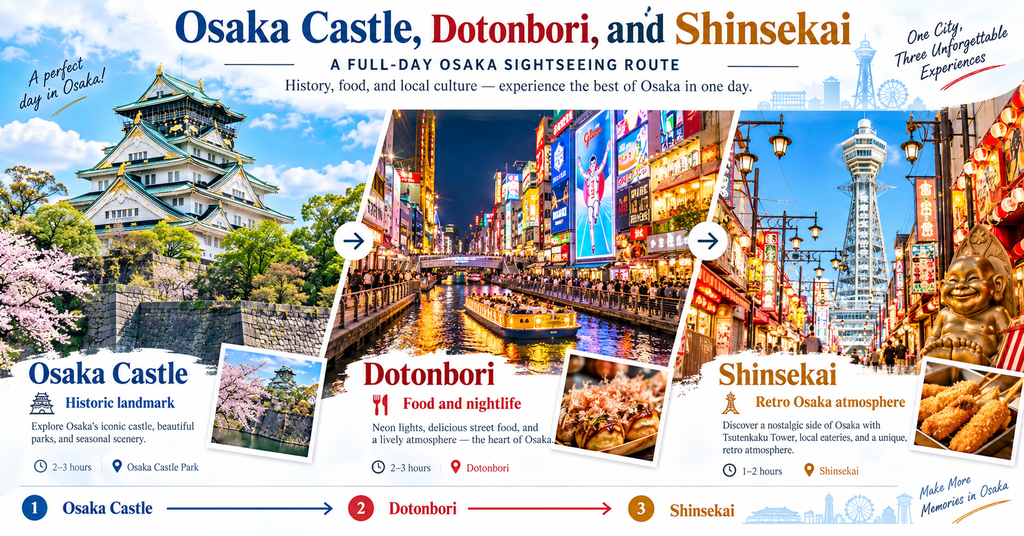
Day 9 gives you a full day to explore Osaka.
Start with Osaka Castle, spend the afternoon around Namba and Dotonbori, and finish the day in Shinsekai.
This route combines history, food, shopping, and Osaka’s lively nightlife.
Morning: Osaka Castle
Start the morning at Osaka Castle.
Walk through Osaka Castle Park and enjoy the views of the castle from the surrounding grounds.
You can also enter the castle museum if you are interested in Japanese history.
The park is large, so give yourself enough time to walk around without rushing.
Check the official Osaka Castle website for current admission and opening information.
Afternoon: Namba and Dotonbori
In the afternoon, head to Namba and Dotonbori.
Walk along the canal, see the famous Glico sign, and explore the busy shopping streets around the area.
This is also a great place to try Osaka specialties such as takoyaki and okonomiyaki.
Take your time walking around and stop wherever looks interesting.
Evening: Shinsekai
Finish the day in Shinsekai.
The area has a retro atmosphere, bright signs, casual restaurants, and views of Tsutenkaku Tower.
Try kushikatsu or another local dish for dinner.
Shinsekai feels very different from Dotonbori, so it is a fun place to end your final full sightseeing day.
Day 10: Last-Minute Shopping and Departure
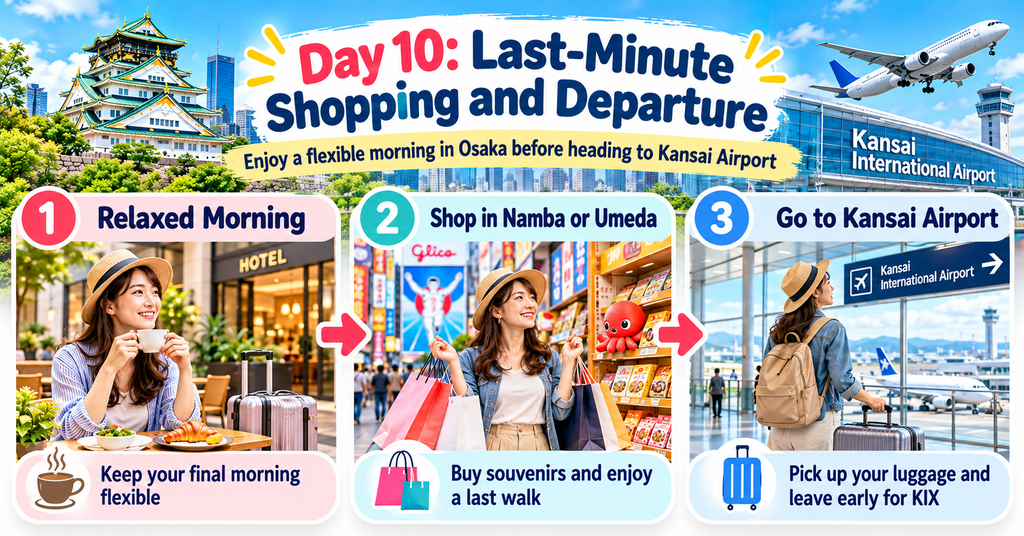
Your final day in Japan should stay flexible.
Use the morning for last-minute shopping, a relaxed breakfast, or a short walk around your hotel area.
Leave enough time to return to your hotel, collect your luggage, and travel to the airport without rushing.
If you are staying near Namba or Umeda, spend a few hours shopping for souvenirs, snacks, cosmetics, or gifts.
You can also revisit a nearby area you enjoyed during your stay.
Check your flight time and airport transfer in advance, especially if you are flying from Kansai International Airport.
Check the Kansai International Airport website for the latest airport access information.
Try to arrive at the airport with plenty of time for check-in, security, and immigration.
If your flight leaves early in the morning, skip sightseeing and travel directly to the airport.
Where to Stay During This 10 Day Japan Itinerary
Choosing the right area to stay can save you a lot of travel time.
For this itinerary, stay near major stations or areas with good train connections.
You do not need to stay next to every attraction. A convenient base makes it easier to explore different parts of each city.
Where to Stay in Tokyo
Shinjuku, Shibuya, Tokyo Station, and Ueno are all convenient areas for first-time visitors.
Shinjuku and Shibuya are good choices if you enjoy restaurants, shopping, and nightlife.
Tokyo Station works well if you want easy access to the Shinkansen, while Ueno offers convenient connections to Asakusa and eastern Tokyo.
Choose an area close to a train or subway station whenever possible.
Where to Stay in Kyoto
Kyoto Station is one of the easiest places to stay for this itinerary.
It gives you convenient access to trains, buses, restaurants, and the Shinkansen.
If you prefer a more traditional atmosphere, consider staying around Gion or central Kyoto.
Kyoto Station is usually the simpler choice if transportation convenience is your priority.
Where to Stay in Osaka
Namba is a convenient base for this itinerary because it is close to Dotonbori, shopping areas, restaurants, and nightlife.
Umeda is another good option, especially if you want easy train connections around Osaka and to nearby cities.
For a first visit, choose Namba if you want to stay close to Osaka’s lively entertainment areas.
How to Get Around Japan During This Itinerary
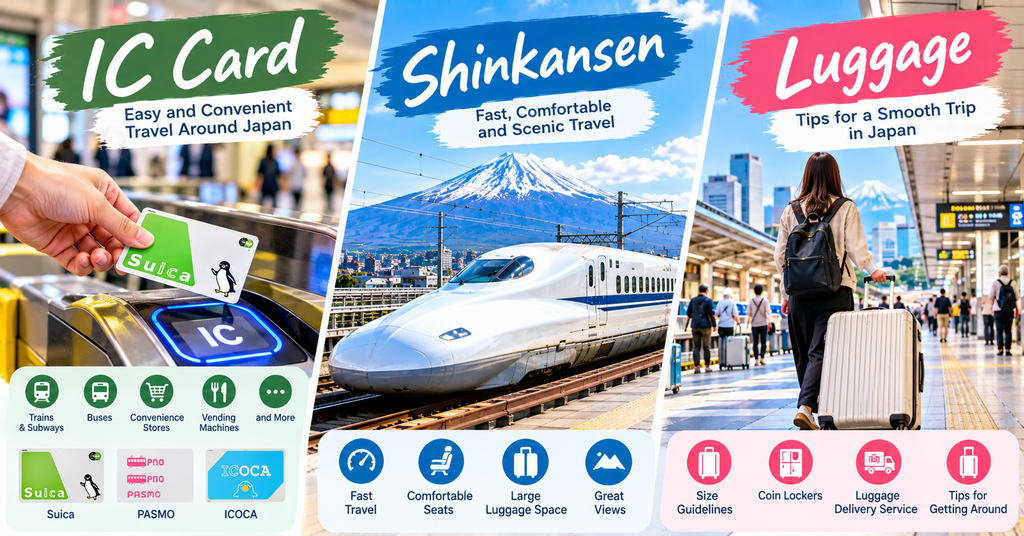
Japan’s public transportation makes this itinerary easy to follow.
Use local trains and subways within each city, take the Shinkansen between Tokyo and Kyoto, and use an IC card for most short-distance trips.
Planning a few key routes in advance can make your trip much smoother.
Want to know which IC card to choose? Read our complete guide to Suica, PASMO, and ICOCA.


Use an IC Card for Local Transportation
An IC card such as Suica, PASMO, or ICOCA is useful for trains, subways, buses, and many everyday purchases.
You can tap the card at ticket gates instead of buying a separate ticket for every local journey.
Keep some cash as a backup because not every transportation service or shop accepts IC cards.
Use the Shinkansen Between Tokyo and Kyoto
The Shinkansen is the easiest way to travel from Tokyo to Kyoto on this itinerary.
The trip takes roughly two to two and a half hours, depending on the train.
Buy your ticket before departure and consider reserving a seat during busy travel periods.
A Japan Rail Pass is not automatically the best choice for this route, so compare the pass price with individual tickets before buying one.
Travel Light Between Cities
Traveling with large suitcases can make train stations and hotel changes more difficult.
Pack light if possible, or use Japan’s luggage delivery services to send large bags between hotels.
A smaller bag makes sightseeing days, especially your stop in Nara, much easier.
How Much Does a 10 Day Trip to Japan Cost?
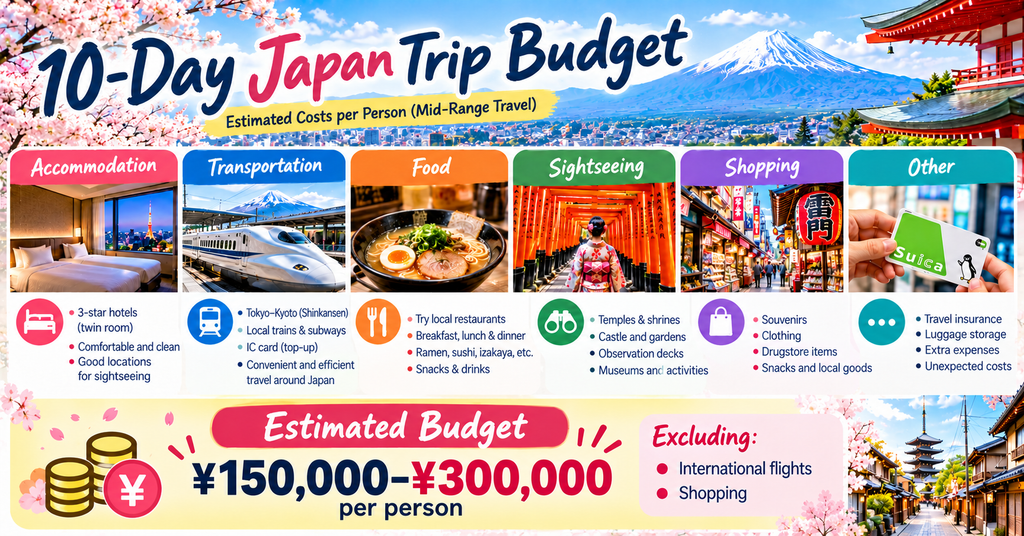
The cost of a 10 day trip to Japan depends heavily on your accommodation, food, and travel style.
As a rough guide, many travelers can expect to spend around ¥150,000 to ¥300,000 per person for 10 days, excluding international flights and shopping.
Budget travelers who stay in hostels or inexpensive hotels and eat casual meals may spend less.
Travelers who choose mid-range hotels, paid attractions, and more expensive restaurants may spend more.
Remember to include the Shinkansen from Tokyo to Kyoto, local transportation, airport transfers, food, accommodation, and attraction fees in your budget.
Hotel prices can also rise during busy periods such as cherry blossom season, Golden Week, and autumn foliage season.
Want to learn more about cash, credit cards, and payments in Japan? Read our complete money guide.

10 Day Japan Itinerary FAQ
Here are some common questions travelers have when planning a 10 day trip to Japan.
Should I Visit Tokyo or Osaka First?
Either direction works, but starting in Tokyo and finishing in Osaka is convenient for this itinerary.
Tokyo is a good place to begin your first trip because you can adjust to Japan’s transportation system before moving between cities.
If your flights are cheaper in the opposite direction, you can simply reverse the itinerary.
Do I Need a Japan Rail Pass for This Itinerary?
You do not necessarily need a Japan Rail Pass for this itinerary.
This route includes only one major Shinkansen journey from Tokyo to Kyoto, so individual tickets may be more practical.
Compare current pass prices with the cost of your planned train trips before buying a rail pass.
Is 10 Days Enough for Tokyo, Kyoto, and Osaka?
Yes.
Ten days gives you enough time to see the main highlights of Tokyo, Kyoto, and Osaka without changing cities every day.
This itinerary also includes Nara while keeping the overall route simple.
Can I Add Hiroshima or Hakone to This Itinerary?
You can, but the itinerary will become much busier.
If you want to visit Hakone or Hiroshima, consider removing one day from Tokyo or shortening your time in another city.
For a first trip, keeping the route simple usually gives you a more relaxed experience.
Should I Fly Into Tokyo and Leave From Osaka?
If the airfare fits your budget, flying into Tokyo and leaving from Osaka can be very convenient.
This lets you follow the itinerary in one direction without returning to Tokyo at the end of your trip.
Check flights from Kansai International Airport before booking, as prices and routes vary.
Final Tips for Your 10 Day Japan Itinerary
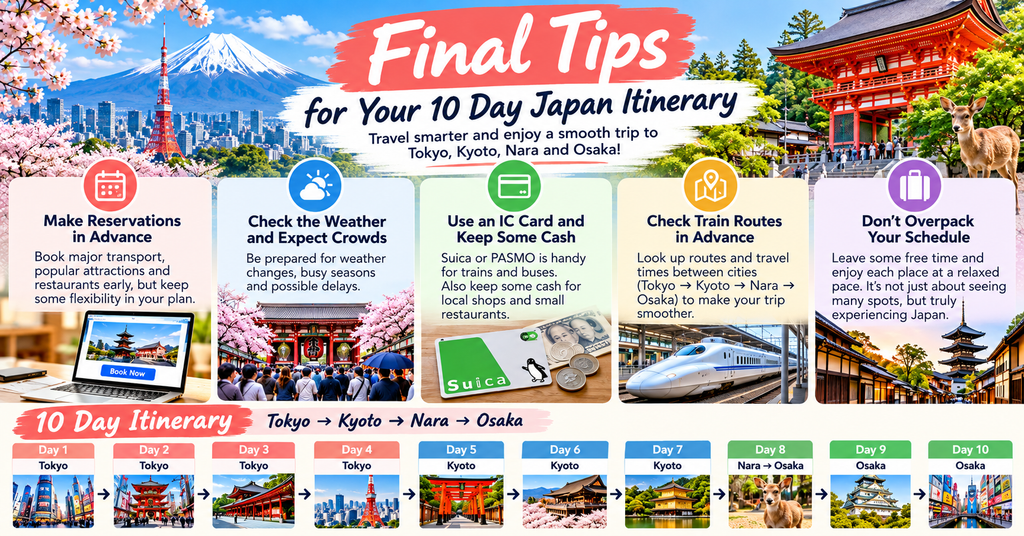
A 10 day Japan itinerary is enough to enjoy Tokyo, Kyoto, Nara, and Osaka without rushing through every destination.
Book important transportation and popular attractions in advance when possible, but leave some flexibility in your schedule.
Weather, crowds, and travel delays can affect your plans, so avoid filling every hour of the day.
Use an IC card for local transportation, keep some cash as a backup, and check your train routes before moving between cities.
Most importantly, take your time and enjoy each area instead of trying to see everything in one trip.
Visiting Japan for the first time? Check our complete guide to essential things to know before your trip.