18 Recommended Day Trip Destinations From Tokyo
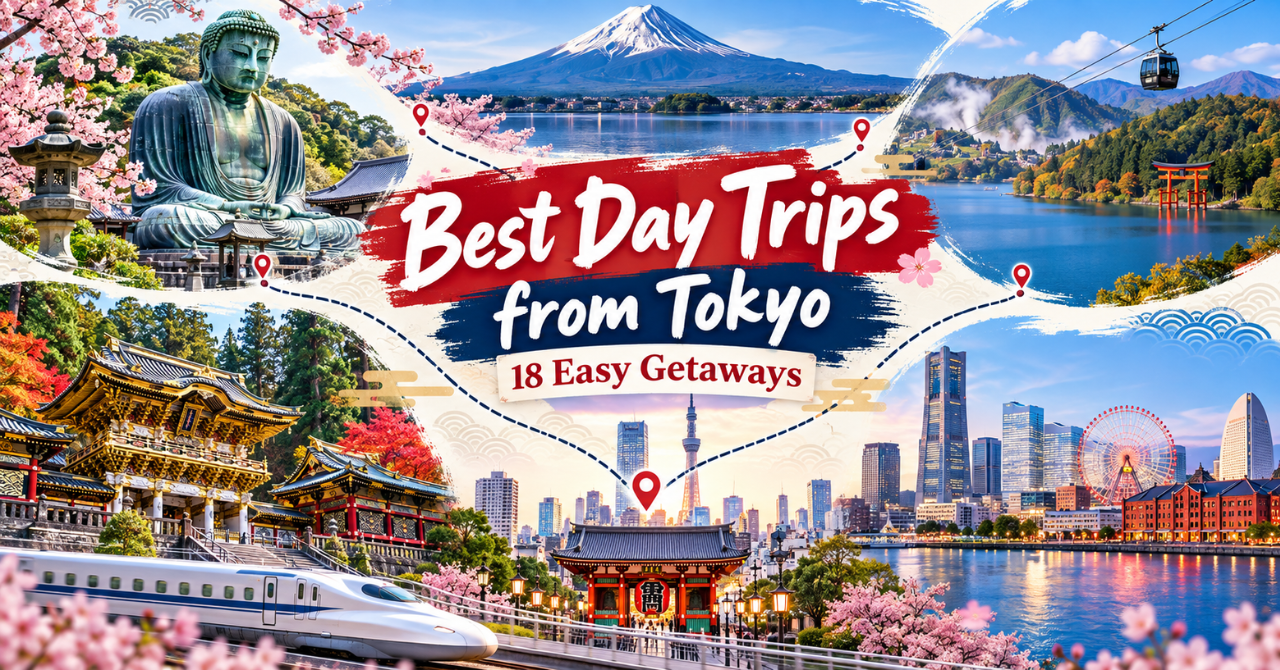
Looking for the best day trips from Tokyo?
Tokyo has enough attractions to fill an entire vacation, but one of the biggest advantages of staying in the capital is how easy it is to explore other parts of Japan.
Within a few hours, you can walk through an ancient temple town, see Mount Fuji across a lake, relax in a hot spring, hike through mountains, eat local specialties, or spend the day at a theme park.
Some destinations are less than an hour from central Tokyo, while others require an early start and a full day of travel.
In this guide, we compare 18 recommended day trips from Tokyo, including approximate travel times, what each destination is best for, and whether it works as an easy day trip or is better for travelers who do not mind a longer journey.
If this is your first visit to Japan, you may also want to read our guide to 20 essential things to know before visiting Japan.
Local Tip: For day trips from Tokyo, travel time matters less than the number of transfers and how late you return. A slightly longer direct train can feel easier than a shorter route with several connections.
- Quick Answer: Best Day Trips from Tokyo
- Best Easy Day Trips from Tokyo
- Nature and Outdoor Day Trips from Tokyo
- Best Onsen Day Trips from Tokyo
- Unique and Theme Park Day Trips from Tokyo
- How to Choose the Best Day Trip from Tokyo
- How to Plan a Day Trip from Tokyo
- Day Trips from Tokyo FAQ
- What Is the Best Day Trip from Tokyo for a First-Time Visitor?
- What Is the Easiest Day Trip from Tokyo?
- Can I See Mount Fuji on a Day Trip from Tokyo?
- Is Hakone Worth Visiting as a Day Trip?
- Can I Visit Nikko in One Day from Tokyo?
- Is Kusatsu Onsen a Good Day Trip from Tokyo?
- How Many Day Trips Should I Add to a Tokyo Stay?
- Final Tips for Choosing a Tokyo Day Trip
Quick Answer: Best Day Trips from Tokyo
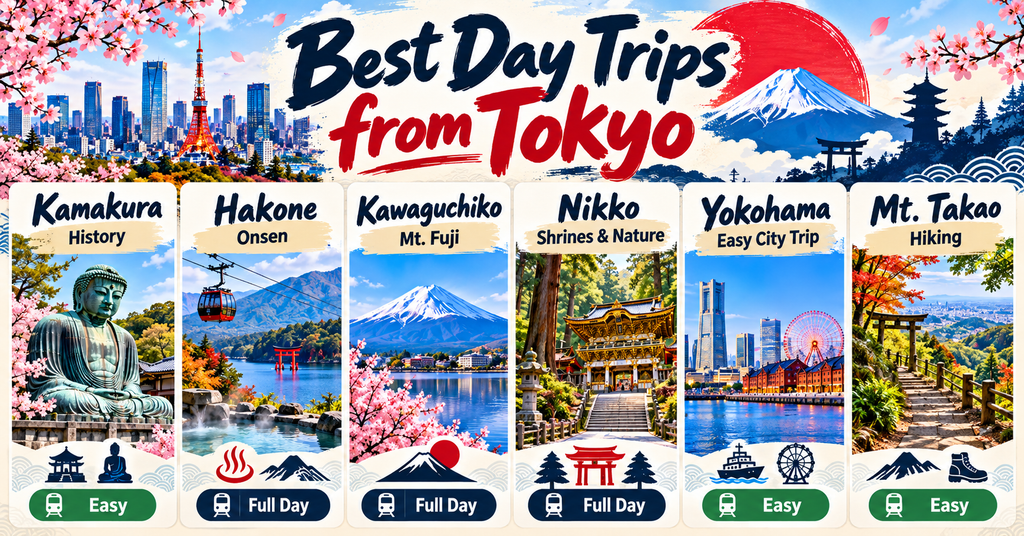
If you only have time for a few trips outside Tokyo, these are some of the easiest options to choose based on your interests.
- Best for temples and history: Kamakura or Nikko
- Best for Mount Fuji views: Lake Kawaguchiko
- Best for hot springs: Hakone or Atami
- Best easy city trip: Yokohama
- Best traditional town: Kawagoe
- Best easy hike: Mount Takao
- Best for families: Tokyo Disney Resort or Moominvalley Park
- Best for seasonal flowers: Hitachi Seaside Park
| Destination | Best For | Approx. One-Way Travel | Trip Style |
|---|---|---|---|
| Kamakura | Temples, history & coast | About 1 hour | Easy |
| Hakone | Onsen & Mount Fuji views | About 1.5 hours | Full Day |
| Lake Kawaguchiko | Mount Fuji scenery | About 2 hours | Full Day |
| Nikko | Shrines, history & nature | About 2 hours | Full Day |
| Yokohama | Harbor, food & city views | About 30 minutes | Easy |
| Kawagoe | Old-town atmosphere | About 35–60 minutes | Easy |
| Mount Takao | Hiking & nature | About 1 hour | Easy |
| Atami | Onsen, seafood & ocean | About 50 minutes by Shinkansen | Easy–Full Day |
| Chichibu | Nature & seasonal scenery | About 1.5 hours | Full Day |
| Hitachi Seaside Park | Seasonal flowers | About 1 hour 40 minutes | Full Day |
| Odawara | Castle & history | About 30 minutes by Shinkansen | Easy |
| Utsunomiya | Gyoza & local food | About 50 minutes by Shinkansen | Easy |
| Okutama | Mountains & outdoor activities | About 1.5 hours | Full Day |
| Mount Nokogiri | Hiking & dramatic views | About 1.5–2 hours | Full Day |
| Tokyo Disney Resort | Theme parks | About 15 minutes to Maihama from Tokyo Station | Full Day |
| Moominvalley Park | Families & Moomin fans | About 1–1.5 hours | Full Day |
| Kusatsu Onsen | Traditional hot spring town | About 3–4 hours | Long Day / Overnight Better |
| Izu Oshima | Island, volcano & nature | About 1 hour 45 minutes by jet ferry | Long Day / Overnight Better |
Travel times are approximate. Actual travel time depends on your departure station, train or bus service, transfers, waiting time, and local transportation after arrival.
Best Easy Day Trips from Tokyo
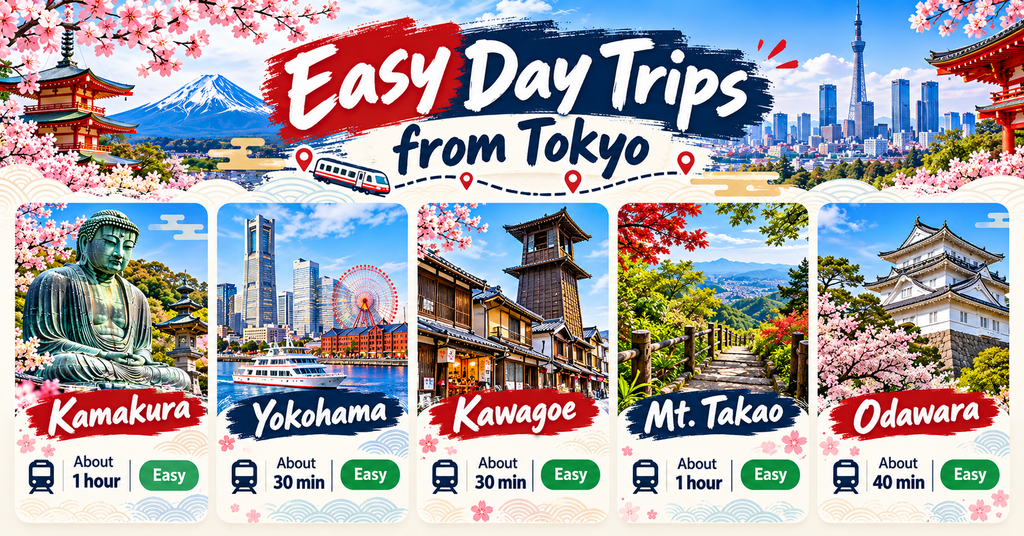
If you want to spend less time traveling and more time sightseeing, start with these destinations.
1. Kamakura – Best for Temples and History
Best for: Temples, shrines, historic streets, cafes, and coastal scenery
Approximate travel time: About 1 hour from Tokyo Station
Kamakura is one of the best day trips from Tokyo for first-time visitors who want to experience historic Japan without traveling all the way to Kyoto.
The city was once an important political center and is now known for its temples, shrines, traditional streets, and famous Great Buddha.
Popular stops include:
- Great Buddha of Kamakura
- Hase-dera Temple
- Tsurugaoka Hachimangu
- Komachi-dori shopping street
- Enoshima, if you have enough time
A direct JR Yokosuka Line train connects Tokyo Station with Kamakura Station, making this one of the easiest major sightseeing trips from central Tokyo.
If you want to combine Kamakura and Enoshima, start early because both areas can easily fill an entire day.
For more information, see the official JNTO Kamakura guide.
2. Yokohama – Best Easy City Escape
Best for: Harbor views, Chinatown, shopping, food, and evening scenery
Approximate travel time: Around 30 minutes from central Tokyo
Yokohama is one of the easiest day trips you can take from Tokyo.
Instead of temples and mountains, Yokohama gives you a different urban experience with a waterfront atmosphere, large parks, historic buildings, shopping, and one of Japan’s most famous Chinatowns.
Popular areas include:
- Minato Mirai
- Yokohama Red Brick Warehouse
- Yokohama Chinatown
- Yamashita Park
- Harbor and waterfront areas
Because the city is so close to Tokyo, Yokohama is also a good choice when you do not want to wake up early or spend several hours on transportation.
Staying until evening is worthwhile because Minato Mirai becomes particularly attractive after dark.
See the official JNTO Yokohama guide for more sightseeing information.
3. Kawagoe – Best for an Edo-Period Atmosphere
Best for: Traditional streets, temples, sweets, and an easy half-day or full-day trip
Approximate travel time: About 35–60 minutes depending on your starting station and train
Kawagoe in Saitama Prefecture is often called Koedo, meaning “Little Edo.”
The historic warehouse district gives visitors a taste of an older Japanese town without traveling far from Tokyo.
Highlights include:
- Kurazukuri warehouse district
- Toki no Kane bell tower
- Kashiya Yokocho, or Candy Alley
- Kitain Temple
- Kawagoe Hikawa Shrine
Kawagoe is also known for sweet-potato snacks, so leave room to try a few local treats while walking around.
It is compact enough to explore without creating an exhausting itinerary, which makes it particularly good for travelers who want a relaxed day outside Tokyo.
For official travel information, see the JNTO Kawagoe guide.
4. Mount Takao – Best Easy Hiking Trip
Best for: Hiking, nature, mountain views, and a break from the city
Approximate travel time: Around 1 hour from Shinjuku
Mount Takao is technically still within Tokyo, but it feels very different from Shibuya or Shinjuku.
The mountain has several hiking routes, and visitors who do not want to walk the entire way can use a cable car or chairlift for part of the climb.
Along the way, you can visit Yakuoin Temple, enjoy mountain food and snacks, and on clear days see Mount Fuji from the summit area.
Autumn foliage season can be particularly busy, so visiting on a weekday or arriving early can make the experience more comfortable.
See the official JNTO Mount Takao guide.
5. Odawara – Best for a Quick Castle Trip
Best for: Japanese castles, samurai history, and travelers heading toward Hakone
Approximate travel time: Around 30 minutes by Shinkansen or about 90 minutes by regular train
Odawara is an easy castle-town escape southwest of Tokyo.
The main attraction is Odawara Castle, which is only a short walk from Odawara Station.
The castle grounds are particularly attractive during seasonal flower periods, and the reconstructed castle keep contains exhibits related to the history of Odawara and the Hojo clan.
Odawara is also famous for kamaboko, a traditional Japanese fish cake.
You can visit Odawara as a standalone trip or combine it with the beginning or end of a Hakone visit.
If you plan to use the Shinkansen, our guide to buying Shinkansen tickets in Japan explains the basic ticketing process.
See the official JNTO Odawara Castle guide.
6. Utsunomiya – Best for Gyoza Lovers
Best for: Gyoza, local food, and an unusual city day trip
Approximate travel time: About 50 minutes by Shinkansen
Utsunomiya in Tochigi Prefecture is especially famous in Japan for gyoza.
Restaurants across the city serve different styles of dumplings, including pan-fried, boiled, and deep-fried versions.
If food is your main reason for traveling, you can turn the day into a gyoza tasting tour and compare several shops.
Travelers who want more than food can also explore attractions around the city such as the Oya area and its former stone quarry.
For more information, visit the official JNTO Utsunomiya guide.
Nature and Outdoor Day Trips from Tokyo
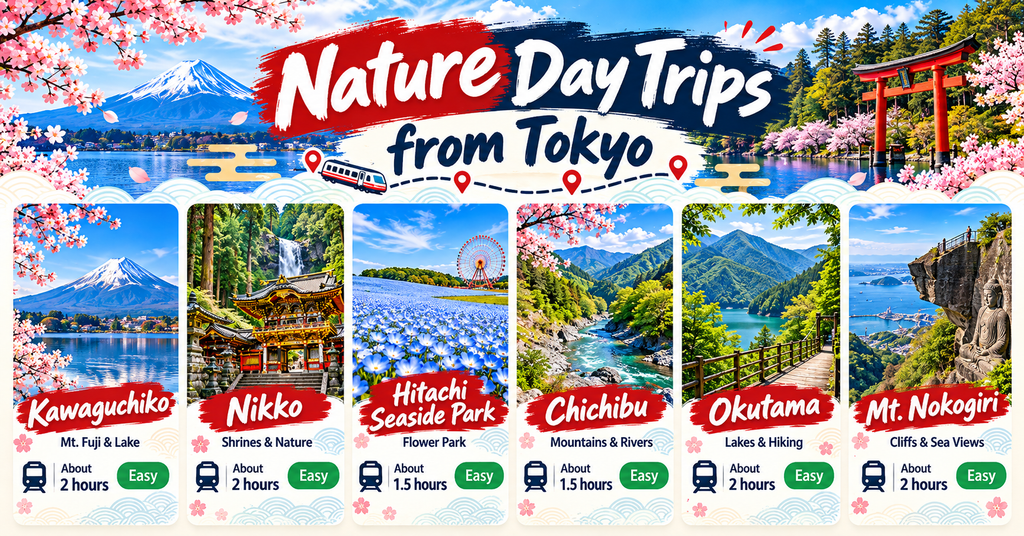
7. Lake Kawaguchiko – Best for Mount Fuji Views
Best for: Mount Fuji views, photography, lakeside scenery, cycling, and ropeway views
Approximate travel time: Around 2 hours from Tokyo
Instead of treating “Mount Fuji” as one single sightseeing spot, first-time visitors should choose a specific area around the mountain.
Lake Kawaguchiko is one of the easiest places to reach from Tokyo and one of the most popular bases for viewing Mount Fuji.
Depending on the weather, you can enjoy the mountain from:
- The lakeside
- Panoramic viewpoints
- Boat cruises
- Ropeway observation areas
- Nearby parks and museums
Mount Fuji can become hidden behind clouds even on otherwise pleasant days. If seeing the mountain is your main goal, check the weather forecast and consider arriving in the morning.
Highway buses connect Shinjuku with Kawaguchiko, while train routes are also available.
See the official JNTO Fuji Five Lakes guide for more information.
8. Nikko – Best for Shrines and Mountain Scenery
Best for: UNESCO World Heritage sites, ornate shrines, forests, waterfalls, and autumn scenery
Approximate travel time: About 2 hours
Nikko is one of the most rewarding full-day trips from Tokyo.
Its best-known attraction is Nikko Toshogu Shrine, part of the Shrines and Temples of Nikko UNESCO World Heritage property.
Other important cultural sites include Rinnoji Temple and Futarasan Shrine.
The wider Nikko area also includes:
- Lake Chuzenji
- Kegon Falls
- Mountain scenery
- Hiking routes
- Hot springs
If you only have one day, avoid trying to see every part of Nikko. A cultural itinerary centered around Toshogu is much easier than combining the shrine area, Lake Chuzenji, waterfalls, and long hikes in a single rushed visit.
Travelers who want to explore both the historic center and the national park more slowly may prefer an overnight stay.
See the official JNTO Nikko itinerary.
9. Hitachi Seaside Park – Best for Seasonal Flowers
Best for: Flowers, photography, cycling, and seasonal landscapes
Approximate travel time: Around 1 hour 40 minutes including the bus from Katsuta Station
Hitachi Seaside Park in Ibaraki Prefecture is famous for enormous seasonal flower displays.
The most recognizable seasons are:
- Spring: Blue nemophila covering Miharashi Hill
- Autumn: Kochia bushes turning deep red
The park also features other seasonal flowers, cycling routes, open spaces, cafes, and amusement facilities.
From Tokyo Station, the Limited Express Hitachi or Tokiwa reaches Katsuta Station in roughly 85 minutes, followed by a bus to the park.
Flower conditions vary from year to year, so check the official Hitachi Seaside Park website before making a special trip for a particular bloom.
10. Chichibu – Best for Mountains and Seasonal Nature
Best for: Nature, river scenery, flowers, autumn leaves, and traditional festivals
Approximate travel time: About 1.5 hours from Ikebukuro
Chichibu in Saitama Prefecture offers mountains, rivers, temples, seasonal flowers, and small-town scenery within reach of Tokyo.
Depending on the season and your interests, you can visit:
- Hitsujiyama Park
- Chichibu Shrine
- Nagatoro
- Arakawa River
- Nearby hiking areas
Spring is known for colorful shibazakura, while autumn attracts visitors for mountain foliage.
The Seibu Railway Limited Express from Ikebukuro makes Chichibu relatively straightforward to reach.
See the official JNTO Chichibu guide.
11. Okutama – Best for a Quiet Nature Escape
Best for: Hiking, rivers, mountains, kayaking, and travelers who want to escape central Tokyo
Approximate travel time: About 1.5 hours
Okutama is located on the mountainous western edge of Tokyo.
Although you are technically still inside Tokyo, the scenery feels far removed from the capital’s skyscrapers and crowded railway stations.
The area offers hiking, fishing, kayaking, lakes, rivers, countryside cafes, and limestone caves.
Because attractions are spread across the region, decide what you want to do before arriving rather than trying to explore “all of Okutama” in one day.
For official information, see the JNTO Okutama guide.
12. Mount Nokogiri – Best for Dramatic Views
Best for: Hiking, Tokyo Bay views, cliffs, temples, and unusual Buddhist statues
Approximate travel time: Around 1.5–2 hours depending on your route
Mount Nokogiri on the Boso Peninsula in Chiba is one of the most distinctive hiking destinations within reach of Tokyo.
The mountain is known for:
- Jigoku Nozoki, or “Hell Peek,” lookout
- Nihonji Temple
- A large stone Buddha
- Views over Tokyo Bay
- Mount Nokogiri Ropeway
You can hike the mountain or use the ropeway for part of the journey.
Wear comfortable shoes because sightseeing around the temple and viewpoints still involves stairs and uneven terrain.
See the official JNTO Mount Nokogiri guide.
Best Onsen Day Trips from Tokyo
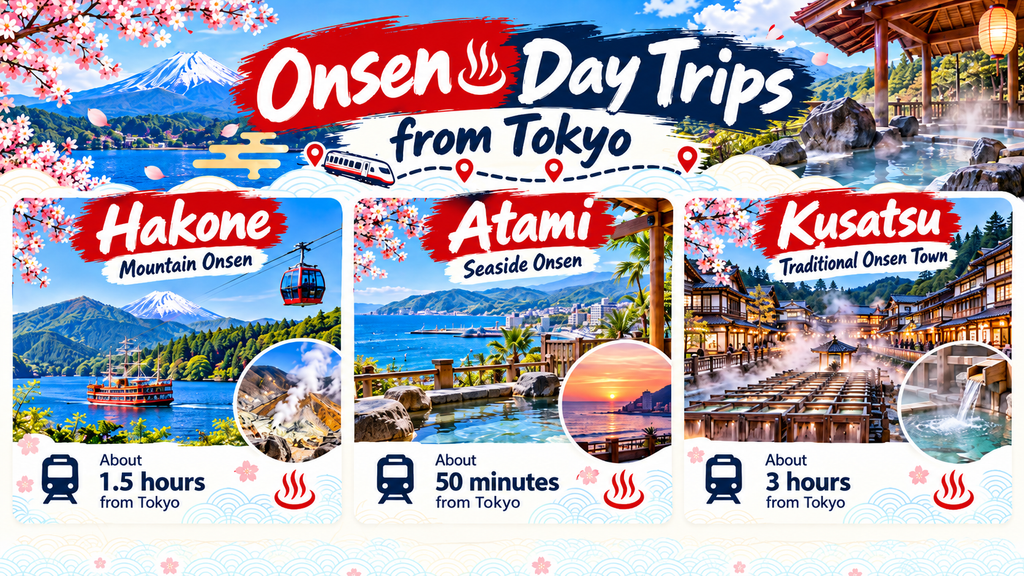
13. Hakone – Best Overall Onsen Day Trip
Best for: Hot springs, Lake Ashi, volcanic scenery, museums, and possible Mount Fuji views
Approximate travel time: About 90 minutes to Hakone-Yumoto from Shinjuku
Hakone is one of the most popular escapes from Tokyo because it combines hot springs, mountain scenery, museums, transportation experiences, and views of Mount Fuji when conditions are clear.
Popular attractions include:
- Lake Ashi
- Owakudani
- Hakone Ropeway
- Hakone Open-Air Museum
- Onsen baths
Hakone covers a large area, so trying to visit every famous attraction in one day can become exhausting.
Choose a few priorities before leaving Tokyo.
A day trip works well if you mainly want sightseeing or a day-use onsen, while an overnight stay at a ryokan gives you a much more relaxed hot-spring experience.
For more information, visit the official JNTO Hakone guide.
14. Atami – Best for Onsen and Ocean Views
Best for: Hot springs, seafood, coastal scenery, and an easy Shinkansen escape
Approximate travel time: About 50 minutes by Shinkansen
Atami is a seaside hot-spring city in Shizuoka Prefecture and one of the fastest resort escapes from Tokyo.
Its combination of ocean views, onsen, seafood, cafes, and museums makes it a good option for travelers who want a slower day.
Unlike Hakone, where attractions are spread across mountainous terrain, much of Atami’s appeal comes from simply enjoying the resort-town atmosphere.
Some facilities offer day-use hot springs, so you do not necessarily need to stay overnight to enjoy an onsen.
Atami is also known for fireworks events held at different times of the year, so check the schedule if your travel dates are flexible.
See the official JNTO Atami guide.
15. Kusatsu Onsen – Best for a Traditional Hot Spring Town
Best for: Serious onsen fans and travelers who want a classic mountain hot-spring town
Approximate travel time: Roughly 3–4 hours from Tokyo
Kusatsu Onsen is one of Japan’s best-known hot-spring towns.
Its symbolic center is Yubatake, the large hot-water field in the middle of town.
You can also enjoy public baths, foot baths, local shops, and mountain scenery.
However, Kusatsu is very different from Yokohama or Kamakura as a day-trip option.
Because travel from Tokyo takes several hours each way, a same-day visit requires an early departure and gives you much less time at the destination.
Our recommendation: Visit Kusatsu as a day trip only if your schedule requires it. For most travelers, staying one night is much more enjoyable.
See the official JNTO Kusatsu guide.
Unique and Theme Park Day Trips from Tokyo
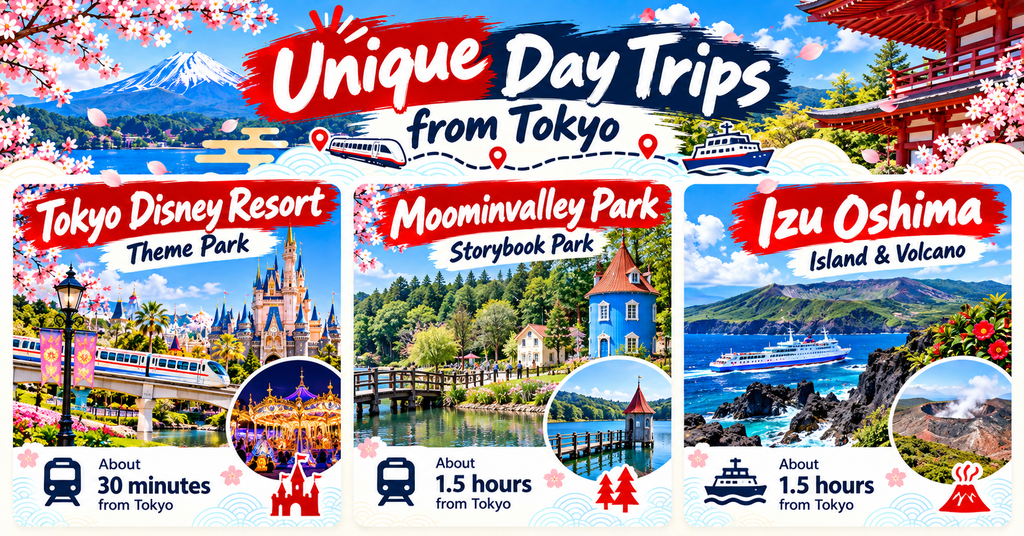
16. Tokyo Disneyland & Tokyo DisneySea – Best for Theme Parks
Best for: Disney fans, families, couples, attractions, entertainment, and themed experiences
Approximate travel time: Maihama Station is about 15 minutes from Tokyo Station by train
Despite the name, Tokyo Disney Resort is located in Urayasu, Chiba Prefecture, just outside Tokyo.
The resort has two major theme parks:
- Tokyo Disneyland: Classic Disney attractions, characters, parades, and themed lands
- Tokyo DisneySea: A unique park built around ports, ocean adventures, and highly detailed themed environments
Do not try to visit both parks properly in one day.
Choose one park and give it a full day.
From Tokyo Station, take the JR Keiyo Line or Musashino Line to Maihama Station. Tokyo DisneySea requires an additional ride on the Disney Resort Line.
Check current tickets, opening hours, and operational information on the official Tokyo Disney Resort website before visiting.
17. Moominvalley Park & Metsä Village – Best for Moomin Fans
Best for: Families, Moomin fans, lakeside scenery, and a relaxed theme-park experience
Approximate travel time: Around 1–1.5 hours depending on your connection
Metsä is located beside Lake Miyazawa in Hanno, Saitama Prefecture.
The area consists of Metsä Village and Moominvalley Park.
Moominvalley Park recreates locations and stories from the Moomin world through exhibits, character experiences, attractions, food, and shops.
Metsä Village has a more relaxed lakeside atmosphere where you can spend time around shops, cafes, and outdoor spaces.
Visitors using public transportation can travel to Hanno Station and continue by bus to Metsä.
Check current tickets, opening hours, and transportation information on the official Metsä website.
18. Izu Oshima – Best Island Adventure
Best for: Volcanoes, hiking, island scenery, hot springs, and adventurous travelers
Approximate travel time: Around 1 hour 45 minutes by high-speed jet ferry from Takeshiba
Izu Oshima is the largest of the Izu Islands and is actually part of Tokyo Metropolis.
The island feels completely different from central Tokyo, with volcanic landscapes, coastline, hot springs, and seasonal camellias.
One of its main attractions is Mount Mihara, an active volcano with hiking routes around the crater area.
High-speed jet ferries operate from Takeshiba Pier, but ferry schedules, port conditions, and weather can affect your itinerary.
Because transportation on the island also takes time, Izu Oshima is an ambitious day trip.
Our recommendation: A day trip is possible with the right schedule, but staying overnight gives you much more time to enjoy the island.
See the official JNTO Izu Oshima itinerary.
How to Choose the Best Day Trip from Tokyo
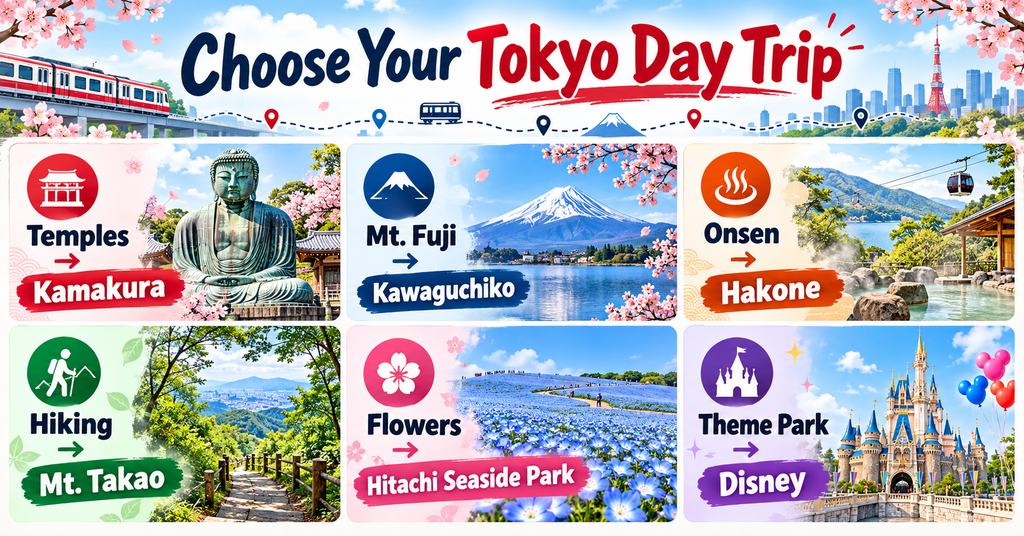
With 18 options, the easiest way to choose is to think about what you want to experience outside Tokyo.
| If You Want… | Recommended Day Trip |
|---|---|
| Traditional temples and history | Kamakura or Nikko |
| Mount Fuji views | Lake Kawaguchiko or Hakone |
| Hot springs | Hakone, Atami, or Kusatsu |
| A very easy city trip | Yokohama |
| Old Japanese streets | Kawagoe |
| Hiking | Mount Takao, Mount Nokogiri, or Okutama |
| Seasonal flowers | Hitachi Seaside Park or Chichibu |
| Japanese food | Utsunomiya or Yokohama |
| A castle | Odawara |
| A theme park | Tokyo Disney Resort or Moominvalley Park |
| An island adventure | Izu Oshima |
How to Plan a Day Trip from Tokyo
Check Your Route the Night Before
Some destinations have several possible train routes, and the fastest option may use a Limited Express or Shinkansen that requires a separate ticket or seat reservation.
Use a navigation app to check:
- Your departure station
- Train line
- Departure time
- Transfers
- Platform
- Reservation requirements
- Last convenient train back to Tokyo
Our guide to the best Japan travel apps includes useful options for train navigation and trip planning.
Do Not Assume Every Train Works With an IC Card
An IC card is extremely useful for local trains, subways, buses, and everyday transportation.
However, Limited Express trains and Shinkansen services may require additional tickets or reservations depending on the service.
Read our IC cards in Japan guide before your trip.
Learn the Train Basics
You do not need to memorize Japan’s railway network.
For a day trip, the most important things are the train line, destination, platform, transfer station, and whether your train actually stops at your destination.
Our beginner’s guide to using trains in Japan explains the process step by step.
Start Early for Longer Trips
For destinations such as Nikko, Lake Kawaguchiko, Hitachi Seaside Park, Mount Nokogiri, or Chichibu, leaving early gives you much more flexibility.
For Kusatsu and Izu Oshima, an early start is even more important.
Check the Weather
Weather matters much more for a nature-focused day trip than for sightseeing inside Tokyo.
This is especially true for:
- Mount Fuji views
- Hiking
- Island travel
- Seasonal flower parks
- Ropeways and outdoor attractions
It is worth having a backup plan if the weather forecast changes.
Day Trips from Tokyo FAQ
What Is the Best Day Trip from Tokyo for a First-Time Visitor?
Kamakura is one of the easiest recommendations for first-time travelers because it combines temples, shrines, historic streets, food, and coastal scenery with a relatively short direct train ride from Tokyo.
Hakone and Lake Kawaguchiko are better choices if Mount Fuji or hot springs are higher priorities.
What Is the Easiest Day Trip from Tokyo?
Yokohama is one of the easiest because it is close to central Tokyo and has frequent train connections.
Kawagoe and Mount Takao are also relatively straightforward.
Can I See Mount Fuji on a Day Trip from Tokyo?
Yes.
Lake Kawaguchiko is one of the most popular day-trip destinations for Mount Fuji views, while Hakone can also offer views of the mountain when weather conditions are clear.
However, Mount Fuji is not guaranteed to be visible. Clouds can cover the mountain even on otherwise good sightseeing days.
Is Hakone Worth Visiting as a Day Trip?
Yes, but choose your priorities.
Hakone has enough attractions for an overnight trip, so trying to visit Lake Ashi, Owakudani, museums, ropeways, and an onsen in a single day can feel rushed.
Can I Visit Nikko in One Day from Tokyo?
Yes.
A day trip focused on the main shrine and temple area works well. If you also want Lake Chuzenji, waterfalls, hiking, or hot springs, staying overnight may be more comfortable.
Is Kusatsu Onsen a Good Day Trip from Tokyo?
It is possible, but it is a long day.
Travel typically takes around three to four hours each way depending on the route, so most travelers will enjoy Kusatsu more with an overnight stay.
How Many Day Trips Should I Add to a Tokyo Stay?
For a first trip, do not schedule so many day trips that you barely see Tokyo itself.
If you have four or five days based in Tokyo, one day trip can provide a nice contrast.
With a longer stay, adding two different trips—such as Kamakura for history and Lake Kawaguchiko for nature—can give you more variety.
Final Tips for Choosing a Tokyo Day Trip
Tokyo is an excellent base for exploring much more than the capital itself.
You can reach temples, hot-spring towns, mountains, coastal cities, theme parks, and even islands without changing your main hotel.
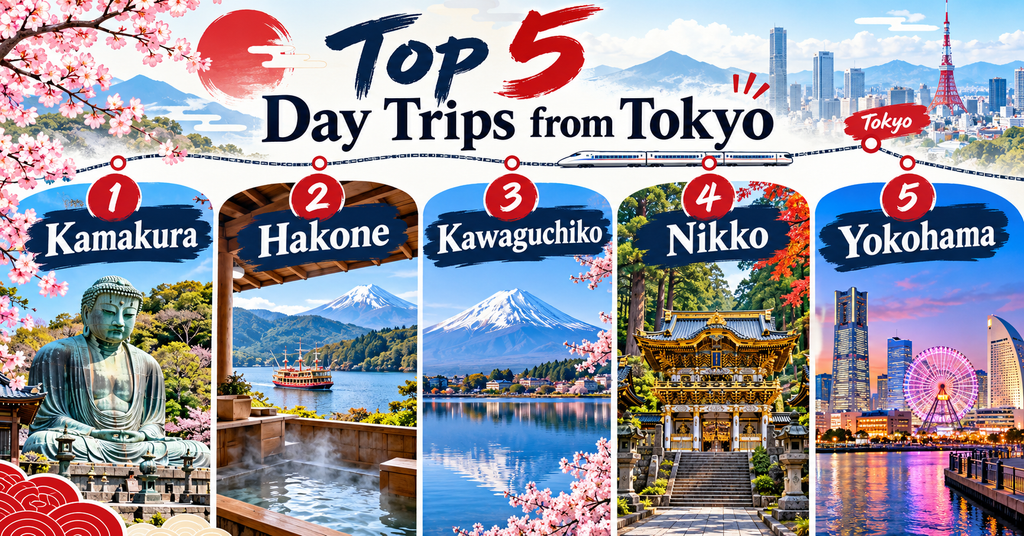
For most first-time visitors, we recommend starting with one of these five:
- Kamakura for temples and history
- Hakone for hot springs and mountain scenery
- Lake Kawaguchiko for Mount Fuji
- Nikko for shrines and nature
- Yokohama for the easiest city escape
The best choice depends on your interests, the season, the weather, and how much travel time you are comfortable with.
Do not feel that you need to visit the farthest destination just because it looks impressive online. Sometimes a simple 30-minute trip to Yokohama or an hour to Kamakura creates a better day than spending most of your time on trains and buses.
If you are still deciding where else to travel during your Japan trip, continue with our guide to the best cities to visit in Japan for first-time travelers.