A Journey Through Japan’s Famous Gardens
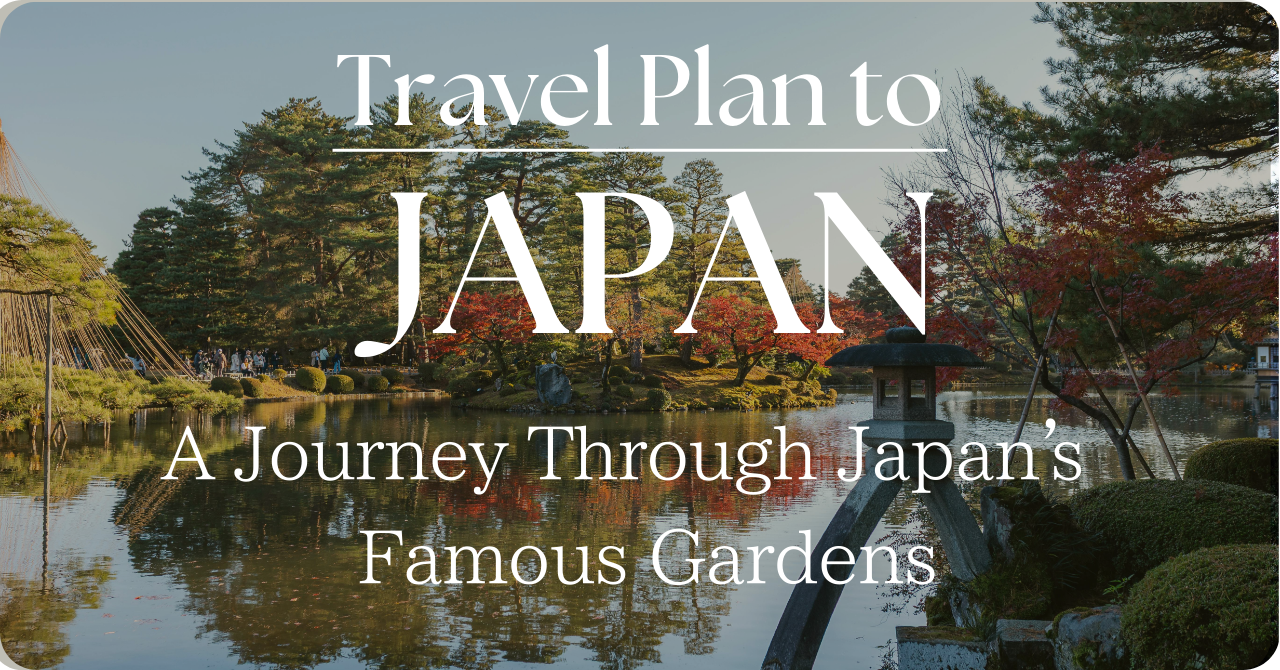
Exploring Japanese gardens leads to a deeper understanding of Japanese history and culture. Understanding the meaning of stones placed in gardens and the different styles of gardens reveals the essence of Japanese culture. The Sakuteiki, Japan’s oldest garden instruction manual, was written during the Heian period (794-1186 A.D.), and it shows the Japanese people’s long-standing interest in garden design. In this article, we will take a closer look at the appeal of such Japanese gardens.
Differences between Japanese and Western Gardens: Different Values towards Nature
Before embarking on a journey through Japanese gardens, let us consider the differences between them and Western gardens. This knowledge will enhance your appreciation during your walk.
Japanese gardens are often centered around a pond, with tsukiyama (artificial mountains), natural stones, and seasonal plants. This reflects the Japanese disposition to value nature. Stones are also used in Western gardens, but they rarely play the leading role.
Another major difference is that Japanese gardens are generally asymmetrical. In contrast, Western gardens tend to be geometric in design, with a strong central axis around which they are symmetrically organized. Japanese gardens aim for harmony with nature, whereas Western gardens emphasize artificial order and design.
Another key difference is that Japanese gardens are typically asymmetrical. In contrast, Western gardens often feature geometric designs with a strong central axis, around which the garden is symmetrically organized. Japanese gardens aim to harmonize with nature, while Western gardens emphasize human-made order and design.
There are three main styles of Japanese garden viewing:
- ・Kanshō-shiki – Viewing the garden from within a room.
- ・Kaiyū-shiki – Strolling through the garden, a style that represents the pinnacle of Japanese garden design.
- ・Shūyū-shiki – Viewing the garden from a boat on a pond, though few examples remain today.
Now, let’s explore some of the most famous Japanese gardens, known as the “Three Great Gardens of Japan,” all of which are designed in the Kaiyū-shiki style.
Kenrokuen Garde
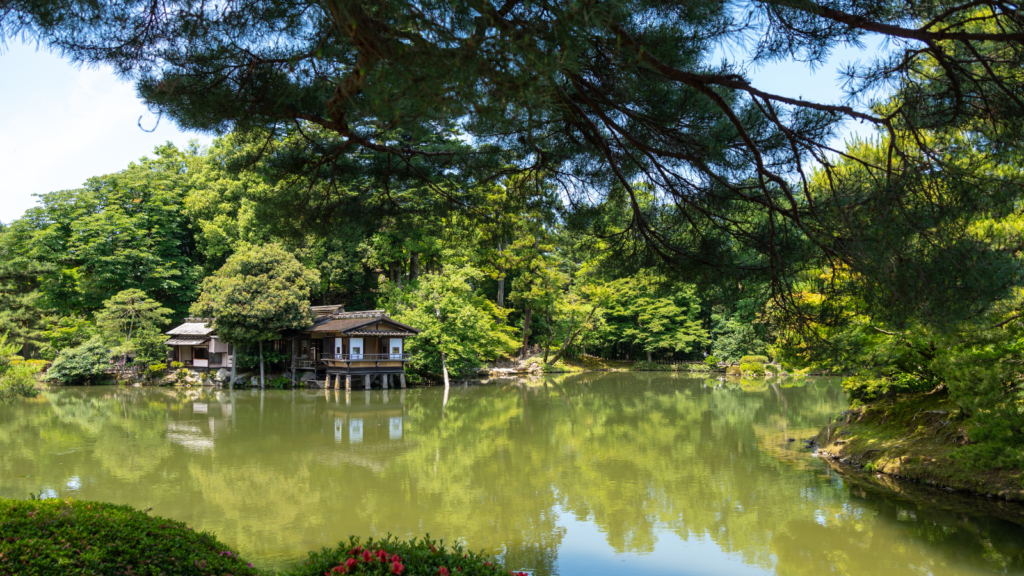
Kenrokuen Garden in Kanazawa City, Ishikawa Prefecture, is a magnificent Japanese garden, originally created in 1676 by Maeda Tsunanori, the fourth lord of the Kaga Domain, around his villa.
The vast garden includes artificial hills, ponds, and tea houses, offering a variety of landscapes. One of the highlights of the garden is that visitors can enjoy nature in each of the four seasons: cherry blossoms in spring, irises in early summer, autumn leaves in fall, and the famous snow-supported trees known as “yukitsuri” in winter. The garden is also beautifully illuminated at night, creating a magical atmosphere.
The garden’s design is based on the Taoist concept of immortality, with a large pond representing the ocean and an island within it symbolizing the place where immortals live. For generations, the wishes of the Kaga feudal lords for long life and eternal prosperity have been projected onto the garden.
[Kenrokuen Garden Official Website]
Kōrakuen Garden
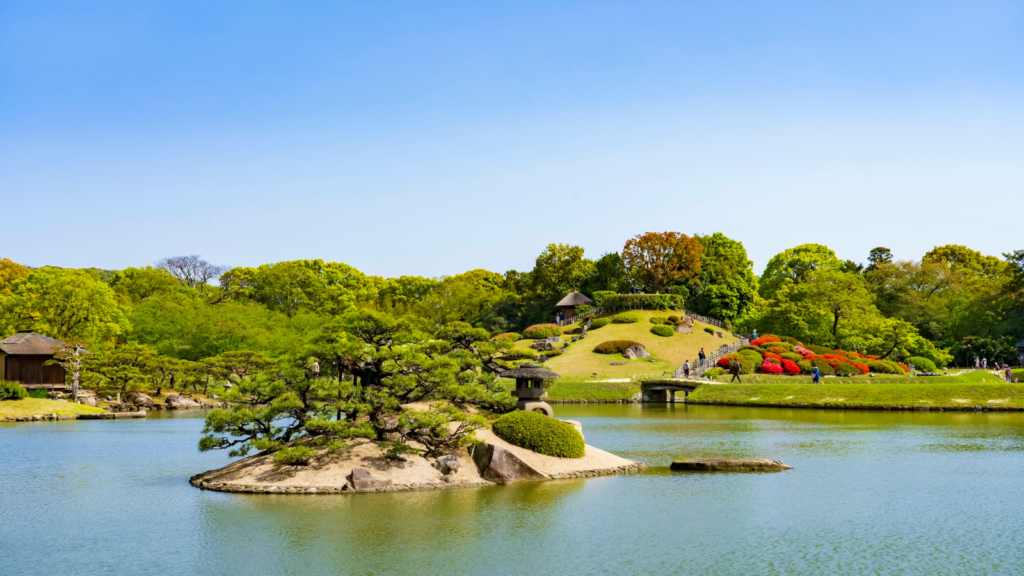
Kōrakuen Garden in Okayama City, Okayama Prefecture, is another representative garden in Japan, built on the orders of the feudal lord of Okayama, Tsunamasa Ikeda. The construction of this garden began in 1687 during the Genroku era (1688-1704) and was completed in 1700.
Kōrakuen is known for its historical buildings, such as Enyōtei and Renchiken, which still remain today. The park also has a tea house, Chasodō, dedicated to the famous tea master Sen no Rikyū.
Visitors can enjoy the ume (plum) grove in spring and the colored leaves of the Chishio-no-mori forest in autumn. In addition, various events are held throughout the year, such as tea picking festivals and moon viewing parties.
In addition to being a place of relaxation for feudal lords, Kōrakuen was also a training ground for the martial arts. The vast lawns, ponds, artificial mountains, and tea houses are connected by paths and waterways, and have remained unchanged since the Edo period.
[Okayama Kōrakuen Garden Official Website]
Kairakuen Garden
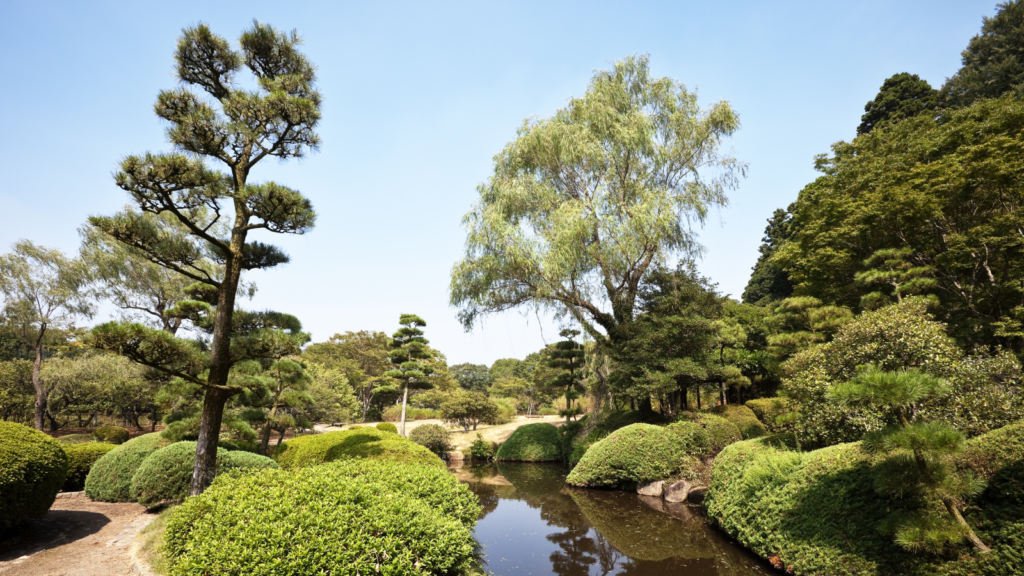
Kairakuen Garden in Mito City, Ibaraki Prefecture, is another wonderful Japanese garden. It was built in 1842 by Nariaki Tokugawa, the ninth lord of the Mito domain, as a place for the people of the domain to relax. Nariaki was also the father of the last shogun, Yoshinobu Tokugawa.
After passing through the main gate, visitors are greeted by a bamboo grove. Descending downward, you will find the Togyokusen, which literally means “a spring that flows year-round with cool, crystal-clear water.” The garden’s main attraction is Kōbuntei, a simple one-story building consisting of 10 rooms that was used as a recreation center for women of the time. The name “Kōbun” is another name for plum (Japanese apricot) blossoms, and there are about 3,000 plum trees of about 100 varieties planted in the garden.
Kairakuen is also thought to represent the concept of “yin” and “yang.” Quiet locations in the shade represent “yin,” whereas sunny areas where plum blossoms bloom in early spring represent “yang.” This contrast is one of Kairakuen’s most appealing aspects.
Designed as a place for the public as well as the lord, Kairakuen reflects Tokugawa Nariaki’s care for his people. He planted thousands of plum trees to create a space that everyone could enjoy.
The Stone Garden of Ryōan-ji Temple, Praised by Queen Elizabeth II
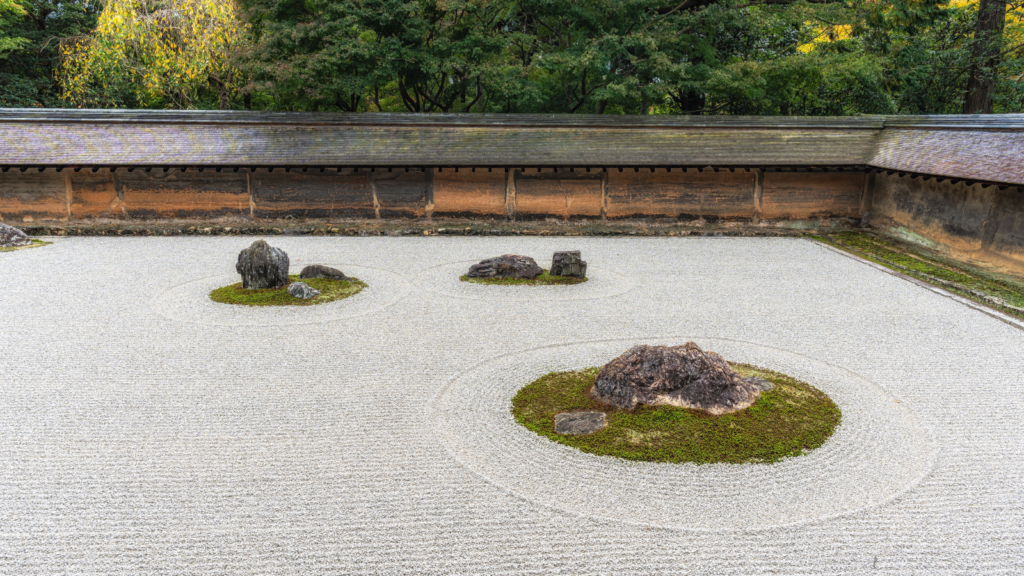
Lastly, we’d like to introduce a well-known Kanshō-shiki garden. The world-famous stone garden at Kyoto’s Ryōan-ji Temple is a Zen garden created in 1450 by Hosokawa Katsumoto, a major figure in the Muromachi Shogunate, and was visited by Queen Elizabeth II in 1975, who lauded it and sparked global interest in Zen Buddhism.
This stone garden is an example of “karesansui,” a dry landscape garden that represents natural scenery without the use of water, using only sand and stones to symbolize mountains and water features. The artist and date of creation are unknown, but the minimalist design, which embraces Zen philosophy, promotes introspection.
Despite its modest size, this garden employs perspective to create a sense of depth. The stones are arranged in groups of seven, five, and three, numbers considered auspicious in Japan, adding a philosophical dimension to the garden. The garden’s backdrop changes with the seasons, with cherry blossoms in spring and autumn leaves enhancing its beauty.
Many people sit and practice Zen in this serene setting, making it a perfect location for anyone seeking quiet and reflection. Furthermore, from May to July, water lilies bloom at Kyōyōchi Pond on the temple grounds, and water birds can be observed gliding across the placid water’s surface.
[Kyoto Prefecture Official Website]
In addition to those mentioned above, Japan has countless other beautiful gardens. Their composition varies by period and place, and many gardens use natural stone, moss, and land contours to highlight Japan’s distinct seasonal beauty. These gardens also represent the Japanese people’s Zen spirit as well as the artistry of previous generations of gardeners.Understanding Japanese gardens can be considered as a gateway to understanding the Japanese spirit itself, making them a must-see for anyone looking to deepen their knowledge of this country.
Furthermore, Japanese gardens are frequently located in metropolitan areas and aim to combine nature and architecture. It is highly advised that you take a stroll around beautiful gardens whenever you visit Japan: doing so will undoubtedly enrich your experience and provide you with a deeper connection to the cultural essence of our country. Enjoy your journey!