Convenience Stores in Japan: A Complete Guide for Travelers
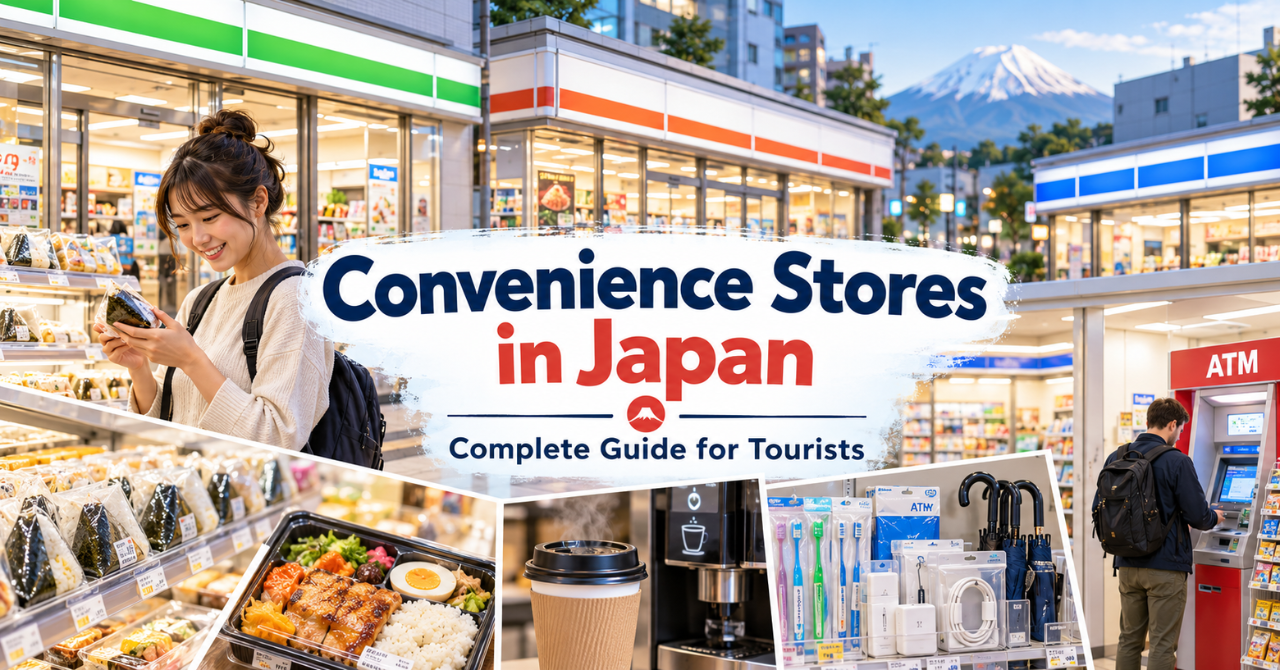
Convenience stores in Japan, often called “konbini,” are useful places for much more than buying snacks and drinks.
Travelers can use them for quick meals, coffee, ATMs, payment services, printing, tickets, toiletries, and other everyday needs.
The three major chains you will see most often are 7-Eleven, FamilyMart, and Lawson.
Many convenience stores are open late or 24 hours, which makes them especially helpful when restaurants, banks, or other shops are closed.
In this guide, you will learn what you can buy at convenience stores in Japan, how to pay, how to use ATMs and other services, and useful tips for first-time visitors.
- What Are Convenience Stores in Japan?
- What Can You Buy at Convenience Stores in Japan?
- How to Pay at Convenience Stores in Japan
- Using ATMs at Convenience Stores in Japan
- Useful Convenience Store Services for Travelers
- Can You Use Convenience Store Toilets in Japan?
- How to Eat Convenience Store Food in Japan
- Tax-Free Shopping at Convenience Stores
- Convenience Store Etiquette in Japan
- When Are Convenience Stores Useful for Travelers?
- Common Mistakes at Convenience Stores in Japan
- Tips for Using Convenience Stores in Japan
- Final Tips for Convenience Stores in Japan
What Are Convenience Stores in Japan?
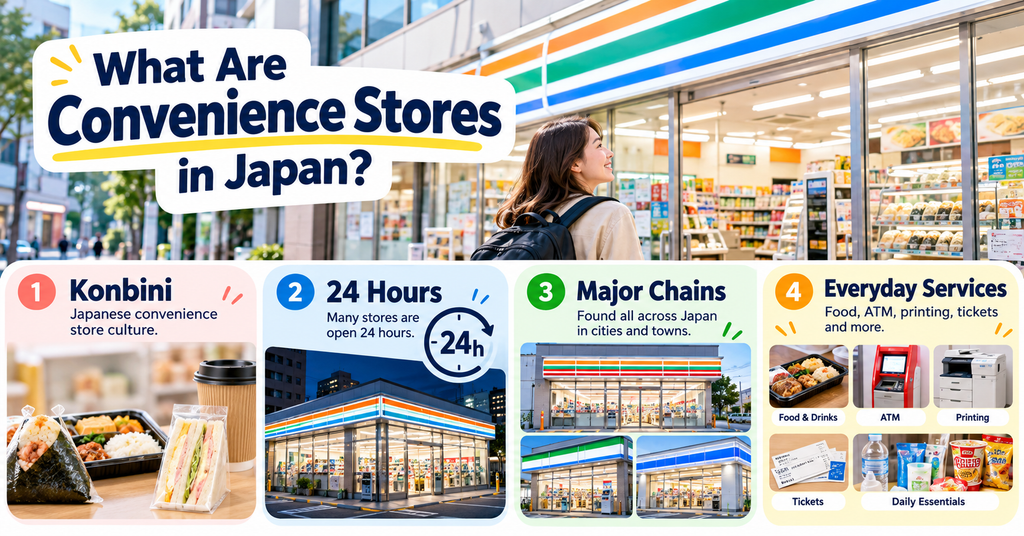
Convenience stores are found throughout Japan in cities, residential areas, train stations, and many tourist destinations.
In Japanese, they are commonly called “konbini.”
They sell food, drinks, daily necessities, and travel essentials, but they also provide services that may be surprising to first-time visitors.
Depending on the store, you may be able to withdraw cash, print documents, buy tickets, send packages, or pay bills in the same place.
Major Convenience Store Chains in Japan
The three convenience store chains travelers are most likely to see in Japan are 7-Eleven, FamilyMart, and Lawson.
All three sell a wide range of food, drinks, snacks, coffee, toiletries, and everyday items.
The products and services are similar, but each chain also has its own exclusive foods, desserts, drinks, and store services.
You do not need to choose one chain for your entire trip, so try different convenience stores and see which products you prefer.
Are Convenience Stores Open 24 Hours?
Many convenience stores in Japan are open 24 hours a day, making them useful for early mornings, late nights, and unexpected travel needs.
However, not every store is open 24 hours.
Stores inside airports, hotels, train stations, office buildings, or other facilities may have shorter opening hours.
Always check the opening hours if you plan to visit a specific store very early or late at night.
What Can You Buy at Convenience Stores in Japan?
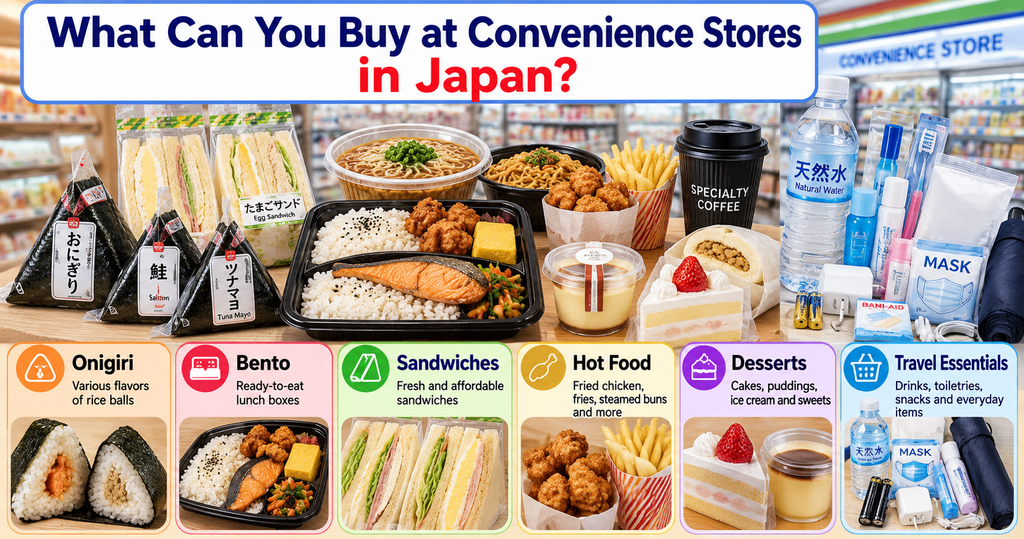
Japanese convenience stores sell much more than snacks and drinks.
You can find quick meals, hot food, coffee, desserts, toiletries, medicine-related daily items, umbrellas, batteries, and many other useful products.
The selection varies by store and location, but convenience stores are especially useful when you need something quickly during your trip.
Onigiri, Bento, and Ready-to-Eat Meals
Convenience stores are a popular place to buy affordable ready-to-eat meals.
You can usually find onigiri rice balls, bento boxes, pasta, noodles, salads, curry, and other prepared dishes.
Onigiri are especially convenient for travelers because they are easy to carry and come with many different fillings, such as salmon, tuna mayonnaise, and pickled plum.
Many chilled meals can also be heated at the store before you leave.
Sandwiches, Bread, and Snacks
Convenience stores sell a wide variety of sandwiches, bread, pastries, chips, chocolate, and other snacks.
Popular options include egg sandwiches, fruit sandwiches, sweet bread, and savory bakery items.
These foods can be useful for breakfast, a quick lunch, or a snack between sightseeing stops.
Many stores also sell seasonal and limited-edition products, so the selection may change throughout the year.
Hot Food and Convenience Store Coffee
Many convenience stores have a hot food counter near the register.
Depending on the store, you may find fried chicken, croquettes, sausages, steamed buns, or other hot snacks.
Freshly brewed coffee is also widely available from self-service coffee machines.
After paying, you usually receive a cup and use the machine near the register to prepare your drink.
Drinks, Desserts, and Ice Cream
Convenience stores have large refrigerated sections with water, tea, coffee, soft drinks, juice, and other beverages.
They also sell a wide range of desserts, including pudding, cakes, cream puffs, Japanese sweets, and ice cream.
Japanese convenience store desserts are popular because new and seasonal products are released regularly.
Some stores also carry regional products that you may not find in other parts of Japan.
Toiletries and Travel Essentials
Convenience stores are useful when you forget a small travel item or need something unexpectedly.
You can often find toothbrushes, toothpaste, tissues, masks, razors, socks, underwear, umbrellas, batteries, chargers, and basic personal-care products.
The selection is usually smaller than at a drugstore, but convenience stores are often easier to find and may stay open much later.
This makes them especially helpful when you need an essential item late at night.
How to Pay at Convenience Stores in Japan
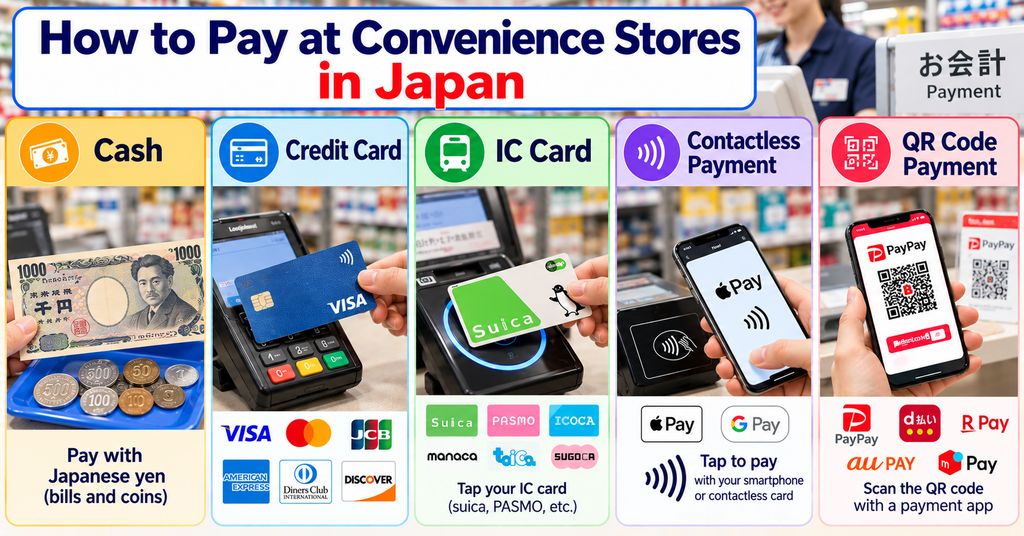
Convenience stores in Japan accept several payment methods.
Cash is widely accepted, and major chains also accept many credit cards, transportation IC cards, and other cashless payment methods.
However, some products and services may have different payment rules, so it is useful to keep some Japanese yen with you.
For a complete overview of cash, credit cards, IC cards, and mobile payments, see our guide to money and payments in Japan.
Cash
Cash is one of the easiest ways to pay at convenience stores in Japan.
You can use Japanese yen for normal purchases such as food, drinks, and daily necessities.
Some special services, including certain bill payments or other transactions, may only accept cash.
Keeping a small amount of cash with you is useful even if you usually prefer to pay by card.
Credit and Debit Cards
Major convenience store chains accept many major credit and debit cards.
Visa, Mastercard, JCB, American Express, and other international brands are commonly accepted.
Contactless card payments are also available at many stores.
However, some products and services cannot be paid for by credit card, and an overseas card may occasionally be declined.
Carrying another payment method is a good backup.
IC Cards
Transportation IC cards can also be used for shopping at many convenience stores.
Cards such as Suica, PASMO, ICOCA, and other major transportation IC cards are widely accepted.
To pay, select the IC card payment option or tell the staff that you want to use an IC card, then tap your card or compatible smartphone on the reader.
This can be especially convenient because the same card can be used for both transportation and small purchases during your trip.
For more information about Suica, PASMO, ICOCA, and other transportation cards, see our complete guide to IC cards in Japan.
Contactless and QR Code Payments
Many convenience stores also accept contactless payments and QR code payment services.
Depending on the store, you may be able to use services such as Apple Pay, Google Pay, iD, QUICPay, or supported QR payment apps.
However, not every payment service is available to international visitors, and some Japanese payment apps require a local account or other setup.
If you are visiting Japan from overseas, a credit card, transportation IC card, or cash is usually the simplest option.
Using ATMs at Convenience Stores in Japan
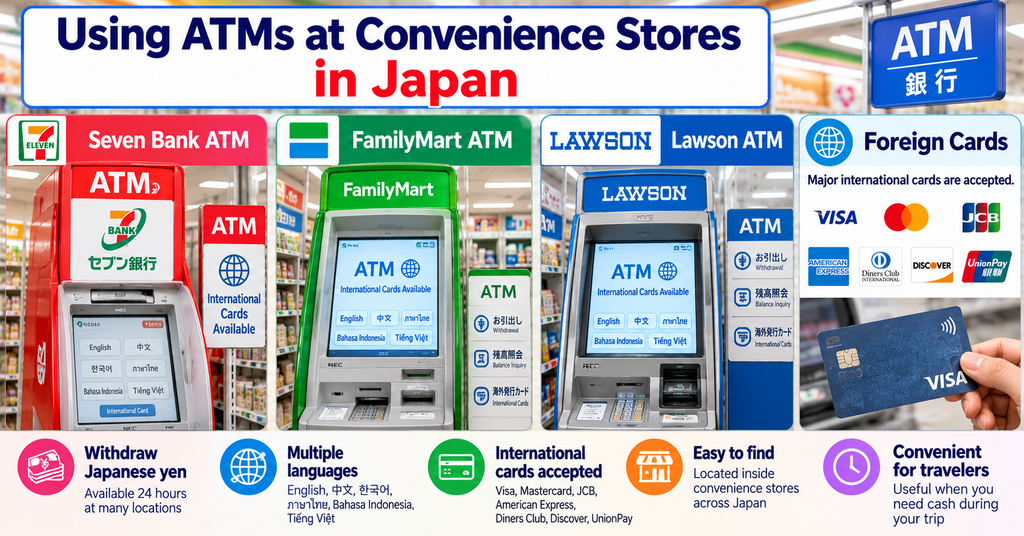
Convenience store ATMs are one of the easiest ways for international travelers to withdraw Japanese yen.
Many ATMs accept overseas-issued debit and credit cards and offer English-language menus.
However, accepted cards, withdrawal limits, fees, and operating hours can vary depending on the ATM and card issuer.
If one ATM does not accept your card, try another major convenience store or ATM network.
Seven Bank ATMs at 7-Eleven
Seven Bank ATMs are commonly found inside 7-Eleven stores and are popular with international travelers.
They accept many overseas-issued cards, including Visa, Mastercard, UnionPay, American Express, JCB, Discover, and Diners Club.
English and other language options are available on the ATM screen.
For most overseas-issued cards, the maximum withdrawal per transaction is 100,000 yen, although limits may differ depending on the card or transaction type.
For the latest information about overseas cards, withdrawal limits, and ATM availability, check the official Seven Bank website.
ATMs at FamilyMart and Lawson
FamilyMart and Lawson also have ATMs that can accept overseas-issued cards.
Many FamilyMart stores use E-net ATMs or Japan Post Bank ATMs.
FamilyMart also provides official information for international visitors about ATMs, payments, tax-free stores, and multi-copy machines.
E-net ATMs accept major international cards such as Visa, Mastercard, UnionPay, and JCB.
Lawson Bank ATMs also support several overseas-issued cards, including Visa, Mastercard, JCB, and UnionPay.
The ATM type can vary by store, so check the logos shown on the machine before inserting your card.
ATM Fees and Foreign Cards
ATM fees can vary depending on the ATM network, your card brand, and the bank or company that issued your card.
Your home bank may also charge an international withdrawal fee or currency conversion fee.
Before confirming a withdrawal, check the ATM screen for any fees or exchange-rate options.
Some ATMs may offer a choice between paying in Japanese yen or your home currency.
If you are unsure, compare the exchange rate and fees before completing the transaction.
Useful Convenience Store Services for Travelers
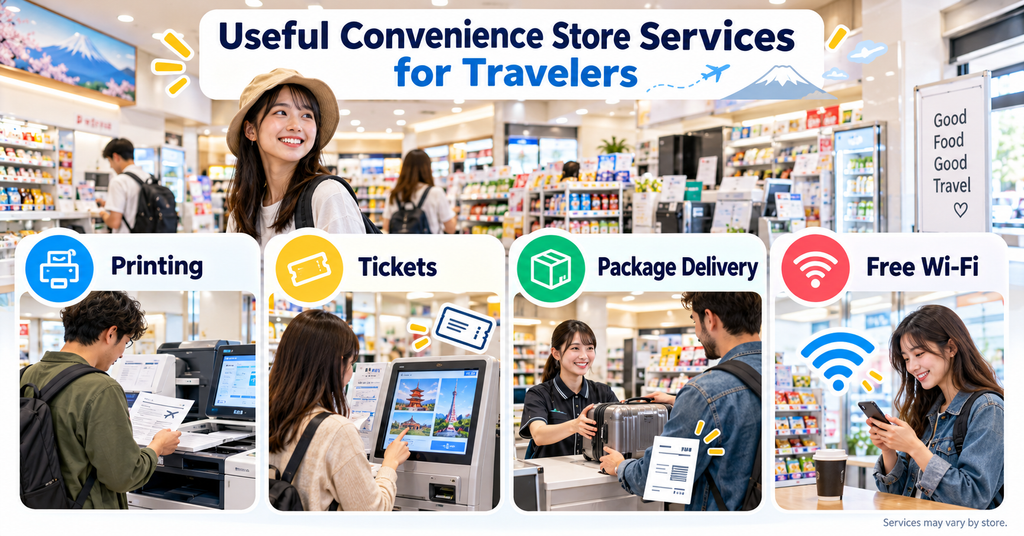
Convenience stores in Japan offer many useful services in addition to food and shopping.
Depending on the store, you may be able to print documents, buy tickets, send packages, or use free Wi-Fi.
Available services vary by chain and location, so check the signs inside the store if you need something specific.
Printing and Copying
Many convenience stores have multi-copy machines that can print documents and photos.
You may be able to print PDF files, images, or other documents from your smartphone, cloud storage, or a registered online service.
This can be useful if you need to print a reservation, travel document, ticket, or other file during your trip.
The available functions, languages, and prices vary by convenience store chain.
You can also check the official 7-Eleven service guide for information about printing, tickets, ATMs, and package delivery.
Buying Tickets
Convenience stores can also be used to buy or collect certain tickets.
Depending on the chain, you may find tickets for theme parks, attractions, concerts, sports events, highway buses, and other activities.
Some tickets can be purchased directly using a store terminal or multi-copy machine, while others must be reserved online first and then paid for or collected at the convenience store.
Always check the ticket provider’s instructions before visiting the store.
Sending Packages and Luggage
Some convenience stores allow you to send packages and luggage using domestic delivery services.
For example, Yamato Transport packages can be sent from participating 7-Eleven and FamilyMart stores.
This can be useful if you want to send a suitcase or parcel ahead instead of carrying it on trains or buses.
However, not every convenience store accepts every delivery service, and size or service restrictions may apply.
Check the delivery company and store requirements before bringing your luggage.
If you want to travel without carrying a large suitcase, see our complete guide to luggage delivery in Japan.
For details about sending luggage from convenience stores, check the official Yamato Transport information.
Free Wi-Fi and Other Store Services
Some convenience stores offer free Wi-Fi and other useful services.
Free Wi-Fi can be helpful if you need internet access to check directions, reservations, or travel information.
Convenience stores may also sell prepaid cards, stamps, postcards, SIM-related products, and other useful items.
Not every service is available at every location, so check the store signs or official website if you need a specific service.
Some Lawson stores offer free Wi-Fi for travelers. Check the official Lawson Wi-Fi guide for availability and instructions.
Can You Use Convenience Store Toilets in Japan?
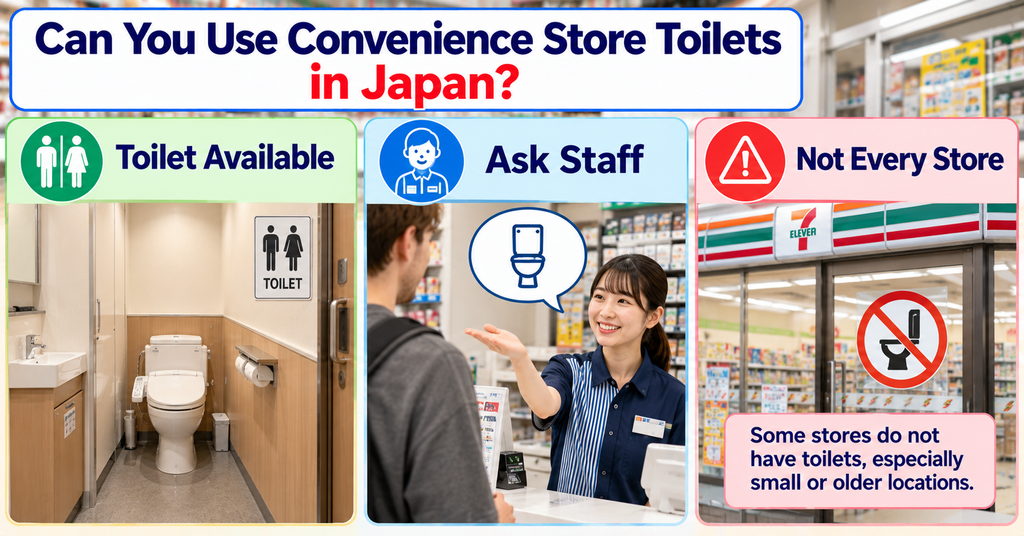
Many convenience stores in Japan have toilets that customers can use.
This can be very helpful when you are sightseeing, driving, or traveling in an area where public restrooms are difficult to find.
However, not every convenience store has a public toilet, and some stores may limit access depending on the location or store policy.
Look for toilet signs inside the store or ask the staff if you are unsure.
For more information about finding and using restrooms during your trip, see our guide to public toilets in Japan.
Not Every Store Has a Public Toilet
Do not assume that every convenience store has a public toilet.
Stores in train stations, office buildings, shopping facilities, or very small locations may not have one available for customers.
Some stores may also temporarily close their toilets for cleaning, maintenance, or other reasons.
If you need a restroom urgently, check the signs near the entrance or inside the store before relying on it.
Ask Before Using the Toilet When Necessary
At some convenience stores, you can simply use the toilet without asking.
At others, a sign may ask customers to speak to a staff member first.
If you are not sure, you can ask, “Toire o tsukatte mo ii desu ka?” which means “May I use the toilet?”
Follow any signs or instructions provided by the store and leave the restroom clean for the next person.
How to Eat Convenience Store Food in Japan
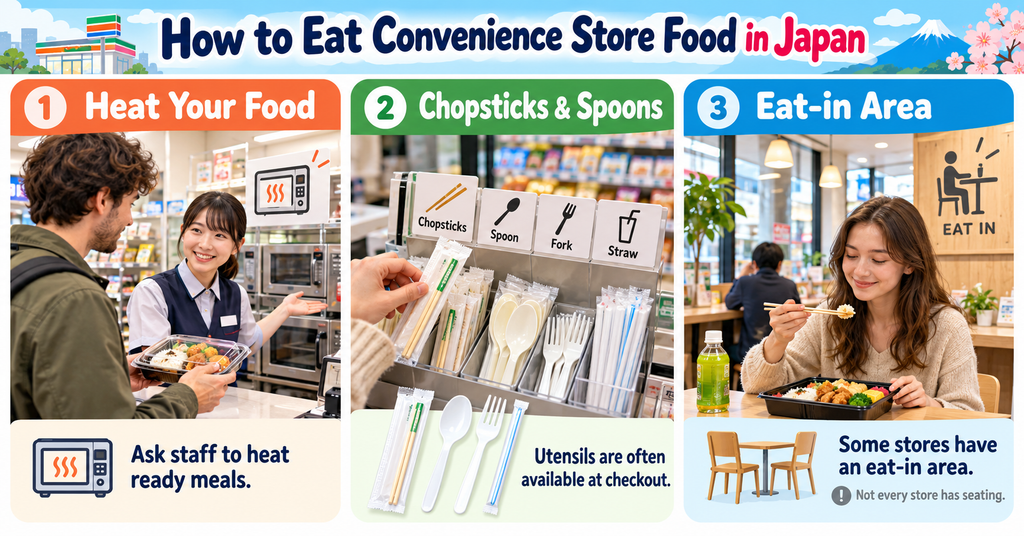
Convenience store food in Japan is designed to be quick and easy to eat.
Many stores can heat meals for you, and staff may provide chopsticks, spoons, forks, or other utensils depending on what you buy.
However, where you can eat your food depends on the store and location, so check before opening your meal.
Ask Staff to Heat Your Food
Many convenience store meals can be heated before you leave the store.
If your food can be microwaved, the staff may ask whether you want it heated.
You may hear a phrase such as “Atatamemasu ka?” which means “Would you like this heated?”
If you want it heated, you can simply say “Hai, onegaishimasu.”
Chopsticks, Spoons, and Other Utensils
Convenience stores may provide chopsticks, spoons, forks, or straws depending on what you purchase.
Staff may ask whether you need utensils, or you may need to select them during checkout.
If you are not sure, you can point to the item or simply ask for “hashi” for chopsticks or “spoon.”
Check your bag before leaving if you plan to eat somewhere else.
Where to Eat Your Food
Some convenience stores have small eat-in areas, but not every location offers seating.
If there is no eating space, take your food to your hotel, a designated rest area, or another place where eating is allowed.
Avoid blocking store entrances, sidewalks, or busy areas while eating.
Also remember that eating while walking is less common in Japan than in some other countries.
Tax-Free Shopping at Convenience Stores
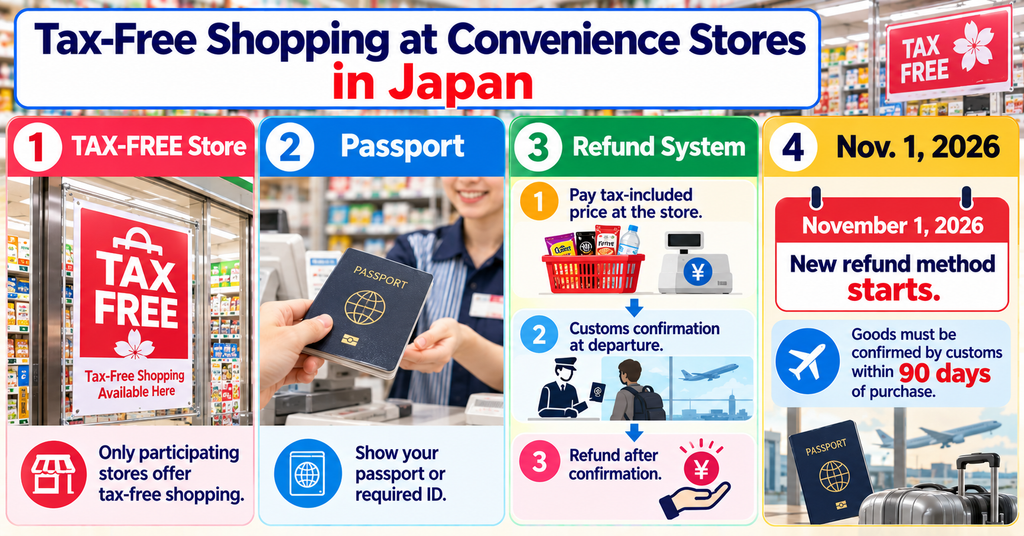
Some convenience stores in Japan offer tax-free shopping for eligible international visitors.
However, tax-free service is not available at every convenience store or every location.
If you want to shop tax-free, look for a TAX-FREE sign and check the store’s requirements before making your purchase.
Japan’s tax-free shopping system is changing from November 1, 2026, so travelers should always check the latest rules.
For a full explanation of Japan’s new tax-free refund system, see our complete guide to tax-free shopping in Japan.
For the latest official information about Japan’s tax-free refund system, check the National Tax Agency guide.
Only Some Stores Offer Tax-Free Shopping
Do not assume that every convenience store offers tax-free shopping.
Only participating stores provide the service, and available hours may also vary by location.
Look for a TAX-FREE sign or check the convenience store chain’s official website before shopping.
You will normally need to meet the eligibility requirements and present the required identification for the tax-free procedure.
Check the Latest Tax-Free Rules
Japan’s tax-free shopping rules are changing on November 1, 2026.
Under the new refund system, eligible travelers will pay the tax-included price when they make a purchase.
They will then need to have the tax-free goods confirmed by customs when leaving Japan, and the equivalent amount of consumption tax will be refunded after confirmation.
Because the procedure is changing, check the latest official information before using tax-free shopping during your trip.
Convenience Store Etiquette in Japan
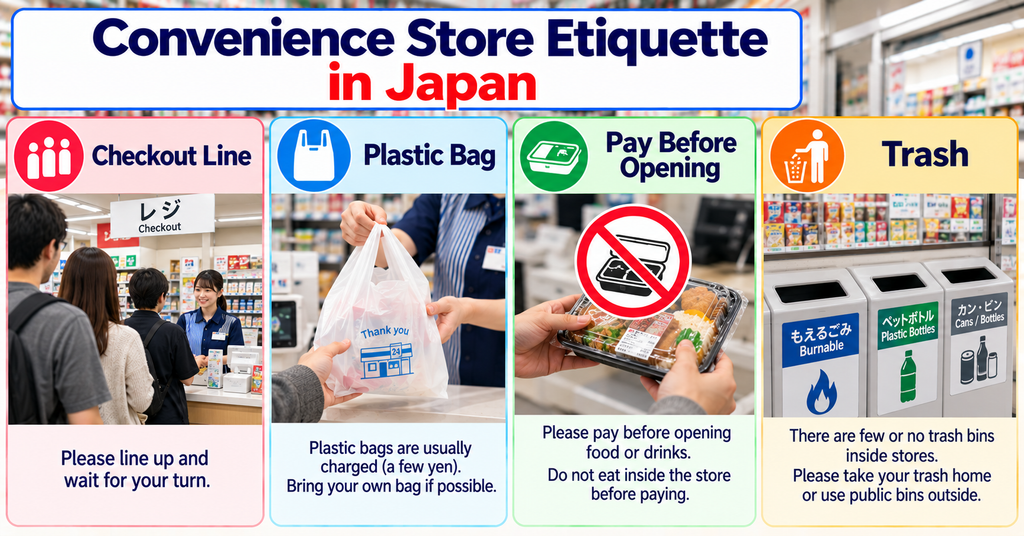
Convenience stores in Japan are casual and easy to use, but there are a few simple customs that travelers should know.
Most of the rules are straightforward, such as waiting in line, paying before opening food, and following store signs.
Knowing these small details can make your visit smoother and help you avoid common mistakes.
Wait in the Checkout Line
When the store is busy, wait in the designated checkout line.
Many convenience stores have floor markings showing where customers should stand.
Do not move directly to an open register if other customers are already waiting in one line.
Follow the arrows or signs on the floor and wait for the next available register.
Plastic Bags May Cost Extra
Plastic shopping bags usually cost a small extra fee in Japan.
Staff may ask whether you need a bag during checkout.
You can say “Fukuro onegaishimasu” if you want one, or “Daijobu desu” if you do not need a bag.
Carrying a reusable bag can be useful if you visit convenience stores often during your trip.
Do Not Open Food Before Paying
Do not open food, drinks, or other products before paying for them.
Take your items to the register first and complete the purchase before eating or using anything.
If you want food heated or need utensils, ask the staff during checkout.
After paying, check whether the store has an eat-in area or take your food somewhere appropriate.
Trash Bins Are Not Available at Every Store
Some convenience stores have trash bins, but they are not available at every location.
Even when bins are available, they are mainly intended for trash from products purchased at the store.
Do not assume that every convenience store will accept large amounts of outside trash.
If you cannot find a trash bin, keep your trash with you until you find an appropriate place to dispose of it.
If you are wondering where to throw away trash while sightseeing, see our guide to finding trash cans in Japan.
When Are Convenience Stores Useful for Travelers?
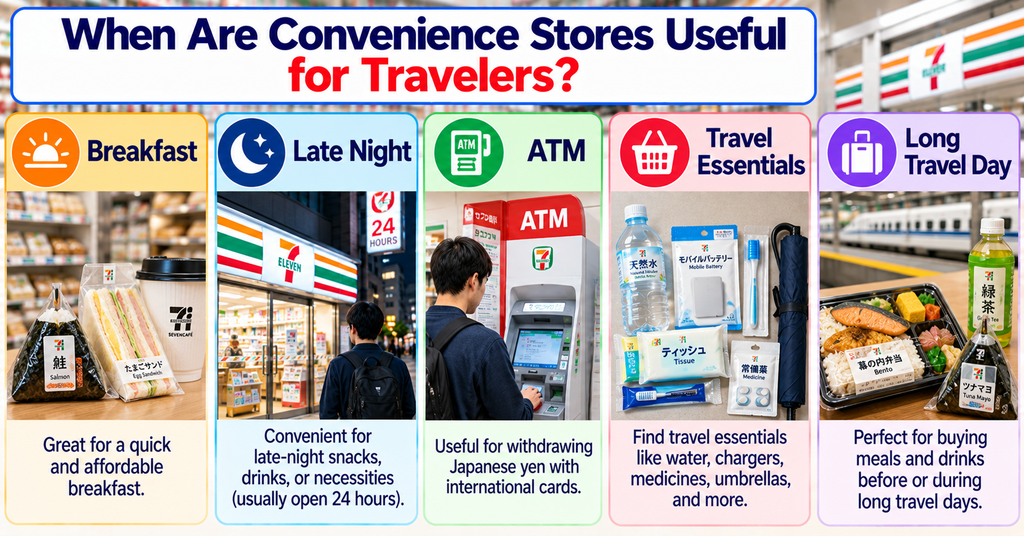
Convenience stores can be useful at almost any point during a trip to Japan.
They are especially helpful when you need food outside normal restaurant hours, cash from an ATM, a forgotten travel item, or a quick stop during a busy sightseeing day.
Because convenience stores are easy to find in many cities and tourist areas, they can be a reliable backup when other shops or services are closed.
Breakfast and Late-Night Food
Convenience stores are useful when you need an early breakfast or late-night meal.
You can buy onigiri, sandwiches, bread, bento, noodles, snacks, coffee, and other quick options without waiting for a restaurant to open.
This is especially helpful if you have an early train, flight, tour, or long sightseeing day.
A convenience store meal can also be a simple option when you return to your hotel late at night.
Withdrawing Japanese Yen
Convenience store ATMs can be very useful when you need Japanese yen during your trip.
Many major convenience store ATMs accept overseas-issued cards and provide English-language menus.
This can be more convenient than looking for a bank branch, especially in the evening or on weekends.
Keep a backup payment method in case your card is not accepted.
Buying Forgotten Travel Essentials
Convenience stores are useful when you forget something small at your hotel or need an item unexpectedly.
You may find toiletries, tissues, masks, umbrellas, socks, chargers, batteries, and other everyday necessities.
The selection is usually smaller than at a drugstore or electronics shop, but convenience stores are easier to find and often open much later.
They can be especially helpful when you need something quickly.
During Long Travel Days
Convenience stores are also helpful during long travel days between cities or sightseeing areas.
You can quickly buy drinks, snacks, meals, coffee, and other supplies before boarding a train, bus, or rental car.
Some stores also have ATMs, toilets, printing services, and package delivery options.
A short convenience store stop can save time when your schedule is busy.
Common Mistakes at Convenience Stores in Japan
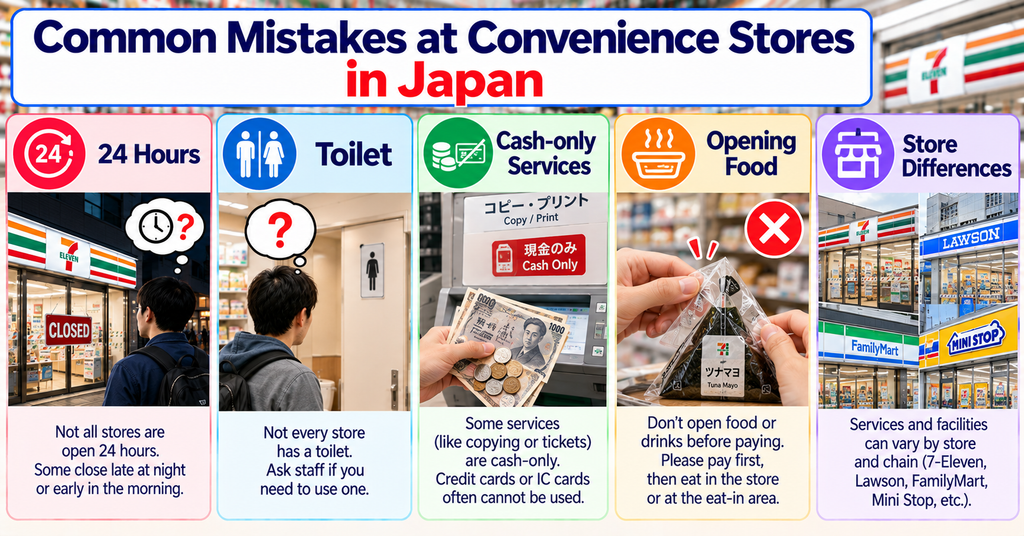
Convenience stores in Japan are easy to use, but first-time visitors can still make a few common mistakes.
Do not assume that every store is open 24 hours or that every location has a public toilet, trash bin, Wi-Fi, or tax-free shopping.
Check the payment method before using special services because some transactions may require cash.
Do not open food or drinks before paying, and follow the checkout line markings when the store is busy.
If you want your meal heated, need a bag, or need utensils, pay attention to the staff’s questions during checkout.
Also remember that convenience store services can vary by chain and location, so check store signs or ask the staff if you are unsure.
Tips for Using Convenience Stores in Japan
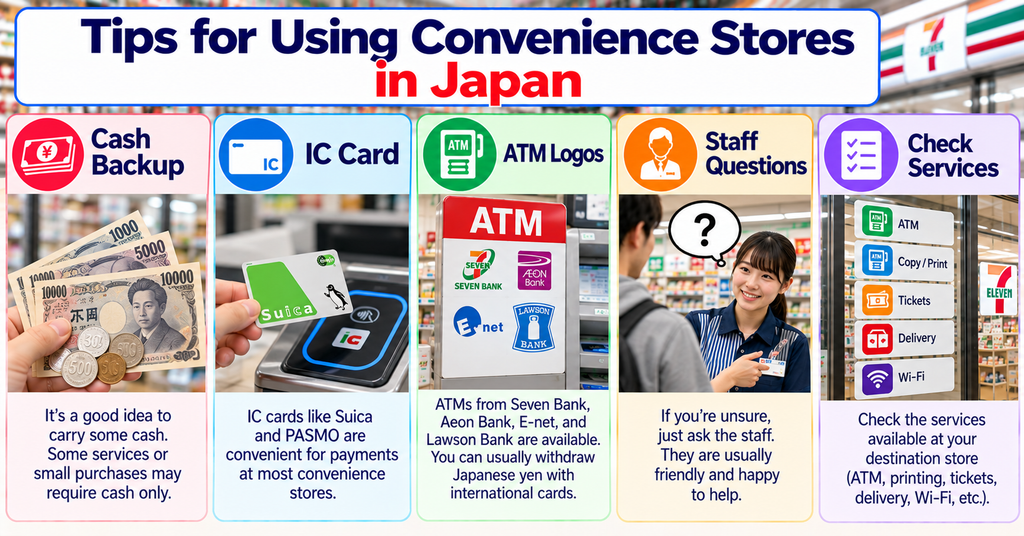
Use convenience stores as a quick backup for food, cash, travel essentials, and other everyday needs during your trip.
Keep some Japanese yen with you because certain services may require cash even if the store accepts cards for normal purchases.
Use a transportation IC card for small purchases when available because it can make checkout faster and easier.
Check the store signs before relying on services such as toilets, Wi-Fi, package delivery, or tax-free shopping.
If you need to withdraw cash, look for the card logos shown on the ATM before inserting your card.
Pay attention to questions from the staff because they may ask whether you need a bag, utensils, or your food heated.
If you are using a multi-copy machine, ticket terminal, or delivery service, allow a little extra time because the process may be unfamiliar on your first try.
Convenience stores are especially useful early in the morning, late at night, and during long travel days when other shops may be closed.
Final Tips for Convenience Stores in Japan
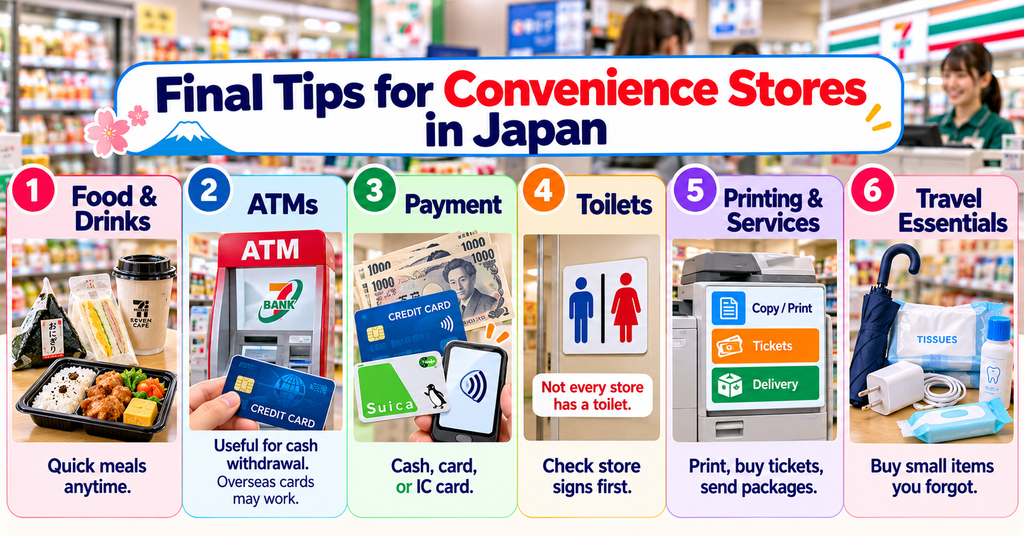
Convenience stores in Japan are one of the most useful resources for travelers.
They are great for quick meals, drinks, ATMs, toiletries, printing, tickets, package delivery, and other everyday needs.
Major chains such as 7-Eleven, FamilyMart, and Lawson are easy to find, but available services can vary by store and location.
Keep some Japanese yen as a backup, check ATM and payment logos, and look for store signs before relying on services such as toilets, Wi-Fi, or tax-free shopping.
If you need food heated, a bag, or utensils, pay attention to the staff’s questions during checkout.
Convenience stores can make travel in Japan much easier, especially early in the morning, late at night, or when you need something quickly.
With a little preparation, you can use Japanese convenience stores confidently throughout your trip.
If this is your first trip to Japan, you may also find our guide to essential things to know before visiting Japan helpful.