How to Say Thank You in Japanese: 12 Useful Phrases for Travelers

Knowing how to say thank you in Japanese is one of the easiest ways to make your trip to Japan more enjoyable.
The most common phrase is ありがとうございます (arigatou gozaimasu), but Japanese has many different ways to express gratitude depending on the situation, the person you are speaking to, and how formal you want to be.
For example, you may use a casual “arigatou” with friends, “arigatou gozaimashita” after someone has helped you, or “gochisousama deshita” after finishing a meal.
In this guide, you will learn 12 useful ways to say thank you in Japanese, along with their meanings, pronunciation, and the situations where each phrase is commonly used.
Even if you only remember a few of these expressions, using Japanese to show your appreciation can make communication with local people feel warmer and more natural.
Want to learn more useful Japanese for your trip? Check out our guide to 52 useful Japanese phrases and conversations.

- How to Say Thank You in Japanese: 12 Useful Phrases
- 1. Thank You – ありがとうございます (Arigatou Gozaimasu)
- 2. Casual Thank You – ありがとう (Arigatou)
- 3. A Quick Thanks – どうも (Doumo)
- 4. Thank You Very Much – どうもありがとうございます (Doumo Arigatou Gozaimasu)
- 5. Thank You So Much – 本当にありがとうございます (Hontou ni Arigatou Gozaimasu)
- 6. Thank You for What You Did – ありがとうございました (Arigatou Gozaimashita)
- 7. Thank You for Everything – いろいろありがとうございました (Iroiro Arigatou Gozaimashita)
- 8. Thank You / Sorry for the Trouble – すみません (Sumimasen)
- 9. Thank You for Taking Care of Me – お世話になりました (Osewa ni Narimashita)
- 10. Thank You for Everything You Did – いろいろお世話になりました (Iroiro Osewa ni Narimashita)
- 11. That Really Helped – 助かりました (Tasukarimashita)
- 12. Thank You for the Meal – ごちそうさまでした (Gochisousama Deshita)
- Which Japanese Thank-You Phrase Should Travelers Use?
- How to Respond to “Thank You” in Japanese
- Japanese Etiquette When Saying Thank You
- Final Thoughts
How to Say Thank You in Japanese: 12 Useful Phrases
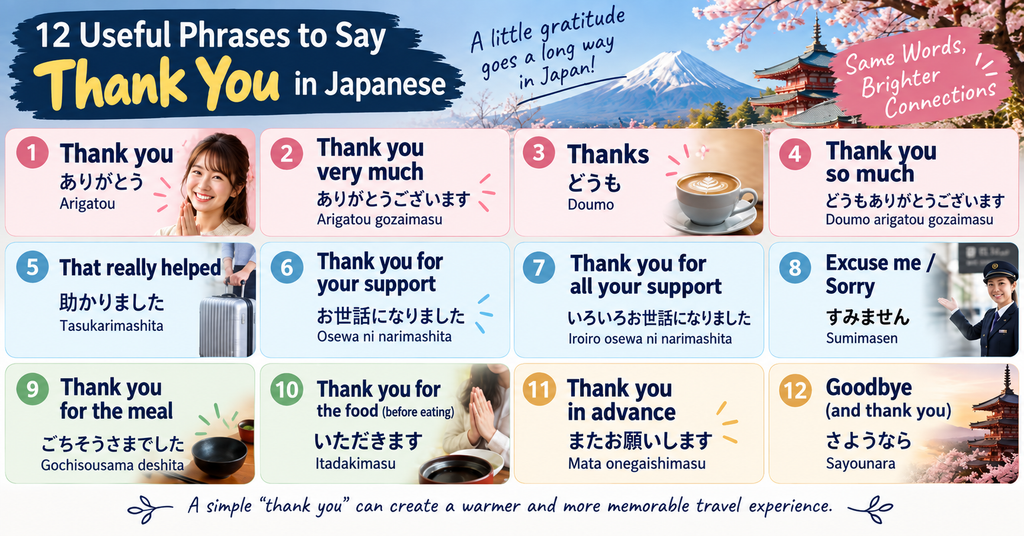
Japanese has several ways to say thank you, and the best phrase depends on the situation and your relationship with the other person.
Some expressions are polite and useful when speaking with hotel staff, restaurant employees, or people you have just met, while others are more casual and commonly used with friends and family.
Below are 12 useful Japanese thank-you phrases that travelers can use during a trip to Japan.
1. Thank You – ありがとうございます (Arigatou Gozaimasu)
“Arigatou gozaimasu” is the standard polite way to say “thank you” in Japanese.
For travelers, this is the most useful expression to remember because it can be used in many everyday situations, including restaurants, hotels, shops, train stations, and tourist attractions.
You can say “arigatou gozaimasu” when a hotel employee helps you, when someone gives you directions, or when a restaurant staff member brings you something.
Because it is polite without sounding overly formal, it is a safe choice when speaking to people you do not know well.
If you are unsure which Japanese thank-you phrase to use, “arigatou gozaimasu” is usually the best place to start.
For more basic Japanese expressions for travelers, you can also check the Japanese language guide from the Japan National Tourism Organization (JNTO).
2. Casual Thank You – ありがとう (Arigatou)
“Arigatou” is a casual way to say “thank you” in Japanese.
It is commonly used with friends, family members, partners, and people you know well.
For travelers, it is better to use “arigatou gozaimasu” when speaking to hotel staff, restaurant employees, shop staff, or strangers because it sounds more polite.
However, if you become friendly with someone during your trip or are speaking in a relaxed situation, “arigatou” can sound natural and warm.
The main difference is simple: “arigatou” is casual, while “arigatou gozaimasu” is polite.
3. A Quick Thanks – どうも (Doumo)
“Doumo” can be used as a short and casual way to say “thanks.”
You may hear Japanese people use it in quick everyday situations, such as when someone holds a door open, hands them something, or gives them a small amount of help.
It is shorter and more casual than “arigatou gozaimasu,” so travelers should avoid relying on it in formal situations.
When speaking to hotel staff, restaurant employees, or people you do not know well, “arigatou gozaimasu” is usually the safer choice.
Still, knowing “doumo” will help you understand a very common expression that you may hear during your trip.
4. Thank You Very Much – どうもありがとうございます (Doumo Arigatou Gozaimasu)
“Doumo arigatou gozaimasu” means “thank you very much” and expresses stronger gratitude than “arigatou gozaimasu.”
It is useful when someone has gone out of their way to help you or when you want to sound especially appreciative.
For example, you might use it if a hotel employee gives you detailed assistance, someone helps you with your luggage, or a local person takes extra time to explain something to you.
It is polite and natural, making it a good phrase for travelers when a simple “arigatou gozaimasu” does not feel strong enough.
5. Thank You So Much – 本当にありがとうございます (Hontou ni Arigatou Gozaimasu)
“Hontou ni arigatou gozaimasu” means “thank you so much” or “I really appreciate it.”
“Hontou ni” means “really” or “truly,” so this phrase is useful when you want to emphasize your sincere gratitude.
For example, you could use it after someone helps you solve a problem, returns something you lost, or gives you important assistance during your trip.
It sounds warm and sincere while still being polite, so it is suitable for both everyday travel situations and moments when you feel especially grateful.
6. Thank You for What You Did – ありがとうございました (Arigatou Gozaimashita)
“Arigatou gozaimashita” is used to thank someone for something that has already been completed.
Compared with “arigatou gozaimasu,” it has a past-tense feeling and is often used at the end of an interaction or after someone has finished helping you.
For example, you might say it when leaving a restaurant, after a hotel staff member has finished assisting you, or after someone has shown you the way.
Travelers will often hear this phrase when leaving shops, restaurants, hotels, and other places where a service has just ended.
It is a very useful expression when you want to thank someone for what they have already done.
7. Thank You for Everything – いろいろありがとうございました (Iroiro Arigatou Gozaimashita)
“Iroiro arigatou gozaimashita” means “thank you for everything” or “thank you for all your help.”
“Iroiro” means “various things” or “many things,” so this phrase is useful when someone has helped you in several different ways.
For example, you might say it to a host, guide, friend, or hotel staff member who has supported you throughout your stay.
It is especially natural when you are saying goodbye and want to express appreciation for more than one favor or kind action.
For travelers, this phrase can be a warm way to thank someone who made your trip easier or more enjoyable.
8. Thank You / Sorry for the Trouble – すみません (Sumimasen)
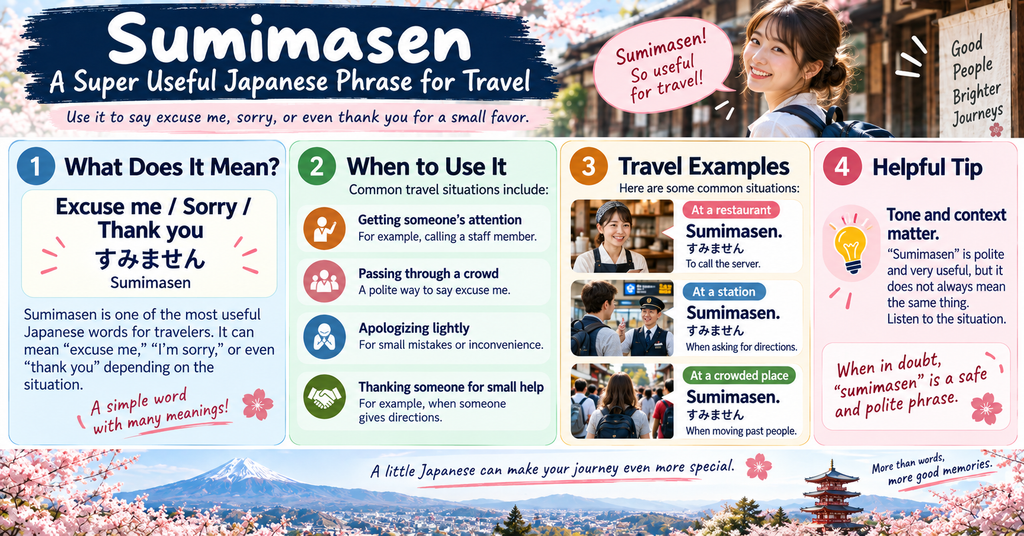
“Sumimasen” is commonly translated as “excuse me” or “I’m sorry,” but in Japanese it can also express gratitude.
It is often used when someone has gone out of their way to help you and you want to acknowledge the trouble or effort they made.
For example, if someone picks up something you dropped, makes room for you, or takes extra time to help you, you may hear Japanese people say “sumimasen” instead of simply saying “arigatou.”
In these situations, the feeling is similar to “thank you, and sorry for the trouble.”
For travelers, “arigatou gozaimasu” is still the easiest phrase to use, but understanding this meaning of “sumimasen” will help you recognize a very natural part of Japanese communication.
9. Thank You for Taking Care of Me – お世話になりました (Osewa ni Narimashita)
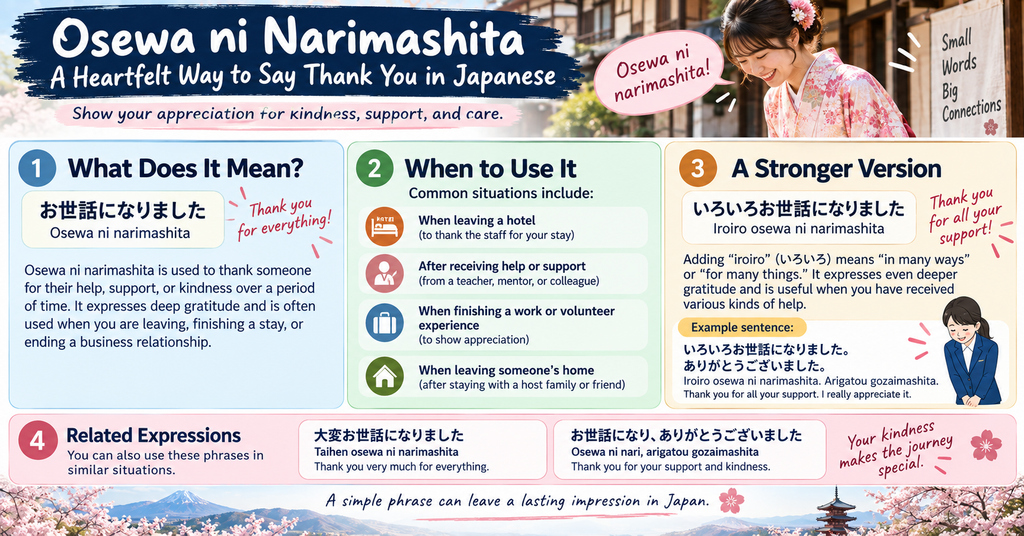
“Osewa ni narimashita” is a Japanese expression used to thank someone for their help, support, or care over a period of time.
A natural English translation can be “thank you for everything you did for me,” “thank you for your help,” or “thank you for taking care of me.”
Unlike “arigatou gozaimasu,” this phrase is usually used when someone has supported you in a more continuous or meaningful way rather than for one small favor.
For example, a traveler might say “osewa ni narimashita” to a host family, tour guide, local friend, or someone who helped them throughout part of their trip.
It is especially common when saying goodbye or when your time with that person is coming to an end.
Because there is no perfect direct translation in English, understanding the situation in which it is used is more important than translating each word literally.
10. Thank You for Everything You Did – いろいろお世話になりました (Iroiro Osewa ni Narimashita)
“Iroiro osewa ni narimashita” is a warm and polite way to thank someone for all the help and support they have given you.
“Iroiro” means “various things” or “many things,” so the phrase can be understood as “thank you for everything you did for me.”
It is especially useful when someone has helped you in several ways over a period of time.
For example, you might say it to a host family, guide, local friend, teacher, or someone who supported you throughout your stay in Japan.
This phrase is often used when saying goodbye, especially when you want to express deeper gratitude than a simple “arigatou gozaimashita.”
For travelers, it is a useful expression to remember when someone has made a meaningful difference during your trip.
11. That Really Helped – 助かりました (Tasukarimashita)
“Tasukarimashita” means “that really helped” or “you were a great help.”
It is used when someone has helped you solve a problem or made a difficult situation easier.
For example, you might say “tasukarimashita” if someone helps you find the right train, explains how to buy a ticket, carries something heavy, or helps you when you are lost.
This phrase focuses more on the fact that the person’s help was useful, rather than simply expressing general gratitude.
You can also say “arigatou gozaimasu” together with it, such as “tasukarimashita. Arigatou gozaimasu,” to sound even more appreciative.
12. Thank You for the Meal – ごちそうさまでした (Gochisousama Deshita)
“Gochisousama deshita” is a Japanese phrase commonly used after finishing a meal.
It is a way to show appreciation for the food and for the people who prepared or served it.
You can say it after eating at a restaurant, after a meal at a ryokan, or when someone cooks for you at home.
Unlike “arigatou gozaimasu,” this phrase is specifically connected to meals and food.
For travelers, saying “gochisousama deshita” when leaving a restaurant or after someone has prepared a meal for you is a simple way to show respect for Japanese dining culture.
You may also hear Japanese people say “itadakimasu” before eating and “gochisousama deshita” after the meal.
For more information about dining customs in Japan, see JNTO’s guide to Japanese manners and dining etiquette.
If you want to learn more about eating in Japan, check out our guide to Japanese dining manners.

Which Japanese Thank-You Phrase Should Travelers Use?
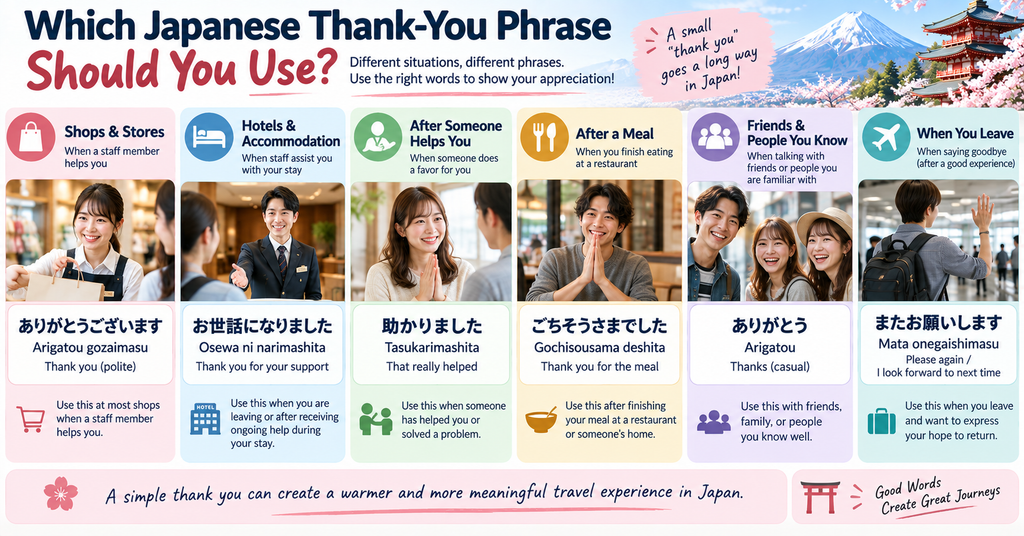
With so many ways to say thank you in Japanese, it can be difficult to know which phrase to use.
The good news is that travelers do not need to memorize every expression.
In most situations, “arigatou gozaimasu” is a safe and polite choice. However, learning a few additional phrases can help you sound more natural depending on the situation.
Here are some simple examples of which Japanese thank-you phrase to use during your trip.
At Shops, Hotels, and Restaurants
At shops, hotels, restaurants, and other places where you are speaking with staff, “arigatou gozaimasu” is usually the best choice.
It is polite, simple, and appropriate even if you are meeting the person for the first time.
After the service or interaction has finished, you can also say “arigatou gozaimashita.”
For example, you might use “arigatou gozaimasu” when a hotel employee hands you your room key, and “arigatou gozaimashita” when checking out at the end of your stay.
After Someone Helps You
When someone helps you with a problem, gives you directions, or does something kind for you, “arigatou gozaimasu” is always a good choice.
If their help was especially useful, you can also say “tasukarimashita,” which means “that really helped.”
For example, if someone helps you find the correct train platform or explains how to use a ticket machine, you could say:
“Tasukarimashita. Arigatou gozaimasu.”
This sounds natural and clearly shows that you appreciated their help.
After Someone Has Helped You Throughout Your Trip
If someone has supported you in several ways over a longer period of time, “osewa ni narimashita” or “iroiro osewa ni narimashita” can be more appropriate.
These phrases are especially useful when saying goodbye to a host family, guide, local friend, teacher, or someone who has helped you throughout your stay.
“Iroiro osewa ni narimashita” expresses a deeper sense of gratitude and can be understood as “thank you for everything you did for me.”
For travelers, this is a meaningful phrase to use when someone has made a lasting difference during your time in Japan.
After a Meal
After finishing a meal, “gochisousama deshita” is one of the most natural expressions to use.
It shows appreciation for the food and for the people who prepared or served it.
You can say it after eating at a restaurant, staying at a ryokan, or enjoying a meal prepared by a host or friend.
You can still say “arigatou gozaimasu,” but “gochisousama deshita” is more closely connected to Japanese dining culture.
With Friends or People You Know Well
With friends, family members, or people you know well, casual expressions such as “arigatou” or “doumo” are often more natural.
“Arigatou” is the standard casual way to say thank you, while “doumo” is shorter and can feel like a quick “thanks.”
If you are unsure whether a casual expression is appropriate, using “arigatou gozaimasu” is still perfectly fine.
For travelers, it is usually better to start politely and use more casual expressions once the relationship feels more relaxed.
How to Respond to “Thank You” in Japanese
When someone says “thank you” in Japanese, there are several ways to respond.
Two common expressions are “ieie” and “dou itashimashite,” but they are not always used in exactly the same way.
For travelers, understanding these responses can help you follow simple everyday conversations more naturally.
No Problem / You’re Welcome – いえいえ (Ieie)
“Ieie” is a casual and natural response that can mean “no problem,” “not at all,” or “you’re welcome.”
It is commonly used in everyday conversations when someone thanks you for something small.
For example, if you help someone pick something up and they say “arigatou gozaimasu,” you may hear “ieie” in response.
The tone is usually modest and relaxed, as if saying, “It was nothing.”
For travelers, this is a useful expression to recognize because it is common in casual Japanese conversations.
You’re Welcome – どういたしまして (Dou Itashimashite)
“Dou itashimashite” is the standard phrase often taught as “you’re welcome” in Japanese.
It is correct and polite, but in everyday conversation, Japanese people may sometimes use simpler expressions such as “ieie” instead.
“Dou itashimashite” can sound slightly more formal or complete, depending on the situation.
For travelers, it is still a useful phrase to know, especially when you want to respond politely and clearly to someone who thanks you.
Japanese Etiquette When Saying Thank You
In Japan, the words you use are important, but the way you express gratitude also matters.
Small gestures, your tone of voice, and choosing the right level of politeness can make your thanks feel more natural and respectful.
The good news is that travelers do not need perfect Japanese to make a good impression.
For more cultural tips, read our complete guide to Japanese etiquette for tourists.
A Small Bow Can Show Extra Respect
A small bow is often used together with words of thanks in Japan.
You do not need to make a deep or formal bow in everyday travel situations. A slight nod or small bow is usually enough when thanking hotel staff, restaurant employees, shop staff, or someone who has helped you.
For example, saying “arigatou gozaimasu” with a small bow can make your gratitude feel more polite and sincere.
Travelers should not worry about getting the angle or timing exactly right. A natural and respectful gesture is more important than trying to follow formal rules perfectly.
Polite vs. Casual Japanese Matters
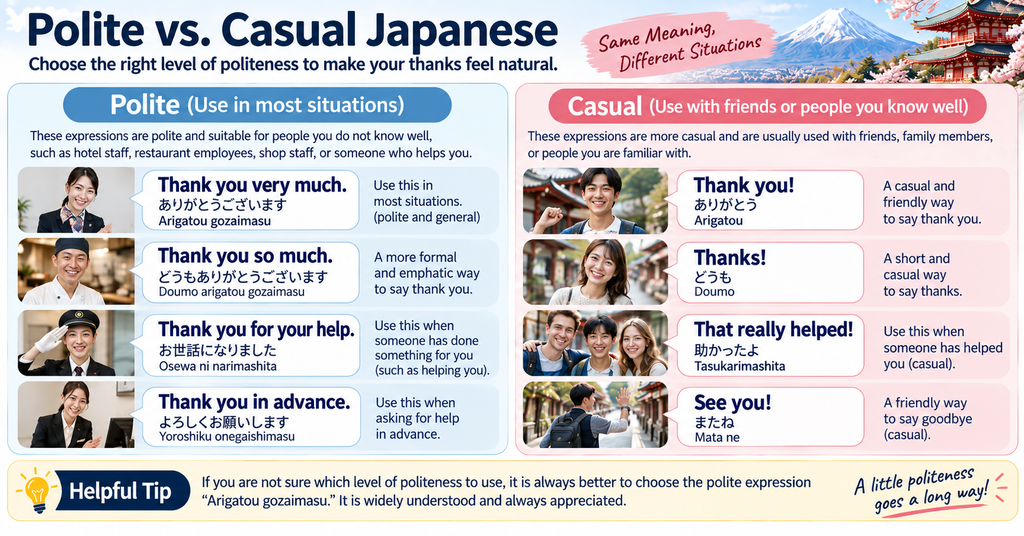
Japanese expressions can change depending on how formal the situation is and how well you know the other person.
For travelers, “arigatou gozaimasu” is usually the safest choice because it is polite and suitable for most situations.
Casual expressions such as “arigatou” and “doumo” are better suited to friends, family members, or people you know well.
If you are not sure which level of politeness to use, choosing the more polite expression is usually a good idea.
You Do Not Need Perfect Japanese
Do not worry if your pronunciation is not perfect.
Most people will understand and appreciate the effort when a traveler tries to say thank you in Japanese.
Even remembering just a few phrases, such as “arigatou gozaimasu,” “sumimasen,” and “gochisousama deshita,” can make everyday interactions feel warmer and more personal.
The goal is not to speak perfect Japanese, but to show appreciation in a respectful and friendly way.
Final Thoughts
Learning how to say thank you in Japanese is a simple way to make your trip feel more personal and respectful.
You do not need to memorize every phrase in this guide. For most situations, “arigatou gozaimasu” is enough, and a few additional expressions such as “sumimasen,” “gochisousama deshita,” and “osewa ni narimashita” can help you communicate more naturally.
The most important thing is to choose a phrase that fits the situation and say it sincerely.
Even a small effort to express gratitude in Japanese can create warmer interactions and make your travel experience more memorable.
I hope this guide helps you feel more confident when saying thank you during your trip to Japan.
If this is your first trip to Japan, you may also find our guide to 20 essential things to know before visiting Japan helpful.