What Is a Ryokan? A Complete Guide for First-Time Visitors
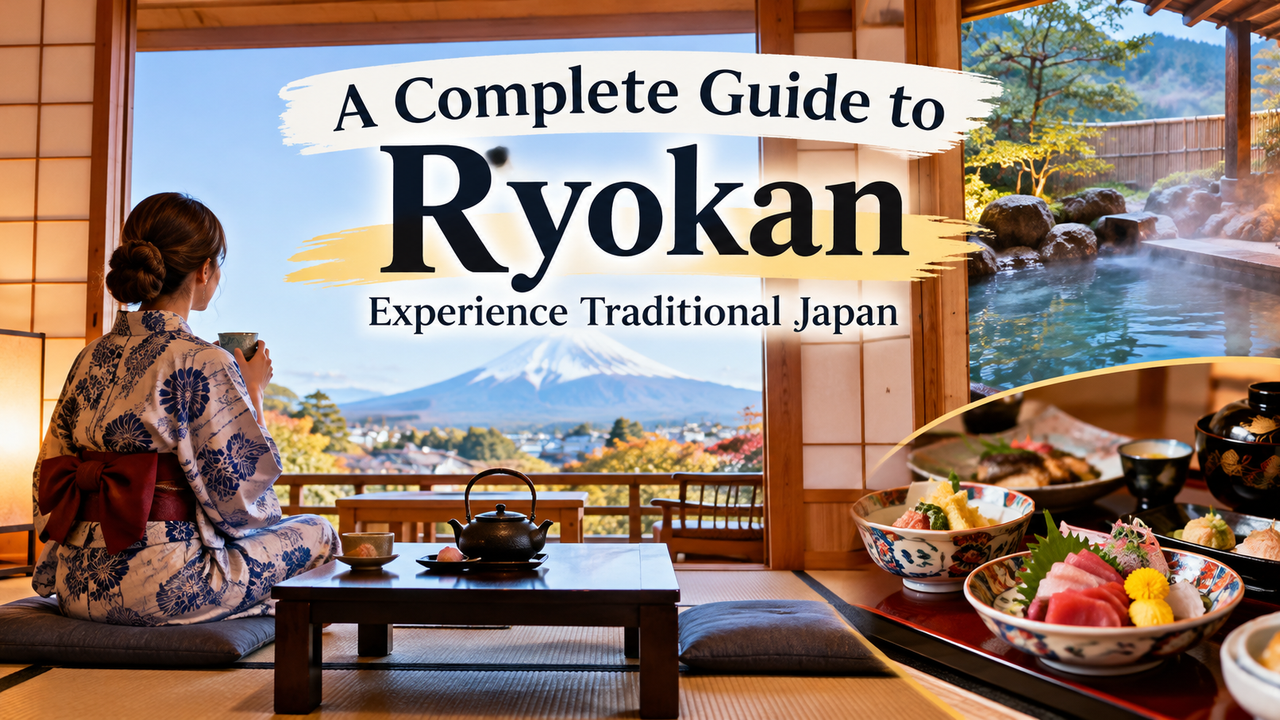
Staying at a ryokan is one of the most traditional ways to experience Japan.
A ryokan is a Japanese-style inn where you can enjoy tatami rooms, futon bedding, yukata, traditional meals, and often an onsen.
For first-time visitors, however, staying at a ryokan can feel a little different from staying at a regular hotel.
You may need to remove your shoes at the entrance, sleep on a futon placed on the tatami floor, wear a yukata around the building, and follow certain rules when using the public bath.
Many ryokan also serve beautifully prepared Japanese dinners and breakfasts using seasonal and local ingredients.
In this guide, you will learn what a ryokan is, how it differs from a hotel, what happens during a typical stay, how much it costs, and the basic etiquette travelers should know before staying at one.
- What Is a Ryokan?
- What Makes a Ryokan Different from a Hotel?
- What Happens When You Stay at a Ryokan?
- What Is a Ryokan Room Like?
- Ryokan Meals: What Will You Eat?
- Onsen at a Ryokan
- Ryokan Etiquette Travelers Should Know
- How Much Does a Ryokan Cost?
- How to Choose the Right Ryokan
- Where Should Travelers Stay at a Ryokan in Japan?
- Final Tips for Staying at a Ryokan
What Is a Ryokan?
A ryokan is a traditional Japanese inn.
Unlike a standard hotel, a ryokan is designed to give guests a more traditional Japanese-style stay.
Many ryokan have tatami-mat rooms, futon bedding, low tables, yukata, and Japanese meals. Some also have onsen, or hot spring baths.
Ryokan can range from simple and affordable inns to luxury properties with private baths, elaborate meals, and highly personalized service.
One of the main attractions of staying at a ryokan is that the accommodation itself becomes part of the travel experience.
For travelers, a ryokan is not just a place to sleep. It is a chance to experience Japanese hospitality, food, bathing culture, and traditional room styles in one stay.
For more information about traditional Japanese inns, see the Japan National Tourism Organization’s Japanese Ryokan Guide.
What Makes a Ryokan Different from a Hotel?
A ryokan can feel very different from a regular hotel.
Hotels usually focus on providing a comfortable room and convenient facilities, while a ryokan often offers a more traditional Japanese experience.
The room style, bedding, clothing, meals, bathing, and service may all be different from what travelers are used to.
For first-time visitors, these differences are part of what makes staying at a ryokan special.
Traditional Japanese Rooms
Many ryokan have traditional Japanese-style rooms with tatami flooring.
Tatami are woven straw mats that have been used in Japanese homes for centuries.
Instead of a large bed and Western-style furniture, the room may have a low table, floor cushions, sliding doors, and simple decorations.
Guests usually remove their shoes before stepping onto the tatami.
For travelers, the room may feel very different from a hotel room, but this traditional design is an important part of the ryokan experience.
Futons Instead of Beds
Many ryokan use futons instead of Western-style beds.
A futon is a traditional Japanese bedding set that is placed directly on the tatami floor.
In many ryokan, staff prepare the futon in the evening after dinner and fold it away again in the morning.
The bedding usually includes a soft mattress, a blanket or duvet, and a pillow.
For travelers, sleeping on a futon can feel very different from sleeping in a hotel bed, but it is one of the most traditional parts of the ryokan experience.
Yukata and Slippers
Many ryokan provide guests with a yukata, a light traditional Japanese robe.
Guests often wear the yukata inside the ryokan, especially when going to the onsen, eating dinner, or relaxing in common areas.
Slippers are also commonly provided, but there are usually some rules about where they can be worn.
For example, slippers are normally removed before stepping onto tatami flooring, and separate slippers may be provided for the toilet.
For travelers, these small customs may feel unfamiliar at first, but they are easy to follow once you know the basic rules.
Japanese Hospitality
Japanese hospitality, or omotenashi, is an important part of the ryokan experience.
At many ryokan, staff provide attentive service and try to make guests feel comfortable throughout their stay.
Depending on the ryokan, staff may welcome you at check-in, explain the room and facilities, serve meals, prepare your futon, and help with local information.
Service styles can vary, especially between small family-run inns and luxury ryokan, but the goal is usually to create a calm and welcoming experience.
For travelers, this personal style of hospitality is one of the main differences between staying at a ryokan and staying at a standard hotel.
What Happens When You Stay at a Ryokan?
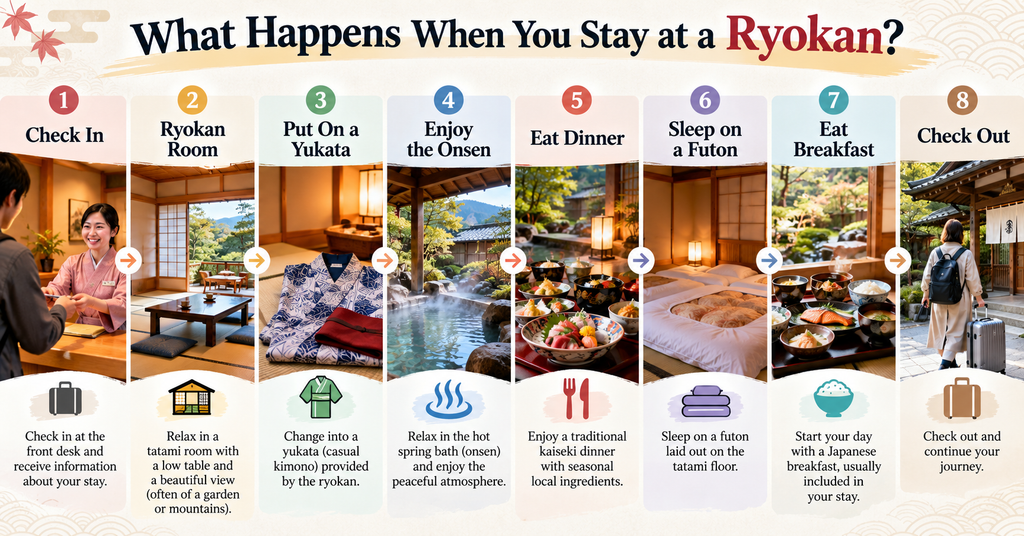
Staying at a ryokan usually follows a slightly different rhythm from staying at a regular hotel.
From check-in to dinner, bathing, sleeping, and breakfast, each part of the stay can feel like part of the experience.
The exact schedule and service style vary depending on the ryokan, but many stays follow a similar flow.
For first-time visitors, knowing what to expect can make the experience much more relaxing.
1. Check In
When you arrive at a ryokan, check-in is usually more personal than at a standard hotel.
Staff may welcome you at the entrance, ask you to remove your shoes, and guide you to the reception area or directly to your room.
You may be asked to complete a registration form and provide your passport if required.
At some ryokan, guests are served tea and a small sweet while the staff explains the facilities, meal times, bath hours, and other important information.
For travelers, it is a good idea to arrive before dinner time, especially if your stay includes an evening meal.
2. Enter Your Room
After check-in, staff will usually guide you to your room and explain the basic facilities.
A traditional ryokan room may have tatami flooring, a low table, floor cushions, sliding doors, and a small area near the window for relaxing.
Tea, sweets, towels, and a yukata are often prepared in the room before you arrive.
In many ryokan, the futon is not laid out yet because the room is used as a sitting and dining space during the day.
For travelers, the room may feel simple compared with a hotel, but the open layout is designed to change depending on the time of day.
3. Change into a Yukata
Many ryokan provide a yukata for guests to wear during their stay.
After settling into your room, you can change into the yukata before going to dinner, the onsen, or other common areas.
The yukata is usually worn with the left side wrapped over the right side and secured with a belt called an obi.
Some ryokan also provide an outer jacket, especially during colder seasons.
For travelers, wearing a yukata is a simple way to enjoy the traditional atmosphere of a ryokan and feel more relaxed during the stay.
4. Enjoy the Onsen
Many ryokan have an onsen or public bath where guests can relax during their stay.
Before entering the bath, you should wash and rinse your body thoroughly at the shower area.
Swimsuits are generally not worn in traditional onsen, and guests usually enter the bath without clothing.
Towels should also be kept out of the bath water. A small towel can be left beside the bath or placed on your head.
Some ryokan have both indoor and open-air baths, while others may offer private baths that can be reserved for couples, families, or travelers who prefer more privacy.
For first-time visitors, learning a few basic onsen rules beforehand can make the experience much more comfortable.
5. Eat Dinner
Dinner is often one of the highlights of staying at a ryokan.
Many ryokan serve a traditional Japanese meal, sometimes in the room and sometimes in a dining area.
The meal may include sashimi, grilled fish, simmered dishes, vegetables, rice, soup, and seasonal specialties.
At more traditional or luxury ryokan, dinner may be served as a multi-course kaiseki meal with several beautifully presented dishes.
Meal times are usually fixed, so it is important to arrive on time and let the ryokan know in advance about any dietary restrictions.
For travelers, dinner at a ryokan is a great opportunity to experience local ingredients, seasonal flavors, and traditional Japanese food culture.
Want to learn more about traditional Japanese food? Read our complete guide to Washoku and Japanese food culture.
6. Sleep on a Futon
Sleeping on a futon is one of the most traditional parts of staying at a ryokan.
In many ryokan, staff prepare the futon in your room while you are having dinner or relaxing elsewhere.
The futon is placed directly on the tatami floor and usually includes a mattress, blanket or duvet, and pillow.
Because the bedding can be folded away during the day, the same room can be used for relaxing, eating, and sleeping.
For travelers who are used to Western-style beds, sleeping close to the floor may feel unusual at first, but it is an important part of the traditional ryokan experience.
7. Eat a Japanese Breakfast
A traditional Japanese breakfast is another special part of staying at a ryokan.
Breakfast often includes rice, miso soup, grilled fish, pickles, eggs, tofu, and several small side dishes.
The exact menu varies by region and ryokan, and seasonal ingredients are often used.
Unlike a typical Western breakfast, the meal may feel closer to a complete Japanese set meal.
For travelers, breakfast at a ryokan is a good chance to experience everyday Japanese food in a more traditional setting before starting the day.
8. Check Out
Check-out at a ryokan is usually simple, but the process may feel a little more personal than at a standard hotel.
Before leaving, make sure you have collected your belongings and returned any items that need to stay in the room.
If meals, drinks, private baths, or other services were not included in the original price, you may pay the remaining balance at reception.
Staff may also help with luggage, transportation, or directions to your next destination.
For travelers, check-out is often a quiet end to the ryokan experience, and staff may see you off at the entrance.
What Is a Ryokan Room Like?
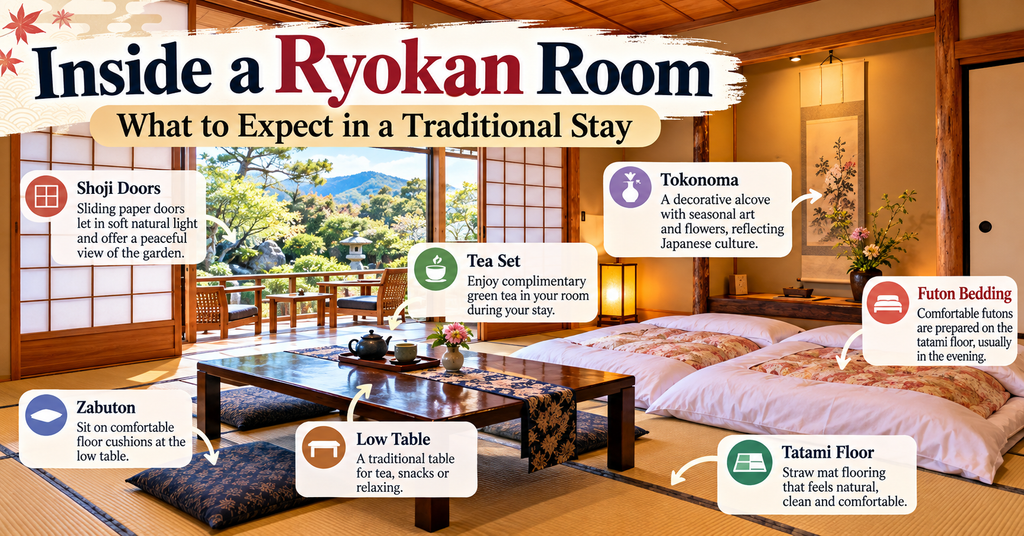
A ryokan room is usually designed to feel simple, calm, and traditionally Japanese.
Instead of a large bed and heavy furniture, the room often uses open floor space, tatami mats, low furniture, and sliding doors.
The same room may be used for relaxing during the day and sleeping at night after futons are prepared.
For first-time visitors, the room can feel very different from a standard hotel, but that flexibility is part of the traditional ryokan style.
Tatami Floors
Tatami flooring is one of the most recognizable features of a traditional ryokan room.
Tatami mats are made from woven rush and have a soft but firm surface.
Guests usually remove their shoes before stepping onto the tatami, and slippers are generally not worn on it either.
Because tatami is part of the living and sleeping area, keeping it clean is considered important.
For travelers, walking into a tatami room is often one of the first moments when the ryokan experience feels distinctly Japanese.
Futons
Futons are commonly used for sleeping in traditional ryokan rooms.
Unlike a Western-style bed, a futon is placed directly on the tatami floor when it is time to sleep.
In many ryokan, staff prepare the bedding in the evening and fold it away again in the morning.
The futon usually includes a mattress, a duvet or blanket, and a pillow.
For travelers, sleeping on a futon may feel unfamiliar at first, but it is one of the most traditional parts of staying in a Japanese-style room.
Low Tables and Floor Seating
Low tables and floor seating are common features in traditional ryokan rooms.
Instead of chairs, guests may sit on cushions called zabuton placed directly on the tatami floor.
The low table is often used for drinking tea, relaxing, or sometimes eating meals in the room.
Some ryokan may also provide a low chair with a backrest for guests who want more support while sitting.
For travelers, sitting close to the floor can feel unfamiliar at first, but it is part of the traditional Japanese room style.
Tea and Traditional Room Amenities
Tea and simple traditional amenities are often prepared in a ryokan room before guests arrive.
You may find green tea, a teapot, cups, and a small Japanese sweet waiting on the table.
Towels, a yukata, and basic toiletries are also commonly provided, although the exact amenities vary by ryokan.
Some rooms may include a small alcove called a tokonoma, where flowers, artwork, or a hanging scroll are displayed.
For travelers, these small details help create the calm and traditional atmosphere that makes a ryokan different from a standard hotel.
Ryokan Meals: What Will You Eat?
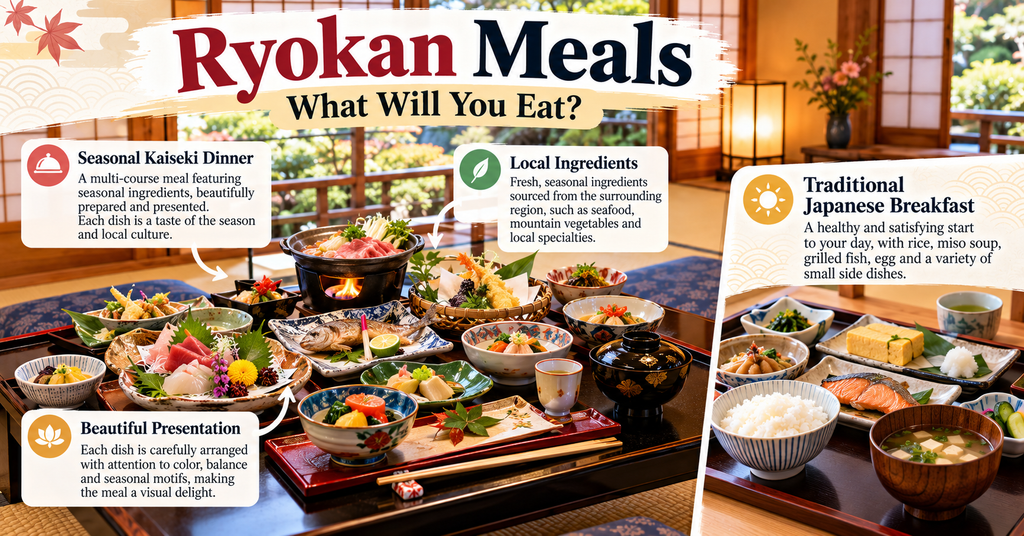
Meals are one of the highlights of staying at many ryokan.
Depending on the property and the plan you book, dinner and breakfast may be included in the price of your stay.
Ryokan meals often use local and seasonal ingredients, and the presentation can be just as important as the taste.
For first-time visitors, eating at a ryokan is a great way to experience traditional Japanese food in a calm and carefully prepared setting.
Kaiseki Dinner
Kaiseki is a traditional multi-course Japanese meal that is often served at higher-end ryokan.
A kaiseki dinner may include several small dishes such as sashimi, grilled fish, simmered vegetables, soup, rice, and seasonal specialties.
The exact menu changes depending on the region, season, and ryokan.
Each dish is usually served in a specific order and carefully presented using seasonal ingredients, colors, and tableware.
For travelers, a kaiseki dinner is not just a meal. It is also a chance to experience the seasonal and artistic side of Japanese food culture.
Japanese Breakfast
A Japanese breakfast at a ryokan is often very different from a typical Western breakfast.
The meal may include steamed rice, miso soup, grilled fish, pickles, eggs, tofu, and several small side dishes.
The exact menu varies by region and ryokan, and local or seasonal ingredients are often included.
Breakfast is usually served as a complete set meal rather than a buffet, although some larger ryokan may offer buffet-style dining.
For travelers, a ryokan breakfast is a great chance to enjoy traditional Japanese flavors in a relaxed setting before starting the day.
Local and Seasonal Ingredients
Local and seasonal ingredients are an important part of many ryokan meals.
Because ryokan are often closely connected to their local area, the food may reflect ingredients and specialties from the surrounding region.
For example, coastal ryokan may serve fresh seafood, while mountain areas may feature vegetables, mushrooms, river fish, or local meat.
Seasonal ingredients are also commonly used so that the meal reflects the time of year.
For travelers, this means that staying at a ryokan in different parts of Japan can also be a chance to experience regional food culture.
Onsen at a Ryokan
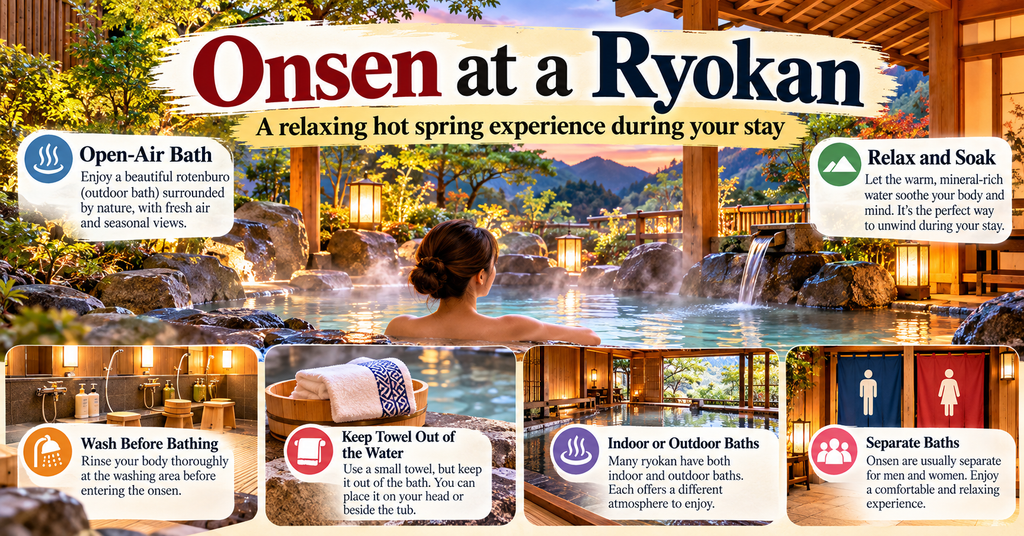
Many ryokan have onsen or large public baths where guests can relax during their stay.
These baths are an important part of the ryokan experience, especially in hot spring towns and traditional inns.
Bathing areas are usually separated by gender, although some ryokan also offer private baths that couples or families can reserve.
For first-time visitors, learning the basic bathing rules beforehand can make the experience much more comfortable.
Public Baths
Public baths are the most common type of bathing area at a ryokan.
Guests usually change in a dressing room, wash their bodies at the shower area, and then enter the shared bath.
Swimsuits are generally not worn, and towels should be kept out of the bath water.
Many ryokan have separate bathing areas for men and women, and some may switch the sides at different times of day.
For travelers, using a public bath can feel unfamiliar at first, but it is one of the most traditional ways to experience Japanese bathing culture.
Private Baths
Private baths are a good option for travelers who want more privacy while enjoying a ryokan bath.
Some ryokan have private bathing rooms that can be reserved for a limited time, while others offer guest rooms with their own private bath.
These baths are especially popular with couples, families, or travelers who may feel uncomfortable using a public bath.
The rules can vary by ryokan, so it is a good idea to check whether a reservation is required and whether there is an extra fee.
For travelers, a private bath can be a relaxing way to enjoy Japanese bathing culture at their own pace.
Open-Air Baths
Open-air baths, or rotenburo, are one of the most popular features of many ryokan.
These baths are located outdoors and allow guests to relax while enjoying fresh air and natural surroundings.
Depending on the location, you may be able to see mountains, forests, gardens, rivers, or snow during winter.
Some open-air baths are shared public baths, while others are private baths attached to guest rooms or available by reservation.
For travelers, soaking in a rotenburo can be one of the most memorable parts of staying at a ryokan.
Basic Onsen Etiquette
Basic onsen etiquette is simple once you know the main rules.
Before entering the bath, wash and rinse your body thoroughly at the shower area.
Swimsuits are generally not worn in traditional onsen, and towels should be kept out of the bath water.
If you have long hair, tie it up so that it does not touch the water.
It is also polite to keep noise to a minimum and avoid swimming or splashing in the bath.
For travelers, following these basic rules helps make the experience comfortable for both you and the other guests.
You can also check the Japan National Tourism Organization’s guide to enjoying onsen in Japan.
For more information about Japanese hot springs, see our guide to the best onsen in Japan.

Ryokan Etiquette Travelers Should Know
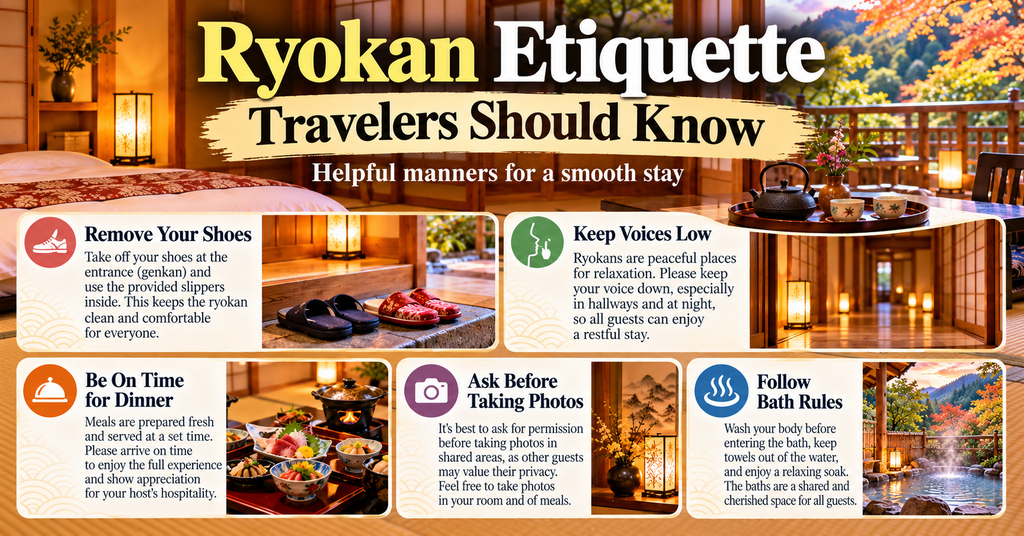
Ryokan have a few traditional customs that may be unfamiliar to first-time visitors.
Most of the rules are simple, and staff will usually explain anything important when you arrive.
The main things to remember are where to remove your shoes, how to use slippers, how to wear a yukata, and how to behave during meals and bathing.
For travelers, knowing these basics can help you feel more comfortable and respectful during your stay.For more cultural tips, read our complete guide to Japanese etiquette for tourists.
Take Off Your Shoes
Removing your shoes is one of the most important customs at many ryokan.
You may be asked to take off your shoes near the entrance before entering the main building or your guest room.
Slippers are often provided for walking in hallways and other indoor areas.
However, slippers should usually be removed before stepping onto tatami flooring.
For travelers, the easiest rule to remember is: outdoor shoes stay off indoors, and slippers usually stay off tatami.
How to Wear a Yukata
Wearing a yukata is one of the most enjoyable parts of staying at a ryokan.
The yukata should be wrapped with the left side over the right side and secured with an obi belt around the waist.
After tying the obi, adjust the yukata so that it feels comfortable and easy to move in.
Guests can usually wear the yukata around the ryokan, including to dinner, the onsen, and common areas.
For travelers, the most important thing to remember is to keep the left side over the right when wearing a yukata.
When to Wear Slippers
Slippers are commonly provided at ryokan, but they are not worn everywhere.
They are usually used in hallways and other indoor areas outside the guest room.
However, slippers should normally be removed before stepping onto tatami flooring.
Many ryokan also provide separate slippers for the toilet, and these should only be used inside the toilet area.
For travelers, the easiest way to avoid mistakes is to pay attention to where other guests remove or change their slippers.
Meal and Bath Manners
Meal and bath manners are important parts of the ryokan experience.
During meals, try to arrive on time, especially if dinner or breakfast is served at a fixed time.
It is also polite to handle dishes carefully and follow basic Japanese dining manners when using chopsticks.
When using the bath, wash your body before entering the tub, keep towels out of the water, and avoid making too much noise.
For travelers, following these simple manners helps make the ryokan experience comfortable and respectful for everyone.
You can also learn more about table manners in our guide to Japanese dining etiquette.
How Much Does a Ryokan Cost?
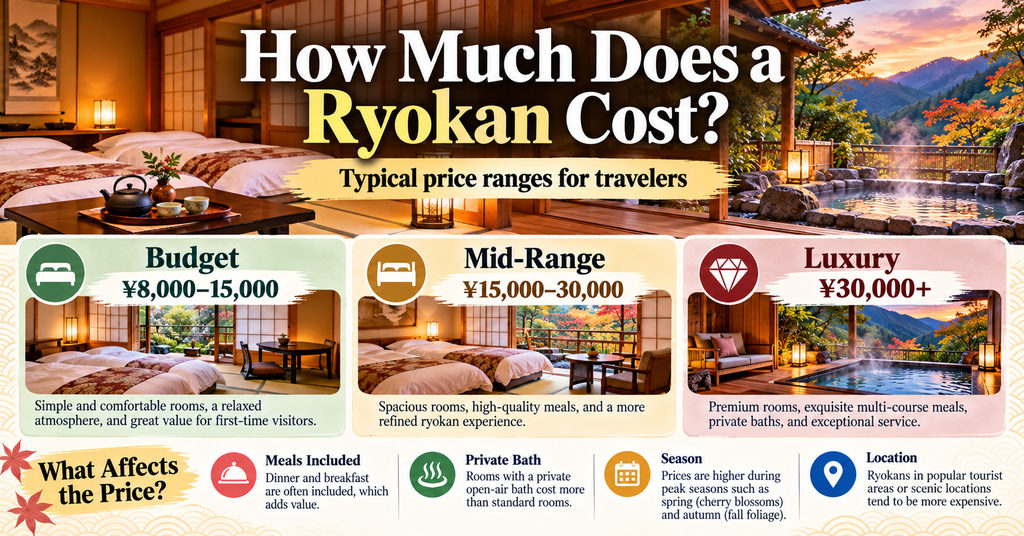
Ryokan prices can vary widely depending on the location, season, room type, meals, and facilities.
Some ryokan are simple and affordable, while others offer luxury rooms, private baths, and elaborate multi-course meals.
One important difference from many hotels is that ryokan prices often include dinner and breakfast.
For travelers, it is a good idea to check exactly what is included before comparing prices.
Budget Ryokan
Budget ryokan are a good option for travelers who want a traditional experience without spending too much.
These properties may offer simple tatami rooms, shared bathrooms, futon bedding, and basic amenities.
Meals may not be included, or guests may have the option to add breakfast or dinner for an extra fee.
Budget ryokan are often smaller and more casual than luxury properties, but they can still provide a comfortable and traditional stay.
For travelers, choosing a budget ryokan is a good way to experience Japanese-style accommodation while keeping travel costs under control.
Mid-Range Ryokan
Mid-range ryokan offer a balance between comfort, traditional atmosphere, and price.
These properties often include tatami rooms, futon bedding, public baths or onsen, and both dinner and breakfast.
Meals may feature seasonal and local ingredients, and some ryokan offer upgraded room types or private baths for an additional fee.
Service is usually more attentive than at a budget property, while the overall atmosphere remains relaxed and traditional.
For travelers, a mid-range ryokan is a good choice if you want a complete ryokan experience without choosing a luxury stay.
Luxury Ryokan
Luxury ryokan offer a more refined and personalized version of the traditional Japanese inn experience.
These properties may include spacious rooms, private open-air baths, carefully prepared kaiseki meals, and highly attentive service.
Some luxury ryokan also offer beautiful gardens, mountain or river views, and special room designs that highlight local materials and craftsmanship.
Because meals, private baths, and premium services may be included, prices can be much higher than at standard ryokan.
For travelers, a luxury ryokan is a good choice if you want the accommodation itself to be one of the main highlights of your trip.
What Is Usually Included in the Price?
What is included in a ryokan price can vary depending on the property and the plan you book.
Many traditional ryokan plans include both dinner and breakfast, while some cheaper plans may include only breakfast or no meals at all.
Access to public baths or onsen is usually included for overnight guests, but private baths may require a reservation or an additional fee.
Yukata, towels, and basic amenities are also commonly provided.
For travelers, the most important thing is to check whether meals, private baths, and other services are included before comparing ryokan prices.
How to Choose the Right Ryokan
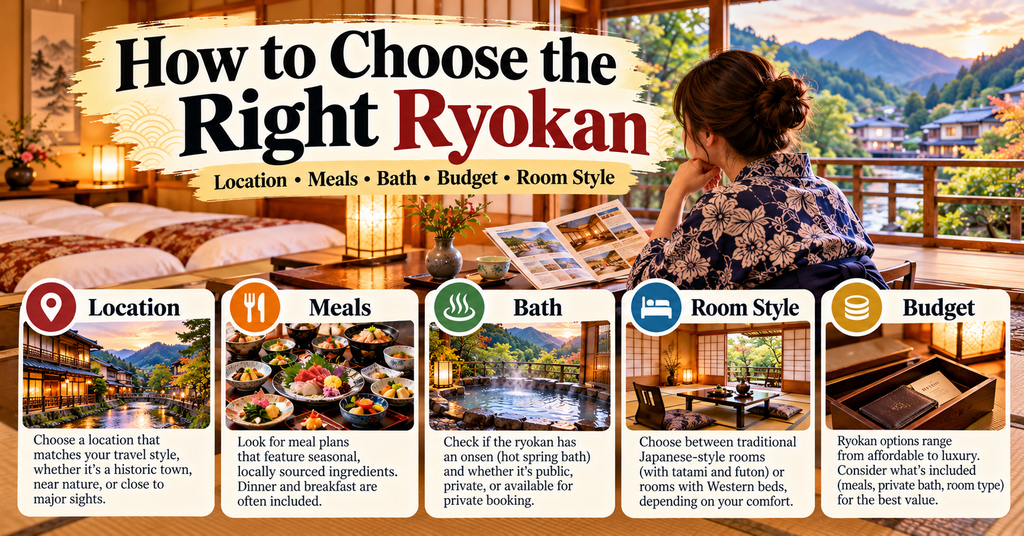
Choosing the right ryokan can make a big difference to your stay.
Ryokan vary in location, room style, meals, bath facilities, price, and level of service.
Some are located in famous hot spring towns, while others are found in cities, mountains, coastal areas, or quiet countryside destinations.
For first-time visitors, checking a few key points before booking can help you choose a ryokan that matches your travel style and budget.
You can also search for ryokan across Japan through the Japan Ryokan and Hotel Association.
Choose the Right Location
Location is one of the most important things to consider when choosing a ryokan.
Some travelers prefer to stay in a hot spring town where they can enjoy onsen and a traditional atmosphere, while others may want a ryokan close to major sightseeing areas.
Ryokan in rural or mountain areas can offer beautiful scenery and a peaceful stay, but transportation may be more limited.
It is also a good idea to check how far the ryokan is from the nearest train station or bus stop.
For travelers, choosing the right location can make the stay more convenient and help you enjoy the kind of ryokan experience you are looking for.
Check Whether Meals Are Included
When booking a ryokan, check carefully whether meals are included in the price.
Many traditional ryokan offer plans with both dinner and breakfast, while others may include only breakfast or no meals at all.
If dinner is included, the meal time is often fixed, so arriving late may affect your dining experience.
Some ryokan also ask guests to choose meal options or report dietary restrictions in advance.
For travelers, checking the meal plan before booking helps avoid surprises and makes it easier to compare different ryokan.
Check the Bath Type
Bath facilities can vary a lot between ryokan, so it is a good idea to check the type of bath before booking.
Some ryokan have large public onsen, while others may offer private baths that can be reserved for couples or families.
Certain guest rooms also come with their own private bath or open-air bath.
If using a public bath is important to you, check whether the ryokan has a true hot spring onsen or simply a large shared bath.
For travelers, choosing the right bath type can make the ryokan experience much more comfortable and enjoyable.
Check Room and Bedding Options
Room and bedding styles can vary between ryokan, so it is worth checking the details before booking.
Traditional rooms usually have tatami flooring and futon bedding, but some ryokan also offer rooms with Western-style beds.
Larger rooms may be better for families or groups, while smaller rooms can be a good choice for solo travelers or couples.
If you prefer a bed instead of sleeping on a futon, look for a Japanese-Western style room or a room with twin beds.
For travelers, checking the room layout and bedding type in advance can help make the stay more comfortable.
Look for English Support
English support can make a ryokan stay easier for international travelers.
Some ryokan have English-speaking staff, while others may provide translated instructions, multilingual signs, or English information at check-in.
Booking websites and official ryokan websites may also show whether English support is available.
In more rural areas, English may be limited, but staff will often still try to help using simple phrases, gestures, or translation tools.
For travelers, checking the level of English support in advance can make the stay feel more comfortable, especially if it is your first time at a ryokan.
Where Should Travelers Stay at a Ryokan in Japan?
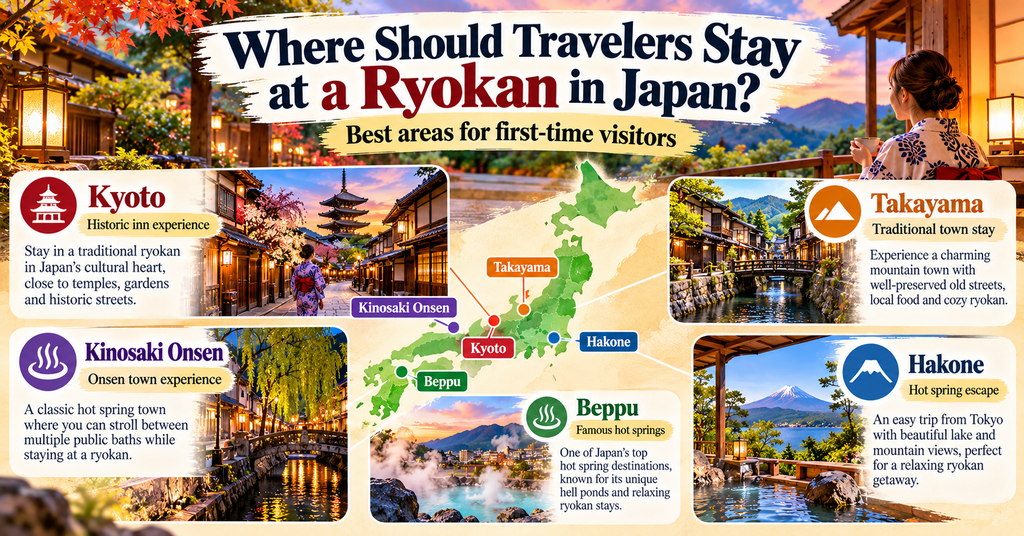
Japan has many great places to experience a ryokan stay.
Some destinations are famous for hot springs, while others are known for historic streets, traditional architecture, local food, or beautiful natural scenery.
For first-time visitors, choosing a well-known ryokan area can make the experience easier because there are more accommodation options and better tourist facilities.
Here are some popular destinations where travelers can enjoy a traditional ryokan stay.
Hakone
Hakone is one of the most popular ryokan destinations near Tokyo.
The area is famous for hot springs, mountain scenery, and views of Mount Fuji on clear days.
Many ryokan in Hakone offer public onsen, private baths, traditional Japanese rooms, and meals made with seasonal ingredients.
Because Hakone is relatively easy to reach from Tokyo, it is a popular choice for travelers who want to add a ryokan stay to a city-based itinerary.
For first-time visitors, Hakone is a convenient place to experience both onsen culture and traditional Japanese accommodation.
Kyoto
Kyoto is another popular destination for travelers who want to stay at a traditional ryokan.
The city is known for its historic neighborhoods, temples, gardens, and traditional architecture, which make a ryokan stay feel especially atmospheric.
Many ryokan in Kyoto are located near famous sightseeing areas and may offer tatami rooms, futon bedding, kaiseki-style meals, and traditional hospitality.
Unlike hot spring towns, not every ryokan in Kyoto has a natural onsen, so it is a good idea to check the bath facilities before booking.
For travelers, Kyoto is a great choice if you want to combine a ryokan stay with cultural sightseeing and historic Japanese scenery.
Kinosaki Onsen
Kinosaki Onsen is a famous hot spring town in Hyogo Prefecture and a great place to experience a traditional ryokan stay.
The town is known for its seven public bathhouses, traditional streets, and relaxed atmosphere.
Many ryokan provide guests with a yukata and geta sandals, making it easy to walk around town and visit different onsen.
Some ryokan also include access to the public bathhouses as part of the stay.
For travelers, Kinosaki Onsen is a good choice if you want to enjoy both ryokan culture and the experience of exploring a traditional Japanese hot spring town.
Beppu and Yufuin
Beppu and Yufuin are two well-known hot spring destinations in Oita Prefecture on the island of Kyushu.
Beppu is famous for its large number of hot springs and wide variety of bathing experiences, while Yufuin is known for its quieter atmosphere, mountain scenery, and stylish ryokan.
Many ryokan in both areas offer onsen, private baths, traditional Japanese rooms, and meals made with local ingredients.
Beppu is a good choice for travelers who want to explore different types of hot springs, while Yufuin is often better suited to those looking for a more peaceful and scenic stay.
For travelers, both destinations offer a great opportunity to experience ryokan culture together with some of Japan’s most famous hot spring areas.
Final Tips for Staying at a Ryokan
Staying at a ryokan is one of the best ways to experience traditional Japanese hospitality.
For first-time visitors, the most important thing is to enjoy the experience without worrying too much about doing everything perfectly.
Remember to remove your shoes where required, follow the basic bath rules, arrive on time for meals, and check what is included in your booking before your stay.
If you are unsure about anything, ryokan staff will usually be happy to explain the rules or help you during your stay.
A ryokan is more than just a place to sleep. It is a chance to experience Japanese rooms, food, bathing culture, and hospitality all in one place.
If this is your first trip to Japan, staying at a ryokan for at least one night can be a memorable addition to your journey.
If this is your first trip to Japan, you may also find our guide to 20 essential things to know before visiting Japan helpful.